I just happened to be surfing past the Broadway Channel on Sirius XM, and found myself startled at the tone of the lyrics of that Hit Parade smash from the 1956 musical, “The Most Happy Fella,” by the great composer/lyricist Frank Loesser, “Standing on the Corner (Watching All The Girls Go By)”—especially at the end:
Saturday, and I’m so broke Haven’t got a girl, and that’s no joke Still I’m living like a millionaire When I take me down to Main Street and I review the harem parading for me there..
Standing on the corner watching all the girls go by Standing on the corner underneath the springtime sky!
Brother, you can’t go to jail for what you’re thinking Or for the “Woo!” look in your eye You’re only standing on the corner watching all the girls Watching all the girls, watching all the girls Go by!
Nobody saw anything wrong with these sentiments in 1956. It was fun, it was cute, it was innocent! A bunch of guys hanging out, leering and ogling women as they walked on the sidewalk, with “woo”—that is, lust— in their eyes and illegal thoughts in their brains, and periodically wolf-whistling at “the harem.”
Sometimes we forget—sometimes women especially forget—that our culture’s ethics regarding sexual etiquette and respect does advance, and has, as much as self-serving activists would have us believe otherwise.
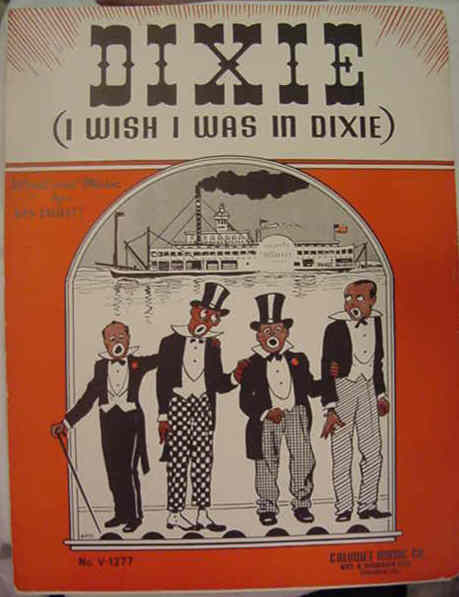
I will introduce this fascinating Comment of the Day by one of the blog’s masters of the long form comment, Chris Marschner, by saying that I think it is only tangentially related to the post, though he would disagree. Chris is writing about the history of “Dixie” and why it should not be associated with racism. Whether I agree with that analysis or not, the fact is that the public does overwhelmingly associate the song with a longing for the simplicities of the Old South, when the darkies were singing in the cotton fields and those Northern folks weren’t sticking in their noses where they don’t belong. This is the basis of an Idaho court’s decision to overturn the conviction of a black defendant after the prosecutor gratuitously and needlessly quoted the lyrics of the song in her closing argument. That decision was correct, because the issue is whether the comment could reasonably have been an appeal, or seemed like an appeal, or have had the effect of an appeal, to racial bias. I don’t think that conclusion is arguable.
The prosecutor failed her client – the people- not because she used the words of an 19th century song but because she failed to come to understand that history and culture of the US has been so bastardized that even an appellate court has no understanding and context of the origins of the song and the history and culture of the south. And, because of its misunderstanding believes the lyrics to be racially prejudicial.
“Maybe Erica is so young, color blind and historically ignorant that she had no idea that “Dixie” has been played at Klan rallies and used as the campaign theme for states rights, segregationist, white supremacy candidates since the Civil War. Maybe she didn’t recognize the cotton reference as racial.”
This song was written by a northerner named Daniel Decatur Emmett and performed in New York in an 1859 minstrel show by Emmitt in blackface. The reference to cotton is geographic in nature because cotton represented the primary agricultural commodity and wealth creator of the southern states – nothing more unless one is predisposed to finding anything related to the antebellum south as racist
Many songs have been coopted by various groups but to suggest that lyrics of Dixie are inherently racial because they are used by White supremacists is faulty logic. If a white supremacist adopted the image of Leonardo D’Vinci’s David or Venus d’ Milo or other classical work of art on their flag that would not mean that any such depiction suggests racial superiority. Continue reading →
Canyon County Deputy Prosecutor Erica Kallin wanted to make the point that the defense attorney for the African American defendant, James D. Kirk, was trying to lead the jury to ignore the evidence that pointed to his guilt in his trial for lewd conduct with a 17-year-old girl and sexual battery of a 13-year-old girl—making them, in effect,”look away” from the truth. How could she make that argument in a vivid way? Clarence Darrow used to use poems in his famous closing arguments; was there a memorable poem that used the phrase, “look away”?
“‘Oh I wish I was in the land of cotton. Good times not forgotten. Look away. Look away. Look away,’ And isn’t that really what you’ve kind of been asked to do? Look away from the two eyewitnesses. Look away from the two victims. Look away from the nurse and her medical opinion. Look away. Look away.”
The jury convicted Kirk, on both counts; the evidence against him was indeed strong. He was sentenced to 20 years in prison. Continue reading →
OK, it’s not exactly “The Homecoming,” but the way they’re scraping the barrel for cable Christmas movies, you might see this one on LMN yet. I just hope I’m not played by Wallace Shawn
Everything was going swimmingly this Christmas morning. We had opened presents, and now Grace and I were making our contributions to the family dinner later today at my sister’s house. A main feature was Grace’s mother’s recipe for a holiday salad that was part of her family’s Thanksgiving and Christmas meals for decades, and now ours. The recipe:
Two bags of cranberries, chopped
2 chopped navel oranges, with peel
2 chopped Red Delicious apples, also unpeeled
2 cups of chopped walnuts
2 diced celery hearts
1-2 cans of cranberry juice concentrate
Sugar to taste, or not (we leave it out.)
All was well until I cored the apples, bought supposedly fresh yesterday at Harris Teeter. They went “squish,” despite being all shiny and crisp on the outside. This would not do, so I was dispatched to the store to pick up suitably fresh apples, without which grandmother’s famous salad just wouldn’t be right.
I jumped into our car (the one that replaced its predecessor that had burst into flames for no apparent reason in a mall parking lot—one of the many delightful events of our 2014). The gas-tank-low light was on, as it had been the day before. The gauge now said that I had five miles left, and the nearest station was only a bit more than two away. Well, these things aren’t perfect: my car stopped about 200 yards from the exit to the station, and in the middle of the street.
I called home, and my wife and son prepared to take his car to the station to get enough gas to let me drive the last leg of the journey, but his car, as is its wont, was dead. Meanwhile, I tried to push mine out of the middle of the street on my own, realizing too late that cars in neutral tend to pick up quite a bit of speed going down a grade, and are remarkably hard to steer and brake from outside the vehicle. I was barely able to stop the car from plowing into a parked Volvo by turning it to roll over the curb onto someone’s lawn. I was loath to leave it there untended while I hiked to the gas station, and I didn’t feel like paying fifty bucks or more for roadside assistance, but I was running out of options. Also time, if I was going to find fresh apples while a grocery store remained open.
I hadn’t seen a single car on the road, until an SUV stopped next to me. The driver, a woman in her thirties who was accompanied by her two teenaged sons, asked it I needed help. I explained my plight, and the two young men assisted me in rolling my car off the lawn into something approximating a legal parking space.
“Stay here: we’ll be right back,” the woman said. She was as good as her word, for she soon reappeared, with one of her sons carrying a festive red plastic gas can filled with fuel. The older son helped figure out how to work the damn spout, which had to be assembled. “See, here’s the flaw,” I explained. “The device solving this problem should not require more intelligence to operate than someone getting into this stupid situation is likely to have.” He agreed, politely. Then he poured all the gasoline into my empty tank.
I prepared to reimburse this family of Good Samaritans, but they refused. “Just pay it forward,” the mother said. “We’re glad we could help out.” I shook her sons’ hands, and hers, and wished them all a Merry Christmas. Then I got the apples, and the salad was perfect.
In the Marshall household, this will forever be known the Miracle of the Christmas Gas Can.
Let us sing!
(to the tune of “Good King Wenceslas” :
1. Jack’s wife said “You must go out. We’ve an apple crisis!” Never would he dare refuse ; Better to fight ISIS. So he set out in his car, Though t’was low in fuel Til it sputtered to a stop (Boy was he a foo-oo-el!)
2. Shifted into neutral then, It rolled t’ward disaster. Jack would soon be chasing it, As the car rolled faster. Pulling hard with all his might, He changed its direction Rested then on somebody’s lawn Waiting for collection.
3. Up now rolls an SUV Driven by a stranger “Trav’ler, tell us, how can we Help you stave off danger?” Her sons helped him move the car; There would be no ticket. Jack composed a secret wish, As if he could pick it.
4. “Find a can, and bring me gas This would be a blessing. Yet I’d be a total ass Their Christmas to be messing.” Suddenly they all drove off, Telling him to stay there Still he doubted they’d return Heeding his mayday there.
5. Damn! The time was running out, And the stores were closing. Should he not get gassed up soon Hope would be foreclosing. Hark! The SUV returns, With a gas can brimming Welcome sight more lovely than Firs with all their trimming.
6. “Let me pay you,” Jack implored. For I owe you greatly.” “No, my friend, just pay it for’d. That’s what’s right innately” Therefore learn the lesson well Be you high or lowly If we all are ethical Every day is holy.
It is slowly dawning on me that Christmas music, one of the annual joys of my childhood and perhaps yours, is in a perilous state, both culturally and aesthetically. The best of the songs musically are religious in nature, which means that schools won’t pass them along to their charges as happened routinely when I was a child, and even playing them on the radio is likely to be regarded as a religious statement. I just loved the music, as I think most kids would if they ever got the chance before they were brainwashed into believing the ancient songs were subversive.
A full court cultural press is underway to make those songs as rarely heard outside of church as hymns, and I don’t see the trend as reversible. One obvious bar to a comeback: current pop stars don’t have the pipes to sing most of them without causing a sound pollution emergency. Or, if one of the few singers who could actually hit the notes dared to cover a carol like “O Holy Night,” he or she would feel required to apply flourishes of the sort that make every rendition of “The Star Spangled Banner” at a major sports event an invitation to PTSD.
Even for the more secular Christmas repertoire, the clock is running out. The most listenable versions, and the definitive ones in most cases, are by performers of the past who are not just dead, but also long forgotten by the current culture. An hour of classic Christmas recordings on the radio is now a reminder of how old I am and close to joining great singers like Bing Crosby, Judy Garland, Andy Williams, Nat King Cole, Jo Stafford, Burl Ives, Gene Autry, Frank Sinatra, Dean Martin, Elvis—dead, dead, dead. I guess Brenda Lee is still alive, so “Rockin’ Around The Christmas Tree” is a little less depressing, but it’s a minor classic at best. It’s gotten so bad that when I hear “The Little Drummer Boy,” I find myself wondering if the whole Harry Simeone Chorale is dead too—Harry died in 2005, and the recording is 56 years old, after all.
Meanwhile, our post-modern culture is sneering at the whole idea of Christmas songs, and Christmas itself. Most modern Christmas songs either are making fun of Christmas, about sex, or just lousy. The tradition is being undermined in more creative ways, too: this week I watched a 2012 straight-to-video movie called “12 Disasters of Christmas,” based on the loopy premise that “The Twelve Days of Christmas” was really a coded recipe for stopping the 2012 apocalypse predicted by the Mayan calendar. “The Mayans knew that the knowledge would have to be preserved for centuries, so they devised a song that would carry the secret and would be passed on and learned by children for generations,” explains the old codger who’s figured it all out. (But why would they choose such a monotonous and stupid song?) Come on, guess: How does the “Chosen One” stop the end of the world?[Answer below.]*
The movie is on to something, though. The Christmas songs that have the best chance of persevering though this age of cynicism and cultural illiteracy may be those that either tell a story or that have an interesting one related to their creation. The simple and beautiful tune of “Silent Night,” for example, as one of those films they used to show in school assemblies every year before some anti-religious hysteric sued, was composed for guitar in response to a Christmas Eve crisis for a small church in the Austrian alps in 1818: the church organ wasn’t working. I have found that Irving Berlin’s “White Christmas” affects me far more deeply since I learned that the Berlins’ infant son died on Christmas day, and that while his children celebrated Christmas as a cultural holiday, Berlin and his wife did not. They spent each Christmas after their son’s death in mourning. The song is a wistful remembrance of a happier time that the composer will never experience again.
Maybe another Christmas song will persevere if its origins are remembered; I was reminded of its history this week as a result of the thaw in U.S. relations with Cuba. Though my wife hates it, the song is one of my favorites, perhaps because it brings back warm memories: I watched the song’s first national broadcast with my sister and parents, and the Marshalls bought the recording the next day.
It was 1962. Noel Regney and Gloria Shayne were a husband and wife songwriting team of modest success. They were saddened by the lack of any spiritual content in popular Christmas songs then; imagine what they would think today.
Like all Americans, they were petrified during the thirteen days of the Cuban Missile Crisis, when the world stood on the brink of nuclear annihilation. As the crisis intensified, Regney found himself inspired to write down a simple poem with a Christmas theme. (Later, the couple would say that neither of them could ever sing the song through, because of the strong emotions it recalled.) When the nation could finally take a deep breath of relief as the threat ended, Gloria devised a melody for her husband’s words, though he had always been the composer when he and wife wrote songs together.
The result of this unique variation on their collaboration was recorded before the end of 1962, but it wasn’t until the following year, when Bing Crosby sang the team’s creation live on ABC’s “Hollywood Palace,” that it became widely known. The song written during the Cuban Missile Crisis became a best-seller, Crosby’s last hit Christmas record, and also the last popular Christmas song to have a religious theme.
It was, and remains, a prayer for peace.
____________________________
* By finding and wearing FIVE GOLDEN RINGS, of course!
We are coming up on the anniversary of my post asking for nominations for the most ethical pop songs from past decades. Both here and in my office mail box, I received excellent suggestion—so many, that I have not been able to find the time to finish the project. However, I am determined to have the final list ready by the anniversary date, November 14, 2014.
So there is still time to get your nominations in. Meanwhile, as I was driving home from a Virginia Beach ethics seminar and keeping myself occupied during the three hour drive with the Sirius-XM 50s-60’s-70’s and 80’s stations, I heard this song, by Leslie Gore, from 1964:
With the domestic abuser ethics issue still percolating in my fevered brain, it occurred to me, as it had not before, what a vile message the song sent to teenaged girls. “What else can” Leslie do about her abusive boyfriend? Dump him, that’s what. I wonder if Janay Rice knows this song.
The continuing charging of licensing fees for commercial use of that most public of songs, “Happy Birthday,” has been an annoying anomaly for as long as I can remember. Why did TV families always sing some lame approximation or substitute when a character had a birthday? Just last week, I expressed my chagrin when Tom Selleck’s extended family on “Blue Bloods” brought out granddad Len Cariou’s birthday cake, blazing with candles, as they sang, “For He’s A Jolly Good Fellow!” Who sings that at a birthday party today? People who don’t want to be held up for the licensing rights for a song over a century old, that’s who. I believe the first time this issue imposed itself on my consciousness was when they sang some lame birthday song stand-in on “The Flintstones.”
Jennifer Nelson, a film-maker, has had enough. She was producing a documentary movie about the song, and naturally wanted it to be performed at one point in her film. Like many before her, she was told she would have to pay $1,500 via a licensing agreement with Warner/Chappell, the publishing arm of the Warner Music Group, which acquired the rights to the song in 1988. Nelson’s company paid the fee and is now seeking certification for a class action law suit arguing that “Happy Birthday” is in the public domain, and has been. Warner/Chappell collects about $2 million a year in licensing fees for it, and the suit seeks return of the fees it collected over the last four years. The lawsuit cites the research of Robert Brauneis, a professor at the George Washington University Law School and the author of a 68-page article titled “Copyright and the World’s Most Popular Song.” In the study, Professor Brauneis demonstrates, to his satisfaction at least, that the Hill sisters, Mildred and Patty, wrote a song in the late 1800s with the same melody called “Good Morning to All.” Nobody is certain who wrote the lyrics referring to a birthday, but it was in popular use as early as 1911. Continue reading →
Today Dick Van Dyke, who is about to turn 85, was interviewed on NPR’s funny game show, “Wait, Wait…Don’t Tell Me!” The star of my all-time favorite sitcom was moved to sing the lyrics to “The Dick Van Dyke Show” famous theme. I had heard them sung by Dick before, but I had forgotten how good they were, both lyrically and philosophically. They were written by the late comic Morey Amsterdam, who played joke-machine Buddy Sorrel on the show, and convince me that he is someone I would have liked to have known. He was a wise man.
Here are Morey’s lyrics (You know the tune, I hope!): Continue reading →




 Ethics Alarms