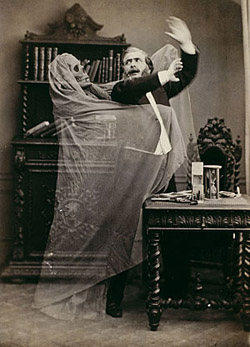
Here we see a common ethics violation: the paranormal researcher has allowed himself to become emotionally involved with his subject...
Any profession, no matter how strange, that thinks seriously about ethics is to be encouraged, and thus it is that Ethics Alarms gives a hearty shout-out to paranormal investigator L.S. Watts, 8 years a ghost-hunter and the co-founder of Grigori Research Institute of Paraspsychology. She has published a set of ethical standards for paranormal investigators that appear to be serious, thorough and well-thought out, addressing issues of professionalism, candor, honesty, conflicts of interest and fairness. Since her profession is by definition likely to be involved with a lot of people who are, shall we say, easy to deceive, and that must also attract more than its share of con artists, humbugs and frauds, there is an obvious need for a clear and sensible ethics code, for which her work would be an excellent starting point. Back in May of 2010, I noted that there was a planned “Town Meeting” on ethics in the field of paranormal investigation, and it’s nice to see progress has been made.
Ms. Watts seems sincere, so I can’t fairly apply the principle I am itching to state, which is that there are activities and fields like astrology, paranormal research, psychics, spiritualism, faith healing, creation science, loan-sharking and hacking for which the only truly valid Code of Conduct would be an extremely brief one that says, “Don’t Do This.” As long as these professions are with us, however, they might as well try to be as ethical as possible.
 Ethics Alarms