Comment of the Day: “The Ice Child” and Staging Theft Ethics”

Arts blogger Jeremy Barker contributes a provocative counter-argument to my stance in the controversy over a D.C. based theater company that borrowed/adapted/stole an original production concept from a New York company without attribution or permission.  My position was (and is) that no rule, principle or law designed to discourage such conduct could avoid suffocating legitimate adaptations, mutations and new uses of  ideas devised by others, with devastating effects on creative expression. This is one of the great ethics controversies in the world of art, and I am glad to see it back in the ring.

Here is Jeremy’s Comment of the Day on my post, “The Ice Child” and Staging Theft Ethics.

“Jack–I just came across this piece and wanted to respond because I think, in quoting me, you ignore part of my argument, and I’m curious if you can clarify your perspective.

“Specifically, I feel like your caveated argument in favor of Factory 449 is based on the sense that it’s common practice to borrow such design or staging elements in text-based theater. I agree, it is. But if we were speaking of a specific author’s text, I think most commenters would have swung the other way. We tend to protect the playwright’s text in a different fashion than we do a design concept. A writer could be accused on plagiarism for either (a) imitating a distinctive plot, or (b) appropriating the same words. Yes, we can argue about what is an acceptable form of “referencing” (no one thinks Arthur Laurents wrote Romeo & Juliet, for instance) and what crosses the line. Often, this applies to how the text is used. But we understand and appreciate a playtext as a protected, distinctive thing.

“Indeed, I’d argue that this logic, which privileges the text, is the basis on which people in this thread are defending Factory 449′s appropriation. Since it wasn’t the same “play,” by which they mean “play text,” it’s not really the same thing, ergo, it’s not ripping someone off wholesale. Continue reading
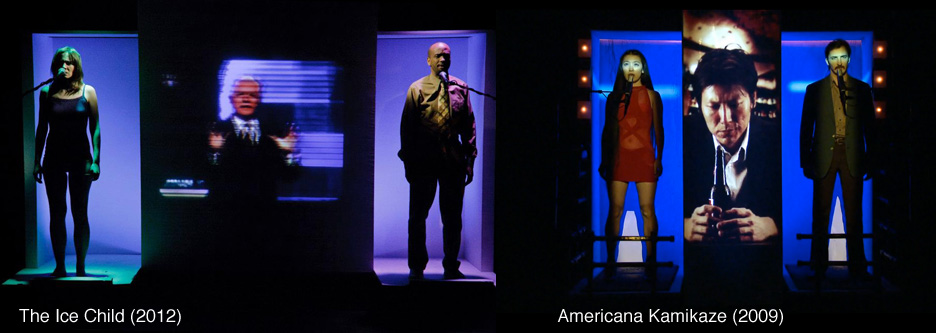
“The Ice Child” and Staging Theft Ethics

Copy or inspiration?

Well-reviewed, received and attended, the Washington D.C. production of “The Ice Child,” an original horror play by members of the three-year-old ensemble Factory 449, has stirred controversy because of its staging and production design, which is not only strikingly similar to a New York production of another horror play, “Americana Kamikaze,” but the company candidly admits that its visual concept was inspired by the 2009 work. Factory 449 also maintains that the plays are different, and that their appropriation of the design elements of the Temporary Distortion production of “Americana Kamikaze” is within the realm of acceptable, and ethical, theater practice. In a statement responding to charges of theft of creative output, the company wrote: Continue reading

Wildlife Documentary Deception

Great. CNN and NBC weren’t enough: now we can’t trust the National Geographic channel and Animal Planet.

Chris Palmer, a veteran wildlife photographer, recently went on NPR to talk about his new book. In Shooting in the Wild: An Insider’s Account of Making Movies in the Animal Kingdom, Palmer reveals the secrets of his trade, which apparently include renting trained animals when the ones in the wild won’t cooperate and putting M&M’s in the carcasses of prey, so the predators eat with gusto. He also expound on the use of a sound-effects technician to simulate sounds of animals breathing, chewing, drinking and flying. “You can’t get close enough to a bear to record his breath or his splashing in the water. If you got that close, you’d be in great danger,” he told NPR.

Although Palmer attributes the increase in the use of staged and fake footage in nature films to tighter budgets and shooting schedules, surely we had an inkling that this went on from the very beginning. The inventor of the form, Walt Disney, used animals as documentary actors in movies like “The Incredible Journey,” and I always assumed that Disney’s “true life adventure” nature films like “Jungle Cat” and “The Living Desert” included staged scenes, including battles between animals that were far from spontaneous.

Disney, however, is in the entertainment business. When wildlife documentaries announce themselves as real, they should be real, and if the producers staged sequences, rented animals, or used M&M’s, they have an ethical obligation to tell the audience. This goes for sounds as well. After all, there are people who think big snakes make the roaring sound the CGI villain makes in “Anaconda”; the fake sounds in nature films mislead many more. Real life footage is supposed to teach us something, not stuff our heads full of more misinformation.

That’s the job of CNN and NBC.

There is a lot of amazing wildlife footage that is not staged; the question now, in light of Palmer’s book, is how we are supposed to identify the fakes. The sound effects are a good clue. I will say this: if I find out that the story of Christian the lion was faked, I’m going to be angry.

But there is always “the battle at Kruger.”

[Thanks to Lauren Larson for the tip.]