Ethics Dunce: Santa Clara County Superior Court Judge Aaron Persky

Let’s see if this sentence generates a fraction of the national attention that the so-called “affluenza” sentence did. For this is much, much worse.

Star Stanford swimmer and Olympic swimming team candidate Brock Turner was arrested in the early morning hours of Jan. 18, 2015  when two Stanford graduate students  saw him on the ground, thrusting his hips atop an unconscious, partially clothed woman. They called police; Turner ran, and police chased him down Turner. In trial, Turner claimed that the woman had consented, though police found her unconscious.

The jury didn’t believe him, and convicted Turner of assault with intent to commit rape of an intoxicated woman, sexually penetrating an intoxicated person with a foreign object and sexually penetrating an unconscious person with a foreign object. The usual sentence for sexual assault is six years in state prison. Santa Clara County Superior Court Judge Aaron Persky, however,  sentenced Turner to six months in county jail and three years’ probation. Turner could get out of prison after just three months.

For rape.

I do not find the Judge’s reasoning persuasive. His arguments were.. Continue reading

Unethical Technology On The Way: Imagine What Breitbart Will Be Able To Do With THIS

The video above shows a still-in-development system called Face2Face (research paper here) created by researchers at Stanford, the Max Planck Institute and the University of Erlangen-Nuremberg. It would allow you to take YouTube video of anyone speaking, and to pair it with a standard webcam  video of someone else emoting while saying something entirely different. Thehe Face2Face system will synthesize a new video showing the originals speaker making the second speaker’s facial movements, including the interior of the mouth, so it looks like the original speaker is saying what the second speaker was.

Tech Crunch reports that the system isn’t quite ready for market yet. Gee, I can hardly wait. This “advance” has the potential of making video just as unreliable and untrustworthy as still photography is now. Web hoaxers, Ted Cruz’s marketing team, unscrupulous political websites like Breitbart and others will have a field day once Face2Face is perfected.

The justification for creating such technology is the same as the rationalizations behind cloning velociraptors in “Jurassic Park”: because we can, and because we can make money with it. Can any good come from Face2Face? It’s late and I’m not at my best, but it seems to me that the end results of having another tool for liars just means more lies, more cynicism, more misinformed people, and less trust.

Isn’t it irresponsible and inherently unethical to invent something like this?

New Rule For 2016: Elected Officials, Politician And Presidential Candidates Will Be Accountable For What They Say, Not What They “Meant To Say”

You know that quote time machine that politicians keep using? It doesn't exist. Stop letting them act as if it does.

You know that quote time machine that politicians keep using? It doesn’t exist. Stop letting them act as if it does.

We have a growing mass of public figures in politics and government who increasingly communicate in sloppy, vague, hyperbolic and ambiguous language and assume that they can wait and see how the public reacts to it before they, their spokespersons, defenders, enablers or friendly pundits need to clarify what they “really meant.”

Well, the hell with that.

Communication precision is more crucial than ever in the new, technology-driven public media, when tweets can be circulated to millions within minutes, and on-camera statements live on YouTube forever. This habit of allowing influential figures to spout lies, nonsense , smoking gun revelations about their character and worse and then insist on a do-over when they are called on the obvious meaning of their own words must stop. Among other things, it appears to be killing the little switch in the brains of these people that is supposed to stop human beings from saying stupid things before they say them. That switch goes by the name Prudence, which  encompasses common sense, respect, responsibility, restraint, honesty in communication, and more. We should want our leaders to have that switch working perfectly. Unfortunately, most of our most prominent leaders and would-be leaders appear not to have a functioning switch at all. Continue reading

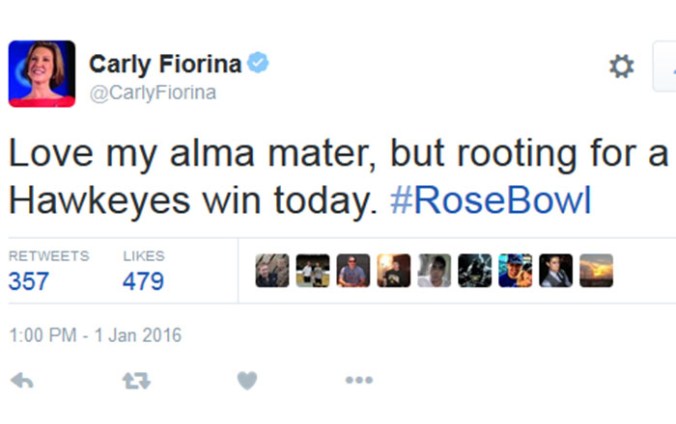
Unethical Tweet Of The Month: Carly Fiorina

carly tweetThe above New Year’s Day tweet was issued by Republican Presidential hopeful Carly Fiorina, now campaigning in Iowa for February’s caucuses, as Stanford and Iowa prepared to do battle in the Rose Bowl. (It was a rout: Iowa got clobbered.)

Fiorina is a  Stanford alum, and the tweet backfired, it seemed, with many on Twitter finding the tweet revealing, and not at all in a good way.

Are there any plausible translations of the tweet that reflect well on Carly’s character? Let’s see: Continue reading

The Benefits of Mutual Respect and Civility vs. Hate and “Partyism”

A New York Times feature from October 3 tells the inspiring tale of a friendship between two scholars, one a Christian, the other an atheist. Their friendship does not thrive in spite of the conflict between their core beliefs, but rather because of it.

Prof. David Skeel, the Christian, recently published  a book, “True Paradox: How Christianity Makes Sense of Our Complex World.”  His atheist friend, Patrick Arsenault,  is  acknowledged in the book and quoted as well, and the Times notes that “True Paradox” “might not have existed at all, or certainly would not exist in its present shape and voice, without the secular scientist as its midwife. And that odd reality is testament to a rare brand of mutual civility in the culture wars, with their countervailing trends of religious fundamentalism and dogmatic atheism.” Says Skeel:

“One of the things we talked about was whether it matters if we persuade each other. I long to have Patrick converted to my perspective. So how can we have a friendship? I see it as toleration in the deepest meaning. We don’t just ‘put up’ with each other’s beliefs. We interrogate them.”

Arsenault tells the Times that “in the culture wars, the rhetoric is acerbic on both sides. On the humanist side, there’s this tendency to view people of faith as not rational. And David is clearly rational. He’s just looked at the same evidence as me and come to a different conclusion.”

Contrast this attitude—rational, respectful, practical, fair, constructive and profoundly ethical, with the “partyism” and bigotry being practiced with increasing intensity as the mid-term elections approach. There is Washington Post columnist Dana Milbank in the video clip above, for example,  not merely accusing Republicans of fear-mongering, but suggesting that their criticism of the Secret Service is insincere: Continue reading

Finally There’s Name For The Conduct I’ve Been Calling Unethical For Years…Now Let’s Agree To Stop It

eclipse

That name is “partyism.”

From Harvard Professor Cass Sunstein:

“…party prejudice in the U.S. has jumped, infecting not only politics but also decisions about dating, marriage and hiring. By some measures, “partyism” now exceeds racial prejudice — which helps explain the intensity of some midterm election campaigns. In 1960, 5 percent of Republicans and 4 percent of Democrats said that they would feel “displeased” if their son or daughter married outside their political party. By 2010, those numbers had reached 49 percent and 33 percent. Republicans have been found to like Democrats less than they like people on welfare or gays and lesbians. Democrats dislike Republicans more than they dislike big business.”

Based on what I’ve seen, the fact that Republicans/conservatives  are nearly twice as likely to be “partyists”  as their hated enemies to the left on the political spectrum doesn’t surprise me. Most of the manifestations of the bigotry I’ve seen out in the open and written about here—restaurants that give discounts to praying customers and bars that claim that they will only serve “red voters”—have come from that sector, but 33 percent isn’t anything for liberals to be proud of, either. Over all, the trend is horrible for the country. As I wrote regarding “Mary’s,” the restaurant that favored its religious customers…

“I detest this kind of thing, and so should you, because it is ethically indefensible and un-American to the core….splitting the world into them and us, good guys and bad guys, the virtuous and the reviled. All of “Mary’s” customers are human beings, and that is the only thing that should matter in the United States of America.”

I confess that since I have been observing this phenomenon, I am preconditioned to think the Stanford research that purported to measure it as has validity. Most social science research, especially involving politics, is so skewed by researcher bias and agendas that it is inherently dubious, and perhaps this example is too: I wouldn’t rely on the percentages. Also 1960 would have to be the absolute low water mark in U.S. political passions, after the remarkably non-partisan, unifying two terms of Dwight Eisenhower while the public felt united against a common enemy in the Cold War. I’m guessing the numbers in, say, 1860 would show a sharper divide.

I do think that the intensity of emotion, rising to bigotry, distrust and hate, in the nation’s political polarization is growing, is very alarming, and dangerous to our health and future. I’d like to know more about where it resides. Is the bulk of the bigotry coming from the low-information voter, who uncritically absorbs every campaign smear, bumper sticker insult and Facebook meme as fact—you know, morons? Or are the individuals who would rather die than see their daughters marry men who oppose the family’s favorite party the narrow-minded political junkies who watch only Fox News and listen to Rush, or who cheer Al, Chris, Rachel and the 24-7 conservative-bashers on MSNBC? I’d like to know.

Naturally theories will abound regarding the reasons for this new bigotry. In a general sense, it is pure cognitive dissonance, and can be explained by people today caring more about politics and ideology than they have for quite a while. People care about something when they sense that it matters to their lives, health and welfare, as well as those around them: if political views were regarded as no more important than what baseball team one rooted for, there is no way substantive bigotry would attach to them. With foreign threats looming, the economy weak, nobody certain of the right policies in so many crucial areas and the pettiness, corruption and ineptitude of parties in and out of power, trust has plummeted. When we can’t trust those whom we have given the job of looking out for our welfare, we become worried and scared, as well we should. Then it makes sense to care more about politics. If we care more, and feel strongly about what should be done either out of a lack of sophistication and gullibility (the morons) or from unbalanced self-education (the zealots), then those who proclaim opposing views seem more obnoxious and more threatening, prompting active discrimination. The Stanford study found that “discrimination against the out-group is based more on out-group animus than in-group favoritism.” That figures. But for a nation, it is suicidal.

This nation of ideals gleaned from a diverse population must value trust and belief in what all citizens share more than it embraces passion and anger over what we disagree over. If we cherish the basic principles of democracy, then we must accept, encourage and respect dissent, frank speech, the shocking opinion and the minority view.  We must always keep our minds open to new ideas, different solutions to old problems, and the possibility that we, or the public officials, scholars and pundits we favor, may be wrong on any one topic or issue. If we can’t do that, we doom ourselves and our culture to self-righteousness, doctrine, cant  and rigidity, which block out enlightenment like an eclipse blocks sunlight. Continue reading

The Campus Sexual Assault Witch Hunt Ethics Train Wreck, Complicated By The Fact That The Witches Are Real

"Wait...are you raping me, or am I raping you?"

“Wait…are you raping me, or am I raping you?”

There is no question that there are sexual predators on college campuses, or that some colleges let them get away with raps on the knuckles for sexual assault or worse. There is also little question, though various parties and activists deny it, that what constitutes genuine sexual assault and even rape has been so thoroughly politicized and muddled by irresponsible rhetoric, dubious statistics and cynical political maneuvering that addressing the problem of actual campus sexual assault is becoming impossible without harming, indeed destroying, the innocent in some cases.

At Stanford, women are rallying for a more stringent process and harsher punishment after student Leah Francis protested in an e-mail to the campus that she had been “forcibly raped” by a fellow student and he was permitted to graduate. Of course, Stanford didn’t find the she had been raped: her assailant was found guilty of sexual assault. The loose use of “rape” to describe sexual assault for political purposes is one of the reasons universities seem incapable of finding a satisfactory balance in handling such cases. At the risk of getting ahead of the post, I would say this: if it is alleged to be rape, then turn the matter over to the police and the justice system. Schools are not allowed to use internal procedures to investigate and punish murder; it makes no sense to permit them to do so with the serious crime of rape. The fact that the standards of proof and the requirements of due process are less stringent in a campus procedure is what simultaneously leads to inadequate sanctions for the guilty and railroading of the innocent. The solution to this problem has always been available: treat allegations of campus rape like any other kind of rape.

Unfortunately, colleges are often in thrall to the political agendas of feminists and their allies, so “rape” can mean many things, as can “sexual assault.” In the casual, morality-free sexual atmosphere now not merely tolerated but nurtured on college campuses, lines of consent are blurred, and missteps are inevitable. At the same time, the permissive sexual environment is a playground for predators, exploiters and manipulators. How are the genuinely culpable sexual assailants to be distinguished from the clumsy, the confused, the misled, or the drunk and overly aroused? Continue reading