Four Supreme Court Decisions: Abortion, Guns, Affirmative Action, Corruption…And Ethics. Part 3: Whole Woman’s Health v. Hellerstedt

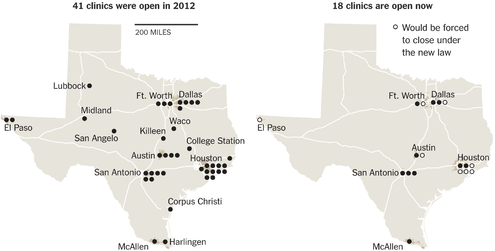
shrinking-number-of-abortion-clinics-in-texas

[The Supreme Court came down with four controversial and ideologically contentious decisions in June, and I apologize for taking almost a month to cover them all. One of the reasons Ethics Alarms occasionally launches a series like this one is to ensure that developing ethics stories of importance do not push important issues to the sidelines. The fact that this four part series had only finished parts 1 and 2 was an irritant to me, as well as some readers.]

In Whole Woman’s Health v. Hellerstedt, decided on June 27, the Supreme Court held in a 5-3 majority that two provisions of a Texas law, one requiring physicians who perform abortions to have admitting privileges at a nearby hospital and another requiring abortion clinics in the state to have facilities comparable to an ambulatory surgical center,  places a substantial and unconstitutional obstacle in the path of women seeking an abortion, because they constituted an undue burden on abortion access.

Life would be so much simpler if our elected officials and activists employed an adaptation of the Golden Rule, and looked objectively at issues from the other side’s point of view. This is especially true in the realm of rights.  Second Amendment absolutists insist that virtually any laws regulating who can purchase guns, when and where they can purchase them, and how and how quickly they can be purchased are efforts to whittle away the right to bear arms. They also argue that such regulations have the ultimate goal of  eliminating that right entirely, which, in many instances is the case, especially if you listen carefully to the rhetoric of the legislators proposing such measures. There is little difference from this and what anti-abortion advocates are attempting to do with laws like House Bill 2 (H. B. 2).

The bill ostensibly is designed to make abortions safer, thus protecting women’s health, just as many gun laws are promoted as safety measures. Oddly, virtually all of the supporters of the Texas bill would make abortion illegal if they could. I’m sure it’s just a coincidence, just as it’s a coincidence that the authors of bills requiring potential gun owners to jump through increasingly burdensome hoops and deal with mandatory trigger locks and “safe gun” technology would gladly repeal the Second Amendment if they could. The ethical principle is the same in both matters: a right isn’t a right if legal obstacles make it difficult to exercise that right.

The question is, what’s a reasonable obstacle? Any regulation imposed on a constitutional right must not create “a substantial obstacle” and must be reasonably related to “a legitimate state interest.” The Supreme Court uses the language and logic of case precedents, which are its previous examinations of these issues and the balancing they require. One such case, though I did not find it mentioned in the majority opinion or dissents in Hellerstedt, would be the voter ID decision of many years ago, in which a strong majority ruled that the state interest in preventing fraudulent voters and maintaining the integrity of the election process justified inconveniencing those who were subjected to the extra burden of obtaining appropriate identification. In recent years, this decision has been questioned because many believe the motive behind voter ID laws is not really to protect the franchise, but to keep likely Democratic voting blocs from the polls.

Is there a difference legally between a bill that is authored with the intent to restrict the right to vote of older, poorer, and darker citizens while claiming that its sole purpose is to make sure non-citizens don’t affect the results of elections, and an identical  bill that is genuinely intended to safeguard the voting rolls, without any political motive at all? No, or at least there shouldn’t be. The Court’s job is to evaluate what the law does, not try to read the minds and hearts of those who wrote it. Justices only should try to do the latter when there is a debate over what the law says.

Ethically, however, there is a significant difference between a law using a public purpose as a sham to accomplish unethical ends, and a law with a legitimate purpose that has some negative side effects. Trying to restrict a citizen’s rights because one doesn’t respect those rights (or perhaps the citizen) is unethical.

The SCOTUS majority, in its typical examination of a balancing case like this, looked at whether there was a sufficient public safety benefit to a law that had resulted in a precipitous reduction in abortion services: Continue reading

Four Supreme Court Decisions: Abortion, Guns, Affirmative Action, Corruption…And Ethics. Part I: Fisher v. University of Texas

Abigail Fisher: Not dark enough to get "an equal shot"

Abigail Fisher: Not dark enough to get “an equal shot”

The under-populated U.S. Supreme Court recently made four decisions on issues with ethical principles involved. This is the first of four posts reviewing the ethics implications of the decisions.

I. Affirmative Action: Fisher v. University of Texas

The University of Texas’ admissions program guarantees admission to top students in every high school in the state. It is dubbed the  Top 10 Percent program, though the percentage cutoff is flexible. A second part of the admissions program admits other students from Texas and elsewhere using standards that take into account academic achievement and other factors, including race and ethnicity. Many colleges and universities base all of their admissions decisions on such grounds. The case before the Court challenged that part of the program, and presented an opportunity for the Supremes to finally declare affirmative action unconstitutional, as previous opinions hinted they might do some day.

This was not the day, however. Justice Kennedy, writing for the majority, said courts must give universities significant but not total autonomy in designing their admissions programs, writing:

“A university is in large part defined by those intangible ‘qualities which are incapable of objective measurement but which make for greatness.’ Considerable deference is owed to a university in defining those intangible characteristics, like student body diversity, that are central to its identity and educational mission.But still, it remains an enduring challenge to our nation’s education system to reconcile the pursuit of diversity with the constitutional promise of equal treatment and dignity.”

This defines either an ethical dilemma, which the Court’s majority is punting, or an ethical conflict…which the Court majority is punting. Is diversity an ethical objective, or a practical one, that is, a powerful non-ethical consideration? It is hard to argue that diversity in a student body isn’t desirable—to enhance the educational experiences of students, to avoid having a permanent, under-credentialed underclass, to “look like America.” However, fairness and common sense argue that admitting one candidate over another who is better qualified simply because of ethnicity or race is per se wrong. I don’t blame the Court at all for not making a clean call.

As usual, President Obama described the result in simplistic terms. “I’m pleased that the Supreme Court upheld the basic notion that diversity is an important value in our society,” he told reporters at the White House. “We are not a country that guarantees equal outcomes, but we do strive to provide an equal shot to everybody.”

Thank you, President Obvious. The crux of the case, however, was what should be done when using race as a standard for admission to attain that diversity denies an “equal shot” to someone who has the misfortune to be white, like Abigail Fisher, or Asian-American. Continue reading

Observations On The George Mason Law School Renaming Debacle

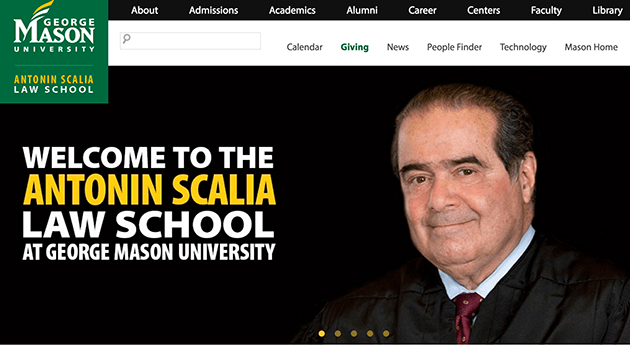
Scalia Law School

Summary: On March 31, George Mason University announced that it was changing the name of its law school, which has rapidly risen from marginal status into respectability in the last few years, to the Antonin Scalia School of Law. The reason: a 30 million dollar contribution from the Charles Koch Foundation, a.k.a. the Koch Brothers and an anonymous donor, who made the name change a condition of his or her generosity. This occurring while the various controversies over Scalia’s legacy and the Supreme Court’s deadlock since his passing were still raging guaranteed indignation from many quarters, including many students and graduates of the law school. The internet and social media communities, meanwhile, having the emotional maturity of fifth graders, concentrated its efforts at snickering over the new school’s acronym, which could be ASSoL, and the Twitter handle, #ASSLAW.

The resulting embarrassment led the school’s Dean to announce  that the name of the school was being altered to “Antonin Scalia Law School.”

Comments:

1. Ethics Alarms had a recent post expressing dismay at the willingness of baseball teams to sell the identity of their ballparks to corporations. This is much worse. George Mason is perhaps the most unjustly forgotten of all the Founders, as he was largely responsible for there being a Bill of Rights in our Constitution The fact that George Mason University and its law school has been slowly rising in prestige and visibility had helped to remedy the unjust obscurity of a historical figure to whom every citizen and the world owes a debt of thanks. George Mason’s honor, however, was considered expendable once the school’s leaders knew the price that using the law school for ideological propaganda could bring at a time of sharp partisan division.

2. Rich people have a right to use their money to make others do things that they shouldn’t or normally wouldn’t want to. The issue is whether there are ethical limits to the kinds of actions and conduct money should be used to buy. Rich families have used their assets to defeat true love, paying  unsuitable suitors to leave without explanation. Desperate celebrities have accepted checks to debase themselves on reality shows. Judas was paid to betray Jesus Christ. Where does using one’s millions to induce a university to betray its duties to alumni and students, as well as other donors and the memory of a crucial American patriot, fall on the spectrum?

3. Was George Mason University obligated to accept 30,000,000 dollars under these conditions? Should money supersede all other considerations for an educational institution? No, and no. Allowing the school to be turned into a billboard for conservative jurisprudence did more than simply alter the name. It altered the perception of the law school, the meaning of its degrees, its public image and its ability to attract a wide range of students from diverse backgrounds. If the school’s leadership didn’t comprehend that, it was a stunning example of institutional incompetence and irresponsible decision-making.

4. If the school’s leadership did comprehend the gravamen of the name change and allowing partisan tycoons to bend the school’s management to their will, then the decision was even less defensible. There was an absolute obligation to consult with the stakeholders in this trade-off: students, alumni, and donors. Failing that obligation constituted a stunning breach of trust. Continue reading

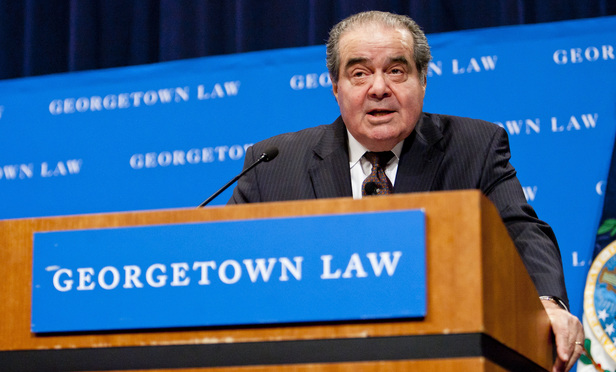
Ethics Observations On Georgetown Law Center’s Scalia Foofarah

Scalia-Georgetown

I am a Georgetown University Law Center grad, as well as a former administrator there. I also know and have personal relationships with several members of the faculty. None of this especially informs my ethical analysis of the community argument there that arose from a rather innocuous official expression of respect and mourning in the wake of Justice Scalia’s death, but if anyone wonders why I’m posting about this rather than many other ethics issues nipping at my heels, that’s part of the reason. The other reason is that this academic dust-up raises interesting ethics issues, and has received national publicity.

Observations on the tale as it has unfolded:

1.  Georgetown Law Center issued a press release mourning the death of Antonin Scalia, including a statement from Dean William M. Treanor that read:

Scalia was a giant in the history of the law, a brilliant jurist whose opinions and scholarship profoundly transformed the law. Like countless academics, I learned a great deal from his opinions and his scholarship. In the history of the Court, few Justices have had such influence on the way in which the law is understood. On a personal level, I am deeply grateful for his remarkably generous involvement with our community, including his frequent appearances in classes and his memorable lecture to our first year students this past November. The justice offered first-year students his insights and guidance, and he stayed with the students long after the lecture was over. He cared passionately about the profession, about the law and about the future, and the students who were fortunate enough to hear him will never forget the experience. We will all miss him.”

[Note: In the original post, I missed the first line, and kept missing it. Don’t ask me why. The text has been finally, after a couple botched attempts, been revised to include it.]

Is there anything inappropriate about the dean’s statement? Not in my view. This is nothing but a traditional expression of professional respect on behalf a prominent institutional member of the legal community. There is nothing in the statement, save for the last sentence, that anyone could argue is untrue. Countless academics, as well as Scalia’s more liberal colleagues, did learn “a great deal from his opinions and his scholarship.” He was an influential and significant figure on the Court. Scalia was generous with his time and passion as a teacher, and by all accounts he was a good one.

The opening statement,  “Scalia was a giant in the history of the law, a brilliant jurist whose opinions and scholarship profoundly transformed the law,”  seems to be what rankled Scalia critics. It shouldn’t have. At worst it is standard memorial puffery. But calling Scalia a giant “ in the history of the law” seems fair whether you agree with his jurisprudence or not: he is certainly among the 20 or so most quoted, most debated, and most provocative justices. The rest shouldn’t be troubling to anyone who isn’t suffering from Scalia-phobia. A Justice can be brilliant and transformational while being wrong.

None of the reports of the controversy ignited by this standard issue sentiment mention it, but Georgetown Law Center isn’t on the Georgetown campus. It has its own campus that is a 15 minute walk from the Supreme Court. Law students regularly attend oral arguments; I did: it was one of the great advantages of studying law there. More than any law school, the Law Center has good reason to feel a special affinity to the Court and all its justices.

2.  What about the last sentence? Is it appropriate for Treaner to speak for the law school community and say that “We will all miss him”? He was reasonable and fair to assume that.  Unfortunately, in today’s vicious partisan divide where opinions and sincere positions reached after thought and research are too often treated as proof of consort with Satan, and ion which even lawyers, who are trained not to take legal arguments personally, are frequently unable to respect a colleague for a well-reasoned argument that they may still think is completely wrong, it was not a safe assumption. Pillory the dean, then, for giving all members of his community the benefit of the doubt, and assuming they are capable of grace, compassion, fairness, professional respect and civility.

It’s still not unethical to assume one’s colleagues have some class.

3. They all don’t, unfortunately. Law Center professors Gary Peller and Mike Seidman (I know Mike, never met Gary) then used the Campus Broadcast system, usually used for event announcements, invitations and policy changes, to send a message  to all members of the student body titled, “Responses to Dean Treanor’s Press Release Regarding Justice Scalia.”  Peller’s statement reads,

Like Mike Seidman, I also was put-off by the invocation of the “Georgetown Community” in the press release that Dean Treanor issued Saturday. I imagine many other faculty, students and staff, particularly people of color, women and sexual minorities, cringed at headline and at the unmitigated praise with which the press release described a jurist that many of us believe was a defender of privilege, oppression and bigotry, one whose intellectual positions were not brilliant but simplistic and formalistic….That ‘community’ would never have claimed that our entire community mourns the loss of J. Scalia, nor contributed to his mystification without regard for the harm and hurt he inflicted.”

This was partisan grandstanding of the worst kind. The professors, of course, have a right to proclaim their opinions to the student body any time they want to, but their complaint here was petty and mean-spirited. It also models behavior that is poisonous both to the legal profession and the culture as a whole. The are saying, in essence,We don’t mourn him, we won’t miss him, and we’re glad to be rid of him, because his legal theories aren’t our legal theories, and we are on the side of the angels while he was an uncaring villain.” Such a message accomplishes nothing positive, and much that is destructive. The professors engaged in demonizing, when their profession and their duty is not to denigrate but reason. If they really think they can prove that Scalia was a defender of privilege, oppression and bigotry, they can make that case in a scholarly paper: I doubt that they can. Scalia often defended the rights to engage in conduct that he did not personally support, as well as some he did: the sloppy rhetoric of Seidman and Peller echoes the legally ignorant who accuse criminal defense attorneys of defending robbery and murder. Continue reading

David Brooks’ Dirty Hit On Ted Cruz: How Pundits Lose Credibility

That's some role model you've chosen there, David

That’s some role model you’ve chosen there, David

…or at least deserve to.

Here is how New York Times columnist David Brooks begins his character evisceration of Ted Cruz:

“In 1997, Michael Wayne Haley was arrested after stealing a calculator from Walmart. This was a crime that merited a maximum two-year prison term. But prosecutors incorrectly applied a habitual offender law. Neither the judge nor the defense lawyer caught the error and Haley was sentenced to 16 years.

Eventually, the mistake came to light and Haley tried to fix it. Ted Cruz was solicitor general of Texas at the time. Instead of just letting Haley go for time served, Cruz took the case to the Supreme Court to keep Haley in prison for the full 16 years.

Some justices were skeptical. “Is there some rule that you can’t confess error in your state?” Justice Anthony Kennedy asked. The court system did finally let Haley out of prison, after six years.”

From this, Brooks goes on to conclude…

…Cruz’s behavior in the Haley case is almost the dictionary definition of pharisaism: an overzealous application of the letter of the law in a way that violates the spirit of the law, as well as fairness and mercy….Cruz’s speeches are marked by what you might call pagan brutalism. There is not a hint of compassion, gentleness and mercy. Instead, his speeches are marked by a long list of enemies, and vows to crush, shred, destroy, bomb them.

Cruz’s behavior in the Haley case [Dretke v. Haley] does nothing of the sort. The columnist intentionally—I’m assuming that he read the case, now—misrepresented what the case was about, how the court reacted, and what Cruz’s ethical duties were regarding it. As it happens, I share much of Brooks’ dislike of Cruz’s rhetoric. This case, however, tells us nothing about Cruz’s character. It tells us that that as Solicitor General of Texas, Cruz did his job, which was to represent his client’s position.

James Taranto, the pretty damn brilliant Wall Street Journal blogger, wit and conservative pundit, nails Brooks to the wall. He writes in part… Continue reading

Update: Some Perspective On Justice Scalia’s “Racist” Question About Affirmative Action

Big fish, meet small pond...

Big fish, meet small pond…

Ethics Alarms recently discussed the unfair attacks on Justice Scalia, now even extending to calls for his resignation, for his legitimate question in oral argument about whether black students accepted into elite schools via affirmative action might be better off being able to excel in less competitive institutions. The question was not racist, reflecting common sense, nor was it necessarily Scalia’s position, as it was an argument raised in one of the briefs on the case. Never mind: much of the media still characterizes the query as outrageous, and social justice warriors are trying to make the episode out to be smoking gun evidence of Supreme Court bias in anticipation of a negative ruling in the case regarding affirmative action.

As the Daily Beast reveals, however, there is a much better explanation than racism for why Scalia might find the argument powerfully supported by the research of Richard Stander and Stuart Taylor in their book “Mismatch” compelling. Young Nino Scalia was a star in elementary school, but failed the entrance exam for the Jesuit High School in Manhattan. His father told him that he might ultimately be better off at a less competitive school where he could shine, and that’s what happened.  Scalia later graduated first in his class at a less prestigious high school. Then he was rejected again when he applied to Princeton University.  Again he took a step down, attended Georgetown University instead, and was first in his class. Continue reading

Race-Baiting Scalia (For Doing His Job)

Ignore them, Nino.

Ignore them, Nino.

As is often the case with topics here, I heard about the uproar over Justice Antonin Scalia’s controversial question during oral argument on the latest challenge to affirmative action accidentally, when a Facebook friend re-posted a furious message from his friend calling Scalia a moron and a racist. Even reading a second hand account of what somebody read that Scalia said (the transcript hadn’t been released, but never mind: that was enough for my friend’s African-American friend to call a Supreme Court Justice a racist and for my friend, who is a liberal-minded professor, to endorse it), I could tell that the attack was unfair and worse, outright race-baiting.

What Scalia was alleged to have asked a lawyer was whether affirmative action actually hurt blacks by putting them in “more advanced” institutions, that they “don’t belong” in elite schools. I knew, no matter what Justice Scalia really said, that he was talking about some blacks, not all blacks. That’s obvious: if an African American student can be admitted to an elite school without the “thumb on the scale” of affirmative action, obviously he or she is qualified and belongs there. But more importantly, I knew from personal experience that being admitted to a top school when the student’s credentials wouldn’t normally warrant it could be disastrous.

I worked in the administration of Georgetown Law Center in the late seventies and early eighties, as the school was trying to increase its percentage of black students. I was involved in the process sometimes, and was stunned by its unfortunate revelations: for example, some of the black students we accepted from elite colleges lacked basic reading, writing and critical thinking skills. I remember one Yale grad in particular who could not write a comprehensible sentence.

Georgetown Law set up a special class for these minority students (and a couple of  white “legacy” admits who were sons of wealthy alums, one of which I had specifically told his father could not possibly graduate, based on his college grades and test scores.) Then the school was sued by one of the affirmative action students, who claimed that making him take the remedial class was demeaning and racist. Of course he would have been better off in a less demanding law school. Affirmative action did none of these students any favors. In my opinion then and now, their welfare, confidence and self-esteem was  sacrificed so Georgetown could look progressive, and to the dubious objective of diversity for diversity’s sake.

It wasn’t just my Facebook friend’s friend that was bashing Scalia as a racist. It was much of the news media. “Justice Scalia Suggests Blacks Belong at ‘Slower’ Colleges” reported Mother Jones. “Scalia: Maybe black students belong at ‘less-advanced’ schools” reported The Hill. MSNBC’s slur was Justice Antonin Scalia floats ‘lesser schools’ for black students.  A New York Times editorial—the paper has, it appears, lost its mind– said that Scalia raised an “offensive premise which has not gotten such a full airing at the Supreme Court since the 1950s.” The New York’s Daily News  headlined“SUPREME DOPE” over a photo of Nino. Continue reading

Of Shoes and Socks, and the Soothing, Unethical Device of Lowered Obama Leadership Goals and Aspirations

shoes and socks

I had a friend in college named David, a talented musician and a funny guy, who one regaled me with his new theory of how to be a success and eliminate anxiety and stress in the bargain.

“See, we make ourselves miserable and guarantee failure by setting our goals impossibly high,” he said. “The secret to a happy, successful, care-free life is to set one’s goals extremely low. Last week, I was depressed because I had aimed at attending all my classes, writing 50 pages on my thesis, and finishing my reading assignments. I didn’t come close to accomplishing this, and I was miserable and guilty as a result.”

“Then I had an epiphany! Today I set my goal, my only one, as putting on my shoes and socks,” David explained. “That was it, the whole thing. Look! I did it! And it’s only noon!” He laughed and skipped away, not a care in the world.

I’m pretty sure he was kidding. Yet the Obama Administration, and its increasingly zombie-like, denial-motivated supporters, appears to have adopted this approach to leadership. Continue reading

A Jumbo For Sulu

SuluGeorge Takei, the Japanese-America actor permanently enshrined in pop culture history for his role of Sulu in the original “Star Trek” TV series. He has essentially lived off that one felicitous part for forty years, recently acquiring less moldy,  non-sci-fi following by being a gay rights advocate.

Takei recently skimmed, or just didn’t comprehend, Clarence Thomas’s  audacious dissent to the Supreme Court’s Obergefell ruling and Justice Kennedy’s majority opinion declaring same-sex marriage to be a fundamental right protected by the Constitution. Apparently he also does not comprehend that Supreme Court dissents are both stimulating and useful to legal scholars as well as those, unlike Mr. Sulu, possessing an open and curious mind.

Thomas made the unusual but provocative argument that human dignity is innate:

Human dignity has long been understood in this country to be innate. When the Framers proclaimed in the Declaration of Independence that “all men are created equal” and “endowed by their Creator with certain unalienable Rights,” they referred to a vision of mankind in which all humans are created in the image of God and therefore of inherent worth. That vision is the foundation upon which
this Nation was built.

The corollary of that principle is that human dignity cannot be taken away by the government. Slaves did not lose their dignity (any more than they lost their humanity) because the government allowed them to be enslaved. Those held in internment camps did not lose their dignity because the government confined them. And those denied governmental benefits certainly do not lose their dignity because the government denies them those benefits. The government cannot bestow dignity, and it cannot take it away.

Thomas was expressing  his disagreement with the majority that the government withholding the right to marry from gays robbed them of human dignity. I think it is a rather pedantic argument that has more validity in the abstract than in reality, but the position that rights come from creation rather than the government is a core concept in the Declaration of Independence, and one that statists, as in “modern Democrats,” like to ignore. If individuals are born with rights, they cannot be truly taken away. If citizens must look to the government to have their rights granted to them, then government is granted too much power in exchange. Thomas’s philosophical argument is classic conservatism. Naturally, that means, in Takei’s intolerant and partyist world view, that he deserves abuse. Continue reading

Ethics Dunce: Above The Law

Wait, you mean Above the Law ISN'T The News Nerd? Could have fooled me.

Wait, you mean Above the Law ISN’T The News Nerd? Could have fooled me.

The legal gossip and commentary blog “Above the Law” is a useful source of inside-baseball stories about the machinations and peccadilloes  of law firms, lawyers, judges and law students, and occasional hard news of special interest to lawyers. Today it sported an intriguing headline:

Samuel Alito Gets A Supreme Benchslap

…which was filed under the categories of Justice Alito, The Supreme Court, and benchslaps. The latter is legal jargon for a reprimand from a judge. The Supreme Court reprimanding one of its own justices is big news, and unprecedented. Like many others, I clicked on the link, and read a jaw-dropping, insulting rebuke of Justice Alito by Chief Justice Roberts, banishing him to  “to a minor appellate jurisdiction” until he writes ” a few decisions in some lower-pressure situations” and is ready to return.

The post explained at the end of the quote that Justice Alito had been temporarily removed from the Supreme Court and appointed to the Eleventh Circuit, and that, according to reports, Alito will be replaced by Judge Ricardo Gonzalez of the District of Puerto Rico.

Then Above the Law’s writer, Staci Zaretski, revealed that…

(This quote comes from The Onion, a satirical news site, but that in no way takes away from the overall awesomeness of imagining a Supreme Court justice being demoted as a form of spanking.)

Ah. So you just wasted my time, then.

I had begun to suspect that the Roberts quote was fake, both for its use of the neckname “Sammie” for one of his brethren, and also because it sounded so much like a manager’s explanation for why a player was being sent to the minors. Nevertheless, posting a fake story, announced with a plausible headline, is unprofessional and unfair to ABL readers: Continue reading