Speaking Of Doing The Right Thing For Unethical Reasons, TV Land Has Pulled “The Dukes of Hazzard”

Wait, there's a CAR in this photo?

Wait, there’s a CAR in this photo?

You know, I think I’m as sensitive as anyone (sane) to nascent racism, and yet somehow I missed the fact, when in my youth I would watch  TV’s “The Dukes of Hazzard” for an average of six minutes before thinking, “BOY is this dumb!” and change the channel lest my IQ be permanently lowered, that the show was a KKK product. That’s because there was nothing vaguely racist or even Confederacy-ish about the show, except the flag design on the fictional super-car the good ol’ Duke boys drove, “The General Lee,” named after a historical figure who, you will recall, was a Confederate general. What would you expect a car called the General Lee to have on its roof, the Portuguese flag?

Never mind. TV Land, the cable channel that celebrates TV shows so old that they provoke mid-life crises by their very existence, just decided to join the political correctness purge that has the Park Service representing at its battlefields that the Union prevailed over a mysterious foe Which Cannot Be Named, and which definitely had no flag to fight for. It has pulled “The Dukes of Hazzard” from its schedule….not because it is trash and no more worthy of preservation for future generations than less popular stinkers like “It’s About Time,” “Pink Lady and Jeff,” “Mr. Terrific” or “Hart to Hart,” but because of the design on the roof of the car.

As a self-appointed guardian of pop culture history, TV Land is obligated to resist such efforts at whitewashing, which I assume will also claim every Norman Lear show (You think you are a progressive, Norman? HA! You’re a racist who dealt in toxic stereotypes!!!) like “The Jeffersons,” “Sanford and Son,” and “Good Times.” Ah, but #blackhypersensitivitymatters, you know, a lot more than letting people watch Catherine Bach in her shorts. Continue reading

Introducing A Third Niggardly Principle, And A Dilemma: Does It Apply To The Confederate Flag?

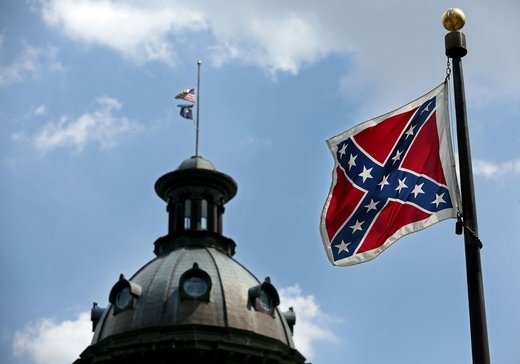
Scarolina flag

Before unveiling the new Third Niggardly Principle, indulge me some observation  on the emergence of a renewed controversy over the Confederate flag as a response to the Charleston, South Carolina shooting of nine black churchgoers last week:

1. The Confederate battle flag did not cause Dylann Roof to start shooting. If  all the Confederate flag had been retired to museums 100 years ago, it would not have turned him into a civil rights advocate.

2. The effort of anti-flag advocates, who are frequently advocates of censorship and restrictions on free speech as well, to exploit this tragedy to advance their pet grievance is transparent and obnoxious, and is even more attenuated than the furious efforts of anti-gun zealots to do the same thing.

3. The flag, like many symbols, represents different things to different people. Racial hate and bigotry is only one of them. The flag legitimately represents pride in a family legacy (“My great grandfather died bravely in Pickett’s Charge”), the historical record, opposition to federal government overreach,  aesthetic appeal, or defiance of authority generally (“I’m a rebel”). Old Glory also represents different things to different people, and we do not ban it because what it symbolizes to some people is unpleasant for them. (Yes, I know some schools have done exactly that. One hopes they are outliers)

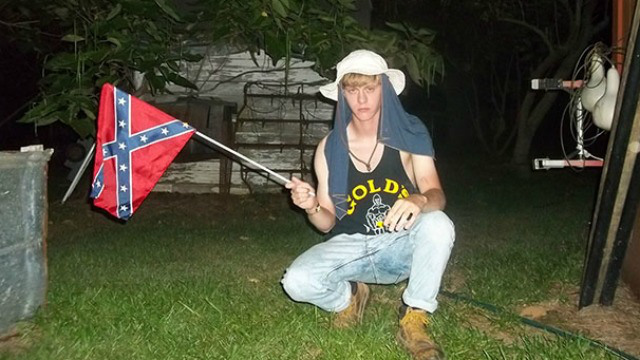
4. Mitt Romney’s much praised tweet—“Take down the #ConfederateFlag at the SC Capitol. To many, it is a symbol of racial hatred. Remove it now to honor #Charleston victims.” —is simple-minded and irresponsible. (See the previous post.) Is Mitt arguing that any speech, symbol or expression that “many” find offensive should be suppressed? It sounds like it to me. Since Roof’s act had nothing to do with the flag, nor was it related to slavery or the Confederacy, how does taking the flag down “honor” his victims? Sure: Roof liked the flag, because of what it symbolized to him. He also liked Gold’s Gym:

dylann-roof1

Would closing down all the Gold Gyms in South Carolina honor his victims? The fact that the attack was racially motivated and that racists often display Confederate flags does not make a state flying the flag complicit in the shootings. Stop using Twitter to discuss complex issues, Mitt! Continue reading

A Presidents Day Celebration (PART 4 and Final): The Wild, Wild Ride From FDR to W.

smiling-presidents

All of the Presidents (except FDR) in this last section were alive and kicking while I was, and so to me they are both more real and less fascinating to some extent. Familiarity breeds, if not contempt, a tendency not to idealize. These leaders are no more flawed than their predecessors, they just seem that way thanks to mass media.

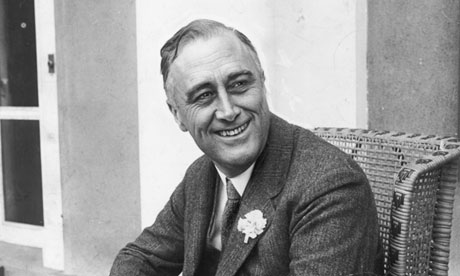
Franklin D. Roosevelt
Franklin Roosevelt

Three terms plus, a World War, a Depression, a transformative Presidency and an epic life spent in public service: FDR is another President who can’t be summed up in an anecdote, one book, or a hundred. He accomplished enough great things to be a deserving icon; he committed enough wrongs to be judged a villain. (He was pretty clearly a sociopath, but a lot of great leaders are, including a fair proportion of ours, including some of the best.) The only completely unfair verdict on this Roosevelt is not to acknowledge the importance and complexity of his life. Here are some of my favorite items about him:

  • FDR wrote down a plan when he was still in school outlining the best way for him to become President. The plan was essentially to follow his distant cousin Theodore’s career steps: Harvard, Assistant Secretary of the Navy, Governor of New York, Vice-Presidential candidate, and President. (He skipped “Rough Rider.”) Amazingly, he followed it, and it worked.
  • Conventional wisdom holds that FDR’s polio transformed his character, and that without that crisis and challenge he would have been content to be a rich dilettante. I doubt it, but there is no question that he fits the Presidential survivor template, and that his ordeal made him stronger, more formidable and more determined.
  • Many Presidents had strong mothers, especially, for some reason, many of our Chief Executives from Roosevelt to Obama. Franklin’s mom, however, wins the prize. It’s amazing Eleanor didn’t murder her. But Mrs. Roosevelt is why Eleanor was there in the first place: all of our Presidents raised by strong mothers married very strong wives.
  • If a computer program were designed to create the perfect American leader, it would give us FDR. He was the complete package; his charisma, charm and power radiate from recordings and films that are 90 years old. That smile! That chin! That head! That voice! He is one of the very few Presidents who would be just as  popular and effective today as the era in which he lived.
  • And just as dangerous. FDR is also a template for an American dictator, which, I believe, he would have been perfectly willing to be. It’s no coincidence that Franklin was the only President to break Washington’s wise tradition of leaving office after two terms.
  • Political and philosophical arguments aside, at least four of Roosevelt actions as President were horrific, and would sink the reputation of most leaders: 1) Imprisoning Japanese-Americans (and German-Americans, too); 2) Ignoring the plight of European Jews as long as he did, when it should have been clear what was going on; 3) Handing over Eastern Europe to Stalin, and 4) Knowing how sick he was, giving little thought or care to who his running mate was in 1944.
  • Balancing all that, indeed outweighing it, is the fact that the United States of America and quite possibly the free world might not exist today if this unique and gifted leader were not on the scene. Three times in our history, the nation’s existence depended on not just good leadership, but extraordinary leadership, and all three times, the leader we needed emerged: Washington, Lincoln, and Franklin. I wouldn’t count on us being that lucky again.

I left the bulk of reflection about the character and leadership style of Theodore Roosevelt to one of Teddy’s own speeches to embody, and I’ll do the same for his protege.

On September 23, 1932, New York Governor Franklin D. Roosevelt gave a speech at Manhattan’s Commonwealth Club. (Everyone, conservative, liberal or moderate, should read it….here.) It was a defining statement of progressive principles and modern liberalism, redefining core American values according to the perceived needs of a changing nation and culture.  It is a radical speech, and would be regarded as radical by many today, even after much of what Roosevelt argued was reflected in the policies of the New Deal.

After sketching the origins and progress of the nation to the present, he flatly stated that the Founders’ assumptions no longer applied:

A glance at the situation today only too clearly indicates that equality of opportunity as we have know it no longer exists. Our industrial plant is built; the problem just now is whether under existing conditions it is not overbuilt. Our last frontier has long since been reached, and there is practically no more free land. More than half of our people do not live on the farms or on lands and cannot derive a living by cultivating their own property. There is no safety valve in the form of a Western prairie to which those thrown out of work by the Eastern economic machines can go for a new start. We are not able to invite the immigration from Europe to share our endless plenty. We are now providing a drab living for our own people….

Just as freedom to farm has ceased, so also the opportunity in business has narrowed. It still is true that men can start small enterprises, trusting to native shrewdness and ability to keep abreast of competitors; but area after area has been preempted altogether by the great corporations, and even in the fields which still have no great concerns, the small man starts with a handicap. The unfeeling statistics of the past three decades show that the independent business man is running a losing race. Perhaps he is forced to the wall; perhaps he cannot command credit; perhaps he is “squeezed out,” in Mr. Wilson’s words, by highly organized corporate competitors, as your corner grocery man can tell you.

Recently a careful study was made of the concentration of business in the United States. It showed that our economic life was dominated by some six hundred odd corporations who controlled two-thirds of American industry. Ten million small business men divided the other third. More striking still, it appeared that if the process of concentration goes on at the same rate, at the end of another century we shall have all American industry controlled by a dozen corporations, and run by perhaps a hundred men. Put plainly, we are steering a steady course toward economic oligarchy, if we are not there already.

Clearly, all this calls for a re-appraisal of values.

So Franklin Roosevelt re-appraised them: Continue reading

The Bo Deplaning Background: A Picture Not Quite Worth 1000 Words

I reluctantly replaced the background photo of Justin Carter (who is still, by the way, awaiting trial for the crime of making a sarcastic comment on Facebook that post-Sandy Hook hysterics decided to treat as a terrorist threat) and put up the iconic photo of Bo, the Presidential dog, being solemnly escorted out of an Osprey to join the First Family in another spectacularly ill-timed vacation in Martha’s Vineyard, together with a photo of the National Debt clock. I hoped the background picture would save me the proverbial thousand words, because I think it speaks eloquently to several issues. But I have already received some squeals of protest, so I’m going to have to use up some of those words after all.

I generally have no problem with any President taking vacations, since the job is impossible and it travels with him, no matter how much he might wish otherwise. I have a problem with Presidents spending excessive amounts of the nation’s time in partisan fundraising, but that’s another issue. As one of the President’s supervisors, I have serious concerns about this President taking so many vacations, because, frankly, I don’t know what he does all day. He appears to have no foreign policy, other than making speeches, waffling, and dithering. He says he is making the economy his full time priority, but I see little indication of that. We know he doesn’t dirty his hands with engaging in politics and forging compromises with the opposition, and based on his statements and stunned surprise when incompetence or misconduct appears, he seems not to know what is going on in his own departments. We know he doesn’t trouble himself with oversight or management—even #1 fan Chris Matthews admits that.

Obama said on The Tonight Show (he has time to appear on The Tonight Show) that the U.S. has no domestic spying program. Today we learn that the NSA has habitually violated privacy restrictions on its spying, meaning that we don’t have a domestic spying program, just a spying program that repeatedly engages in domestic spying. Call me a stickler, but I think a few of those down days on vacation should have been spent instead actually learning what was the real situation before he told the nation things that weren’t true. Or was he lying? If you prefer that explanation, fine. That is another ethical issue. Continue reading

Unethical Quote of the Week: The White House

“Any suggestion that this was an insult to the United States is just flat wrong.  As Lang Lang has stated before, he plays this song regularly because it is one of his favorite Chinese melodies, which is very widely known and popular in China for its melody.  Lang Lang played the song without lyrics or reference to any political themes during the entertainment portion of the State Dinner. He simply stated the song’s title and noted it was well known in China.”

White House Spokesman Tommy Vietor, arguing that Chinese pianist Lang Lang’s  playing of a Chinese  song that referred to Americans a “jackals” at a White House dinner was as innocent as the day is long.

The song was well-known in China all right—well-known as an anti-American song. Continue reading

China’s Secret White House Insult

Lang Lang, the Chinese pianist who played for guests the White House State dinner on Jan. 19 honoring Chairman Hu Jintao, apparently regaled the crowd with an unfamiliar melody (to the Americans) that was really a famous anti-American propaganda song from the Korean War, the theme  to the movie “Battle on Shangganling Mountain.”  Continue reading