Comment of the Day: “The Weeping Bus Monitor: A Half-Million Dollars For Incompetence”

Some critical threads on posts here depress me, and there have been two examples recently. The first is the parade of out-of-work or underemployed lawyers of recent vintage who identify with the unemployed lawyer in the Occupy Wall Street throng of last fall whose response to job-hunting frustration was to give up, hand-letter a sign and blame his law school. These commenters take special umbrage at my hardly original observation that a law degree is good for pursuits other than practicing law, and continue to insist that the degree is suddenly a handicap, as two JDs run for President of the United States for the first time since Dewey challenged FDR in 1944.

The other thread, if less vociferous and bizarre, is even more depressing. These are the tender souls who believe that Karen Klein, the inert school bus monitor shown in a viral video weeping and cringing at the taunts of the 12-year-olds she was supposed to supervise, deserves anything but scorn for stealing taxpayer money and disgracing adulthood in front of impressionable youngsters. Maybe I’ve been reading the comments for two many days, but they seem to have a theme in common, which is the avoidance of personal responsibility and accountability for setbacks and failure, and the eager acceptance of victim status in order to avoid blame and attract sympathy.

Thus I was in the perfect mood to read this spunky post from dkatt, who scored the Comment of the Day on the essay, “The Weeping Bus Monitor: A Half-Million For Incompetence”: Continue reading


The Weeping Bus Monitor: A Half-Million Dollars For Incompetence

Karen Klein is the 68- year-old bus monitor who is the unwilling star of a viral video (below) showing her being insulted and mocked by 12-year-olds on a school bus.

Continue reading

When Routine Deadens Ethics

"Good boy!!!"

A Niagara County, New York coroner just resigned as he faces possible imprisonment after taking a fresh body part from the carnage of a local plane wreck and using it to train his personal cadaver-sniffing dog.

How, you may ask, could anyone, particularly a public coroner, be so callous and ethically numb? “Hey! Here’s a leg! What luck! Now I can train Rex!” How can a professional—or a human being— treat some grieving family’s loved one like a piece of meat?

I think it’s natural, really. Coroners, morticians, medical examiners, rescue workers, military commanders and doctors all have to detach themselves from the human beings whose deaths are a routine part of their daily work, or they risk being unable to do their work at all. Objectivity and independent judgment are crucial elements of professional conduct, and emotion, including sorrow, sympathy, and revulsion, is the enemy of objectivity. The danger is that in order to deaden one’s emotions through repetition and routine, one risks unplugging an ethics alarm. For these emotions are also part of the ethical value of caring.

The coroner might have been excellent at his job, but he lost all human connection to his work. The mangled body part that had once been a living, breathing, loving person seemed like a piece of meat, because to the coroner, like his dog, it was just a piece of meat.

When feeling gets in the way of a professional’s  duties, it is only normal for the professional to try to eliminate them, and even prudent, except that the absence of feelings can cause a deficit in ethics. Building those callouses over normal human emotions are matter of survival in some professions, but doing so creates what I call a “pre-unethical condition” requiring awareness and vigilance.

The Niagara coroner wasn’t sufficiently vigilant, and he fell into a career ending trap.

______________________________

Facts: WGRG New York

Graphic: Greenwich Roundup

Ethics Alarms attempts to give proper attribution and credit to all sources of  facts, analysis and other assistance that go into its blog posts. If you are aware of one I missed, or believe your own work was used in any way without proper attribution, please contact me, Jack Marshall, at  jamproethics@verizon.net.

Scott Olsen, The “Occupy” Movement and The Protest Dilemma

The critics of the various Occupy Wall Street demonstrations are hustling to defuse the backlash from an incident that took place this week in Oakland, where a confrontation between police and Occupy Oakland protesters not only led to many arrests, but also a severely injured protestor. Iraq war veteran Scott Olsen is hospitalized with a fractured skull as a result of being hit by a projectile directed by police, probably a tear gas canister.

In the age of YouTube, the various images of Olsen’s injury were quickly exploited by protest organizers, as should be expected and is entirely fair. All demonstrations and protests are ultimately about public relations: if the protesters manage to be viewed more sympathetically than the group they are protesting against, then they attract sympathy and support. They win. If the protesters become unsympathetic, then they lose. All intense demonstrations eventually become a game of chicken between demonstrators and the government’s law enforcement force, be it police or National Guard. The demonstrators refuse to clear out of an area where they do not have a right to be, either because of the lack of a permit, or because they are disrupting the public peace, safety and welfare. They will try to provoke police without appearing so violent, unruly or scary that they lose public support. The police (or National Guard) have a job to do—they also have their own physical safety to protect—and yet they have to avoid making martyrs out of the demonstrators by appearing too militaristic, and also to make sure that their efforts don’t evoke images of police state oppression. Continue reading

The Shannon Stone Tragedy Ethics Quiz, Part II

Don't try this if you're not a firefighter

 Many commenters were upset with me for characterizing the tragic death of Shannon Stone, who fell to his death while trying to catch a ball during a Texas Rangers game, as the result of his own bad judgment, suggesting that I was impugning the character of a dead man. (I wasn’t.) That reaction sparks the second Ethics Alarms quiz question relating to the incident.

NBC baseball blogger (and lawyer) Craig Calcaterra put up a post this morning headlined “Idiot nearly falls from the stands chasing a ball at the Home Run Derby”:

“Just days after Shannon Stone died from a fall while reaching for a baseball at a Texas Rangers game, a fan at last night’s Home Run Derby nearly fell out of the outfield stands while lunging for a home run ball hit by Prince Fielder.  He was spared serious injury or death only because his friends grabbed him by his feet, held him and then pulled him back as he dangled over the railing above a concrete deck 20 feet below…His name is Keith Carmickle, and common sense is not his forte. His fall came after he stepped up onto the narrow metal table which abutted the railing — the kind you stand in front of and set your drink on while watching the game — and then, while still standing on it, reached down low to catch the ball as it came in…He missed the ball, but his momentum carried him forward and he fell headfirst over the rail. If it wasn’t for his brother’s and his friends’ quick action, down he would have gone. Despite his idiocy, he (a) escaped this dangerous situation of his own making unscathed; and (b) was allowed to stay at the Derby by security. Both of these factors have been added to the “evidence that there is no God and/or that He is not just and fair” side of the big ledger I keep on my desk and in which I tally the wonder and folly of Humanity as I encounter it…”

Your questions to answer, if you dare: 1) Is it fair for Calcaterra to call Carmickle an idiot, and Stone just a random victim of circumstance? 2) Why or why not? Continue reading

The Giordano Decision, Sympathy and Malfunctioning Ethics Alarms

Sympathy and empathy are wonderful and admirable qualities, but they can mess up ethics alarms but good, causing them to ring out with gusto when perhaps they shouldn’t be set off at all.

This, I’m sorry to say, is what seems to be going on with the public and the media in the wake of a North Carolina judge denying Alaina Giordano primary custody of her two children,  in part because Giordano has Stage IV breast cancer, and in part because she is unemployed. Giordano is upset and nobody can blame her for that. She has also started a website exhorting readers to “Say NO! to CANCER discrimination!” There is a Facebook page (of course) rallying support for her, and it already has over 14,000 fans. An online petition to the governor called “Do Not Allow NC Judge To Take Alaina Giordano’s Children Just Because She Has Cancer ” has more than 75,000 signers.

Yet there is nothing inherently unethical, illogical or unfair about family law Judge Nancy E. Gordon awarding custody of 11-year-old Sofia and 5-year-old Bud to their father, who lives and works in Chicago, rather than to their mother, who lives in Durham, and has breast cancer that is most likely terminal. Continue reading

NBC Tries a Hit on Trump, and Exposes Its Own Incompetence

“Trump Fumbles Abortion Question” trumpeted “The Daily Beast” under the label “Confused”. It caused my heart to leap: could The Donald have stuck his foot in his mouth with an obnoxious-presidential-campaign-flirtation-destroying gaffe so soon?  Callooh! Callay!

I rushed to the link, which was on the NBC News site, only to have my hopes dashed. Trump hadn’t made a gaffe at all. Some biased, ignorant NBC reporter, who has decided that it is her life’s assignment to show the American public just who is and who isn’t qualified to run for President of the United States, tried a deceitful and unfair trick question on Trump, who promptly identified it as such. Then, completely mistaken about her assumption that his answer was disqualifying at all, she smugly sat back while her colleagues in the media attempt to present the exchange as a “gotcha.” In  other words, Trump is going to get the Sarah Palin treatment, and this was the first, jaw-droppingly stupid attempt at it. Phooey! It’s bad enough that I keep having to stand up for Palin; now I have to stand up for—ughhh!–-Donald Trump!

Here is part of NBC’s Vaughn Ververs’ account of the exchange between NBC’s Savannah Guthrie and Trump: Continue reading

The “Baby Emma” Saga Revisited: The Core Issue

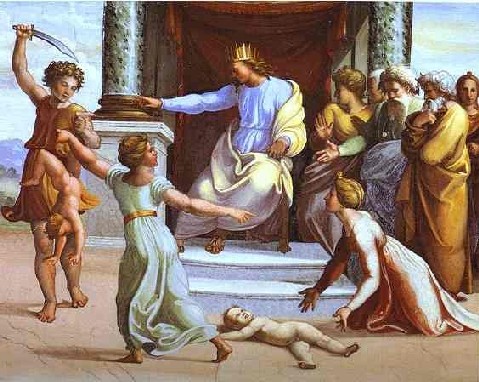
Didnt King Solomon have a case like this once?

When the mother of the child an unmarried father co-created with her decides that she doesn’t want to/ can’t raise the child and doesn’t trust the father to raise her, is it ethical to put said child up for adoption without notifying or consulting the father?

That is the ethical issue the “Baby Emma” incident, first discussed here in an earlier post, ultimately raises. It is a question that I did not discuss in that post, focusing instead on the father’s conduct and his current plight, as self-described on his “Baby Emma” website. I made three ethical assessments, each of which are self-evident:

1. The whole situation would have probably not occurred if John Wyatt and Baby Emma’s mother had been married before conceiving a child.

2. Both of them were irresponsible to plan on having a child together without formalizing a mutual commitment to form a family and raise the child together…that apparently archaic institution known as “marriage.”

3. The mother betrayed John’s trust, deceived him, and treated him unfairly.

I also suggested that, absent a marriage, it is fair and reasonable that the mother of a newborn be able to put the child up for adoption if she deems that course better for the child than being raised by the child’s father. I did not say that was the law, or even that I would vigorously oppose a law that directed otherwise, as Virginia’s law does. I only stated that my own belief is that incentives for irresponsible parenthood are unwise. I have been asked why I focused on the issue I did, rather than the other ethical issues raised by the controversy. It was because the issue was brought to me with the presumption that John Wyatt, the father, was a blameless and unequivocal victim in the matter. My ethics alarms sounded: he has significant ethical accountability for the mess, and I explained why.

As to the answer to question above, I can only say this: it depends. The conduct of Baby Emma’s mother is mysterious and extreme. Did she panic? Did she have a mental break? Why would a lifetime friend and partner of a man conceive a child, pretend to plan to raise her with him, and then secretly negotiate to have the baby adopted and taken out of state?

I see many scenarios that could be behind her decision, which fall into three distinct categories: ethical, unethical, and too close to call: Continue reading

Love Isn’t Enough: the “Baby Emma” Saga

Too bad Baby Emma's father didn't see "Juno" first...

This, from the birth father’s perspective, is the strange story of “Baby Emma,” a newborn whisked out of Virginia by her mother to be adopted by a couple in Utah, which has unusual laws that seem to circumvent fathers’ rights in others states:

“My name is John Wyatt,  the birth father of Baby Emma Wyatt,  born February 10, 2009 in Woodbridge, Virginia.  I have never held my daughter in my arms or even been allowed to see her in person.  My daughter has never had her Daddy hold her and say “I love you” to her, or hug her and kiss her.  Baby Emma and I have been denied those precious moments together.

“Imagine this happening to you: as a 20 year old, you have been friends with the mother since second grade and you have dated since middle school. You anxiously make preparations with the mother of your child, your childhood sweetheart,  for the arrival of your new baby.  You go to the doctor’s appointments, you rub the mother’s belly and feel your baby moving and kicking in the womb.  Both of you pick out the name.  It’s so exciting, you can hardly wait for the arrival of your new baby!! You look forward to what you expect to be the happiest moment of your life, to be with the mother and baby at birth…Both of you make plans on raising the baby together.  Continue reading

Random Encounters with the Human Race: Caring and Helpless

One of the few pleasures left in business travel these days is the chance to meet interesting people who are very different from those I typically encounter at home. One my last trip, waiting for a connection, I was buying a cup of specialty coffee an airport stand from a friendly man with a lovely African accent. “How much?” I asked.

“All of it,” he said, smiling, as he glanced at the travel funds in my wallet.

“Can’t do that, ” I joshed. “It all belongs to my wife.”

And suddenly this stranger who I was never going to see again was pouring out his life story, choking up with emotion in the process. Continue reading