The Case Of The Too Candid Catholic Teacher

"You can unzip it, Patricia, when you work somewhere else...."

“You can unzip it, Patricia, when you work somewhere else….”

Apparently I missed another “media firestorm,” so allow me to catch up, particularly since the analysis of this story has been muddled beyond comprehension.

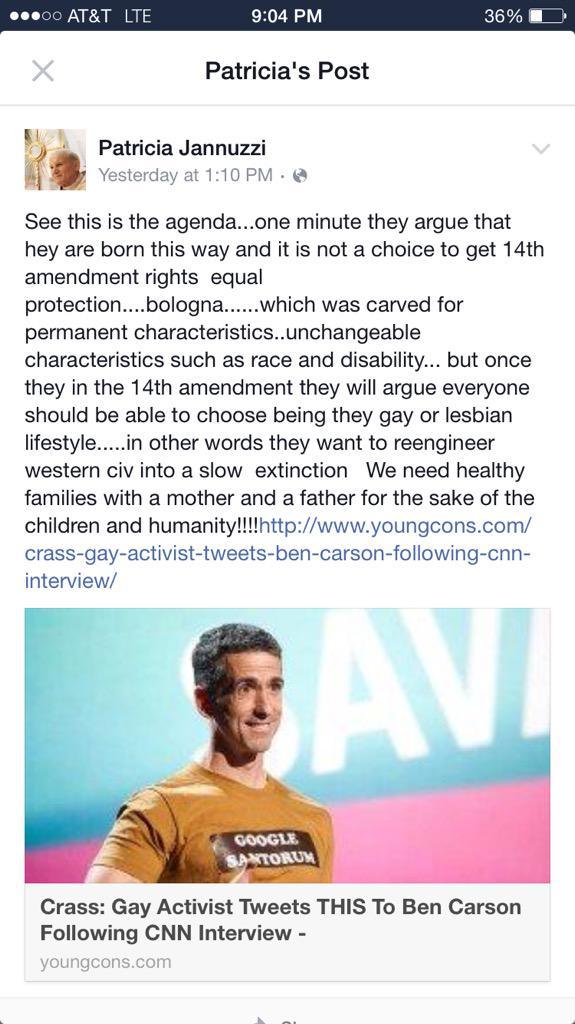
Patricia Jannuzzi, a religion teacher at Somerville’s Immaculata High School, posted this on her personal Facebook page:

jannuzzi-fb-post

This being the internet, after all, someone sent it far and wide, with resulting embarrassment to the school. Jannuzzi, a theology teacher with Immaculata for 33 years, was ordered to de-activate her Facebook page after an online petition   demanded that she be punished. Jannuzzi was placed on administrative leave,  and the school administration notified alumni, parents and students, in a letter that said in part,

“This episode has reflected not only on this teacher but, by extension, on Immaculata High SchoolWe regret deeply any hurt this has caused to any individuals and the negative light in which it has cast our school….Although these were posts to a personal social media page, Immaculata High School recognizes the need to ensure that our faculty, staff and students full understand the behaviors expected of them as members of our community and recognize our intolerance of discriminatory behaviors of any kind.”

Points: Continue reading

Best Ethics Movie Of The Year: “Whiplash”

I doubt that it will win “Best Picture” at the Oscar (though the consensus seems to be that J.K. Simmons, who dominates the film, has “Best Supporting Actor” in the bag), but “Whiplash” is the best film of the year that explores an ethics conundrum of long standing.

Without spoiling the film for those of you—the odds say a majority—who haven’t seen it, let me explain why.

“Whiplash” is ostensibly about a gifted music student’s quest to become not merely a good but a great jazz drummer. On the way, he encounters a fanatic, merciless, manipulative and demanding teacher (Simmons) who sees the young man’s passion and potential and is determined to either make his greatness bloom or break him trying. The movie raises the eternal question of the ethical obligation of the gifted to use their gifts to enrich society, culture and mankind. Arturo Toscanini once berated Bing Crosby for “wasting” his once-in-a-lifetime voice on popular music rather than opera. Is possession of a remarkable ability or talent something that forces the possessor to live an altruistic existence, subordinating his or her own desires to what will most benefit others? Is it unethical to refuse, to choose another path, one that is less daunting, easier, more relaxing, surer, without the stress, without the burden of chasing perfection and extraordinary success? Continue reading

Case Study In “When Ethics Fail, Law Takes Over”: Harvard’s Prof-Student Romance Ban

Harvard_yard_winter_2009j

Harvard used to just say “it’s wrong,” but left it up to the faculty’s ethics in the school’s infinite faith in its own superior virtue. My Freshman Humanities professor, poet William Alfred, was married to a former student. As is usually the case in this matter, ethics alone often wasn’t enough to restrain the lust of  many aging, prestigious, powerful professors facing a veritable cornucopia of luscious, young, ambitious co-eds they could court using brains, worldly wiles, charm and the promise of good grades. Now the profs have more to bolster their self-control…from the New York Times:

Harvard University has adopted a ban on professors having sexual or romantic relationships with undergraduate students, joining a small but growing number of universities prohibiting such relationships. The move comes as the Obama administration investigates the handling of accusations of sexual assault at dozens of colleges, including Harvard.

The ban clarifies an earlier policy that labeled sexual and romantic relationships between professors and the students they teach as inappropriate, but did not explicitly prohibit professors from having relationships with students they did not teach.

Harvard said in a statement released Thursday that the change was made after a panel reviewing the institution’s policy on Title IX, the federal law prohibiting sex discrimination in education, determined that the university’s existing policy language on “relationships of unequal status did not explicitly reflect the faculty’s expectations of what constituted an appropriate relationship between undergraduate students and faculty members.” It said the committee revised the policy “to include a clear prohibition to better accord with these expectations…Besides banning sexual and romantic relationships between professors and all undergraduates, the policy also bans such relationships between teaching staff, such as graduate students, and the students who fall under their supervision or evaluation.

Good. Long overdue.

This is also an excellent use of Harvard’s status and leadership, as the oldest and most famous institution of higher learning. Other universities will now suddenly be responsible as well.

Gee, do you think Harvard took my advice?

Nahhh.

And Now A Brief Public School KABOOM! From Your Sponsor…

exploding-head

There were fewer Ethics Alarms posts last year about outrageous conduct by public school teachers and administrators. I think this was because my brain was trying to save itself from ending up on the ceiling, as it so frequently does in these KABOOM! inducing stories.

And here is the first one of 2015…

In Gustine, Texas, population 457, there is just one schoolhouse for the elementary school kids. Apparently some incontinent young prankster has repeatedly deposited #2 on the gym floor, and since they had no clues, teachers rounded up two dozen student suspects—some as old as 12–and ordered them  “to pull down their pants” so the teachers could “check them to see if they could find anything.”

I’ll tell you what teachers would find if they tried that on my kid: a criminal complaint and an arrest warrant. Continue reading

Jumbo! The Substitute Teacher’s Defense

girl-elephant-clip-art

Presenting the first Jumbo* of 2015, and it’s a lulu.

A jury convicted Sheila Kearns, a former substitute teacher in Columbus, Ohio, of four felony counts of disseminating matter harmful to juveniles. For some inexplicable reason—she reportedly told a colleague that “those kids see worse” at home— had shown the film “The ABCs of Death” during five periods of a Spanish class at East High School  in April 2013.The movie consists of 26 chapters, each representing a graphic death and representing a letter of the alphabet:  “E is for Exterminate,” “L is for Libido,” ”O is for Orgasm,” “T is for Toilet,” and so on. You know, perfect classroom fare.

Kearns earned her Jumbo for swearing in court that she had no idea what the movie—titled “The ABCs of Death,” remember—was about.  Her attorney said she never would have knowingly showed it. One of her students. however, testified that Kearns watched the 129-minute movie, which presumably would have given her a pretty good idea that it was about, uh, death. And ABC’s….

After watching the movie the jury became convinced, its foreman told reporters, that Kearns might not have been aware of the movie’s content the first time she showed it, but she would have figured it out by by the second, third, fourth and fifth showings.

Can’t slip anything by these twelve!

*Jumbo: a Jumbo is a special Ethics Alarms award for conduct that emulates the gag from the Broadway musical and film “Jumbo,” in which Jimmy Durante, as a circus clown trying to steal an elephant, is caught red-handed by a sheriff, and asked, “Where are you going with that elephant?” “Elephant? What elephant?,” Jimmy replied.

_______________________

Facts: Seattle PI

The Special Needs Student, the Compassionate Teacher and the “Awww!” Factor (UPDATED)

Debra Fisher

Regular readers here are familiar with the “Ick Factor,” the common phenomenon where a situation that causes an emotional response of revulsion, disgust or fear is labelled unethical when there is nothing unethical about it. Many kinds of conduct are icky, but still on the right side of ethics, if only one can put aside the gag reflex. The reverse of the Ick Factor is the less common “Awww!” Factor, where particular conduct seems loving, caring and nice, but is in fact unethical in one or more respects. Such is the case of New York City special needs teacher Debra Fisher.

In October, Fisher was suspended when e-mails were discovered on the school computer system showing that she had been spending school time raising funds for a special project on behalf of Aaron Phillip, a thirteen year old special needs student who is an aspiring animator with his own blog. The project’s goal was to raise $15,000 for a nonprofit devoted to developing Aaron’s talent, an organization called “This Ability Not Disability” founded and administered by Fisher.

Awww!

The problem was that while her efforts on behalf of the student were supported by the school, Fisher, an occupational therapist at Public School 333 with nine years of service, did not have permission to perform them during school hours. Thus she was suspended for six weeks. Now she is suing the school system for back pay, telling reporters, “I’m just trying to fight for what I believe is right.”

If she believes she is right, then she shouldn’t be working at the school at all, because she is in fact dead wrong.

But awfully nice. Continue reading

Vote For The Curmies: The Worst In Unethical Education, 2014

Rick Jones2

Every year, blogger Rick Jones (above) announces his “Curmies” (he is the Curmudeon, after all) nominations for “the person or persons who most embarrass the profession of educator.”

I encourage Ethics Alarms readers to vote over at Rick’s blog. Here are his worthy nominees, with Rick’s commentary:

1. James Miller, President B. Kaye Miller, and their co-conspirators at Bergen Community College, who suspended and demanded a psychiatric evaluation of art professor Francis Schmidt for tweeting a photo of his seven-year-old daughter wearing a t-short reading “I will take what is mine with fire and blood” even after it was proven that the line is a well-known pop culture reference to the Game of Thrones. They did finally back off several months later, but it was too little, too late. In mitigation: if you’re both an idiot and completely unengaged in popular culture, that line might actually make you think about recent school shootings. In aggravation: the shirt is obviously inoffensive, the process was obviously flawed, and the school’s defense of their actions is the perfect balance of irrationality and pomposity.

2. A cadre of incompetents at Harley Avenue Primary School in Elwood, NY, who cancelled the school’s traditional kindergarten show because of concern with making their charges college-ready. In mitigation: I can think of none. In aggravation: these people have no comprehension of child development, of what goes into making a show, of real college-readiness, or indeed of anything other than their own hubris, from what I can tell.

3. Secretary of Education Arne Duncan is likely the worst cabinet member of the 21st century, but he outdid even his own high standards of incompetence and arrogance with the proclamation that even students with disabilities will be expected to attain basic standards of reading and math: “We know that when students with disabilities are held to high expectations and have access to a robust curriculum, they excel.” Actually, no, Arne, we know no such thing, and if you think we do, maybe you should get off the hard stuff. In mitigation: I got nothing. In aggravation: Duncan’s plan has no upside, will cost pots of money, and ignores differences between students’ innate ability and preparation while pretending to privilege individuality.

4. Wasatch (UT) High School officials, for puritanically altering female students’ yearbook photos without as much as giving the girls the opportunity to fix their alleged transgressions. In mitigation: there was indeed a sign warning students of the need to obey the school’s dress code. In aggravation: the policy was enforced inconsistently and apparently whimsically. More significantly, the level of sexism involved is positively stunning: boys had their pictures taken with shirts gaping open, tattoos, copious amounts of visible boxer shorts… and a cutline “Studs doin’ what studs do best.” I couldn’t make this up.

5. There were plenty of cases of schools’ and universities’ over-reacting to the Ebola pseudo-crisis. We’re going to give the specific nomination to Cline Elementary in Friendswood, TX, not because their craven stupidity was any worse than that exhibited by several other schools, but because of the distance the teacher in question was from an actual outbreak while traveling in Africa relative to the distance to the nearest confirmed case to the district itself: roughly 11 to 1. In mitigation: there was lots of false information circulating, and parents (especially) were nervous. In aggravation: you’re supposed to be a school. Educate. When people are being paranoid idiots, it is your responsibility to keep your collective heads and do the right thing.

6. The administration of Rhame Avenue School in East Rockaway, NY, for taking teacher Vuola Coyle out of her classroom because her students’ test scores were too good. Yes, too good. It costs the school because students supposedly learn too much in 4th grade and therefore don’t show enough improvement as 5th graders. In mitigation: we haven’t really heard the school’s side of this story. In aggravation: even if everything else is false, the school’s addiction to testing, and to practice testing, is demonstrable.

7.The University of North Carolina for allowing a corrupt system of allowing athletes (especially) to enroll in “paper courses” for the sole purpose of keeping them eligible or off suspension to continue for nearly two decades. In mitigation: the real offenses are in the past, as are the worst of the offenders. But if the release of an investigator’s report marks a new event in the minds of SACS accreditors, it can for Curmie, too. In aggravation: it is impossible to believe that a lot of people currently in powerful positions at UNC didn’t know exactly what was going on and did nothing. And if “everyone does it,” it is the portent of very bad things to come, indeed.

8.Assistant Principal Paula Johnson and the rest of the administration of Bayside Middle School in Virginia for suspending 6th grader Adrionna Harris, who took a razor away from a classmate who was cutting himself, immediately throwing it away. But she dealt with the problem instead of calling a teacher. In mitigation: Adrionna was technically in violation of a rule that actually makes sense if not applied irrationally. In aggravation: the administrators wouldn’t have known about the incident if Adrionna hadn’t told them, so she was punished for being honest as well as being heroic.

In part because Rick was very busy this year, his nominations do not include as many subjects of Ethics Alarms posts as usual: only #2, #7 and #8 of Rick’s nominees were discussed here. On the other hand, Rick left un-nominated some truly awful examples of unethical teachers, administrators and institutions that flipped my bippy, such as, these, currently being assessed as I prepare my Best and Worst of Ethics 2014 list. They are a miserable list too, and include… Continue reading

Is It Ethical For Professors To Date Students?

teacher-student datingProfsBlog asks the question regarding law professors and law students, but the question doesn’t change by narrowing the definition. The question is really, and only, “Is it ethical for teachers to have romantic relationships with students?” The answer is, has been, and forever shall be, “No.”

The answer to an ethics question sometimes becomes obvious when it is apparent that every argument on one side is either a logical fallacy, an unethical rationalization, or the application of an invalid ethics principle. Such is the case here, and thus I somewhat question the motives of the author of the post, Kelly Anders. Wishful thinking, perhaps? Asking the question creates the illusion that there is a real controversy. In this case, there isn’t.

I addressed this question a long time ago, in an early post here barely seen at the time but among the most frequently visited since. I wrote:

[P]rofessors [are] obligated to maintain a position of authority, objectivity and judgment as mentors and teachers of the whole student body, and [have] a duty to their schools not to allow their trustworthiness to be undermined by having intimate relationships among the same group that they [are] supposed to be supervising and advising. Dating a student is a professional breach of trust, and one that adversely effects the integrity of the entire educational institution…. The appearance created when a supervisor/manager/leader indulges in intimate relations with someone over whom they have authority, status and power—and every professor has authority over every student, in class or out— undermines the institution and the profession, by sending the false message that such relationships are standard, approved, and implicitly desirable in the culture where they occur…A professor has a potential teacher-student relationship with all students at a university, not just those in his or her classes.

Dating a student who happens not to be in one of those classes is what lawyers call “a distinction without a difference.” Many students and professors will reasonably assume that the pairing arose out of the student-teacher relationship, and in some ways it almost certainly did. A teacher always has superior power over any student by virtue of his or her position of authority, and it is an abuse of that power to use it to entice students into dates or bed…

[It] is naive to ignore the extended conflicts such relationships create. Might the professor’s best friends on the faculty be more generous when grading their friend’s significant other if he or she is one of their students? Will the professor consciously or subconsciously be easier on the friends of his student lover if they are in his class? The fact that the question can be asked shows that the situation should not occur where it can be asked.

Students, all students, must be off-limits as romantic partners for professors and administrators in universities, regardless of what rules are in place.Professors who date students risk their jobs because a student body is not their sexual smorgasbord, and it is a breach of trust and duty to treat it like one.

I wouldn’t change a word, except that typo I just noticed, and just fixed in the original. Nor is anything I wrote then revolutionary or new. These are the realities of authority, professionalism, leadership and power. It’s just that sometimes people really, really wish they were not. Continue reading

Comment of the Day: “Rationalization List Update: 29 (a). The Gruber Variation and 47. Contrived Consent, or ‘The Rapist’s Defense'”

Magician, hoax-exposer, historian, truth-seeker James Randi

Magician, hoax-exposer, historian, truth-seeker James Randi

Alexander Cheezem weighed in with a wonderful expansion on The Gruber Variation (and its parent, Rationalization #29,  The Altruistic Switcheroo). It speaks for itself: the gist involves the situations when deception really does have  beneficial results for the deceived,  intended by the deceiver—in which case, the claim that an otherwise unethical act was “for his own good” mean that the act not have been unethical, and thus the claim is not rationalization, but truth.

One immediate result of Alexander’s comment is that I’m editing the text in #29. I wrote:

It is true that misfortune carries many life lessons, that what doesn’t kill us often makes us stronger, and that what hurts today may be the source of valuable wisdom and perspective later, but it really takes a lot of gall to cheat, lie to, steal from or otherwise harm someone and claim it will be a good thing in the long term. Yet an amazingly large number of people possess this much gall, because the Altruistic Switcheroo is very common, especially among parents who want to convince themselves that bad parenting is really the opposite. A marker for this rationalization is the statement, “You’ll thank me some day”—the specious theory of the sadistic parent who named his son “Sue” in the famous Shel Silverstein song made famous by Johnny Cash. No, he won’t.

“A Boy Named Sue” is a lousy example. It is true that the singer ends the song by saying he isn’t thankful, and I don’t blame him, but the father’s theory was borne out: the name did make his son tougher. There’s nothing in the lyrics to suggest that he name choice was sadistic, and if the only rationale for the song was what the father claimed it was, it’s no rationalization. Oh, it was cruel, irresponsible and unfair—and stupid— but the father did name the boy “Sue” for his own good. (The fact that his cruel tactic worked still doesn’t make it right: that would be 3. Consequentialism, or  “It Worked Out for the Best.”

I’ll end the passage before the dash.

Here is Alexander’s Comment of the Day on the post, “Rationalization List Update: 29 (a). The Gruber Variation and 47. Contrived Consent, or ‘The Rapist’s Defense'”:

Interesting additions, but I think that the Gruber Variation needs a bit of a caveat in nuance regarding its description: it needs to be distinguished from both legitimate teaching techniques which involve parallels and certain grey areas.

To handle the last first, I’ll just give a few examples, starting with Project Alpha ( http://en.wikipedia.org/wiki/Project_Alpha ) and the Sokal Hoax (http://en.wikipedia.org/wiki/Sokal_affair ). Both involved presenting people who were supposed to safeguard against deception with a hoax in order to expose the holes in said safeguards. Both involved rationales which closely paralleled the Gruber Variation in several respects, and were criticized for actually following that sort of logic (I disagree, although I do think that both were ethically “grey”). Continue reading

Unethical Quote Of The Month (Lawyer Representing A Hypocritical And Unethical Client Division): Keith Wyatt

“She lied to her mother so she could have sex with her teacher. She went to a motel in which she engaged in voluntary consensual sex with her teacher. Why shouldn’t she be responsible for that?”

—-Lawyer Keith Wyatt, L.A. Unified School District’s trial attorney who successfully defended it in a law suit by the family of a middle school girl who had been engaged in a six month sexual relationship with her math teacher. The girl’s family claimed the district negligently permitted the teacher’s criminal conduct to occur and that the teacher’s exploitation of the girl had caused emotional damage to their daughter. Wyatt also told a radio interviewer that it was a more dangerous for a 14-year-old to cross a street in traffic than to have sex with her middle-school teacher.

Yes, he’s an idiot.

Yeah, those middle school tarts all want it, right, Keith?

Yeah, those middle school tarts all want it, right, Keith?

The school district fired him, disavowing and apologizing for his comments. Yet they were willing to let Wyatt argue in court—on the school’s behalf, remember— that a 14-year-old middle school student was mature enough to consent to having sex with her 28-year-old teacher, and that she shared responsibility for what happened. Wyatt introduced the girl’s sexual history into evidence as proof of his client’s lack of culpability.

There is nothing wrong or unethical about Wyatt’s tactics in the trial itself. State law is weird in this area—this is California, after all, home of Hollywood, Roman Polanski fans, Woody Allen enablers, Miley Cyrus and the Kardashians—for while the age of consent is 18 in criminal cases, two appellate court rulings have held that the argument that a minor can consent to sex with an adult is permissible in civil law suits. He did what the law permitted him to do in defense of his client. That’s not just ethical lawyering, it is at the core of legal ethics. The argument won. Wyatt did what he was trained to do, paid to do, and obligated to do if he agreed to take the case

However, it is a revolting and irresponsible argument for any school or school district to make. Wyatt should have made this clear, and maybe he did (though that quote doesn’t support such a supposition.) Who in their right mind–well, OK, this is L.A.–would send their child to a school system that takes the position that a 14-year-old student is responsible when she is raped by her 28-year-old teacher, and that she’s really not being harmed if he does? The teacher, Elkis Hermida, was convicted of lewd acts against a child and sentenced in July 2011 to three years in state prison.  Continue reading