From “The Ethics Incompleteness Principle” Files: Memphis, Tennessee’s Confederate Statues

A better application of the Ethics Incompleteness Principle would be difficult to find than the decision by Memphis, Tennessee to remove a huge monument to Jefferson Davis, the president of the Confederacy, and an even larger heroic equestrian statue (above) of Nathan Bedford Forrest, swashbuckling Confederate general and (allegedly) the first Grand Wizard of the Ku Klux Klan,  from two public parks.

As we have discussed here in great detail, I am unalterably opposed to the current mania among our Left-leaning friends and neighbors  of tearing down statues, monuments and memorials honoring  past historical figures because their lives, beliefs and character do not comport with current day standards or political norms.  This primitive exercise in historical censorship has been especially focused on famous and notable figures from the Confederacy, although recent efforts have targeted George Washington, Thomas Jefferson, Andrew Jackson and even Theodore Roosevelt. Of the attacks on memorials to Confederate figures, I wrote,

[ Union veterans]  didn’t think of the former Confederates as traitors, or racists, or slavery advocates. They, like the Union veterans, were just men of their times, caught up in a great political and human rights conflict that came too fast and too furiously for any of them to manage. They were caught in the same, violent maelstrom, and knew it even 50 years earlier. Soldiers on both side wrote how they admired the courage of the enemy combatants they were killing, because they knew they were, in all the ways that mattered, just like them. It was the Golden Rule.  After the war, these soldiers who had faced death at the hands of these same generals, officers and troops, did not begrudge them the honor of their statues and memorials, nor their families pride in the bravery of their loved ones.

Yet now,  self-righteous social justice censors who never took up arms for any cause and in many cases never would, employ their pitifully inadequate knowledge of history to proclaim all the Civil War’s combatants on the losing side as racists and traitors, and decree that they should be hidden from future generations in shame. We have honored men and women for the good that they represent, not the mistakes, sins and misconduct that are usually the product of the times and values in which they lived. In doing so, we leave clues, memories, controversies, differing views, and stories for new generations to consider and better understand their own culture and society, and how it came to be what it is.

Those who want to tear down monuments to the imperfect, whether they know it or not, are impeding knowledge, perspective, wisdom, and understanding. They want only one view of history, because they will only tolerate one that advances their ideology and values—just as the Americans of the past believed in their values. Foolishly, I suppose, they trusted future generations to act on their own ethical enlightenment without corrupting the historical record.

I feel strongly about this, as the tone of that post, far from my first on the subject, shows.

But… Continue reading
The Unethical, Un-American, State Travel Bans

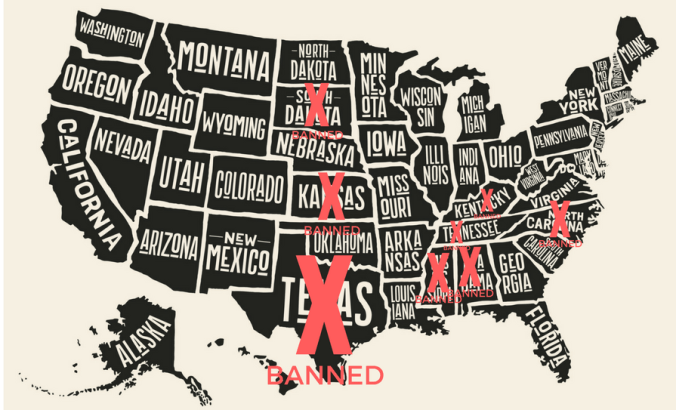
Recently various states have decided to punish their fellow members of the United States of America for daring to adopt laws of which they do not approve. The method: bans on government employees traveling to those states on business and the state dime, with the hope that the state’s lead will discourage private travel as well. Why are they doing this? Oh, many reasons, I suppose, all of them insufficient to justify the conduct, which is unethical.

Some of the state legislators who pass these bans, and the governors who sign them, want to place economic sanctions on the other states, even if the effects are limited. After all, they can’t stop the citizens of the states from traveling, only government employees. But pressure is pressure, and the limited measures are an attempt to meddle in the democracy of those other bad states. Another reason is virtue-signalling, as a state seeks to show that it supports a group that is politically strong in that region against another state’s policies that displease it. A third reason is the related motive of grandstanding. Finally, a state might use a travel ban to strike back at another state that is banning state travel there. An eye for an eye, a voucher for a voucher.

Yes, this will end well.

I wish I didn’t have to say this, because I know everyone thinks I pick on liberals, progressives and Democrats, but it’s the Democratic majority states that are using this weapon, especially…well, can you guess? Oh, come on, guess. Yes, the major offender is California. Others are New York, Minnesota, and Washington state.

“Our country has made great strides in dismantling prejudicial laws that have deprived too many of our fellow Americans of their precious rights,” says the public statement of California’s Attorney General Xavier Becerra of California, who has been instrumental in getting the Golden State to limit trips to Alabama, Kansas, Kentucky, Mississippi, North Carolina, South Dakota, Tennessee and Texas. You know, those conservative bad places, where people with sub-normal IQ’s cling to their guns and Bibles. His quote is a classic of arrogant, doctrinaire, narrow-minded, elitist self-righteousness. Continue reading

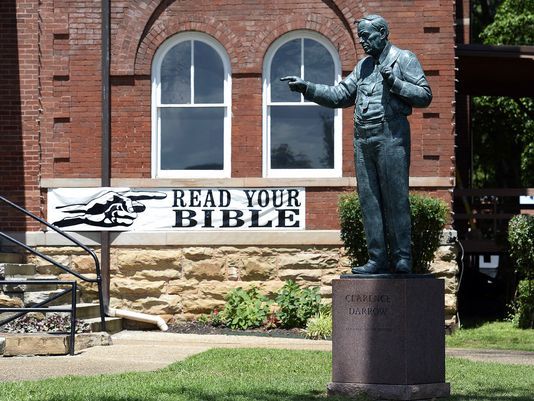
What Clarence Darrow’s Dayton Statue Stands For

Apparently about a third of the population of Tennessee still doesn’t buy Darwin’s Theory of Evolution (according to a 2015 Pew Research Center study) so it should not be too much of a surprise that in Dayton, Tennessee,  site of the famous 1925 Scopes Trial, a newly erected statue of Clarence Darrow in front of the historic red brick courthouse where the trial took place was met with some protests. At a County Commission meeting in the town,  resident Ruth Ann Wilson suggested that bronze Darrow might unleash a plague or a curse. “I rise in opposition to this atheist statue, all right?” she said. “This is very serious, folks.”

No, that isn’t serious, but the persistence of ignorance both generally and about the issues battled over in 1925 are.  Another resident, Brad Putt, is quoted by the New York Times as saying,  “People around here know that if you have a court case, you have to have two sides,” referring to the fact that there has been a Williams Jennings Bryan statue standing in front of the courthouse  since 2005. “You can’t have Optimus Prime unless you have Megatron. You’ve got to have a yin to the yang.” Well, that’s not quite right either, depending on what Bryan and Darrow symbolize. If the idea is to have the most famous opposing counsel in U.S. legal history facing off, okay, that’s fair. If he is saying, as I think he is, that science and religion must counter and balance each other, that’s nonsense. Continue reading

Calling This Lawyer Unethical And Incompetent Doesn’t Quite Capture His Basic Problem: He’s An Idiot

http://www.youtube.com/watch?v=xGDbtT7D3hE

Defending his client of rape charges, Tennessee criminal defense lawyer Steve Farese told the jury during his closing argument,

“People can be very good at lying. Women can be especially good at it because they’re the weaker sex and we … and we want to protect them and not have anybody take advantage of them at least I do.”

Head-exploding  fact #1: The jury Ferese was appealing to by emphasizing the inherent dishonest nature of  “the weaker sex”  was made up of eleven  women and three men.

Head-exploding  fact #2: The jury still acquitted Ferese’s client.

That doesn’t make his argument ethical. The statement appealing to anti-women bias was a direct ethics violation, a breach of  Tennessee Rule of Professional 8.4 (d) forbidding lawyers from engaging in conduct that is prejudicial to the administration of justice, which deliberately appealing to anti-woman bias clearly is. For the future, the episode also raises questions about whether such a closing would breach the new ABA rule 8.4 g,  yet to be adopted in Tennessee or any state, which states that it is unethical for a lawyer to

“engage in conduct that the lawyer knows or reasonably should know is harassment or discrimination on the basis of race, sex, religion, national origin, ethnicity, disability, age, sexual orientation, gender identity, marital status or socioeconomic status in conduct related to the practice of law.”

The ABA notes specify that “This paragraph  does not preclude legitimate advice or advocacy consistent with these Rules.”

I am certain Ferese’s statement would breach 8.4 (g), not that it isn’t unethical anyway.

Continue reading

Dead President Ethics: The Post Mortem Odyssey Of James K. Polk

James K. Polk is one of my favorite Presidents, in part because he has never received his due for being spectacularly effective, if unwavering ruthless in achieving his goals. By the standards of fulfilling his own stated objectives, a President can’t be more successful than Polk. He pledged to expand U.S. territory to the West, Southwest and North, and did so, then served only one term, as he had promised. Polk also wrote a fascinating diary, essentially an autobiography.

His relative obscurity arises in part because he was a one term President, but primarily because he existed in the shadow of his fellow Tennessean, Andrew Jackson, who was more flamboyant, more influential on more political fronts, and had far more than four years in the spotlight. He was also much taller. Poor Polk lived just three months after leaving office, dying of cholera in 1849, in Nashville. Tennessee. The laws of the time held that those who died of that dread disease be buried within 24 hours to prevent epidemics, so the former President of the United States was  laid to rest in a mass grave less than a year after leaving the White House.

A year later, Polk was removed from the mass grave and buried on the grounds of his Nashville home, Polk Place, in accordance with the will he drew up five months before his death. Polk, a lawyer, stipulated that his body and that of his wife be buried there, and that after his death and his wife’s, the property should be held in trust by the state, which would be bound allow a blood relative to live there. Unfortunately for the dead Polks, the ex-President made a tyro’s drafting gaffe. After Polk’s widow Sarah died in 1891, a court voided the terms of the will because it violated the common-law Rule Against Perpetuities: a property owner can’t bequeath property to unborn future generations. So Polk Place was sold to private interests, eventually razed, and today there is a boutique hotel on the property. On Sept. 19, 1893, Polk’s body and Sarah’s were moved again, to the Nashville grounds of the Capitol.

On a small patch of grass within a stone’s thrwo of the Capitol, the Polks’ grave is lies in a modest but attractive classical monument framed by Greek columns, with an inscription declaring  that Polk “planted the laws of the American union on the shores of the Pacific.” It was designed by William Strickland, the architect who also designed the Capitol itself and George Washington’s sarcophagus at Mount Vernon in Virginia. But Polk’s Jackson problem continues: his gravesite is dwarfed by a nearby equestrian statue of Old Hickory, and tourists virtually ignore it. And while Jackson’s grave at the Hermitage, his family plantation, is a major tourist draw in Nashville, Polk remains—that is Polk’s remains remain—an afterthought. When President Trump visited Nashville last month, he laid a wreath on Jackson’s tomb, and saluted him in a speech. As for the perpetually dissed 11th President, the campaign jeer of the Whig Party running against the first Dark Horse candidate in 1844 apparently remains appropriate: “Who is Polk?”
Continue reading

Unethical Protest, Unethical Protesters, Just Desserts

protest-immigrant

Last week’s “A Day Without Immigrants” protest could be the example in the dictionary to illustrate “unethical protest,” or perhaps “stupid protest.”  The stunt of immigrants not coming to work to protest policies aimed at illegal immigrants and terrorists was a non sequitur, proving nothing, saying nothing. Nobody wants to stop immigration, nobody has an objection to legal immigrants, and the danger of the U.S. not having sufficient legal immigrants is precisely none. According to the Ethics Alarms Protest Check List, “A Day Without Immigrants”  was an epic, embarrassing, dud. If my immigrant employees used this jaw-droppingly dumb protest  to justify not coming to work, I would do exactly what Bradley Coatings, Incorporated  in Nolensville, Tennessee did.

I’d fire them all. Continue reading

Ethics Dunce: The Joy of Knitting Proprietor Elizabeth Poe

poe

Once more, we see the disturbing trend of hyper-partisan business owners attempting to divide the nation into politically exclusive camps, with progressive and conservative bars, restaurants, supermarkets, hardwear stores, pet shops and, in this case, yarn shops. This is madness, and indefensible ethically, especially in a pluralistic democracy. It is also pure bigotry, attributing negative character traits to individuals based on one characteristic alone. Banning customers because they have a political view is no less hateful, and no less offensive to the nation’s ideals, than banning them because they are black.

Elizabeth Poe, owner of a small yarn store, The Joy of Knitting, in Franklin, Tennessee, doesn’t comprehend that, so she proudly posted this  unethical announcement  on Facebook, telling potential customers who participated in the Women’s March last week,

“…if you want yarn for any project for the women’s movement that you please shop for yarn elsewhere…The vulgarity, vile and evilness of this movement is absolutely despicable. That kind of behavior is unacceptable and is not welcomed at The Joy of Knitting. I will never need that kind of business to remain open. Two wrongs will never ever make it right. As the owner of this business and a Christian, I have a duty to my customers and my community to promote values of mutual respect, love, compassion, understanding, and integrity. The women’s movement is counterproductive to unity of family, friends, community, and nation.”

Whereas shunning fellow citizens because they advocate different policies and positions than you do is a wonderful way to “promote values of mutual respect, love, compassion, understanding, and integrity, unity of family, friends, community, and nation.” Continue reading

Behold..THE DUMBEST ETHICS STORY EVER TOLD!!!

peetoy

Are you ready?

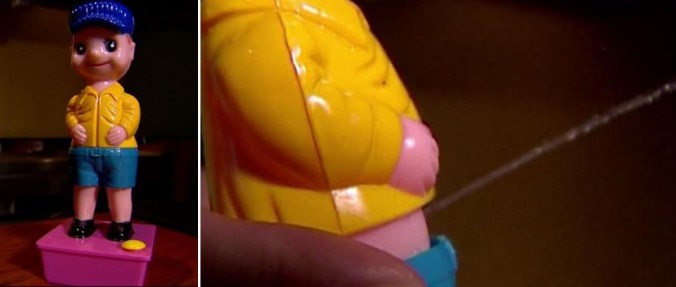
James and Isabelle Lassiter, who hail from Texas, were visiting Murfressboro, Tennessee and stopped into a Wasabi Japanese Steakhouse recently with their children. Apparently the sense of humor at hibachi restaurants has declined precipitously since the last time I ate at one, for I am told that the gag the Lassiters endured is now common fare. One of the Wasabi chefs held up a plastic toy depicting a little boy, and when the boy-toy dropped his shorts, he squirted water in a long, thin stream, as if urinating. The children were delighted! They were especially delighted when the stream hit their mom in the face.

Isabelle Lassiter was not delighted. In fact, she and her husband called the police, and accused the chef of sexual assault. “It peed on me…basically, out of his… wee wee area,” Isabelle explained, delicately.”It really didn’t have a wiener, but you got the point.” Investigators, who briefly took the toy into custody, indeed noted that the toy wasn’t anatomically correct. An officer wrote, “I observed the toy to have no penis and just a hole for the water to shoot out.”

PLEASE don’t tell me that if the toy did have a plastic penis, the claim of “sexual assault” would have been taken more seriously.

The Lassiters agree that this detail should not matter. “Just because somebody cut off a piece of plastic…doesn’t change the fact that you’re getting peed on,” said James Lassiter. “It was a sexual style assault on my wife.”

This is not a hoax. I wish it was a hoax. Reading about it has temporarily disrupted my capability to organize my thoughts, so I’ll just note the following in no particular order:

1. It was not sexual assault, by any stretch of the imagination. Nobody “peed on” Mrs. Lassiter. The cook squirted water on her, using a juvenile, risqué version of a squirt gun.

2. If Isabelle thought even  for a second that the stream of liquid was urine, she has a cognitive problem. Isabelle, pay attention: plastic figures do not urinate. They are toys. They have no bladder or kidneys. Even if the liquid comes from the toy’s “wee wee area,” it can’t possibly be urine.

3. Calling the police was beyond an over-reaction; it was truly idiotic, and it should be punishable. I’m trying to think of any reason not to have an ordinance that declares a spurious and wasteful call for police a misdemeanor carrying a hundred-dollar fine. Of course, such an offense should only be declared in extreme circumstances…like this, for example.

4. The manager of Wasabi did issue an apology to the couple, but claims he has never had any complaints about the toy in the past. “The kids like it, they think it’s a water gun, kind of like a water gun you know,” said Mr. Huang. Ah! The old “if kids think it’s funny, it’s ethical” standard. This standard is not reliable. The Lassiter kids might well have also found it hilarious if the chef hit their surprised mother with a cream pie, a pillow, or a dead cat. Continue reading

Ethics Alarm: In Memphis, Facts Are Now Racist

Infamy. I hope.

Infamy. I hope.

This truly upsetting story is in part about headlines, and I had a hard time deciding on one for the post. It makes my head explode—I am trying out a new Swiffer now—but it really shouldn’t have exploded, considering recent developments. I could name Commercial Appeal’s editor Louis Graham (left) an Ethics Dunce, which he certainly is (in addition to being a fool, a coward, and a disgrace to journalism), but that doesn’t do him justice. I thought about making his editorial apologizing for stating facts in a headline as an Unethical Quote of the Month, but this was worse than a bad quote. This was surrender.

The Memphis, Tennessee newspaper the Commercial Appeal, a Gannett publication, headlined its front page story about the attack on police in Dallas “Gunman targeted whites.” Here it is:

memphiscom headline

Indeed, African-American gunman Micah Xavier Johnson specifically said that his objective was to  kill white police officers. Nonetheless, protestors attacking the paper for publishing a “racist’ headline gathered outside the paper’s office in downtown Memphis last week. Black Lives Matter signs were in evidence.

Commercial Appeal editor Louis Graham met with protesters, and apologized with a front page editorial titled “We got it wrong.” He wrote in part… Continue reading

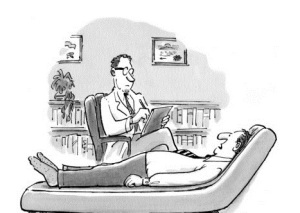
Ethics Quiz: Therapist Biases And Ethics Confusion

(Boy, does this freak disgust me...)

(Boy, does this freak disgust me or what...)

The Tennessee Senate’s Senate Health and Welfare Committee members have overwhelmingly approved a proposed bill that seeks to protect  therapists from 2014 changes in the American Counseling Association’s Code of Ethics. The Code decrees that “counselors refrain from referring prospective and current clients based solely on the counselor’s personally held values, attitudes, beliefs and behaviors.” The bill, however, will allow practitioners to refuse to accept a patient without legal or professional penalties as long as they refer the individual  to another qualified professional.

The Tennessee Association for Marriage and Family Therapists opposes the legislation, saying “This bill is in direct opposition to the ethical code of the American Association of Marriage and Family Therapy and potentially harmful to clients,” the group said in a statement. “Our mandate to do no harm to the consumer, we believe, would be violated.” A therapist who testified before the committee opined that “they can keep their belief system and still offer good counseling but not based on their religious beliefs.” Others have objected to a legislative body dictating professional ethics.

Your Ethics Alarms Ethics Quiz today is…

Is the proposed bill reasonable and ethical, or just a way to allow bigoted counselors to discriminate?

Continue reading