The Garland, Texas Shooting, Free Speech and Ethics

Geller: Like it or not, the First Amendment was designed for her and people like her: infuriating people.

Geller: Like it or not, the First Amendment was designed for her and people like her: infuriating people.

Last Sunday, two men opened fire outside uber-Islam-hater Pamela Geller’s “Muhammad Art Exhibit and Cartoon Contest” in Garland, Texas. Both gunmen were killed by police, a security guard was wounded. Since cartoons of the Prophet have sparked killings around the globe, this was a risk, if not an inevitability, of holding such an event. That was undoubtedly one of the reasons for it, in fact: to show defiance of those that would cow us into self-censorship.

Since the episode, commentators and pundits have engaged in various levels of  confused ethical thought regarding the competition and the shooting, much of the confusion due to cognitive dissonance regarding Geller, who is beyond question an anti-Muslim bigot. So horrible is it to their delicate liberal sensibilities to have the principle of freedom of speech represented by Geller that rather than accept it, many would prefer to jettison freedom of speech itself. In this they seem to have forgotten that the reason for free speech is precisely to protect the most infuriating, inflammatory, controversial speakers, whether they be hateful fanatics like Geller, or Martin Luther King.

It really is remarkable that the First Amendment has survived so long, since those who discuss it in public the most frequently are journalists and politicians, neither of whom are consistently able to interpret it accurately.

Ethically, this isn’t hard, or shouldn’t be. In fact, not a single new issue is raised by the Texas shooting that was not thoroughly covered here five years ago:

1. No group, no matter how offended or righteous and no matter what its holy book says, is ethically entitled to threaten violence against those who say, or draw, things that they find offensive, including the offense of blasphemy.

2. Encouraging such groups to do this by self-censoring is cowardly and a threat to free speech. Thus South Park and Comedy Central breached their duties to the nation, the culture and free speech by censoring a satirical animated series after receiving radical Islamic threats. As I wrote here: Continue reading

Extreme And Deluded Doesn’t Mean “Dangerous”…Or Is The Real Threat Something Else?

Texas-Police

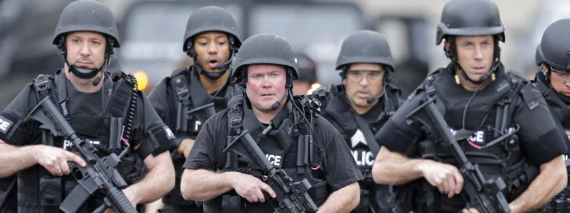
The Republic of Texas, as an intriguing  YouTube documentary explains, is a small separatist group in the Lone Star State that maintains its own quixotic mini-government, including official currency, a president, a legislative body and even “courts.” Its senators and president gathered in the center of a Bryan, Texas, meeting hall, surrounded by curious or sympathetic onlookers, to debate issues of the national currency, develop international relations and celebrate the birthday of one of their oldest members. Suddenly one of the onlookers stood opened the hall door, letting in an armed force including the Bryan Police Department, the Brazos County Sheriff’s Office, the Kerr County Sheriff’s Office, Agents of the Texas District Attorney, the Texas Rangers and the FBI. It was a raid. The twenty  officers rounded up, searched and fingerprinted all 60 meeting attendees, and seized all cellphones and recording equipment.

What triggered such a frightening show of force? It was an elephant gun-flea response to the fact that the Republic of Texas had issued a “summons” to a Kerr County judge and another to a bank employee, ordering them to appear in the Republic’s court at the Veterans and Foreign Wars building in Bryan the day very the officers burst in on the group’s “congress.”

“You can’t just let people go around filing false documents to judges trying to make them appear in front of courts that aren’t even real courts,” Kerr County sheriff Rusty Hierholzer told the media. Ah. Some deluded club members engage in overreach while pretending that they have founded a new government rather than an eccentric social group–sending a bogus but sincere summons is a misdemeanor at worst—and this is seen as just cause for an armed raid? Hierholzer said he needed an army to serve a search warrant for suspicions of a misdemeanor, because there was a 1997 incident where 300 state troopers had an stand-off with well-fortified Republic of Texas leader with mayhem on his mind.

I have no sympathy with secessionists, militias, or other such groups. They are, however, engaged in the grand American tradition of opposing authority, complaining about the state of the nation, and gathering with others of a like mind to see if they can fix what’s wrong. The government putting a police-state scare into such groups, showing contempt for them and treating them like terrorist cells is un-American, in contrast. It’s harassment, and an attempt to discourage lawful dissent and to chill Constitutional rights. Continue reading

No, This Didn’t Quite Make My Head Explode, And That’s The Scary Part

Not quite...

Not quite…

In Kermit, Texas, a nine-year-old boy was suspended for telling a classmate that his replica of the “one ring” from “The Hobbit” could make him disappear. This was taken as a “terroristic threat,” it seems.

There was a time, long ago, when this kind of child abuse, cruelly and stupidity on behalf of school administrators would cause my head to do its Mount Vesuvius impression. That was before I was exposed to so many other similar episodes of educator incompetence, from sea to shining sea. It was before I recognized that the educational profession has become infested with frightened, deluded, power-abusing fools who care less about the children in their charge than avoiding lawsuits and converting the next generation into spineless, fearful, unimaginative, submissive puppets. Continue reading

And Now A Brief Public School KABOOM! From Your Sponsor…

exploding-head

There were fewer Ethics Alarms posts last year about outrageous conduct by public school teachers and administrators. I think this was because my brain was trying to save itself from ending up on the ceiling, as it so frequently does in these KABOOM! inducing stories.

And here is the first one of 2015…

In Gustine, Texas, population 457, there is just one schoolhouse for the elementary school kids. Apparently some incontinent young prankster has repeatedly deposited #2 on the gym floor, and since they had no clues, teachers rounded up two dozen student suspects—some as old as 12–and ordered them  “to pull down their pants” so the teachers could “check them to see if they could find anything.”

I’ll tell you what teachers would find if they tried that on my kid: a criminal complaint and an arrest warrant. Continue reading

Two Embarrassed Legislators, Sex, And The Resignation Line

Question: When does a sexually-charged incident obligate an elected legislator to resign?

Answer: When one or more of the following is true:

  • When the legislator has been found guilty of a sex-related offense in a court of law ( or guilty of any crime, since law-makers must no be law-breakers.)
  • When the incident indicates a bigoted and disrespectful attitude toward women.
  • When the incident makes the legislator’s necessary status as a role model to children and others impossible to sustain,
  • When the incident embarrasses the legislative body and calls its competence, integrity and trustworthiness into disrepute.
  • When the incident calls into question the legislator’s judgment and trustworthiness.

With these standards in mind, let us examine the recent plights of two legislators, one Republican, and one Democrat. First, the Republican:

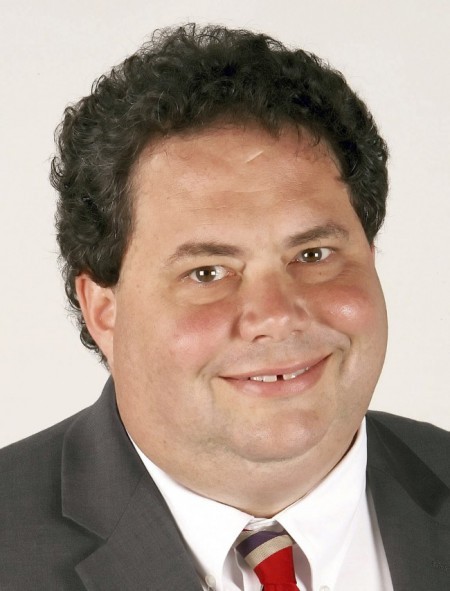
Rep. Blake Farenthold (R-Tex.)

Blake

Continue reading

How Should We Judge Second Apologies?

Sure, who wouldn't think this was funny coming from a member of your school board?

Sure, who wouldn’t think this was funny coming from a member of your school board?

The most important feature of apologies is that they express sincere and honest regret for the real harm done. If the first apology for misconduct fails that test, how much credence should a second attempt have? Does it negate the first apology completely? Ought it to be read and understood in light of the initial, unsatisfactory apology? Or should it be ignored completely as a public relations document crafted to achieve a result, rather than to express genuine contrition?

The case of Chris Harris, a board member for the Hooks Independent School District in the town of Hooks, Texas, provides a fascinating test.

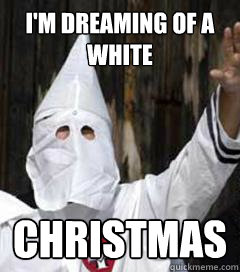
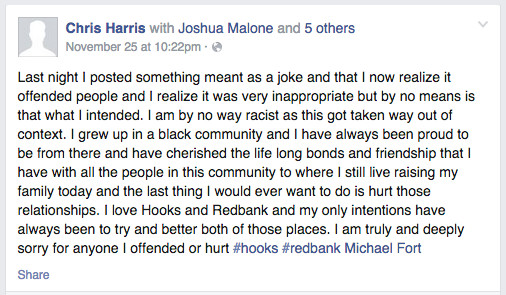
Lat week, Harris posted an image of a Klu Klux Klan member with the caption, “I’m dreaming of a white Christmas”  to his Facebook page. The reaction to this was what almost anyone with a fully functioning cerebrum would expect, a category that Harris does not belong to, or at least did not when he posted it. Perhaps after shouting, “Doh!” or perhaps not, Harris rushed to repair the damage, publishing this apology:

Harris apology 1

Terrible apology! Continue reading

Three Republican Candidates: Gaffes, Disqualifications, Or Something Else?

shooting-yourself-in-the-footI felt badly about piling up three posts recently on unethical female Democrats running for office, and was inspired by the Washington Post’s Greg Sargent to do some analysis of Republican candidates who, at least according to Sargent, deserve equivalent criticism to what has been leveled at Alison Lundergan Grimes for refusing to say whether she voted for President Obama. [She did it again last night in her debate with Sen. McConnell.]

Sometimes finding Republican candidates who deserve an Ethics Alarms slap is hard, unless they say something bat wacky like, say, Richard Mourdock. If a Democrat is flagged by The Daily Beast or the Post, I can be pretty sure there was something said or done that was objectively troubling, because the mainstream media will bury anything from a Democrat that is vaguely defensible. A Republican, however, might be accused of certified insanity for a statement that offends progressive cant. Fox and many of the right wing websites, meanwhile, will ignore any Republican whose pronouncements don’t rise to “I am the Lizard Queen!” level of derangement, and will find fault with Democratic candidates on dubious grounds. Here are the GOP candidates for today’s ethics audit: Joni Ernst (U.S. Senate in Iowa); Tom Cotton (U.S. Senate in Arkansas); and Greg Abbott  (Texas Governor race): Continue reading

Ethics Hero Emeritus: Edna Gladney (1888-1961)

Edna Gladney

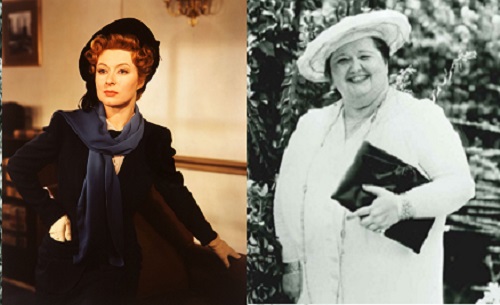
I am ashamed to admit that I never heard of Edna Gladney before I chanced upon a late night Turner Movie Classics showing of the 1941 biopic “Blossoms in the Dust,” which earned the great Greer Garson one of her many Academy Award nominations for her portrayal of Gladney (that’s Greer as Edna on the left). I was unaware of Gladney’s amazing life, legacy and contributions to society because 1) I’m not from Texas; 2) it is hard to learn about great people that society forgets about, and 3) feminists aren’t doing their job, perhaps because a strong and indomitable woman whose life was devoted to saving unwanted children rather than preventing their existence doesn’t interest them as much as it should.

Yet Gladney is exactly the kind of woman whose life should inspire young girls today, and young men too, for that matter. Still,  I recently asked 18 randomly chosen friends and acquaintances who Edna Gladney was, and not one of them knew.

And most of them didn’t know who Greer Garson was, either.

Sigh. Continue reading

Ethics Observations On Wendy Davis’s Controversial “Wheelchair Ad” Attacking Greg Abbott

1. The campaign of Texas Democratic gubernatorial candidate Wendy Davis has issued an attack ad directly referencing gubernatorial rival Greg Abbott’s partial paralysis, and includes the image of an empty wheelchair. Davis could claim—and will, if she hasn’t already–that  the implication that his use of a wheelchair argues against his qualifications to be governor is inadvertent or imagined, except that her supporters were caught in a Project Veritas video mocking Abbott for his disability, and Davis has made gaffes relating to his handicap before, as when she said that he hadn’t “walked a day in her shoes.”

2. She is a member of a party with supporters in the media ready to pounce on any Republican who makes a similarly provocative reference to an opposing candidate’s race, religion, ethnicity, gender or “abled status.” The double standard is certainly a campaign boon to Democrats, but they have to take advantage of it a bit more subtly than this.

3. What is primarily wrong with the ad, however, isn’t the wheelchair, or the use of tactics that would called an appeal to bigotry if they were used by Republicans. It is that the arguments the ad seem to be making are stupid, unfair and wrong, and ones that Davis, who is a lawyer, must know are stupid and wrong, or she is stupid and wrong. Continue reading

Ethics Quote of the Week: Ken White of Popehat

First Amendment“…Our freedoms are recognized or denied based on court rulings. Our understanding of those court rulings often derives from media coverage of them. When we do a lousy job of covering law, or when we put up with journalists doing so, we’re doing a lousy job as citizens.”

—-Attorney-Blogger Ken White, after meticulously exposing how the media, old and new, completely misrepresented a Texas court’s striking down  an overly broad statute as protecting “upskirt” photographs.

Ken White has delivered another masterpiece, expertly debunking the news media’s criminally ignorant analysis of a Texas Court opinion. I must admit, when I saw the headline “Texas Court: Ban on ‘Upskirt’ Photos Violates First Amendment Rights” and its ilk around the web, I just assumed that reporters were being sensational and dumb as usual, and moved on to other things. Thank goodness Ken was on the case, and properly flagged the danger in lawyers reacting this way. We have a tendency as a profession to think, “Well, there they go again, completely misunderstanding the law, poor dears” when we should be working overtime to set the record straight. I admonish my seminar attendees for doing this regarding the public’s distorted view of legal ethics, and fell into the same trap myself.

Ken’s dissection of the flat-out wrong reporting on this case is frightening: it is clear that most reporters are incapable of understanding what court opinions mean, yet there they are, writing nonsense and making the public more ignorant, not to mention making them think taking upskirt photographs is legal and constitutionally protected.

Counselor White has had a busy year that has kept him from providing his usual volume of daily enlightenment. He is back in top form, and we should all be grateful.