A “Curmie” Comment Of The Day Double-Header, #1: “Ethics Verdict: Non-Math Propaganda Does Not Belong In Math Textbooks”

Curmie,” whose lively and erudite blog has been a favorite of mine for many years, weighed in on Ethics Alarms with his usual force on several substantial issues last week. Here is his first of two Comments of the Day (the other will be along shortly), both involving Florida controversies. This one takes off from the post, “Ethics Verdict: Non-Math Propaganda Does Not Belong In Math Textbooks”

***

Meh.

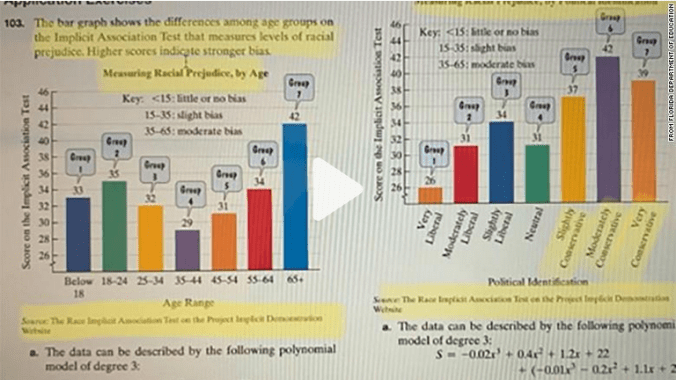
Certainly the injection of any kind of political agenda into elementary school math textbooks is a significant problem. Or at least it would be, if it actually happened on anything like a regular basis. What I find most interesting about this case is the fact that neither Governor DeSantis nor anyone on the Board of Education has (yet, as I write this) shown an example of the offending material from any of the books that have been sanctioned. I presumed that since the list of books has indeed been made public, numerous such examples will soon be forthcoming. Then we can make an informed judgment. Except, of course, now the governor is claiming the specifics are “proprietary information” as publishers weigh possible appeals to the rejections. Were I of a cynical disposition (perish the thought!), I might suggest that that delay ought to get him past the November elections. [JM Note: Subsequent to Curmie’s comment, some examples of varying persuasiveness (see above) were made public.]

What we have by way of example, at least that I can find, is an obviously absurd question that appeared on a homework sheet in a Missouri school. Back when I was blogging more regularly, I’d write about similarly stupid assignments several times a year. I’ve got to yield here to Florida State Representative Carlos Smith’s observation that “The best his [DeSantis’s] propaganda machine could do was deflect to a Missouri district that apologized for a homework assignment they didn’t approve.” Importantly, the worksheet was pulled from a website, not a textbook. So we can’t blame McGraw-Hill or Houghton-Mifflin-Harcourt for that particular outrageousness. Continue reading

Ethics Verdict: Non-Math Propaganda Does Not Belong In Math Textbooks

The New York Times reports that Florida has rejected 42 of 132 math textbooks proposed for use in public school classrooms because they “incorporate prohibited topics or unsolicited strategies” including social-emotional learning and critical race theory, according to the state’s Department of Education.

Good.

The tone of the Times article is framed to advance the “Wow, look at what radical conservative hate-mongering Neanderthals they have running the asylum in Florida, with that racist, transphobic Ron DeSantis as governor!” narrative. But this is only a partisan issue because one party’s core ideology, the Democratic Party, has, in “Happy Days” parlance, “jumped the shark,” or in my parlance, is in the process of sliding toward totalitarianism.

Here’s reporter Dana Goldstein’s second paragraph:

But Florida has a new law, which goes into effect in July, limiting the way that sexual orientation, gender identity and social-emotional skills are taught. Gov. Ron DeSantis is also expected to sign legislation, known as the “Stop W.O.K.E. Act,” prohibiting instruction that could prompt students to feel discomfort about a historical event because of their race, sex or national origin.

What does that have to do with a Department of Education deciding that mathematics textbooks should be entirely–not substantially, not mostly, but entirely, about mathematics? It doesn’t matter, or shouldn’t, what distractions, pet agendas, tangential advocacy or ideological indoctrination is in a math textbook. It doesn’t belong there. Standing for that rather simple and, I would think, obvious principle is not a partisan position, unless one party is interested, indeed invested, indeed determined to advance in something other than education. That something is indoctrination, and indoctrination of the young is essential for totalitarianism to grab a nation, culture, society and people by the throat. Continue reading

Regarding the New, Improved Second Amendment, Indoctrination and Hanlon’s Razor

Just in time for the latest round of political exploitation of a gun-related tragedy, it has been discovered that a school history textbook used in some Texas  high schools (and probably others) mis-states the meaning of the Second Amendment, neatly editing away the part that all the controversy is about.

In fact, John J. Newman’s “United States History: Preparing for the Advanced Placement Examination,” rewrites the Second Amendment to the United States Constitution. On page 102 of Newman’s book (page 134 of the PDF version), the author summarizes the amendment in a way that distorts its meaning:

newman-book-1

Could this be intentional? Well, it is certainly wrong, and one is not being conspiratorial to wonder how such a blatant error 1) got into a history text in the first place , 2) passed any review process, and 3) lasted this long.

It is well-established that the Second Amendment  guarantees the individual’s right to keep and bear arms, and not only in a militia. How far that guarantee extends is indeed a matter of intense debate, but Newman has misleadingly limited that right only to those who are members of a government militia, essentially editing the amendment right into obsolescence.  Though that is clearly where many anti-gun zealots, including Senator Diane Fienstein, CNN talk-meister Piers Morgan, and many others would like to see it go, it is not the current state of the law, and never has been.The Supreme Court opinion in  District of Columbia vs Heller (2008), which is not mentioned in the textbook, held that the Second Amendment “protects an individual right to possess a firearm unconnected with service in a militia, and to use that arm for traditionally lawful purposes, such as self-defense within the home.”

There is no defending Newman’s textbook, except as a justifiable attempt to destroy the Second Amendment by teaching students that the right to bear arms doesn’t exist in the modern world—in other words, by using deception and indoctrination. Continue reading

The Ignorant Citizen’s Ethical Duty Not To Make Others As Stupid As He Is

Here is the problem, of which the worst of the Tea Party movement is only the latest in a long line of examples.

We want typical citizens to participate in the democratic process. It is critical that they do. But the Framers recognized that participation in self-government needs to be responsible, and that responsible democratic government requires knowledge, common sense, and wisdom. They also recognized that the majority of any population doesn’t possess that; this is why they originally limited the right to vote.

Okay, that was a big mistake: if you are going to have free society, everyone should have a say in it. Still, a citizen has an obligation to be civically literate before he or she starts trying to tell everyone else the best way to run the town, the state or the country, and civic literacy, as anyone can tell by reading the comments on any news or public affairs website (except this one, of course), civic literacy, not to mention common sense, is in short supply. People either don’t value civic literacy, or more likely, don’t recognize when they don’t have it. Continue reading