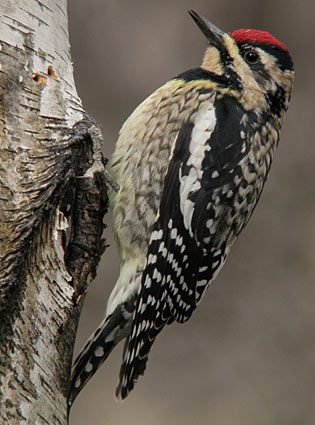
“Don’t worry, Mr. Sapsucker—the birders are looking out for you. Just be grateful you don’t go to public school in San Antonio.”
In the intense avocation of bird-watching, a code of ethics reminds practitioners of common sense. In public school education, there is no accepted code of ethics. And there is precious little common sense.
Cornell University’s Macaulay Library contains more than 200,000 bird call recordings, and 150,000 of them can be downloaded onto smartphones and other electronic devices. This allows canny bird-watchers to play the calls in the wild, attracting rarely-seen species.
Unfortunately, these realistic calls, experts say, can stress birds, including endangered species. Thus there is a code of ethics for the recreation of birding, The American Birding Association’s Principles of Birding Ethics, and it states,
“Limit the use of recordings and other methods of attracting birds, and never use such methods in heavily birded areas, or for attracting any species that is threatened, endangered or of Special Concern, or is rare in your local area.”
It’s a well-conceived code that gives behavioral guidance where guidance is needed.
Now let’s look at a profession where most of us would say common sense is essential, and where the lack of it leads to unethical and unacceptable conduct born of institutionalized incompetence. No, this time I’m not talking about our government. I’m talking about the educational profession, and the public schools. Continue reading
 Ethics Alarms