Sunday Ethics Warm-Up, 11/18/18: “The Show Must Go On” Edition

Here we are.

After a brief recovery Friday the 16th, an early morning seminar for D.C. Bar admittees yesterday crashed me entirely, which is why there were no posts. I almost didn’t make it to the end of the program, which surprised and alarmed me; the last few minutes were excruciating. But I have never cancelled a seminar, and when I do, it will be because my metaphorical chips are about to be cashed. Those who know my theatrical history will recall that I damaged my lungs in college staging and performing a professional dinner theater show six days a week (during final exams)  while I was suffering from a serious bronchitis attack; that I refused to cancel in-door performances of The American Century Theater (RIP) during snow storms, and one out-door performance during an electrical storm. Not being able to do my job and fulfill my responsibilities due to illness or injury absolutely crushes me (like many of my obsessions, this one is partially Dad’s fault: he refused to take sick days), and keeping Ethics Alarms current is the least burdensome of my responsibilities.

Once again, I apologize.

1. More apologies, Arlington High School Dept.: My ill-timed illness is also keeping me away from my 50th high school class reunion. I intended to make it, and wanted to make it: I had a wonderful time in high school, and met many of the best people I have ever known while I was there. Past reunions have been somewhat depressing for me: seeing people I remember vividly as young, vital and full of excitement for the future looking as old as they are and often feeling defeated by life makes me feel old, and the inevitable sad cases who feel he or she has to boast about successes and wonderful kids caused me stress as I barely controlled the urge to tell them off. Nonetheless, I regard attendance at such milestones as an obligation to the past, a demonstration of respect for where we have come from and the people and institutions that got us to where we are. And, of course, the more old friends who attend, the better the experience is for everyone. I wish there was a way to let my classmates know that I still think about them and care about them. This blog isn’t it.

2. Who made bad losers in politics respectable? When public trust in democratic institutions reached some yet-to-be-determined tipping point, a democracy is finished. Once, not too long ago, the tradition in American politics was that the defeated candidate—the office didn’t matter, nor did the margin of victory—conceded the race in a timely fashion, congratulated his or her opponent, and vowed to help and assist the victor as much as possible.  This not only modeled graciousness and good sportsmanship, but also protected the system. Now every election shows this healthy model being further pushed into cultural obscurity, with a new low being established in Georgia last week, when the loser of the governor’s race, Stacey Abrams, blamed her loss on a failure of democracy, refused to officially concede while admitting that she had lost, and announced a lawsuit alleging that Governor-Elect Brian Kemp and Republicans had tampered with the election without offering any proof or evidence. Well, maybe this wasn’t the new low; it would be hard to top Roy Moore.

3. The new Title IX rules. The Education Department finally released new guidance on how  Title IX, the federal statute that forbids sex and gender-based discrimination in public schools and colleges, should be enforced. This was desperately needed after the Obama Administration had muddled and corrupted the process with blatant gender bias and its infamous “Dear Colleague” letter, creating a culture that undermined free expression and due process on college campuses and due process rights for students accused of sexual misconduct. Continue reading
And The ACLU Takes A First Class Seat On The Brett Kavanaugh Ethics Train Wreck. Of Course It Has. (The ABA Stayed In Coach)

The American Civil Liberty Union has decided to make an “exception” to its supposedly unshakable policy of being non-partisan and non-political—Oh,  the pop-up fundraising appeal the group is currently showing on its website says to contribute to “stop Trump’s attack on civil liberties.” Then it vanishes, with the permanent text on the site staying abstract and without any overtly partisan slant.  Nice. And dishonest!—and announced its opposition to Kavanaugh’s confirmation.

This should not have surprised anyone, because the ACLU has become a sham organization, claiming to be non-partisan and apolitical while every day making it increasingly obvious that it, like so many organizations that take that pose (including virtually all of the mainstream news media), it is a fully committed ally of the Democratic Party. Nonetheless, there is always hope that at crucial moments in the nation’s history, organizations will find their soul, their guys and their principles before they seep away.

For this we need look no farther than The American Bar Association, another “non-partisan” group that habitually endorses Democratic Party agenda items that should not concern it at all. Its membership is overwhelmingly Democratic, and being that this entire section of the political spectrum is in the process of being ethically corrupted, many members, including members of its governing body, were prepared to turn on Brett Kanavaugh, a judge the organization had rated as very qualified for the Supreme Court, and recommend his rejection as a consequence of unsubstantiated, last minute allegations of sexual misconduct by an accuser dredging up dim memories from more than three decades ago. As a lesser tactic, many were in favor of bolstering the Democratic Party’s disingenuous call for an open ended FBI investigation, not because it is likely to clarify anything, but because it will accomplishe the Party’s stated objective since before Dr. Ford was persuaded, or pushed, to play the part of Anita Hill in this adaptation of “The Clarence Thomas Hearings.” They want to delay until after the November elections.

Thus it was that Robert Carlson, the latest Democratic Party contributor to lead the organization, wrote this letter on ABA letterhead, falsely stating that he was speaking for the ABA itself:

“The American Bar Association urges the United States Senate Judiciary Committee (and, as appropriate, the full Senate) to conduct a confirmation vote on Judge Kavanaugh’s nomination to the Supreme Court of the United States only after an appropriate background check into the allegations made by Professor Ford and others is completed by the Federal Bureau of Investigation.”

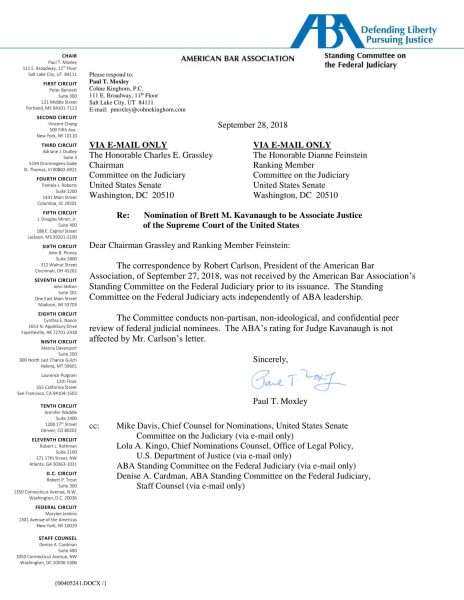
Rather than allow him to hijack its process and integrity, the ABA sent this letter to the Judiciary Committee, clarifying that Carlson was speaking for himself only:

Of course, if it were really a non-partisan, non-ideological organization, the ABA would be in the process of removing Carlson from office. In every organization, falsely using one’s post to imply organizational support of a personal view is a firing offense. Instead, the ABA took the face-saving measure of posting Carlson’s misleading letter (lawyers are prohibited from engaging in misleading conduct) under a link saying, “ABA President Calls For…” THAT’S deceit (lawyers are prohibited from engaging in deceit). Most readers will not notice the material distinction between the President of the ABA’s position and the official ABA position, and that’s just the way the association wants it.

Well, it’s not exactly integrity, but it’s a lot closer than what the ACLU has become. Continue reading

Now That The ACLU No Longer Wants To Be The ACLU, The United States Needs An ACLU

In a confidential memo obtained by former board member Wendy Kaminer, the American Civil Liberties Union has defined a policy that retreats from and undermines—perhaps the best word is betrays— its traditional mission of protecting the Bill of Rights, and especially the First Amendment rights of all Americans.  The memo says in part,

Work to protect speech rights may raise tensions with racial justice, reproductive freedom, or a myriad of other rights, where the content of the speech we seek to protect conflicts with our policies on those matters, and/or otherwise is directed at menacing vulnerable groups or individuals….We are also firmly committed to fighting bigotry and oppression against other marginalized groups, including women, immigrants, religious groups, LGBT individuals, Native Americans, and people with disabilities. Accordingly, we work to extend the protections embodied in the Bill of Rights to people who have traditionally been denied those rights. And the ACLU understands that speech that denigrates such groups can inflict serious harms and is intended to and often will impede progress toward equality.

…There is no presumption that the First Amendment trumps all other amendments, or vice versa. We recognize that taking a position on one issue can affect our advocacy in other areas and create particular challenges for staff members engaged in that advocacy. For example, a decision by the ACLU to represent a white supremacist group may well undermine relationships with allies or coalition partners, create distrust with particular communities, necessitate the expenditure of resources to mitigate the impact of those harms, make it more difficult to recruit and retain a diverse staff and board across multiple dimensions, and in some circumstances, directly further an agenda that is antithetical to our mission and values and that may inflict harm on listeners…Our defense of speech may have a greater or lesser harmful impact on the equality and justice work to which we are also committed, depending on factors such as the (present and historical) context of the proposed speech; the potential effect on marginalized communities; the extent to which the speech may assist in advancing the goals of white supremacists or others whose views are contrary to our values; and the structural and power inequalities in the community in which the speech will occur….

Where the ACLU defends the right to speak of those with whom it disagrees, it should generally engage in counter-measures both to reinforce the
values the speaker attacks and to make clear that we do not endorse the substance of the views. Some options might include:

1. Denouncing the views in press statements, op-eds, social media, and other available fora.

2. Participating in counter-protests. When we assist people in securing the right to march or demonstrate for views we condemn, we can and generally should support and participate in counter-protests, with consideration given to participation by senior staff or board members to highlight the ACLU’s commitment and ensure that such participation does not disproportionately burden other staff.

3. Supporting other counter-speech by supporting, organizing or helping to organize events, facilitating access to media, or taking other actions that will amplify and
strengthen the voices of those espousing our values.

4. Expanding our work on behalf of the values the speaker attacks.

5. Earmarking any fees recovered from the case to projects within the ACLU that further the values that we support and the speaker attacked, or donating them to another organization that works to advance those values, preferably in the geographical area where the speech occurred….

Continue reading