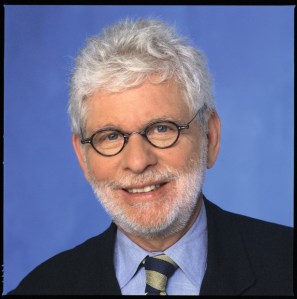
Richard Cohen, a fair and smart liberal columnist who sometimes jumps the ethics rails…like now.
Richard Cohen, the veteran liberal columnist at the Washington Post, is not your usual knee-jerk partisan pundit. He’s that rarity, a thoughtful and fair opinion journalist who does not choose his positions according to which side he would rather have drinks with. He really, really doesn’t like Republicans and conservatives, but he is capable of siding with them, or at least against his philosophical brethren, when common sense and matters of basic right and wrong beckon. I used to think of him as a left-biased partisan, but then I had a chance to read E.J. Dionne and Eugene Robinson on a regular basis, and Cohen’s relative objectivity and fairness became obvious.
He does have blind spots, however. One is sexual harassment, which, as an older guy who likes flirting with young women at the gym and doesn’t understand that whole “unwelcome advances” thing, he just doesn’t comprehend. Another is the compliance delusion. To be seriously unethical in Cohen’s eyes, you have to break the law. Otherwise, it’s “everybody does it.” Cohen is prone to fall for other classic rationalizations as well. He is a “gut instinct”analyst where ethics are concerned, and gut instincts aren’t enough. They will eventually lead you astray. They lead Cohen astray.
This was the glaring flaw in his recent column about the Benghazi controversy, where Cohen fell into line with the Obama protectors in the media whose argument is, “So they lied…who cares?” He wrote in part…
“…President Obama was then really Candidate Obama and he surely did not want the words “terrorist attack” uttered during the presidential campaign. In addition, the CIA and the State Department were in a cat fight and could not agree on the wording of the talking points — or even, from a fair reading of their clashing e-mails, who the fanatical enemy was: al-Qaeda or members of Congress? In all this, it’s almost possible to forget that four Americans died in Benghazi. The event was a tragedy and it hardly matters, as then-Secretary of State Hillary Clinton vociferously maintained, if the attack occurred spontaneously or was planned. Either way, it was a success for the terrorists and a debacle for the United States.
“It is good to find out how this happened — who’s responsible for the inadequate security, etc. — and it is also good to hold the Obama administration accountable for putting out a misleading statement. But the record will show that a thorough report was, in fact, compiled. Its authors were Thomas Pickering, an esteemed retired diplomat, and Adm. Mike Mullen, an equally esteemed retired chairman of the Joint Chiefs of Staff. They found the standard mistakes and snafus — but no crime….Watergate, though, was a crime. Iran-contra was a crime. Government officials were convicted and some of them went to jail. Fudging a press release is not a crime. Compromising on wording is not a crime…It is not a crime either to make a mountain out of a molehill, but this particular one is constructed of a fetid combination of bad taste and poisonous politics. Dig down a bit and it becomes clear that some — many? — Republicans suspect that Barack Obama and-or Hillary Clinton are capable of letting people die to cover up a terrorist attack. Either that, or this is what they want us to think.”
It’s a fascinating passage, because you can see Cohen slowly going off the ethical rails: Continue reading →



 Ethics Alarms