
Frequent readers here know how much I detest hoaxes, even ones just designed to be funny. News hoaxes are especially vile, as they are often designed to fool people and news outlets. These cause false rumors to spread, and send disinformation through the web and into brains, especially mushy brains. Hoaxes that consist of sufficiently ridiculous components that anyone should know they are not to be believed aren’t really hoaxes at all; they are more akin to satire. They are benign and often illuminating.
What does one make of a hoax that is simultaneously ridiculous and designed to fool people who need to be fooled in the public’s interest? I regard that as an ethical hoax. NYU physicist Alan Sokal designed and pulled off just such two decades ago, as he described here:
For some years I’ve been troubled by an apparent decline in the standards of intellectual rigor in certain precincts of the American academic humanities. But I’m a mere physicist: if I find myself unable to make head or tail of jouissance and différance, perhaps that just reflects my own inadequacy.
So, to test the prevailing intellectual standards, I decided to try a modest (though admittedly uncontrolled) experiment: Would a leading North American journal of cultural studies… publish an article liberally salted with nonsense if (a) it sounded good and (b) it flattered the editors’ ideological preconceptions?
The answer, sadly, was yes. Despite being salted with copious Authentic Frontier Gibberish like “catastrophe theory, with its dialectical emphases on smoothness/discontinuity and metamorphosis/unfolding, will indubitably play a major role in the future mathematics; but much theoretical work remains to be done before this approach can become a concrete tool of progressive political praxis,” his article, “Transgressing the Boundaries: Toward a Transformative Hermeneutics of Quantum Gravity,” was peer reviewed and published in the Spring/Summer 1996 issue of Social Text.
Later, Sokal explained his motives:
“While my method was satirical, my motivation is utterly serious. What concerns me is the proliferation, not just of nonsense and sloppy thinking per se, but of a particular kind of nonsense and sloppy thinking: one that denies the existence of objective realities, or (when challenged) admits their existence but downplays their practical relevance….In short, my concern over the spread of subjectivist thinking is both intellectual and political. Intellectually, the problem with such doctrines is that they are false (when not simply meaningless). There is a real world; its properties are not merely social constructions; facts and evidence do matter. What sane person would contend otherwise? And yet, much contemporary academic theorizing consists precisely of attempts to blur these obvious truths — the utter absurdity of it all being concealed through obscure and pretentious language.”
Sokal’s exposé of the sloppiness and lack of rigor in scholarship has spawned followers, as well it should. Using academic studies and papers is the ultimate appeal to authority in social and scientific policy disputes. If the journals that publish them are lazy and biased gate-keepers, they are untrustworthy authorities, which means that they aren’t authorities at all. That makes a Sokal-style hoax, properly and fairly executed, that rarity of rarities, The Good Hoax.
As they explained in the magazine Skeptic, Dr. Peter Bogghosian, a full time faculty member in the Department of Philosophy at Portland State University, and James Lindsay, a Phd in mathematics and the author of four books, wrote and submitted the most ridiculous paper they could think of. The title: “The Conceptual Penis as a Social Construct.” Here’s the abstract:
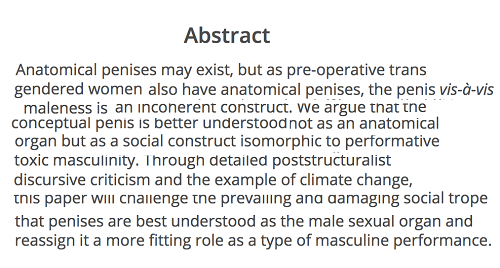 You read that right: the paper argues that penises affect climate change. Behold: Continue reading
 Ethics Alarms