Back Off, Progressives: Dwight David Eisenhower Was An Excellent President In His Time.

Which is, after all, the only time that matters.at the time.

I just wrote a long rebuttal to a recently Trump Deranged friend of impressive mind and credentials, who decided to go after, of all people, President Dwight Eisenhower for a speech in which he extolled moral values because, my friend’s Facebook post declared, “in real life the years of Eisenhower’s administration—essentially all of the 1950s—did not even come close to measuring up to the tenets of social, racial, ethnic and sexual justice and economic equity that most of us today believe are the standards of a just society.”

“That is an important reminder for all of us us that times do change,” he continued, “and that as right-thinking as Eisenhower’s words seem on the surface, they were spoken by the leader of a society that was very repressive in many ways—economically, socially, racially, sexually and otherwise.” This, to use the vernacular, pissed me off greatly. Ike has gone higher in my estimation of him as President the more I read about him and especially the more I watch other President struggle with the job he seemed to do effortlessly. (Of course, Ike may be the only one of our Presidents for whom the office could be considered a step down in difficulty and responsibility, after overseeing the Allied effort to save the world in World War II.)

Here, with minor edits to protect the guilty, is what I posted in response to that slap at Ike:

***

But this is the purest form of Presentism, and a grossly unfair assessment of Ike, one of our most under-rated and effective Presidents. It is always easy to go back and condemn figures of the past who did not have the benefit of many decades of accumulated experience and wisdom; easy and wrong. It is by this standard that we saw efforts in demented regions like San Francisco (and our own) to strip historical honors from, among others, the Founders, because they were not sufficiently psychic to reject their society’s and culture’s mistaken beliefs, such as the inherent inferiority of other races to theirs.

 I’ve studied Eisenhower’s own writings and those about him. His vision of the Presidency was that his job was to protect and preserve the culture, not change it; that the culture would evolve and change in its own time, when society was ready for it. As a result, Eisenhower led a United States that honored and trusted its institutions at a level that seems astonishing today. He had a great part in that.

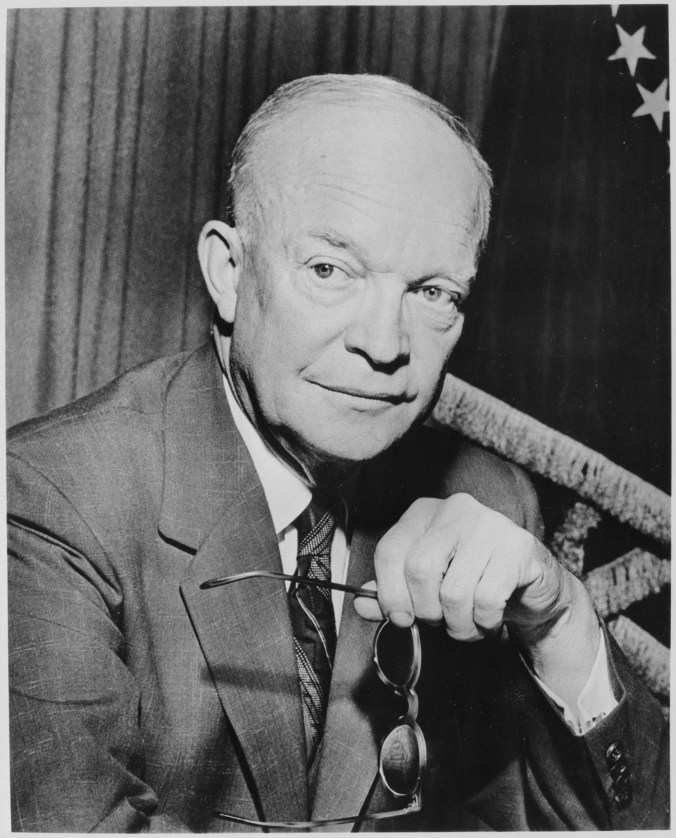
Nobody accused him of being a “king,” but in Boston, even then a bulwark of the Democratic Party, kids listened to “Hail to the Chief” on the most popular children’s show (creepily titled “Big Brother”!) as a photo of Ike appeared (the one above, in fact) on the screen and we “toasted” the President of the United States with a glass of milk. The Horror.
Continue reading

Ethics Dunce: Don Surber

Don Surber is a former journalist and current conservative pundit whose blog and substack I occasionally peruse, usually without too much alarm. However, he has issued a substack essay that, if I had to summarize in three words my objections to it and any culture wars guerilla who cited him as authority would be, “This doesn’t help.” A longer version follows.

Surber’s piece is called “In praise of ties” and carries the subheading, “They helped build a society that we are destroying.” If Glenn Reynolds had not endorsed the link, I would have stopped reading right there. I know ties are going to be used as a metaphor for the decline of elegance, respect, adulthood, civility, dignity, elan and eclat, blattity-blah, but still. Don’t insult my intelligence. This is the equivalent of “In praise of stovepipe hats,” “In praise of spats,” “In praise of derbies” or “In praise of bustles.” These are all fashions, and fashions rise and fall like steam and autumn leaves. We get used to them, if they hang around long enough, and yes, sometimes their demise are linked to cultural factors that have little to do with fashion. Nonetheless, longing for a time when men wore ties as a matter of societal conformity makes one seem like Grandpa Simpson, screaming at clouds. Worse, in fact.

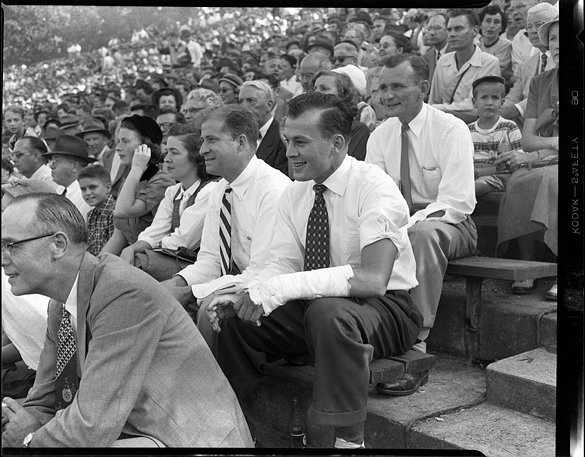
Surber writes, “Chuck Berry always wore a tie. Gas station attendants wore them. You could trust your car to the man who wore the star because he had a tie on. Men wore ties to ballgames because men were civilized. Ties were important because they gave a sense of authority but ties also showed that a man wants to belong in society. As Benjamin Franklin said, “Eat to please thyself, but dress to please others.”

Sure, Don. I always thought those pictures of men wearing ties at baseball games were ridiculous. Ted Williams, one of my father’s heroes whom he passed on to me, famously refused to wear a tie: he had a very long neck and didn’t think ties looked good on him. Ben was right, but when the tie as a symbol of wanting to appear formal and serious wane—it hasn’t waned completely —then people will adopt other ways of “dressing to please.” It is the way of the world, and there is nothing about these transitions to lament.

But Surber was just getting started. Here he is at full speed:

Continue reading

Remember Davy Crockett (and thank you, Fess Parker!)

If you don’t remember Fess Parker, who died this week as an 85-year-old winery owner, you missed the Fifties. Parker played Davy Crockett in Walt Disney’s TV miniseries about the lively Tennessee frontiersman, and did it with such sincerity and style that he not only turned coonskin caps into a national craze, he also rescued Davy Crockett from creeping obscurity. Continue reading