Morning Ethics Warm-Up, 6/26/2018: Our Amazing, Evolving, Contentious Culture

Good Morning!

1. Outrageous Self-Promotion Dept.: Just in case you live in the vicinity of Washington, D.C., AND are interested in the cultural impact of the works of Gilbert and Sullivan in the U.S., AND would like to see me (and three long-time friends and colleagues who will periodically join me in performing some selections from the brilliant satirical operettas) discuss this rich and wide-ranging topic (Politics! Satire! Movie scores! Broadway musicals!) over a three-hour session that will fly like the wind, all it will take is a mere 50 dollars (just 35, if you are a Smithsonian Associates member) and your attendance. I’d love to see you. The program is Gilbert and Sullivan in the 21st Century, this Saturday, June 30, at 9:30 a.m. Here are the details.

2. Speaking of culture…If you want to feel better about the state of U.S. culture, I recommend watch a Beach Party movie. I just saw the first one all the way to the end for the first time—to realize that it was easily the best of its line (there were six—SIX!!!—more) is mind-boggling all by itself—and found it immediately uplifting. The 1963 William Asher-directed relic looks like it’s from some particularly demented parallel universe, depicting a weird place where 30-year-olds pretend to be  loitering teenagers who do nothing all day but gyrate to frenetic versions of the Twist, listen to awful surf music that makes the Jan and Dean sound like Brahms in comparison, do some surfing themselves (but just the males), and interact with B-list comics like Morey Amsterdam and Harvey Lembeck. The songs and their hackneyed lyrics make you yearn for the nuanced hip-hop musings of Kanye West; the comedy makes “Big Bang Theory” seem like Oscar Wilde, and to speculate on what kind of populace would actually enjoy such badly-conceived and sloppily-executed crap is to risk madness. If this was America in 1963, a) Good riddance, b) How did we survive? and c) No wonder the Soviet Union thought they were going to win!

No blacks are to be seen; indeed no skin color of any shade but glistening white is visible anywhere—didn’t these people even tan? Here’s a typically clueless exchange to ponder:  Annette Funicello: “The professor got his robe from the chief of the Tokyo Fire Department!” Random 30-year-old teenage beach bum: “Great! I’ll call him if my rickshaw catches fire!”  [laughter]. In the hilarious motorcycle gang, where all of the actors appear to be at least 45, the male members’ leather jackets say “Rats” on the back, and their female cohorts’ jackets say “Mice.” None of the”girls” have any function in the film, and no higher purpose, than to moon after the guys and gyrate in their faces.  Accepted conduct is for every male youth to gawk, pant, and emit some sound the equivalent of a wolf whistle every time a shapely female passes. The romantic lead (of sorts), teen idol Frankie Avalon, trying to make virginal, had-to-get Annette jealous, grabs a generic Scandinavian waitress and just starts kissing her. It’s like a magnet. Just kisses her He doesn’t  even wait. When you’re a star, they let you do it. You can do anything. Then he tells her he loves her so she’ll make out with him until Annette loosens up. This is the hero, remember.

They should show this film in every junior high school American History class. I’m very serious about this.

3. An abject lesson in how the news media uses language to manipulate public perception: Virtually every news report about the Trump administration’s actions at the Mexican border described them, and are still describing them, in headlines as “family separation.” The cumulative effect of this is to make casual, not fully-engaged readers and listeners think that family separation is the objective of the policy. The objective of the policy is to enforce current immigration laws while obeying other legal requirements, such as the one that forbids children from remaining with federally  detained parents.  This is, under the Ethics Alarms definition, fake news: deliberately deceitful reporting that conveys a false impression. The equivalent would be characterizing the imprisonment of African American men convicted of felonies as “the Trump policy of making black families into single-parent households.” Continue reading

Ethics Observations On The Red Hen

Believe it or not, I had not heard about a Lexington, Virginia restaurant kicking out Sarah Huckabee Sanders and her family who were there to enjoy a meal when I wrote, a couple of hours ago, in part…

The virtue signaling fad is officially dangerous… since sanctuary cities are applauded for defying law enforcement, and more and more private establishments are basing their service on the political view of potential customers…This will spread, and we will have a completely dysfunctional society if and when it does. It is the natural progression of the divisive strategies and rhetoric employed by “the resistance” and the news media, and is undiluted cultural poison.

Here’s the story: Stephanie Wilkinson, the owner of the bucolic rural Virginia restaurant, was called at home and told the President’s spokeswoman was dining there with a group. Asked what the staff should do, she somehow couldn’t think of the correct and ethical answer, which is “Give her and her group the same hospitality and excellent service we strive to give all our customers. We don’t discriminate.” Instead, she drove to the establishment and told Sanders to leave. Sanders tweeted,

“Last night I was told by the owner of Red Hen in Lexington, VA to leave because I work for @POTUS and I politely left. Her actions say far more about her than about me. I always do my best to treat people, including those I disagree with, respectfully and will continue to do so.”

For her part, the owner told the Washington Post that she would do it again, because “there are moments in time when people need to live their convictions. This appeared to be one.”

Sanders is right, and Hutchinson is despicable, un-American, unethical, and wrong.

Other notes: Continue reading

Morgan Freeman, Cultural Shifts, And The Dirty Old Man’s Dilemma

I wondered how it was that Morgan Freeman, black, progressive, a Barack Obama enthusiast and the owner of a squeaky clean image, was hit with career- and reputation-endangering accusations of “inappropriate conduct” that were on balance far, far less alarming than the borderline or outright criminal offenses claimed by the victims of most of the #MeToo targets. Now we know: Morgan Freeman, then 79 , was interviewed by a young, attractive CNN reporter before the Harvey Weinstein story broke. The actor made creepy, sexually suggestive comments to her, and they bothered her as she continued to consider them during her maternity leave, which began soon after the interview. When she returned, Harvey Weinstein had been exposed, #MeToo was in full swing, and the reporter, Chloe Melas, had a new and unexpected male celebrity to investigate and perhaps take down.

This does not appear to be another example of a vicious abuser whom the Weinstein story allowed to finally meet justice after years of victimizing those who came within his sphere of power. All of the claims against Freeman are garden variety dumb, blundering sexual harassment without malice, almost exclusively by the spoken word. Although the news accounts mention “unwanted touching,” the only description of such touching involves Freeman touching a woman’s skirt and threatening to lift it. There have been no “groping” accusations, at least not yet.

Never mind. The allegations so far have already harmed, probably irreparably, the Academy Award-winning actor’s career. Visa has dropped him as its long-time spokesman. Honors he has received are being reconsidered. More penalties are sure to come.

Freeman issued a clumsy, non-apology apology, saying,

“Anyone who knows me or has worked with me knows I am not someone who would intentionally offend or knowingly make anyone feel uneasy. I apologize to anyone who felt uncomfortable or disrespected — that was never my intent.”

It’s a poor apology, but I believe him. He never intended to make anyone uncomfortable, and it didn’t occur to him that any woman would make a big deal out of being—from his perspective—flirted with, even naughtily, by a very old man and iconic movie star. In this, he falls not in the ugly Cosby, Harvey, Kevin, Matt and Charlie category but into the sadder George H.W. Bush class, which I will call “The Dirty Old Men Division.” Continue reading

KABOOM! Harvard’s Class Of 2003’s Reunion Attack On Jared Kushner

I was going to write about this depressing and disgusting episode from the anti-Trump derangement parade yesterday, but I thought I could keep my head from exploding if I waited a bit. No such luck.

As some of you know, I come from a Harvard family. My Dad went there on the GI Bill; my mother was working as the Dean’s secretary when she and my Dad met. I attended the College, and so did my sister. Long after we had left, my mother was still working in the administration, ultimately as Asst. Dean of Housing. I was raised about 15 minutes from Harvard Square. I ushered at the football games when I was in high school. Many of my best and oldest friends are Harvard grads; I loved the place. It was a terrific place to go to school. This story, however, makes me deeply ashamed, and demonstrates, not for the first time in recent decades, how poorly the university’s leadership has upheld the core values of America’s oldest institution of learning, opting instead for partisan politics and divisiveness.

Since the 19th century, Harvard has invited alumni in reunion years—that is, ever five years—to write personal updates about their lives, and have it published free of charge by the University and mailed to all class members.The crimson covered paperback is called the Red Book. I have read more of them than I can count, between my father and myself. Here’s one of my father’s:

Continue reading

Morning Ethics Warm-Up, 5/22/2018: Blemishes

Goooood Morning!

1. What is so hard to understand about the concept of Freedom of Speech and Freedom of Assembly? The Daily Beast negligently covers a story about how some alt-right groups are planning some kind of anniversary/reunion event in Charlottesville. (Funny, I thought we celebrated anniversaries of good things) and how some activists are plotting to block them. I especially like this sentence:

“Activists warned Charlottesville last year that the Unite the Right rally could turn violent. Now they’re determined to keep neo-Nazis out of their city for the anniversary.”

The rally turned violent because the counter-demonstrators turned it violent with help from authorities, who couldn’t, couldn’t, or didn’t want to keep the alt-right and the antifa demonstrations away from each other. This is the Berkeley trick: “Your speech will incite violence from us, so its irresponsible for you to speak. This issue was supposedly settled when the ACLU fought to allow Nazis to march in Skokie, Illinois 40 years ago.  In the end, the Nazis didn’t march but the principle that they couldn’t be blocked because of their message was made clear. I wonder if the self-righteous, speech-restriction fans represented by Black Lives Matter activist Lisa Woolfork even know about that case, given such ignorant quotes as,

“[Charlottesville authorities] seem to have gotten the message that white supremacist ideology is dangerous, but they are not willing to take, I believe, the truly moral step to say Kessler’s rally is a white supremacist Nazi rally, and therefore is inimical to our values and that we can ban that.”

No Lisa, you can’t ban that. You can’t ban ideas, no matter how dangerous you think they are, or how dangerous they in fact may be. The theory that the government should ban speech based on morality is infinitely more dangerous than anything these alt-right jerks say, but you still have the guaranteed right to promote such democracy-rotting garbage. Another Lisa quote:

“We did not ignore the white supremacists and let them proceed to go about their business undisturbed without any censure. These ideas are harmful, and they lead to horrible consequences in the real world.”

And I repeat: What is so hard to understand about the concept of Freedom of Speech and Freedom of Assembly? It sure seems to be especially hard to understand for the Left recently. Continue reading

What Is Fairness, Justice And Proportion For Aaron Schlossberg?

“He’s a jerk. Let’s squash him like a bug…”

Surely by now you know of Aaron Schlossberg, the latest cultural villain.

He was the star and author of a bizarre incident at a restaurant in Manhattan. Schlossberg, who is a midtown Manhattan lawyer, freaked out beyond all reason when a customer began conversing in Spanish with employees at the restaurant. “Your staff is speaking Spanish to customers when they should be speaking English,” he protested. “Every person I listen to — he spoke it, he spoke it, she’s speaking it. This is America! “My guess is they’re not documented, so my next call is to ICE to have each one of them kicked out of my country.If they have the balls to come here and live off of my money — I pay for their welfare, I pay for their ability to be here — the least they can do is speak English…I’m calling ICE.”

Naturally, this was captured on a phone video. Naturally, it was posted to social media. Once upon a time a person could behave like a jackass and only have the immediate witnesses to his conduct know about it. No more. Now, thanks to omnipresent cell phones, everyone is under more or less constant surveillance, and a bad moment, a sudden outburst or an ill-considered word can and will be wielded by steely-eyed social justice enforcers to destroy a miscreant’s life to the maximum extent possible.

Is that the kind of society you want to live in? It would be wise to consider the fate of Aaron Schlossberg.

Somehow his name became known. The news media picked up his tantrum: the Daily News put it on its front page! The New York Post reported that he has been evicted from his office by Corporate Suites, the company that held his law office lease.  His firm’s associate quit, with a nice virtue-signaling tweet. A petition demanding that he be disbarred has more than 10,000 signatures, and there is a GoFundMe effort to a  hire a mariachi band to follow him around New York.

That’s kind of funny, I have to admit. Continue reading

Morning Ethics Round-Up, 3/5/2018: An Oscar Hangover, A Panamanian Mess, An Australian Play, And A 7-11 Moment

Hello!

1 Let’s get the Oscars out of the way. I didn’t watch, choosing instead to finish streaming Netflix’s excellent “Seven Seconds.” I have skimmed the transcript and checked the reporting, however, and these items leap out..

  • On the “red carpet,” Ryan Seacrest was snubbed by the majority of the stars he tried to chat with them. Seacrest was accused of sexual harassment by his ex-personal hair stylist last year. His employer hired an independent counsel to investigate, and could not confirm her allegations, so he kept his job.Never mind: he was snubbed like a leprous skunk at a picnic anyway.

This is a flagrant Golden Rule fail. Not one of the over twenty stars who walked by him while he was trying to do his job would feel fairly treated if they had been in his position. It also is as perfect and example as there is of how the #MeToo movement is a witch hunt, not interested in facts, or fairness, just power and the ability to destroy without due process.

If I was going to watch the Oscars, the treatment of Seacrest in the pre-show would have changed my mind. These are awful people. To hell with them.

  • The disgusting and smug Jimmy Kimmel hosted, because he’s “America’s Conscience of America” despite seeking ratings by encouraging parents to be cruel to their own children for his amusement.

He began the night with a penis joke.

  • As I noted in yesterday’s Warm-Up, the Oscars are now part of the effort to divide the nation. Bigotry is good, as long as it’s trendy bigotry:

…Presenting the best director award, Emma Stone introduced the nominees as “these four men and Greta Gerwig.” Nice. Misandry is funny! (Gerwig lost. GOOD.)

Maya Rudolph assured the presumably racist white viewers, “Don’t worry, there are so many more white people to come.” Bite me, Maya.

…And, of course, “Get Out!,” the racist film that I have already written about more than it deserves, won Best Screenplay, because representing all white people as monsters is award-worthy.

  • In the past I have devoted whole posts to the Academy’s snubs in its “In Memoriam” segment, which is supposedly Hollywood’s final salute to film artists who made their final exits. At this point, I really don’t care what the Academy does, but the loved ones and fans of the snubees care, and that should matter to the Academy. Here is the complete list of omissions that at least someone has complained about. I’ve highlighted the ones who really should have been included:

Bill Paxton
Stephen Furst
Powers Boothe
Juanita Quigley
Ty Hardin
Francine York
Miguel Ferrer
Skip Homeier
Anne Jeffreys
Lola Albright
Lorna Gray
Dina Merrill
Conrad Brooks
Robert Guillaume
John Hillerman
Jim Nabors
Rose Marie
Adam West
David Ogden Stiers
Dorothy Malone
Della Reese
Dick Enberg
Tobe Hooper

The names fall into five categories. Bill Paxton is in one of his own: he was left out of the list due to a silly technicality: he died right before last year’s Oscars, so it was too late to include him in 2017, and some jerk decided that since he was a 2017 death, he couldn’t be honored this year either.  The second category is flat-out mistakes: Dorothy Malone won a Best Actress Oscar; if that isn’t enough to be listed, what is? Director Tobe Hooper was responsible for a film that revolutionized horror movies, “The Texas Chain-Saw Massacre,” and also directed “Poltergeist.” He was an important director. When two of your films launched sequels, remakes, sequels to remakes, and endless knock-offs, Hollywood should show some respect: it made millions because of Tobe Hooper.

Category 3: John Hillerman and Powers Boothe were successful and prolific film actors in some major movies, though both are remembered best for their TV work. There is no good argument for omitting them.  In the fourth category are TV actors who made a few mostly  forgettable films: West, Jeffreys, Merrill, Ferrer and Hardin. I can see the argument: they will be honored at the Emmys.

Stephen Furst deserves a category all his own. He played a memorable character in a classic, iconic film: “Flounder” in “Animal House.” That should have been enough to earn a place in the roll call.

That’s it for the 2018 Academy Awards.

Let us never speak of it again. Continue reading

Ethics Quiz: Your Swedish Post-Mortem Avatar

Swedish scientists believe artificial intelligence can be used to make “fully conscious copies” of dead people, so a Swedish funeral home is currently looking for volunteers who are willing let the scientists use their dead relatives in their experiments. The scientists want to build robot replicas, and to try to approximate their personalities and knowledge base in their artificial “brains.”

For those of you who are fans of the Netflix series “Black Mirror,” there was an episode closely on point in which  grieving woman bought an AI -installed mechanical clone of her dead boyfriend. (This did not work out too well.)

I was about to discard objections to such “progress” as based on ick rather than ethics, when I wondered about the issues we already discussed in the posts here about zombie actors in movies and advertising. Is it ethical for someone else to program a virtual clone of me after I’m dead that will be close enough in resemblance to blur what I did in my life with what Jack 2.0 does using an approximation of my abilities, memories and personality?

I think I’m forced to vote “Unethical” on this one as a matter of consistency. Heck, I’ve written that it’s unethical for movies and novels to intentionally misrepresent the character of historical figures to such an extent that future generations can’t extract the fiction from the fact. (Other examples are here and here.) Respect for an individual has to extend to their reputation and how they wanted to present themselves when they were alive. Absent express consent, individuals should not have to worry that greedy or needy relatives, loved ones, artists or entrepreneurs will allow something that looks like, sounds like and sort of thinks like them to show up and do tricks after the eulogy.

I am not quite so certain about this branch of the issue, however, and am willing to be convinced otherwise. After all, pseudo Jack could stay inside, and only be programmed to do a nude Macarena while wearing a bikini for my wife, while no one else would be the wiser. Or nauseous. And after all, I’m dead. Why should I care? Well, the fact is I do care. For me, this is a Golden Rule issue.

Your Ethics Alarms Ethics Quiz of the Day is this:

Will the Swedes who elect to allow scientists to try to perfect Dad-in-a-Box for nostalgia, amusement, companionship  and to take out the garbage be unethical, betraying their departed loved ones’ dignity?


An Apology To Bradford Dillman, And Introducing The Dillman Rule

I owe Bradford Dillman, the movie and TV actor who died on January 16, an apology. I hope I learn something from it.

If you had asked me during the Seventies and Eighties who I regarded as the epitome of a hack actor, it would have been Bradford Dillman. For most of the period he was a guest star on every TV drama imaginable, usually phoning in the same performance as a serious, tense, often nasty weasl or jerk. I came to believe that he was a serious, tense, often nasty weasel or jerk; otherwise, why would he only play such roles? Although Dillman’s career began well, with his portrayal of a fictional version thrill-killer Dickie Loeb in Compulsion, the film version of the Leopold-Loeb murder and trial. “Bradford Dillman emerges as an actor of imposing stature as the bossy, over-ebullient and immature mama’s boy, Artie,” A. H. Weiler wrote in a Times review. Dillman shared best actor honors with co-stars Dean Stockwell and Orson Welles at the Cannes Film Festival, and that was about the last honor he ever got. His career went downhill from there.

I never forgave him for appearing as John Wilkes Booth in 1977’s  horrible  “The Lincoln Conspiracy.” I am a Lincoln assassination buff, and looked forward to the movie, braving a blizzard to see it and dragging my bride to be along with me as one of our first dates. I was embarrassed.  The film was so bad I walked out of it, one of only five movies to force me out of the theater since I was a kid (The others, for the record: the original “Dawn of the Dead,” “The Silent Scream,” “JFK,” and “The Wicked Dreams of Paula Schultz.”)

As usual, it wasn’t that Dillman was bad, it was just that he was predicable, and the material he was acting in was lousy. Oh, now and then , a major film like “The Way We Were,” a couple of the Dirty Harry films, or a decent TV show like “Columbo” had a Bradford Dillman character, so they got, reasonably enough, Bradford Dillman to play him, but by then the cognitive dissonance scale—

—was working against Dillman. Bradford was already lodged at the bottom. If he was in it, whatever it was was pulled down below zero in my mind. Bradford Dillman? Yechhh.

This was a bias. I stopped really watching Bradford Dillman, and only reacted to him based on old grudges and assumption formed so long ago that I couldn’t even recite them. It was prejudice. It was unfair. It breached the Golden Rule. I never gave him a chance, for decades. Continue reading

The Slippery Slope: From Cyber-Zombie Peter Cushing To Hologram Zombie Maria Callas

“We don’t have to pay her, and she can do a hundred shows a week!”

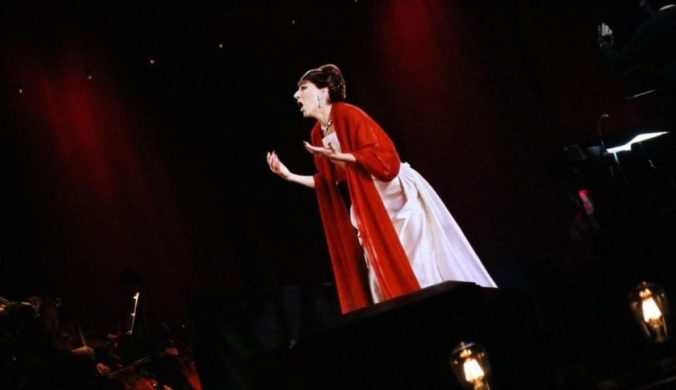
Thanks to the creation of a hologram clone, opera legend Maria Callas,  dead since 1977, appeared onstage at Lincoln Center last week. This is the continuation of a project that previously resurrected such departed stars as Tupac Shakur and Michael Jackson. Roy Orbison, who died in 1988, appeared after Callas. I wonder if he sang, “Pretty Hologram”?

I see where this is going, don’t you? We’re heading straight to “Looker,” the science fiction film directed and written by the late Michael Crichton (“Jurassic Park,”“Westworld,” Disclosure,” “ER,”—How I miss him!).  In that prescient 1981 movie, an evil  corporation transferred the images of living models to a computer program that could use then make the new CGI versions to do and say anything, and do so more effectively and attractively than the living models themselves, in television ads and even in live appearances via hologram. Then the company had the models killed.

In the New York Times review of singing Zombie Callas, the little matter of ethics never was mentioned.  Times critic Anthony Tomassini was not very critical, writing in part,

…[T]here is an amazing video of [Callas]  in Act II of Puccini’s “Tosca” in 1964. But no full operas by one of the greatest singing actresses in history; this hologram performance can seem to fill in a bit of that gap. The operatic voice, and the art form itself, can feel so fragile. What better way to represent that fragility — while also reviving it, in a kind of séance — than a hologram?…In introductory comments, [the director] said that the project has tried to present Callas with “restraint, subtlety and delicacy.” The notion of a singing hologram might seem incompatible with such a goal. Yet moments during Sunday’s preview were surprisingly affecting…The problem, as it always has been in opera fandom, will be if this specter from the past prevents a full appreciation of the vitality of opera and singing today. 

That’s the problem, is it? No, the problem is the same ethical problem I had with regenerating the deceased actor Peter Cushing in “Rogue One”: Continue reading