Supreme Court Vacancy Ethics: A Competent Choice, An Unethical Announcement, And An Irresponsible Reaction

gorsuch

You know, if every day is going to set off multiple political ethics controversies, I’m not going to have time to write about lobster hats.

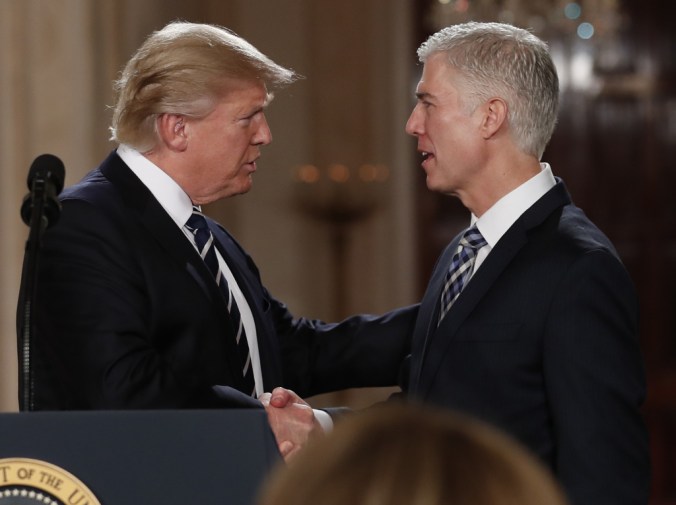
Last night, President Trump selected Colorado federal appeals court judge Neil Gorsuch as his Supreme Court nominee.

A. The Choice

Except for those who literally are determined to freak out and condemn anything President Trump does, this was a competent, responsible choice. He would be one of the best of the available choices for any Republican President, more qualified than Obama’s snubbed selection, Merrick Garland, to fill the same vacancy, and Garland was certainly qualified. It’s ridiculous that Gorsuch is one more Harvard grad on a Court that is exclusively Harvard and Yale, but that aside, he adds some diversity of outlook by being from the middle of the country rather than the coasts. He writes clearly, unlike, say, Justice Kennedy, and is not a pure political ideologue, like Ginsberg or Alito.

Before the Democrats’ rejection of Robert Bork shattered the tradition of allowing every President the privilege of having his SCOTUS nominations approved absent real questions about their competence or honesty, a nomination like this one would have garnered bipartisan praise. Trump made a responsible, competent, choice. Really. He did.

B. The Announcement Continue reading

The President Elect’s Happy New Year Tweet, With Musical Reflections From Ethics Alarms

trump-tweet-happy-new-year

It’s hard to know whether to laugh or cry.

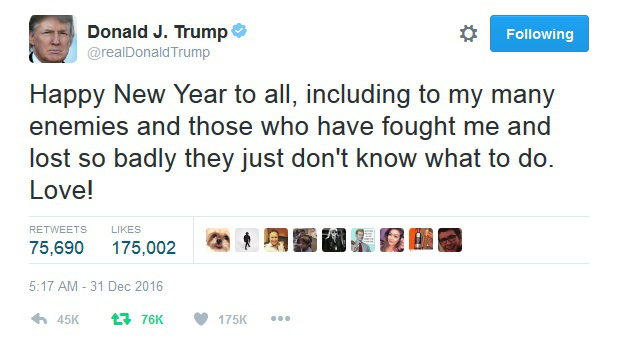
The reactions to Donald Trump’s tweet above were so predictable.  Trump-haters are continuing their meltdown, because he used that scary word “enemies,” and imagining political foes being hung by piano wire and shot against a wall…maybe even THE wall. Trump’s fans are cheering, “That’s our guy!” Predictable or not, here is the official Ethics Alarms reaction to what may be Trump’s first tweet destined for the Yale Book of Quotations:

1. Get used to this. He’s not going to stop. I recommend re-reading this post from last year, on the Julie Principle. In fact, heeeeere’s Julie!

2. Oh, let’s get this out of the way: it’s a juvenile, undignified, un-Presidential message, and a deliberately provocative thing to do. It also  made me laugh out loud, I have to admit. Really, if you’re going to let this sort of thing drive you crazy, you’re not going to make it through four years. You’re not even going to make it through one. Reserve a padded room. I’m serious. Think about this song, because this is where you’re headed…

Continue reading

“The 2016 Election Is a Disaster Without a Moral”? Only If You’re In Denial, Mr. Chait!

That should be "lessons," plural...

That should be “lessons,” plural...

The many outbursts of  liberal anger, resentment, accusations and denial over the election have been revealing, and not in a good way. Few have been as directly and stubbornly misguided and biased, however, as the current New York Magazine article by Jonathan Chait, with the clickbait title, “The 2016 Election Is a Disaster Without a Moral.”

It is, in essence, yet another example of Democrats attempting to argue away any accountability for their own misfortune, making Chait’s piece itself a denial of several moral lessons, such as “I am the architect of my own destiny,” “Take responsibility for your failures,” and “Don’t blame others for your own mistakes.” The post-election progressive freak-out, of which Chait is a part, also has a very important moral lesson in store, the one embodied in the Serenity Prayer authored by theologian and philosopher Reinhold Niebuhr (1892–1971):

God, grant me the serenity to accept the things I cannot change, the  courage to change the things I can, and wisdom to know the difference.

Clearly, this moral lesson is completely elusive, with pointless recounts underway supported by the Clinton campaign; round the clock complaining about the Electoral College, part of the 225 year-old rules of the game the Democrats accepted when they ran a candidate in the election; unethical and futile attempts intimidate electors or convince them to violate their vows;  embarrassingly infantile laments and near-breakdowns of whining students on college campuses,; and “Not My President!” protests and riots.

The lessons are there to learn, Jonathan, you just don’t want to learn them. He actually writes—and if this isn’t denial, I don’t know what is, “It is hard to think of an election defeat more singularly absent of important lessons.”  What??? To the contrary, it is hard to think of an election that taught more important lessons than this one. Continue reading

Trump’s Critics And The “Julie Principle” Follow-Up: And If You Don’t Pounce On Every Silly Trump Tweet Like It Was A Threat To The Constitution, You Won’t Be As Likely To Have THIS Happen…

doh-dohFrom PHILADELPHIA (CBS/CNN)

“President-elect Donald Trump is coming under fire that there should be “consequences” for flag burners, but in 2005, Hillary Clinton backed a bill that would have criminalized burning the American flag.

While she was senator of New York, Clinton co-sponsored the Flag Protection Act of 2005, which would have outlawed “destroying or damaging a U.S. flag with the primary purpose and intent to incite or produce imminent violence or a breach of the peace.”

You see, another benefit of practicing”The Julie Principle” is that it provides some protection from confirmation bias, which, as Ethics Alarms keeps telling you, makes you stupid, and cognitive dissonance, which warps your perception. Let me return to another section of the original “Julie Principle” post: Continue reading

Trump, His Critics, And The Julie Principle

We return now to “The Julie Principle,” an ethics concept I introduced three and a half  years ago. “The Julie Principle lies at the center of tolerance in its most productive sense. It also will keep you from going crazy “ was how the post was introduced. Here is the guts of it.

When a characteristic or a behavior pattern appears to be hard-wired into someone, it makes no sense to keep complaining about it. You either resolve to tolerate it ( and accept responsibility for the consequences of doing so), or decide that it is too much to endure, meaning that the relationship has to end.  “Fish gotta swim, birds gotta fly…” [ Note: this is the most famous lyric in the second most famous song in “Showboat,” “Can’t Help Lovin’ Dat Man o’ Mine,” sung by the tragic, abused mulatto Julie.]

The Julie Principle comes in handy in resolving many ethical dilemmas. In making an ethical analysis requiring balancing, the illusion, when it is an illusion, that a major part of the equation can be removed by just a little more advocacy, education or pressure permanently warps the process. We have been debating same-sex marriage here in several threads, and the illusion that gays can change their orientation, that it is a choice rather than part of their essence, is a massive impediment to reaching a rational accord. The Julie Principle applies. Do we want gay Americans to be part, and feel like a part, of the American fabric, or do we want to make what is essential to their being a deal-breaker? We’re the ones with the choice, not them.

I think the Julie Principle makes the choice obvious. It makes the choice obvious in the immigration debate as well. All those illegals are here. They have ties to family, the economy and the community: they aren’t leaving. “Fish gotta swim, birds gotta fly…” Does it make sense to keep punishing million of people for what they can’t change, or do we accept them for the good they can do from this point on? Sure, it would be preferable if we hadn’t allowed so many to walk across our boarders…But it’s too late to do anything about that. 

Fish gotta swim, birds gotta fly…”

The challenge in executing the Julie Principle is how you accept your bird or fish without letting that act corrupt your own values, or stop you from continuing to advocate and fight for them.

The left-wing media and still-bitter Democrats and progressives really need to learn the Julie Principle regarding Donald Trump, and fast. It might be too late to stop them from going crazy, but if they don’t learn it, they will drive everyone else crazy, and still accomplish nothing. Continue reading

Marion Barry and The Julie Principle

Poor Julie. Luckily for her, she didn't exist. Washington, D.C. does.

Poor Julie. Luckily for her, she didn’t exist. Washington, D.C. does.

The Washington Post just discovered that D.C. Councilman Marion Barry is unethical, and boy, is it steamed!

Well, that’s not quite fair. The Post editors authored an editorial about Barry’s latest example of his complete rejection of ethical principles other than his guiding star, which is “If it’s good for Marion Barry, it’s good for everyone else.” Barry recently published a self-congratulatory, delusional autobiography (I nearly wrote about it, but I was afraid doing so would make me nauseous), “Mayor for Life,” and right in the acknowledgments, he announces that one of his council aides, LaToya Foster, spent “nights, weekends, and many long hours of assistance” working on book at taxpayer expense.  Using D.C. government employees as his personal staff was standard operating procedure for Barry during his various pre- and post-crack terms as mayor, so there is little chance that he played it straight this time. No chance, really. A Washington City Paper investigation of calendar entries and emails showed that Foster’s work on Barry’s book “stretched far beyond her off-hours and into the D.C. Council workday, an arrangement that appears to violate D.C. Council ethics rules.”

The Post should stop editorializing about Barry’s ethics and instead focus attention where it might do some good: the D.C. voters and citizens he has thoroughly exploited and corrupted. Barry is a prime example of what I have dubbed The Julie Principle, evoking the famous lyrics of Julie’s lament in “Show Boat,” “Fish gotta swim, birds gotta fly…”   If Oscar Hammerstein was writing those lyrics today about Barry, the song, sung by voters of D.C.’s Ward 8, would go,

Fish gotta swim, birds gotta fly”

Marion Barry will cheat, steal and lie..

Can’t help loving that man of mine. Continue reading

“Noah” Ethics

God

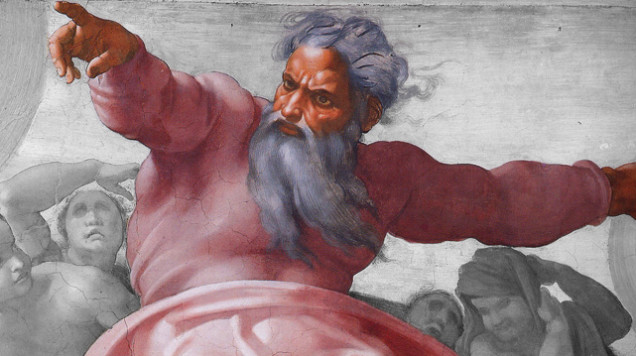
There is nothing unethical about “Noah,” the biblical spectacular that harkens back to the grand old days when Cecil B. DeMille reigned supreme. I haven’t seen the movie, and yet I can say that with absolute certainty. The reason I can say it that there is no way on earth that a movie about Noah and the Ark, in this day and age, could possibly be unethical. Even if the Old Testament were literal fact, which it is not, cannot be and in all likelihood was never intended to be, “Noah” couldn’t possibly be unethical, because it is a movie.

Never mind that of all the Biblical fables, with the possible exception of Adam and Eve, the tale of Noah is perhaps the most obviously impossible. The movie is art—of one kind or another—and does not represent itself as a documentary or make any factual assertions whatsoever. Thus it can be distinguished from a truly unethical film like Oliver Stone’s “JFK,” which intentionally misrepresented recent historical facts to “prove” a theory of the Kennedy assassination that was irresponsible and almost certainly false. Is “Noah” dishonest? It is impossible to be dishonest about a presumptively non-historical event about which there is no direct evidence whatsoever, and when there is no intention to deceive. Is it disrespectful? Art has no duty to be respectful. Is it fair? Fair to who? An artist’s stakeholders are those who appreciate his or her art. Does it do harm, or intend to? No. Continue reading