When Ethics Alarms Don’t Ring: The Firemen and the Baseball Field

In July, a Silver Spring, Maryland fire house captain became so annoyed by home runs landing in the department’s parking lot from a nearby baseball field that he used a hose from a fire truck to flood the field. There is no question about what he did: a video recorded the deluge over the outfield fence that lasted three minutes.

This government employee tantrum, according to Montgomery County court records, caused at least $1,000 in damage and left the baseball field in such bad shape that two home games had to be canceled. Police have filed criminal charges against the captain and a fellow firefighter accused of backing up the truck to assist with the flooding scheme. Christopher J. Reilly, the captain, and Alan K. Barnes, a master firefighter, have each been charged with three misdemeanor counts: disorderly conduct, malicious destruction of property valued at more than $1,000 and conspiring with each other to commit malicious destruction of property.

The Washington Post’s story about the incident goes to great lengths to let apologists for the juvenile fireman have their say. Even if the firemen were to plead guilty, one defense lawyer told the Post, their motives could might be seen by a jury understandable. After all, the Montgomery County fire department explained that baseballs have damaged both the fire station just behind the ball field’s left field fence and vehicles parked in its lot. “I would argue that they thought a little water would be a harmless way to teach them a lesson,” the lawyer said.

Oh. Well, as long as they thought flooding the field was harmless, it was harmless, right? The firemen should both be fired and convicted, but I’ll bet that they get the lightest slap on the wrists at most. They are heroes, after all, and Rationalization # 11, the Kings Pass will protect them if Rationalization #2 or #33 don’t.

Ethics Dunces: The World Anti-Doping Agency, the International Tennis Integrity Agency & Professional Tennis Generally

I rate this episode as pure King’s Pass misconduct by both organizations and professional tennis.

Jannik Sinner, the top-ranked men’s tennis player in the world, just got a three-month ban for testing positive for a banned anabolic steroid last March. He says he “accepted” the short ban, and why wouldn’t he? It means he won’t miss any Grand Slam tournaments. The French Open, the season’s next major, starts May 25 and the ban ends May 4. This is like baseball banning a starting pitcher for throwing a doctored ball for three games so he doesn’t miss any starts.

The International Tennis Integrity Agency had decided earlier not to suspend Sinner by buying his excuse for why he tested positive: the clostebol in his doping sample was due, see, to the player getting a massage from a trainer who had used the substance to help a wound on his finger heal quicker. Never mind that virtually every athlete caught using steroids has claimed “accidental” contamination. It is why baseball went to a strict liability system after its steroid scandal.

Ah, but professional tennis is more dependent on its big stars than baseball for its gate income and TV ratings, so suspending the #1 ranked player in the world has unpleasant ripple effects.

This convenient resolution of Sinner’s violation, however, is also causing some rippling. After the settlement was announced, three-time major champion Stan Wawrinka posted on X: “I don’t believe in a clean sport anymore …” # 8 ranked Daniil Medvedev, said, alluding to double standards (Ya think?), “I hope everyone can discuss with WADA and defend themselves like Jannik Sinner from now on.”

Continue reading

Tales of the King’s Pass

During the baseball off-season the MLB channel on DirecTV has a lot of dead time to fill between the periodic announcements of trades, free agent signings and post-season awards and honors. Lately it has been re-running an old Bob Castas show called “Studio 42” (that’s Jackie Robinson’s number) where the perpetually boyish-looking baseball commentator, who now really is Old Bob, interviews retired players and managers about significant games and moments in their careers.

In an episode I happened across this morning after my dog woke me up and then stole the bed as soon as I got out of it, Costas’s guest was the late, great manager Whitey Herzog, like so many successful baseball managers, a mediocre-to-poor player in his Major League career. Whitey told a story that is as good an example of the King’s Pass, #11 on the Rationalization List, as there is.

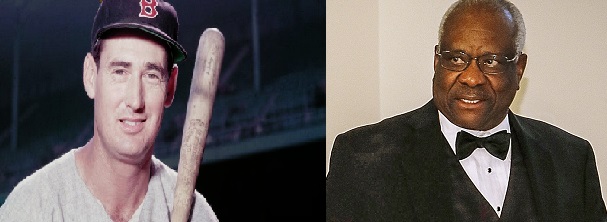
He said that in one game between the old Washington Senators (the first Senators, the team that moved to Minnesota and became the Twins) and the Red Sox in Boston, Ted Williams had drawn a walk on a 3-2 pitch right down the middle of the plate that the umpire had called a ball. Williams was famous for his plate discipline and above-average eyesight, and umpires frequently let him, opposing players complained, call his own balls and strikes because unpires acknowledged that he was better at it than they were. Herzog came to bat late in the same contest having walked four times and with a chance to set a record by getting five bases-on-balls in a single game. He told Costas that the umpire called him out on strikes on a 3-2 pitch in the dirt.

“I turned around and said to the ump, ‘You give Williams five strikes and give me only two. It should be the other way around!'”

This struck me particularly squarely because I had been thinking about the Judicial Conference declining to take any action against Supreme Court Justice Clarence Thomas, who has been the subject of a Senate Judiciary inquiry ever since ProPublica revealed that the Justice had neglected to report around half a million in luxury travel and gifts as legally required by the Ethics in Government Act of 1978.

Continue reading

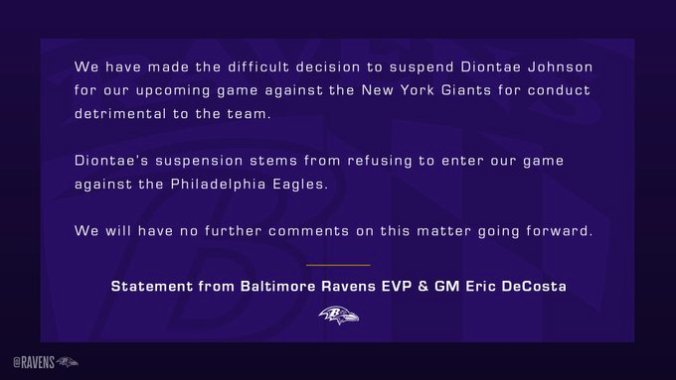
Ethics Dunce: Baltimore Ravens Wide Receiver Diontae Johnson

It is sad but probably to be expected that so many professional athletes don’t get the ethics thingy. The latest incident: Diontae Johnson, a wide reciever for the NFL’s Baltimore Ravens, for refused when his coach ordered him to take the field late in the team’s Week 13 game against the Philadelphia Eagles. The Ravens are still trying to make the play-offs, but it wouldn’t matter if the game had no importance to the Ravens’ fortunes at all. Johnson is a member of the team; he draws a salary. Apparently he was angry and frustrated over his lack of playing time since the Ravens acquired him, and had been complaining to teammates for weeks. “Tough noogies,” as they used to say when I was a kid in Arlington, Mass. (An alternative was “tough bunnies.” I never understood that, any more than I knew what a “hosey” was.)

Johnson was immediately suspended.

Wait…why was this a difficult decision? It was an obvious decision. This week the Ravens announced that Johnson was told to stay away from the team as a likely disruptive influence. There was some question why the Ravens didn’t just release him, but apparently that is because they don’t want any other teams strengthening themselves during the play-off run portion of the season.

Continue reading