Baseball Ethics: On MLB’s Reinstatement of Pete Rose and the 8 Dirty 1919 White Sox

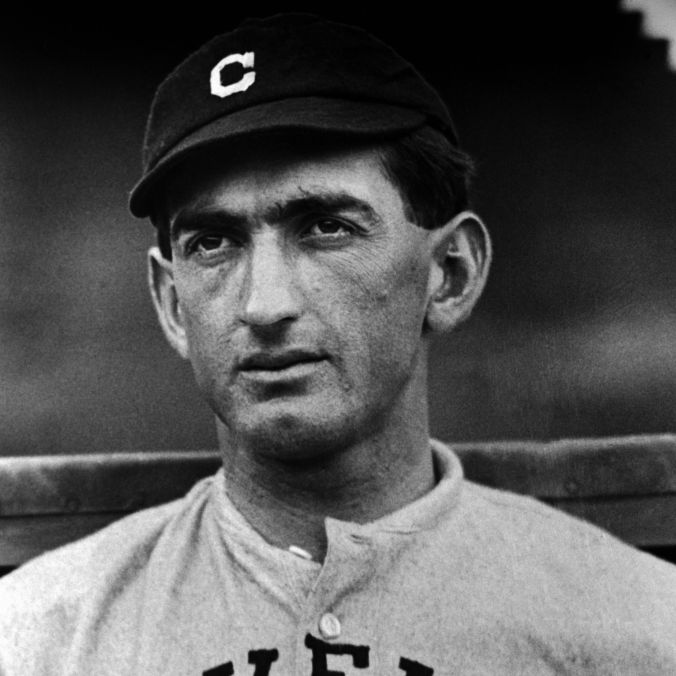
Today Pete Rose and other players “banned for life” by Major League Baseball were reinstated. This doesn’t mean they have been brought back to life, and it won’t get them into baseball’s Hall of Fame in Cooperstown. All it means is that a banning for life doesn’t extend past a banned player’s death.

I have to say, I thought this would bother me more than it does.

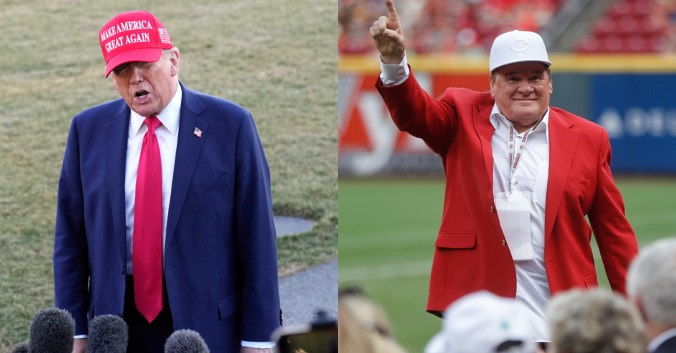
The decision by Commissioner Robert D. Manfred, whom I would regard as the Worst Commissioner Ever were it not for the fact that his predecessor, the revolting Bud Selig, should have that distinction forevermore, was clearly prompted by the death of baseball scumbag Pete Rose, President Trump’s meaningless promise to “pardon” him, whatever that means, and the Rose family’s renewed efforts to get baseball’s all-time hit leader into the Hall of Fame. From a lawyer’s perspective, I can’t quibble with Manfred’s logic that a lifetime ban, however deserved, should expire upon death, as most things do.

Continue reading

Trump’s Pete Rose Pardon: Not the Most Unethical Pardon, Just the Dumbest

Above you see the President with a photo of the late, great, baseball slimeball doing the Nazi salute like Elon Musk, which I’m sure is what endears him to Trump.

Kidding!

Not kidding: between their various pardons, I’m pretty sure Presidents Biden and Trump have so degraded the status of the Presidential clemency power that it will never recover. Once, such pardons conveyed ethical values and legitimate justifications for a President’s compassion. This thobbingly stupid pardon should make the gesture an embarrassment forevermore.

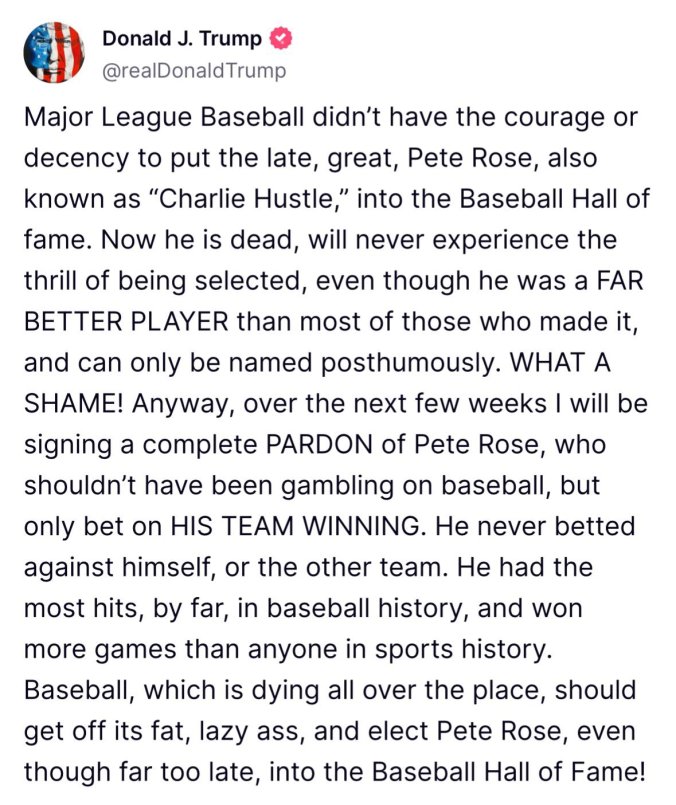
Here is the President’s asinine, even by his standards, Truth Social post:

Ugh. Fisking this crap is too easy but noxious, like shooting dead rats in a barrel…

Continue reading

Again, Hall of Fame Ethics, and Again, Ethically Inert Sportswriters Want To Elect Steroid Cheats

I know I’ve written a ridiculous number of posts about the logical, institutional and ethical absurdity of electing baseballs’s steroid cheats to the Hall of Fame in Cooperstown, but I have sworn to slap this down every time it rears its metaphorical ugly head until my dying day.

The 2025 Baseball Writers’ Association of America voted Ichiro Suzuki (one vote shy of being a unanimous selection), CC Sabathia and Billy Wagner into the Hall. Three quick ethics notes on this. First, whoever it was who left Suzuki off his ballot should be kicked out of the association using the equivilent of the Ethics Alarms “Stupidity Rule.” He is not only a qualified Hall of Famer, but belongs among the upper echelon of Hall of Famers with the likes of Ty Cobb, Babe Ruth, Ted Williams and Rogers Hornsby.

Second, I have no problem with CC Sabathia making the Hall, but that he was elected just a couple of months after Red Sox star Luis Tiant was rejected by a veteran’s committee, probably ending his Hall of Fame chances for good, shows just how arbitrarily the standards for Hall admission are applied. Tiant was objectively better than Sabathia, a bigger star, and while CC was a flashy presence on the mound, Tiant was more so. Luis (or “Loooooie!” as he was known in Fenway Park) died last year, and had said that if they weren’t going to let him into the Hall while he was alive, they shouldn’t bother after he was dead. Maybe the voters were just honoring his wishes…

Continue reading

Ethics Heroes: The Baseball Hall of Fame Era Committee

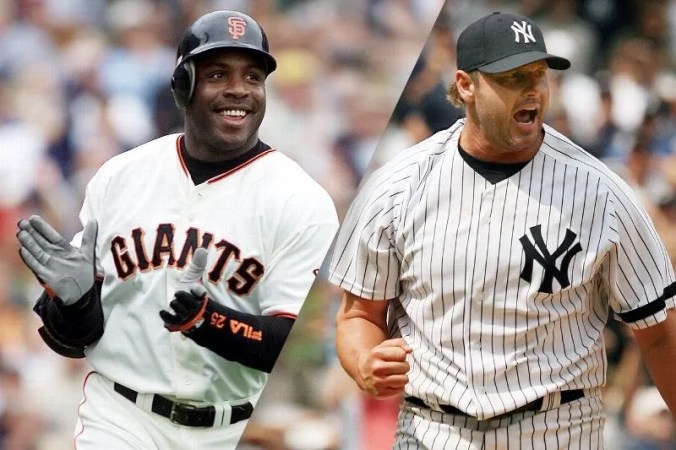
A new 16-member committee was charged with voting on the Hall of Fame membership cases of eight select players who had failed to acquire the necessary number of votes in their years on the main Hall ballots, which are cast by, ugh, baseball’s sportswriters. The results of their deliberations were announced yesterday: of the seven, only one, former Blue Jays first baseman Fred McGriff received the required twelve votes. He is deserving beyond a doubt, but the bigger story and even better news from an ethics perspective is that Barry Bonds, the King of the Steroid Cheats, the game’s career and single season record-holder in home runs, was rejected again. Also seeing their otherwise Hall-worthy career achievements rejected were Bond’s fellow PED-tarnished colleagues Roger Clemens and Rafael Palmeiro, both of whom, like Bonds, received few votes from the committee members.

Continue reading

A Non-Election Day Ethics Special! An Ethics Test For Baseball Hall Of Fame Voters

The major League Baseball Hall of Fame at Cooperstown released its eight-player Contemporary Baseball Era ballot yesterday, as part of its revamped enshrinement process. A 16-person committee including of Hall of Fame players, baseball executives and veteran sportswriters will vote on the candidates at baseball’s winter meetings in December. A player must receive 12 votes to be elected.

All of the eight players failed to get enough votes through the regular voting process. The players on the list, limited to distinguished players who made their greatest contributions from 1980 to the present era, include…

  • Barry Bonds
  • Roger Clemens
  • Curt Schilling
  • Albert Belle
  • Don Mattingly
  • Fred McGriff
  • Dale Murphy, and
  • Rafael Palmeiro.

A clearer ethics test for the voters would be hard to imagine. The threshold question is whether last year’s admission to the Hall of Red Six icon David Ortiz, who once tested positive for an unidentified performance enhancing drug according to test results that were illegally leaked, will be regarded as sufficient precedent to admit Bonds, Clemens, and or Palmeiro. That Bonds was a long-time steroid cheat who did great damage to the game is undeniable. The evidence against Clemens is weaker, but still damning. Palmeiro had the distinction of going before Congress and proclaiming that steroids were the bane of the game and he would never sully himself by using them, and quickly thereafter testing positive himself. None of those three should be admitted to the Hall, and the presence of current Hall of Fame members, I hope, may ensure that they are not. Continue reading

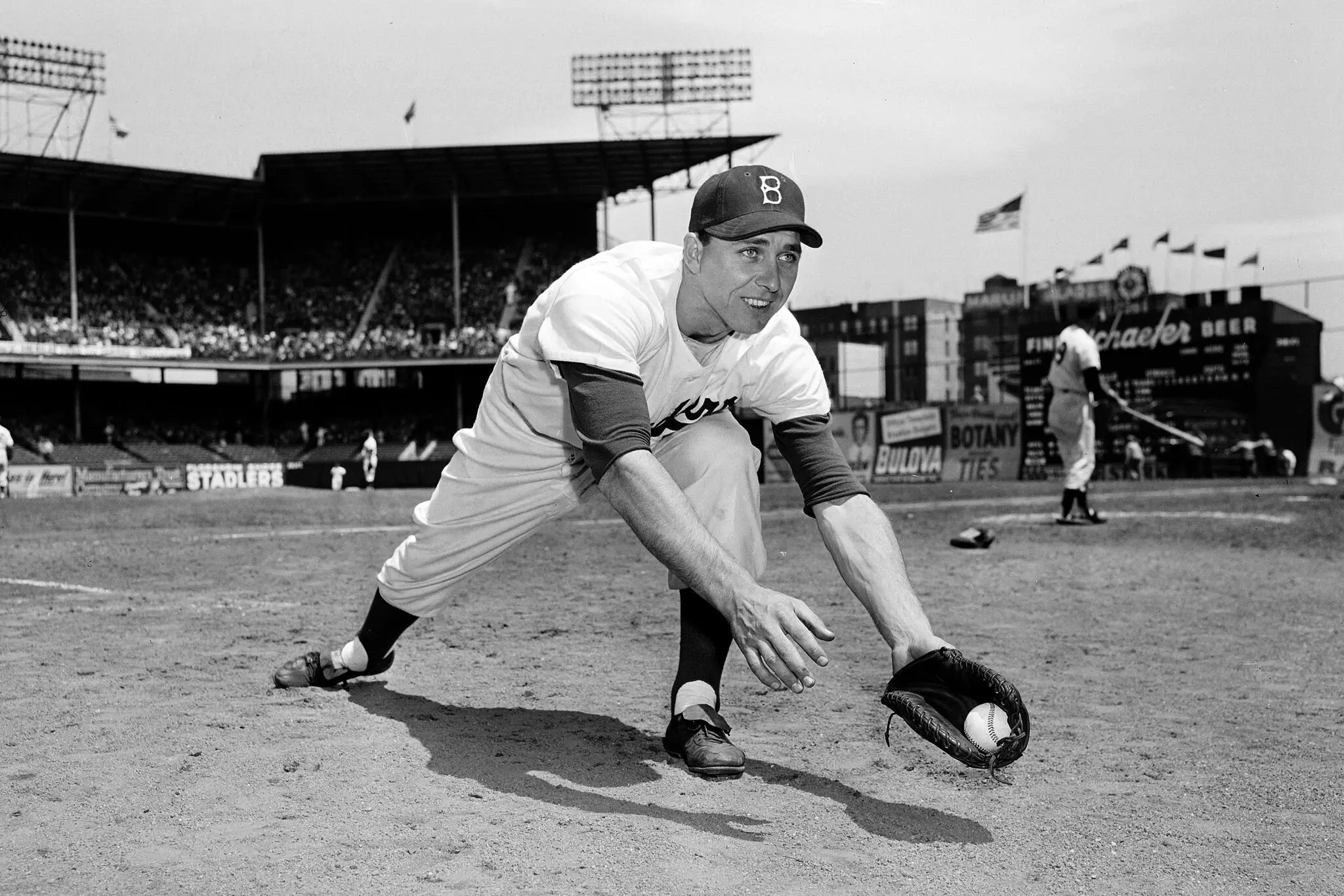
A “Bias Makes You Stupid” Case Study: Gil Hodges And The Hall Of Fame

Hodges

Let’s get the easy part out of the way right off the bat: Gil Hodges, elected this week to the Major League Baseball Hall of Fame in Cooperstown, NY, was not a Hall of Fame caliber player, and it was as a player that he was selected. He was also not qualified to be voted into the Hall as a manager, though there is no question that Hodge’s single famous achievement as a manager, the upset World Series Championship attained by the 1969 Mets, played a large part in burnishing his reputation.

And yet the group of old ex-players and others that make up what used to be called the Hall of Fame’s Veteran’s Committee put Hodges, who died suddenly 50 years ago at the age of 48, voted to place a plaque honoring him among those of Lou Gehrig, George Sisler, Harmon Killebrew, Jeff Bagwell and other far superior first basemen in the game’s long history. (To be fair, Hodges isn’t the least qualified HOF member at that position; that distinction goes to Tony Perez.) The reason for Hodges’ ascension was bias, the positive variety for a change, and lots of it.

Continue reading

How Sloppy (Or Dishonest) Historical Research Can Deceive For Decades: The Daniel “Doc” Adams Affair

AdamsDoc

While we’re on the topic of “disinformation”….

Let’s have a show of hands, shall we? How many of you think that Civil War General Abner Doubleday invented baseball? Let’s see, one…two...thirty four…wow, that’s still a lot, especially since Doubleday’s connection to the game was thoroughly debunked almost a century ago and there is no evidence that he ever claimed any credit for the development of the game. Nevertheless, a commission appointed in 1905 to determine the origin of baseball announced in1907 that “the first scheme for playing baseball, according to the best evidence obtainable to date, was devised by Abner Doubleday at Cooperstown, New York, in 1839.”

We now know—well, some of us know—that the “best evidence” was, to put it technically, crap. Abner wasn’t much of a general either.

OK, now those who have heard of “Doc” Adams ( 1814 – 1899) and know he was one of the major contributors to the invention of baseball as it is played today raise your hands. One..one? That’s all? Documents show that all Adams did—he was an early baseball player and later a league executive who oversaw writing “The Laws of Baseball”—was to establish the distance between bases at 90 feet apart, settle the length of a game at 9 innings and define a baseball team as nine players rather than eight, ten or eleven. He also invented the position of “shortstop.”

Continue reading

Once Again, Hall Of Fame Ethics (Or The Lack Of Them)

Schilling

The MLB Hall of Fame vote, at least since the Steroid Era, gives us a window into the ethics of baseball writers, and the view is pretty grim. Baseball Writers’ Association of America ballots, many of which are made public before the election results are revealed, annually show dead ethics alarms and an absence of critical thinking, but as someone who has been reading these guys (they are almost all guys) since I was 12, this is no surprise. The smart and thoughtful ones like Joe Posnanski, Roger Angell, Bill James and Peter Gammons, are exceptions. I wouldn’t trust most of the rest to take out the trash.

A player who has been retired for at least five years has to be on 75% of the writers’ ballots (ten players can be listed on a ballot) needed to be “enshrined,” as they like to say in the Cooperstown museum, and a player has ten tries to make it. This year, nobody was selected.

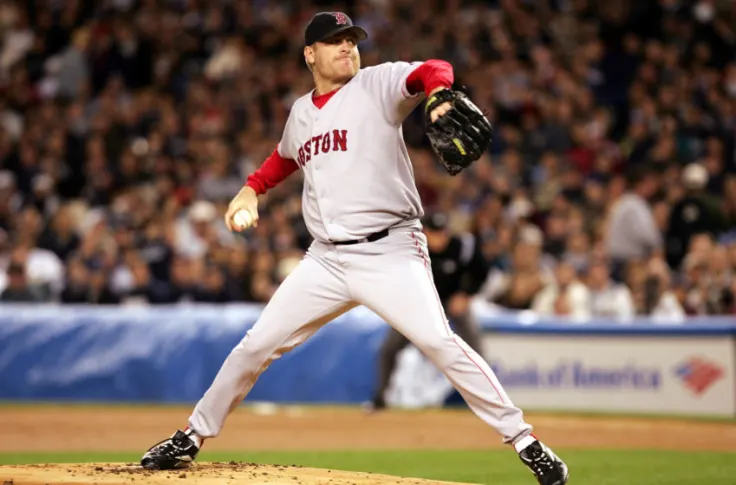
The result was a slap in the face to former Orioles, Philadelphia, Arizona and Red Sox starting pitcher Curt Schilling, and was intended to be. He just missed the 75% level last year, and usually that means that a player gets in the Hall the next time, especially in a year like this one, where there were no major additions to the candidates. Schilling, by prior standards, by statistical analysis, and by the simple reality that he was famous while playing and had a single iconic moment that will keep him in baseball lore forever—the “bloody sock” game, should be an easy call. Yet ESPN and other sources refer to him as “controversial.” Why is he controversial? He’s controversial because he is religious, conservative, Republican, and an outspoken Trump supporter, none of which has a thing to do with baseball. Schilling also, to his credit, refuses to submit to his critics and the social media mobs. He is independent and comfortable with who he is, he is articulate in expressing his opinions (at least by typical athlete standards), and can and will defend his points of view. He shouldn’t have to, however, to be admitted to the Hall of Fame.

His sportsmanship and professional comportment while playing was never less than impeccable. Curt Schilling has a deep respect for the game (one opinion that has been held against him is his insistence that steroid users are cheaters), and he has done nothing since leaving baseball that was sufficiently vile to harm it in any way. To the contrary, he and his wife (now battling cancer) have been active in charity work and community projects. That satisfies the Hall’s so-called “character clause.”

Continue reading

Morning Ethics Warm-Up, 4/17/2020: Sir Paul, Fauxahontas, #MeToo, The Flying Ace, And The 2016 Ethics Villain Of The Year

good morning.

my college freshman dorm room was where e.e. cummings spent his freshman year too. never liked ol’ e.e.’s poetry much, but admired his clever stunt to avoid having to worry about upper case letters, presenting laziness as style.

i wonder if i could do the same thing with basic spelling?

1. You don’t necessarily have to blame the victim, but you shouldn’t give him gifts for being irresponsible either. Pitching ace Roy Halladay had only been retired for three years when he died in the crash of a private plane he was flying. After his death, he was elected by baseball writers to the Major League Baseball Hall of Fame ahead of the mandatory five -year waiting period, an honor that was given posthumously to Roberto Clemente, the Pittsburgh Pirates outfielder who died in a plane crash in 1972 while trying to deliver relief supplies from Puerto Rico to earthquake-ravaged Nicaragua. Clemente was a no-arguments Hall of Famer; Halladay was not, though he was certainly a valid candidate. He was elected by sympathy and emotion as much as by careful evaluation; this is one reason the Hall makes players wait at least five years. Now the  National Transportation Safety Board’s report on the investigation of his death is coming out.

This week it reported that Halladay had a  mix of amphetamine, morphine and other prescription drugs in his system while he was doing aerial acrobatics and stunt flying. It was a miracle that he didn’t kill anyone else, as he was flying dangerously close to boats before his amphibious sport plane  plunged into the Gulf of Mexico  on Nov. 7, 2017.

The 13-page report says Halladay had 10 times the recommended level of amphetamine in his system, as well as an antidepressant, a muscle relaxant, a sleep aid and morphine. Continue reading

From The Ethics Alarms “Butt Out!” Files: Now Members Of Congress Are Telling The Hall Of Fame Who To Enshrine

Yesterday,  U.S. Rep. David Trone Trone (D-Md.) and  Rep. William Lacy Clay (D-Mo.), Rep. Ann Wagner (R-Mo.) and Sen. Roy Blunt (R-Mo.) held a news conference calling  on the Major League Baseball Hall of Fame’s Golden Era Committee to nominate and elect former centerfielder Curt Flood when the committee meets in December. Trone said he was looking for something that both parties could agree on, and hit on this, which is, coincidentally, something neither party has any expertise about whatsoever.

“This really resonates across both sides of the aisle,” Trone said.  “Everybody in America, whether you’re Republican, Democrat, independent, white, black or brown, believes in the American dream and fairness and decency. Decency and fairness and justice. And we all believe in that at our core, in all parties, in all colors.’’

Trone says he polled colleagues in each party about supporting Flood “because Washington is such a broken community, nobody is doing stuff together. We ought to try where we can actually do something together to honor somebody who really paid a price. Curt Flood paid a pretty horrible price. He put everything on the line — his whole career, his whole life, he put it all out there on the line. It’s been really easy for people to come together and say, ‘You know what? We have to do something about this. Let’s do something decent for a change and speak to who America really is.”

Grandstanding. Race-pandering. Virtue -signaling. Abuse of position.

Also ignorant and stupid. Continue reading