Morning Ethics Warm-Up, 4/4/2018: Baseball Lies, A Presidential High Crime, And A Judge Makes A Panty Raid


http://www.youtube.com/watch?v=BPoiac9I9OY

Wake Up!

1 Fake history, baseball style. Broadcasts of Red Sox games from Fenway Park in Boston refer to “the Pesky Pole,” the official name of the tall, yellow foul pole in right field. It is named in honer of the late Johnny Pesky, who also is honored in a statue outside the park—it featured him and his team mates and longtime friends, Ted Williams, Dom DiMaggio, and Bobby Doerr. Pesky, with a couple of brief interruptions,was a Red Sox lifer, beginning with his 1942 rookie season, and ending with his death several years ago as an honorary coach. In between, he was Sox minor league manager, the big team’s manager, a hitting coach and a broadcaster.

The Pesky Pole got its name because the notoriously power-free shortstop reputedly hit several of the few he managed to slug in his career by knocking a pitch  around the marker, which arose from  what is now the shortest foul line in baseball. The  low Fenway right field fence veers sharply out from there to over 400 feet, so such homers are considered, and indeed are, lucky flukes. During his brief and undistinguished tenure as a Red Sox radio color man, former Red Sox pitching ace Mel Parnell repeatedly told the story about how Johnny won a game for Mel in 1948 with a pole-shot. This tale led directly to the team officially naming the pole on September 27, 2006, on Pesky’s 87th birthday, with a commemorative plaque placed at its base and everything.

Afterwards, and not before, someone actually checked the game records. Pesky never hit the home run  described by Parnell. He only hit six home runs in Fenway at all, and nobody knows how many hit the pole, looped around the pole, or even went to right field. (Pop-ups hit by Punch-and-Judy hitting shortstops sometimes landed in the screen over the left field wall for home runs, as the cursed Bucky Dent can attest.) Nevertheless, the fake history is in place: the Pesky Pole is named that because Johnny Pesky hit a famous home run off of it, or was famous for looping cheap homers around it, or something.

Baseball excels at creating fake history, the most notable being represented by the locale of its Hall of Fame, in Cooperstown, New York. When the museum was envisioned, the accepted story about the game’s origin was the Union general Abner Doubleday invented the sport in 1839 and organized the first game in Cooperstown. After the construction was underway,  research suggested that everything about the Doubleday tale was rumor and myth, but baseball and the museum’s management, in one of the all-time classic examples of adopting the philosophy of the newspaper editor in “The Man Who Shot Liberty Valence,” went to great lengths to keep the original story before the public. Eventually some hard evidence surfaced suggesting that the game was invented by Alexander Cartwright, who was eventually inducted into the Hall as the game’s creator, while Doubleday is not. Nonetheless, the myth survives. Major League Baseball Commissioner Bud Selig, for example,  said in 2010 that “I really believe that Abner Doubleday is the ‘Father of Baseball.'” This is the equivalent of saying that one believes in the Easter Bunny.

Selig was later inducted into the Hall of Fame.

2.Believe it or Not! I would support impeaching  President Trump for his tweeting attacks against Amazon. This is such an abuse of Presidential power that it demands at least a Congressional reprimand or sanction. Amazon lost $53 billion in market value in the wake of the tweets, meaning that investors, retirees, and ordinary Americans lost wealth as well. It is unconscionable for a President of the United States to deliberately target a company, just as it is wrong for a President to punch down at a private citizen, but the consequences of doing what Trump has done to Amazon is far, far worse. The Wall Street Journal suggested in an editorial that if the attack on Amazon was politically motivated because Amazon mogul Jeff Bezos owns the Washington Post, impeachment would be justified. Yes, that would be even worse, but it is not an essential element of this “high crime.” The President of the United States must not abuse his power by intentionally harming lawful businesses.

The foolish resistance is so focused on trying to impeach Trump based on exotic laws and imaginary conspiracies that it doesn’t see the real thing when it’s right in front of its face, and the anti-Trump media has so destroyed its credibility by embracing ridiculous impeachment theories that a valid one will just look like more of the same. Continue reading
I Know, I Know, But I Swore I Would Never Let A Bad Barry Bonds Defense Go Unanswered

There are a few reoccurring assertions that Ethics Alarms readers know I am duty bound to defenestrate, no matter how repetitious it is for them and me. The gender gap argument in salary is one; election night in 2016 spawned another, when hack historian Doug Brinkley falsely claimed that the same party seldom holds the White House for three straight terms. That Bill Clinton’s sexual misconduct was “private personal conduct” unrelated to his professional trustworthiness was long on my list, though that one seems to be, finally, discredited. There are others involving gun control, marriage, illegal immigration and more; I should list them in one place some day.

None annoys me any more, however, than the rationalizations mounted to claim that steroid cheats belong in baseball’s Hall of Fame.

It happened again this week, as it will every time the Hall of Fame ballots are counted this time of year. On the MLB Channel on Sirius-XM, two alleged experts, analysts Casey Stern and former pitcher Brad Lidge each gave their list of ten former players who belonged in the Hall of Fame, and both listed Barry Bonds and Roger Clemens as deserving. When Lidge went through his “reasoning”—I hate scare quotes, but here they are unavoidable—I wanted to leap through my car radio and throw him out his studio.

It wasn’t just the unethical opinion that infuriated me. It was the sheer ignorance and intellectual laziness of it. The man clearly has never practiced critical thinking in his life. Nobody taught him. Like the President, he literally doesn’t know what ethics are, and reasons by rationalizations and conventional wisdom, meaning that if enough dolts say something, it becomes a persuasive position to him. It is unethical—malpractice, negligence, incompetence—to argue like this when you are holding yourself up as an expert, and addressing the public through mass media. You are making the public more ignorant and stupid, and less able to think clearly, with every word. Stern, who is about five times smarter and more articulate than Lidge, used slightly less moronic arguments to defend Bonds, but only slightly.

So I’m sorry if you have heard this before, but I made a promise to myself, my readers, and baseball, which I love. Here are Lidge’s arguments to allow Bonds into the Hall of Fame, and why they are crap.

  • Bonds was on his way to a Hall of Fame career before he used steroids.

Yes, and that brilliant scientist was on the way to a Nobel prize before he falsified his data. This idiotic argument–maybe the worst of the worst—absurdly holds that if  something would have occurred if a disqualifying event hadn’t happened, the disqualifying event shouldn’t count. It also embodies the “he didn’t have to cheat, so his cheating was no big deal” fallacy. This would have excused Richard Nixon: after all, he won by a landslide anyway, so what difference does it make that he tried to illegally undermine the McGovern campaign? Ugh. It makes me crazy even writing about this one.

  • Bonds cheated during a period when cheating was rampant, so a lot of the player he surpassed weren’t disadvantaged.

Continue reading

Baseball Hall Of Fame Ethics Bulletin

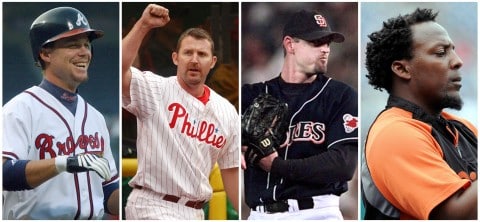
The results of the voting for the Major league Baseball Hall Of Fame in Cooperstown are in. The Baseball Writers Association of America elected Braves third-base great  Chipper Jones, slugger Jim Thome , relief pitcher Trevor Hoffman and Montreal Expo legend Vladimir Guerrero, excellent ad deserving choices all.

Joe Morgan is happy tonight. The writers did not elect Barry Bonds, Roger Clemens, Manny Ramirez, Sammy Sosa or Gary Sheffield, steroid cheats all. Nor did any of them come particularly close to the 75% of ballots cast (a voter can select up to ten) necessary for enshrinement.

Good.

Morning Ethics Warm-Up, 1/2/2018: Cheaters, Stoners And Head Explosions

good morning

(i lived in e e cummings’ old dorm room as a college freshman. never got him at all, but it would be great not to have to worry about the shift key)

1 Three wrongs don’t make a right. They track baseball’s Hall of Fame votes as they come in now, using those ballots that the baseball writers make public (not all of them do). It looks like neither Barry Bonds, nor Roger Clemens, the all-time “greats”—cheaters cannot be fairly considered great—who sullied the game and its records by using performance enhancing drugs, are not gaining support to the extent than many predicted, and will fall short again.

Good. That makes six years down and only four more to go before the two are no longer eligible for this method of entering Cooperstown. Not so good is the development that the newer and younger voters tend to support Barry and the Rocket while the older sportswriters they replace as voters did not. Why is this? Well, the young Turks don’t see anything wrong with illegal drugs, for one thing: they probably used–use?— them themselves. Next, they have been hearing the routine rationalizations and flawed arguments defending Bonds for 20 years, which can rot one’s brain—I know they have nearly rotted mine, and I know they are worthless. Mostly, I think, each succeeding American generation has less ethical literacy and competence than the one before. The field isn’t taught in grade school, is barely mentioned in the media, and unlike the good ol’ days of “The Lone Ranger,” “Father Knows Best”  and “The Defenders,” popular culture undermines an ethical culture more than it nurtures one.

There is also a new bad argument for letting in Bonds and Clemens, which would then open the floodgates for arguably worse baseball deplorables like Alex Rodriguez and Manny Ramirez—who knows? Maybe even Pete Rose. That line of reasoning  is that since the Baseball Commissioner, Bud Selig, who averted his gaze while the steroid epidemic was infecting every team and the evidence was undeniable, was admitted to the Hall last year by his complicit cronies, the cheating players he enabled should be forgiven too.

That this is increasingly being cited a justification by the younger writers tells us that mothers aren’t teaching their kids that two wrongs don’t make a right any more.

2.Three wrongs don’t make a right, Part II. In related news, California went all-pot-head at midnight New Years Eve. My conviction that legalizing marijuana is an abdication of government’s responsibility to protect society, a leap down a deadly slippery slope, and the product of greed and cowardice hasn’t abated one iota, but I’m happy to have a large-scale experiment to prove me wrong—or right. Now we can expect a wave of stoners as well as illegal immigrants into the Golden State—ah, what a paradise it will be! This creeping crud in U.S. culture is also in part the result of a terrible example of “two wrongs make a right” fallacy—I’m sure you have either heard it or—yecchh—used it yourself. “Alcohol and tobacco are worse than marijuana, and they are legal!”

Yes, about that: guess what is on the rise and killing more people? From the New York Times a few days ago:

[A]lcohol overuse remains a persistent public health problem and is responsible for more deaths, as many as 88,000 per year. … [T]here has been about a 50 percent uptick in emergency room visits related to heavy drinking. After declining for three decades, deaths from cirrhosis, often linked to alcohol consumption, have been on the rise since 2006….[B]inge drinking — often defined as five per day for men and four per day for women — is on the rise among women, older Americans and minorities. Behind those figures there’s the personal toll — measured in relationships strained or broken, career goals not met and the many nights that college students can’t remember.

3. Gee, thanks, David, I love starting a new year with my brains on the ceiling...David Leonhardt, one of the many Democratic operatives with press credentials (Instapundit calls them)  writing for New York Times, exploded my head with his New Years column, “7 Wishes for 2018.” His wishes 1, 2, 6 and 7 each would have done the trick by themselves, but collectively it was Krakatoa all over again.

Here are David’s four wishes: Continue reading

Why Marvin Miller Doesn’t Belong In The MLB Hall Of Fame In Cooperstown [Updated and RETRACTED!]

UDDATE! With apologies to all, I’m retracting this post. I had bad information: the entire thesis of the post is based on the false belief, which I acquired literally decades ago, that baseball union chief Marvin Miller was a lawyer. I know that a lawyer should not be celebrated for achieving the goals of his client; I’m not at all sure about my conclusions if the individual is a non-lawyer labor leader. I haven’t considered Miller in that context. I have to think about it.

I apologize to Ethics Alarms readers and also the admirers of Mr. Miller, and I hope he won’t be visiting me on Christmas Eve. One thing the web doesn’t need is more bad information, and I regret adding to it, even for a couple of hours.

My sincere thanks to reader LoSonnambulo for the slap in the face…

Last week,  Major League Baseball’s 6-member Modern Baseball Era committee considered ten Hall of Fame candidates, previously passed over in the regular voting process, whose biggest contributions to the game came between 1970 to 1987. It elected former Detroit Tigers and Minnesota Twins starting pitcher Jack Morris and his Tiger team mate Alan Trammell, one of the very best shortstops of the era. Both were borderline choices, but Trammel was certainly deserving. Morris got over the hump because of a single memorable game, his Game 7, 10-inning, 1-0 shutout that won the 1971 World Series for Minnesota over Atlanta in of the 1991 World Series. Now that starting pitchers in the Series seldom go even 5 innings, much less ten, Morris’s performance seems especially god-like, but the fact remains that single achievements are not supposed to put players in the Cooperstown, New York Museum. Among the candidates who were rejected was my beloved Luis Tiant, the spinning, whirling, Cuban ace of the Cleveland Indians and Boston Red Sox, one of the most unique pitchers in the history of the game, and while he was active, universally considered a great player, which he was. “Looie” deserves to be in the Hall, and is in his eighties now. He should have been voted in over Morris.

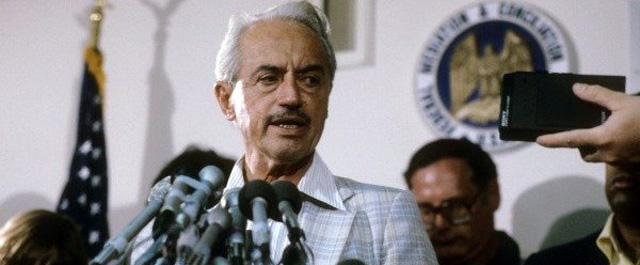
But the rejected candidate that sportswriters have long been rooting for wasn’t even a player. He’s Marvin Miller, who died in 2012 and who headed the players’ union from 1966 to 1982. Under Miller’s direction, the MLB players’ union became one of the strongest unions in the United States. He is credited with leading the efforts to eliminate the Reserve Clause, which once bound players to teams until they were traded, released, or retired. When he took over the union, the top baseball salary was about $100,000 a year. Today it is about 30 million a year, and the minimum salary is over $500,000. Legendary broadcaster Red Barber once said that  Miller, “along with Babe Ruth and Jackie Robinson, is one of the two or three most important men in baseball history.”

Well, Arnold Rothstein, Barry Bonds and the inventor of anabolic steroids had immense impact on baseball too. Continue reading

Ethics Hero: Baseball Great Joe Morgan

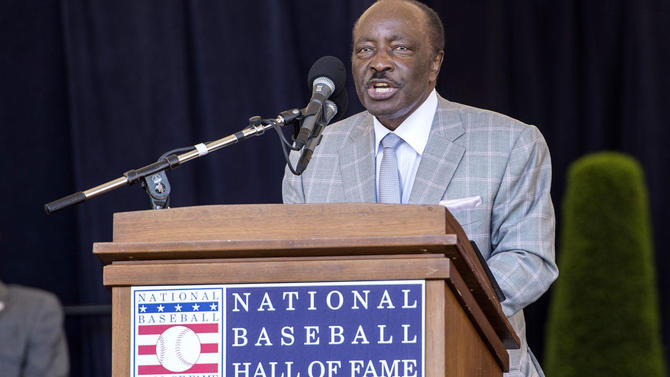
The baseball writers are filling out their Hall of Fame ballots, and Hall of Fame member Joe Morgan authored a much-needed letter on behalf of his fellow honorees to urge voters to keep steroid cheats out of the Hall. He wrote—on Hall of Fame stationary, so it is clear that this was both personal and official:

The Hall of Fame is Special – A Letter from Joe Morgan

Over the years, I have been approached by many Hall of Fame members telling me we needed to do  something to speak out about the possibility of steroid users entering the Hall of Fame. This issue  has been bubbling below the surface for quite a while. 

I hope you don’t mind if I bring to your attention what I’m hearing. 

Please keep in mind I don’t speak for every single member of the Hall of Fame. I don’t know how  everyone feels, but I do know how many of the Hall of Famers feel. 

I, along with other Hall of Fame Baseball players, have the deepest respect for you and all the writers who vote to decide who enters Baseball’s most hallowed shrine, the National Baseball Hall of Fame. For some 80 years, the men and women of the BBWAA have cast ballots that have made the Hall into the wonderful place it is. 

I think the Hall of Fame is special. There is a sanctity to being elected to the Hall. It is revered. It is  the hardest Hall of Fame to enter, of any sport in America. 

But times change, and a day we all knew was coming has now arrived. Players who played during  the steroid era have become eligible for entry into the Hall of Fame. 

The more we Hall of Famers talk about this – and we talk about it a lot – we realize we can no longer  sit silent. Many of us have come to think that silence will be considered complicity. Or that fans  might think we are ok if the standards of election to the Hall of Fame are relaxed, at least relaxed  enough for steroid users to enter and become members of the most sacred place in Baseball. We don’t want fans ever to think that. 

We hope the day never comes when known steroid users are voted into the Hall of Fame. They  cheated. Steroid users don’t belong here. 

Players who failed drug tests, admitted using steroids, or were identified as users in Major League  Baseball’s investigation into steroid abuse, known as the Mitchell Report, should not get in. Those  are the three criteria that many of the players and I think are right. 

Now, I recognize there are players identified as users on the Mitchell Report who deny they were  users. That’s why this is a tricky issue. Not everything is black and white – there are shades of gray  here. It’s why your job as a voter is and has always been a difficult and important job. I have faith in  your judgment and know that ultimately, this is your call. 

But it still occurs to me that anyone who took body-altering chemicals in a deliberate effort to cheat  the game we love, not to mention they cheated current and former players, and fans too, doesn’t  belong in the Hall of Fame. By cheating, they put up huge numbers, and they made great players  who didn’t cheat look smaller by comparison, taking away from their achievements and consideration for the Hall of Fame. That’s not right. 

And that’s why I, and other Hall of Famers, feel so strongly about this.  

It’s gotten to the point where Hall of Famers are saying that if steroid users get in, they’ll no longer  come to Cooperstown for Induction Ceremonies or other events. Some feel they can’t share a stage  with players who did steroids. The cheating that tainted an era now risks tainting the Hall of Fame  too. The Hall of Fame means too much to us to ever see that happen. If steroid users get in, it will  divide and diminish the Hall, something we couldn’t bear. 

Section 5 of the Rules for Election states, “Voting shall be based upon the player’s record, playing  ability, integrity, sportsmanship, character, and contributions to the team(s) on which the player  played.” 

I care about how good a player was or what kind of numbers he put up; but if a player did steroids,  his integrity is suspect; he lacks sportsmanship; his character is flawed; and, whatever contribution  he made to his team is now dwarfed by his selfishness. 

Steroid use put Baseball through a tainted era where records were shattered. “It was a steroidal farce,” wrote Michael Powell in the New York Times. It is no accident that those records held up for decades until the steroid era began, and they haven’t been broken since the steroid era ended.  Sadly, steroids worked. 

Dan Naulty was a journeyman pitcher in the late 1990s who admitted he took steroids, noting that his fastball went from 87 to 96. He told Sports Illustrated’s Tom Verducci in 2012, “I was a full-blown  cheater, and I knew it. You didn’t need a written rule. I was violating clear principles that were laid down within the rules. I understood I was violating implicit principles.” 

The Hall of Fame has always had its share of colorful characters, some of whom broke or bent society’s rules in their era. By today’s standards, some might not have gotten in. Times change and  society improves. What once was accepted no longer is. 

But steroid users don’t belong here. What they did shouldn’t be accepted. Times shouldn’t change  for the worse. 

Steroid users knew they were taking a drug that physically improved how they played. Taking  steroids is a decision. It’s the deliberate act of using chemistry to change how hard you hit and throw by changing what your body is made of. 

I and other Hall of Famers played hard all our lives to achieve what we did. I love this game and am  proud of it. I hope the Hall of Fame’s standards won’t be lowered with the passage of time.  For over eighty years, the Hall of Fame has been a place to look up to, where the hallowed halls  honor those who played the game hard and right. I hope it will always remain that way. 

Sincerely, 

Joe Morgan

Good.

I agree in every respect. Continue reading

Morning Ethics Warm-Up: 8/1/17


Good Morning, World!

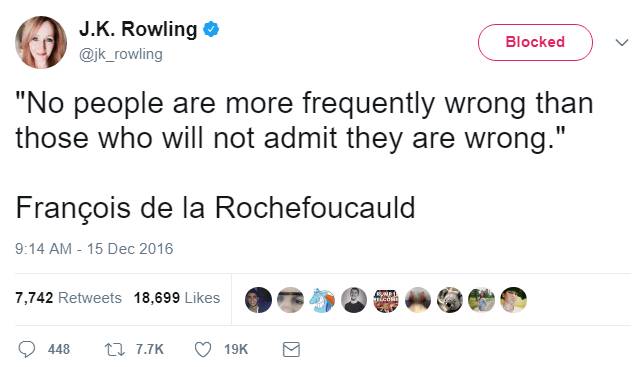
1. Follow-Up on the 7/28 morning post: Sometimes a popular public figure’s words and conduct so obviously show a deficit of character that I wonder if those who admire him or her are not paying attention, or are creeps themselves. “Harry Potter” author J.K. Rowling is officially in this category. First, I do not care for foreigners who obsessively bash our leaders, however bashable. They don’t have standing, in most cases, and their opinions are by definition uninformed if they don’t live here. Most obnoxious of all, however, in Rowling’s case, was her indefensible conduct regarding her recent infamous fake news tweet that circulated to her mob of followers a deceptively edited video showing President Trump cruelly ignoring a boy in a wheelchair, when he in fact stopped, crouched, and spoke to the child. She did this (“When someone shows you who they are, believe them.’ – Maya Angelou” was the snotty accompanying comment) on July 28, and the same day it was widely debunked, with the actual video being circulated on the web. No response came from Rowling, even as her tweet and libel continued to be liked and retweeted by “the resistance.”

On July 30, even CNN’s Brian Stelter, with extra time on his hands because his alleged news media ethics show avoids criticizing bias in the news media, flagged the bad tweet, and asked why Rowling hadn’t retracted it. Come on, Brian, you know why! It is for the same reason CNN continues to use unethical journalism to attack the President: they don’t believe he’s worthy of fairness or honesty.

Finally,  after various conservatives dredged up this year-old tweet from Rowling to show her hypocrisy and shame her with her own chosen words…

and after left-wing, fellow Brit Trump-basher Piers Morgan expressed frustration with her, and after PunditFact, a spin-off of PolitiFact, rated Rowling’s claim “Pants on Fire,” and after the boy’s mother herself denied that Rowling’s version occurred, the author finally retracted the tweet and took it down. She also tweeted this unethical apology:

Re: my tweets about the small boy in a wheelchair whose proferred hand the president appeared to ignore in press footage, multiple sources have informed me that that was not a full or accurate representation of their interaction. I very clearly projected my own sensitivities around the issue of disabled people being overlooked or ignored onto the images I saw and if that caused any distress to that boy or his family, I apologise unreservedly. These tweets will remain, but I will delete the previous ones on the subject.

This is a miserable apology, containing the stinking tell of the non-apology apology, “if anyone was offended” in this case the equivalent “if that caused any distress.”  The two people she non-apologizes to had no reason to be “distressed,’ since the tweet wasn’t an attack on them. This is not an apology at all, since it does not apologize ..

…to the person fraudulently attacked, President Trump, as well as his family and supporters

…to those deceived by her retweeted lie, and

…to the people who trusted her and became accessories in the false attack

…for taking four days to take down a lie that had been thoroughly exposes as one.

On the Ethics Alarms Apology Scale, it is a bottom of the barrel #10:

An insincere and dishonest apology designed to allow the wrongdoer to escape accountability cheaply, and to deceive his or her victims into forgiveness and trust, so they are vulnerable to future wrongdoing.

This rot is actually worse than a #10, as Rowling dares to ladle soppy virtue-signalling onto it. She only falsely attacked the President of the United States and spread a lie around the world because she is so, so sensitive and concerned about the treatment of handicapped people! Don’t you understand? It’s because she’s so compassionate and good that this happened!

It is my experience that good people can usually manage a sincere and remorseful apology to those harmed by their words or conduct.

2. This unethical lawsuit could sustain a stand-alone post, but I refuse to devote one to it as a matter of principle. Continue reading

From “The Ethics Incompleteness Principle” Files: Anomalies And The Boston Red Sox Uniform Number Retirement Standards

The Ethics Incompleteness Principle argues that no rule works in all circumstances, so you have to be alert to when making exceptions is appropriate. The concept is illustrated by how the Boston Red Sox retire uniform numbers.

I will explain…

Major League Baseball teams retire the uniform numbers of players who they want to honor in perpetuity. The number is displayed somewhere in the ballpark, and no player on that team can ever wear it again.

Doing this requires standards, however, or else the honor becomes diluted and the retired numbers include those that seem increasingly strange and arbitrary as time goes by. The New York Yankees have retired so many uniform numbers that no single digit will ever again grace the back of a Yankee star. Moreover, several of the individuals who sanctified those numbers include players who never were and never will be called “great,” like Bernie Williams, who led the league in exactly one category, once, in his entire career, and whose Similarity Score index contains all very good but not great outfielders, the most similar being Paul O’Neil, a former Yankee star whose uniform is not retired. Another retired Yankee uniform number is that of Roger Maris, who only played for the Yankees for six years, many of them unremarkable. Having one’s uniform retired in the Bronx along with those of Babe, Lou, Mickey and Joe appears to mean “Somebody in charge really liked him.”

Well, at least that’s a standard that is easy to maintain.

The Boston Red Sox, in contrast, were not going to have a retired uniform glut. The franchise established an iron set of criteria for the honor, with three prongs:

1. The player must be an inarguable Red Sox great who played at least 10 years with the team.

2. The player must be an elected member of the Baseball Hall of Fame in Cooperstown.

3. The player must retire as a member of the Red Sox.

Today the Red Sox are retiring the number of David Ortiz, who retired himself at the end of last season. While he might well be voted into the Hall of Fame, he may not, for complex and controversial reasons. The Red Sox, who could reasonably argue that Ortiz has been the most popular and important player in the team’s history (though Ted Williams was the best) rightly concluded that to delegate to the  Hall of Fame voters the determination of whether Ortiz’s #34 would be retired with lesser Boston heroes made no sense. Thus his uniform number will momentarily obliterate that second prong, which had already been waived once. In that case, the beneficiary was Johnny Pesky, a classic anomaly and line-blurrer. Continue reading

Ethics Dunce: “The Big Hurt,” Frank Thomas [UPDATED]

An ethics whiff for Frank Thomas

An ethics whiff for Frank Thomas

Baseball, and all its annual ethics puzzles, begins in about two weeks when Spring Training gets underway.  Meanwhile, I have to tolerate everyone talking about Tom Brady and the Cheating Patriots as the NFL makes billions encouraging  Americans to cheer for the gradual lobotomizing of young athletes for their pigskin entertainment. Still, even the off-season of America’s Pastime provides ethics fodder.

Frank Thomas, the 6’6″ 300 pound ex-first baseman, never was suspected of using steroids before he was elected to the  Hall of Fame, in part because he was naturally so huge and strong that if he had used steroids he would have ended up battling Godzilla in Tokyo. “The Big Hurt,” as he was called, was and is an outspoken opponent of steroid use in baseball, but speaking at  the annual White Sox fan convention last week, he proved that he is an ethics bush-leaguer.

The recent Hall of Fame vote  elected two players, Jeff Bagwell and Ivan Rodriguez, long rumored to be users of performance enhancing drugs, and the vote totals showed  increased support for uber-steroid cheat Barry Bonds and accused steroid-user Roger Clemens. The New York Post reported that Thomas said, without mentioning names, after he was asked how he felt about the election results, Continue reading

Ethics Observations On The 2017 Hall Of Fame Vote

815-baseball-hall-of-fame-c

Baseball’s Hall of Fame votes were announced yesterday, and is often the case, the ethical issues raised were as interesting as the choices. The Baseball Writers Association Of America chooses who is to be enshrined; successful candidates must be on 75% of all ballots submitted, and have ten years of edibility after the initial 5 year waiting period expires.

Here were the vote totals of the players receiving significant support; the years each player has been on the ballot is the last number.

Jeff Bagwell 381 (86.2%)  (7)

Tim Raines 380 (86.0%) (10)

Ivan Rodriguez 336 (76.0%) (1)

Trevor Hoffman 327 (74.0%) (2)

Vladimir Guerrero 317 (71.7%) (1)

Edgar Martinez 259 (58.6%) (8)

Roger Clemens 239 (54.1%) (5)

Barry Bonds 238 (53.8%) (5)

Mike Mussina 229 (51.8%) (4)

Curt Schilling 199 (45.0%) (5)

Manny Ramirez 105 (23.8%) (1)

Bagwell, Raines and Rodriguez were elected. Hoffman, the all-time leader in relief pitcher saves, just missed, and will almost certainly get into the Hall next year.

Ethics Observations:

1. More than anything, it is discouraging to see Barry Bonds crossing the 50% threshold. Bonds cheated, took the integrity out of some of baseball’s most important records, has lied about it to this day, and corrupted the game. Of course he is disqualified by the character requirements for entrance to the Hall. Bond’s vote total rise is attributed to several factors, including the old, unethical rationalizations we have been reading in defense of Bonds since he was playing. The latest excuses include the influx of younger voters who never saw Bonds nor witnessed the grotesquely inflated mutant he turned himself into, more voters throwing up their hands in frustration over the problem of sifting through so many players whose PED use is rumored, likely, or insufficiently proven, and voters who find the Hall’s recent election of former commissioner Bud Selig hypocritical, since he contrived ignorance to allow Bonds and others break the rules as long as possible. None of those excuses and rationalizations justify a single vote for Bonds.

2. Ivan Rodriquez‘s election also probably helped Bonds. He was one of the greatest catchers of all time, quite possibly the greatest defensive catcher, but in Jose Canseco’s first baseball and steroid tell-all book, “Juiced,” the steroidal slugger wrote of personally injecting I-Rod with the stuff while they were Texas Rangers. The catcher never tested positive in a drug test, but Canseco’s accusation was credible, especially after Rodriquez magically gained about 25 pound of muscle and started hitting home runs. Unlike Bonds, however, the evidence against him was slim.  Jose, for example, is one of the great slime-balls in sports history. He may not be a liar, but since he admittedly wrote hisbook out of spite, he might be.

3. Ivan, in turn, was helped by the election of Jeff Bagwell. No player ever pinned steroid use on him, but Bagwell was judged a steroid-user by many because he became so muscular after starting out as a normally-built third baseman. Bagwell lifted weighs like a fiend, and clearly had a Hall of Fame level career, so keeping him out purely on suspicion seemed unfair, and was. His election slipped down the slope to boost Rodriquez, though, which in turn allowed some writers to rationalize voting for Bonds (and Roger Clemens, not as clearly guilty as Bonds, more seriously implicated than Rodriguez). Continue reading