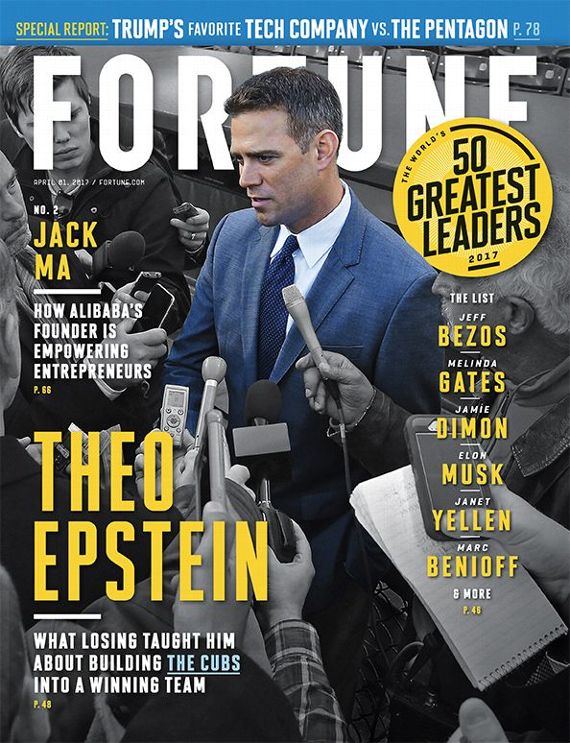
Ethics Quote Of The Month: Chicago Cubs President Theo Epstein

“That is ridiculous. The whole thing is patently ridiculous. It’s baseball–a pastime involving a lot of chance. If [Ben] Zobrist’s ball is three inches farther off the line, I’m on the hot seat for a failed five-year plan.”

—-Theo Epstein, president of the Major League Baseball’s 2016 World Champion Chicago Cubs, upon learning that Fortune Magazine had chosen him #1 among “The World’s Greatest Leaders” in a click-bait list released last week.

Thank-you, Theo, for explaining moral luck and the perils of consequentialism to the public. When it came down to the final innings of Game 7 in last year’s World Series, it looked for a while like Cubs manager Joe Maddon was about to blow the chance to win an elusive title after over a century of frustration by keeping his clearly gassed closer on the game. That his risky decision didn’t make Maddon a goat for the ages and Epstein one more name in the long list of Cubs saviors was pure moral luck—the element of chance that often distinguished heroes from villains. winners from losers and geniuses from fools in the public’s mind—and gross consequentialism, judging decisions by their uncontrollable results rather than their objectively judged wisdom and ethics at the time they were made.

If the Cleveland Indians had won that crucial game in extra-inning, no matter how, Epstein might have made Fortune’s list (I doubt it), but he would have been nowhere near the top. Continue reading


The Phenom, The Agent And The Cubbies: 2015’s First Baseball Ethics Controversy

No, I don’t count Pete Rose.

Kris Bryant, whose day will come.

Kris Bryant, whose day will come.

The lesson of the Kris Bryant dispute is that sometimes the result that seems the least fair is also the right one. Bryant, in case you don’t follow baseball or do not live in Chicago, is the hot Chicago Cubs minor leaguer—what used to be called a “phenom” in the old days—who will not be playing third base for the Cubs when the season opens despite everyone’s agreement that he is not just ready for National League, but ready to star in it. Last week, the young man was assigned  to  the Cubs’ Triple-A Iowa farm team.  Cubs fans are upset. Sports pundits are outraged. Bryant’s agent is furious.

What’s going on here?

A lot.

The MLB  collective bargaining agreement, negotiated and signed by both baseball management and the players union, gives teams control over players for six years before a player can enter free agency and sell his talents to the highest bidder. Thus most young players earn a small percentage of their true market value initially, and, if they are good, hit the jackpot after that. (The average salary in Major League Baseball is $4 million a year). There is a catch, however—and an unavoidable loophole. A full season is defined as 172 days, though the season is 180 days. If a young player is left off the roster until there are fewer than 172 days remaining in the regular season, that season doesn’t count as one of the six years; a player can’t become a free agent mid-season six years later. Before the demise of the reserve system that bound a player to one team until the team released or traded him, there was no reason not to promote a promising minor league star to the big team the second it looked like he was ready. Now, there is a big reason: delaying those few games will give the team an extra year of control, since under the rule, 6 years and 171 games is still just six years. That means an extra year of the player at bargain compensation, and possibly an extra year of the player, since he can fly the coop once the clock has run.

This is not a new issue: players and agents have been complaining about teams doing this for years, but the rules allow it. Since the rules allow it, and since the monetary and competitive benefits of waiting those extra nine days can be huge, there is nothing unfair or unethical about a team taking advantage of the provision. Indeed, it would be irresponsible and a breach of management’s fiduciary duties not to save millions and ensure the extra year of a star’s services. What, then, has made Bryant’s case so contentious?

It’s the Cubs, that’s what. Continue reading

Law vs. Ethics: A Cautionary Tale From Texas

You fucked up

“You can’t worry forever about your mistakes. You fucked up. You trusted us. Make the best of it. ” —Otter (DuPont) to Flounder (Its former employees) in “Animal House”

Law and ethics are two different things, and courts are frequently forced to embrace unethical results in order to uphold a bad law or to deal with a messy fact pattern. It is seldom, however, that one sees as blatant an example of atrociously unethical behavior being ruled legal as in a recent case in Texas, decided this month. It is the kind of case that promotes distrust all around, as you will see. When that is the result, the ruling itself is unethical.

In the case of Sawyer, Kempf, et al. v DuPont and Company, an employer’s false promise not to exercise a legal right in order to induce its employees to forgo their negotiated rights was deemed unenforceable. The legal reasoning is solid. The ethics stinks, and is as good an example as you will ever find for the inspiration behind Charles Dickens’ (speaking through his creation Mr. Bumble, in “Oliver Twist”) statement, “The law is a ass.” Continue reading

Now THIS Is A Conflict of Interest!

The news is that negotiations between the Boston Red Sox and the Chicago Cubs over what the Cubs will pay the Sox as compensation for nabbing their tarnished boy genius General Manager Theo Epstein are not going smoothly, and no wonder. The situation as it stands is a conflict of interest classic, with no obvious solution. You don’t have to know a thing about baseball to love it: this was designed by the Ethics Gods as an exam question.

Consider: Continue reading