Why Our Culture Needs Old Movies

Typical of the free-association manner in which my brain works, a fatuous essay by a New York Times pundit about a subject he doesn’t understand (but I do)–performing—excavated an ethics memory from my childhood that hadn’t sparked a neuron in decades.

Frank Bruni, for some reason, felt it was necessary to re-hash the ancient debate over whether a movie star is really a skilled “actor,” and can be deserving of an Oscar over “real” actors. Naturally, his target was Tom Cruise and his performance in “Top Gun: Maverick,” the most popular and successful movie of the year. I don’t feel like arguing with Bruni over this; I’ve had the debate too many times. (No, Cruise isn’t going to get an Oscar for this sequel, but he has given Oscar-worthy performances before, because nobody can play Tom Cruise as well as he can). I’ll just give the short version: if an actor plays a part better than any other actor could, it is irrelevant that he can’t play any other part. As a director, I’ll cast a charismatic one-trick pony who is perfect for a particular role over a brilliant, versatile artist who could play Hamlet to cheers every time.

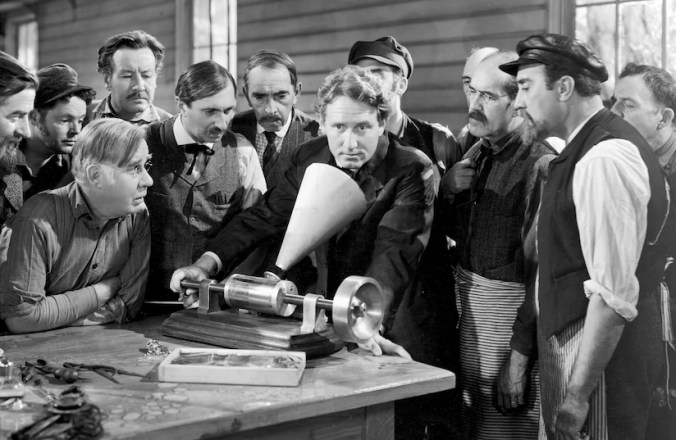
But that is neither here nor there. Here is there: Bruni’s discourse made me think of Spencer Tracy, a movie star and superb actor who had a wonderfully dismissive view of his own field, and then “Edison the Man,” the 1940 biopic, starring Tracy, about Thomas Edison. It was a black and white film that my father made a point of having me see. That film sparked my early interest in Edison, American inventors, technology and extraordinary people through history.

One scene in the movie, however, made a special impression. Edison and his research lab have been laboring on the creation of a practical incandescent light bulb day and night for months. Finally they think they have the right design, and the tungsten filament bulb to be tested is carefully assembled. The new bulb is handed to Jimmy, a teen who does odd jobs at the laboratory, and he dashes across the facility to give it to Edison. In his excitement, Jimmy trips and falls, smashing the precious bulb. Edison’s crew is furious; Edison reproaches the lad. Jimmy is devastated and inconsolable. When Edison’s men finally craft a replacement bulb, Edison calls for Jimmy and give him custody of the bulb, and asks him again to carry it to its destination on the other side of the building. Jimmy, striding carefully and slowly this time, completes his historic task.

Continue reading

The Edison Contradiction, Or Why Great Achievers Are So Often Unethical People, And Civilization Is Still Better Off For It

When I noted Thomas Edison’s birthday recently, and pointed readers to the two classic old movies about Tom as a man and boy, reader Chris Marschner wrote,

Re Edison I have seen the films with Tracy and Rooney. Tracy’s portrayal was historically one sided depicting Edison as merely a slave to his inventiveness. I dont recall it showing him as an egotistical tyrant who put real meaning into unbridled competition with Nikolai Tesla. I believe the director conveniently left out the part when Edison electrocuted an elephant to show alternating current was dangerous.

Edison’s inventions are ubiquitous and spawned the growth of the American economy but I would suggest his understanding of ethics would be on par with Harry Reid.

After my response noted that Edison, “like most who reach the absolute top of a field or profession…was absolutely obsessed with one single mission, and was an indifferent father, husband, friend. That’s the sacrifice such people make; yes, ethics is not on their agendas. Nonetheless, they are essential to the advance of civilization. He was a great inventor, not a great man….and he would have never claimed otherwise.”

Reader Steve-O added,

It doesn’t stop with the great scientists and inventors. A lot of the great leaders, political, military, business, arts, and otherwise, were TERRIBLE at human relations and dreadful even as colleagues. A random sampling might include:

Political:

1. FDR – a sociopath and an adulterer.
2. Churchill – a heavy-handed functional alcoholic.
3. Clemenceau – anti-clerical bully who married one of his students.
4. Ataturk – Brute, racist, alcoholic, looked the other way on genocide.
5. Bismarck – “blood and iron.”

Business:

1. Rockefeller – intentionally drove competitors out of business, monopolist.
2. Henry Ford – anti-Semite, conspiracy theorist, Nazi sympathizer.
3. Andrew Carnegie – anti-religious bully, deliberate indifference to poor conditions on his watch.
4. George Pullman – tried to set himself up as king as well as boss of his workers.
5. James “Diamond Jim” Brady – glutton, playboy.
6. Howard Hughes – one word: Yikes!

Military:

1. Douglas MacArthur – the only difference between him and God was that God didn’t think he was MacArthur.
2. George Patton – a warrior who couldn’t live in peacetime, his own staff despised him.
3. Joseph Joffre – indifferent, borderline incompetent, very little regard for the lives of his men.
4. Horatio Nelson – extremely poor treatment of his wife, who never did him wrong.
5. Joe Stilwell – “Vinegar Joe.”

Music:

1. Richard Wagner – tenth-rate human being all around.
2. W.A. Mozart- tortured genius who sometimes tortured others.
3. Johannes Brahms – dark genius who was more at home with music than relationships.
4. Anton Bruckner – macabre, possible pedophile.
5. Rimsky-Korsakov – nasty drunk.

I nearly answered, “Don’t get me started on actors, singers, artists and directors!”

Or, for that matter, Presidents of the United States.

However, this is a serious and confounding problem in ethics. History teaches us that our greatest achievers often not only give very little priority to ethics, but that a strong argument could be mounted that a concern for ethics would have seriously curtailed their positive effect on human progress and society. Is this, in some ways, a direct challenge to the position, my position, that it is every human being’s duty to strive to live by ethical values and decision-making. It is indeed. Continue reading

Afternoon Ethics Warm-Up: On Bans, Taboos, And Dreams


Good afternoon!

1. Answer: I’m thinking about it. A kind commenter asks when I am going to put up a full post about Facebook’s censorship of Ethics Alarms, which had harmed the blog’s traffic and, what is worse, made it increasingly difficult to carry the message of ethics over bias and rationalizations to the greater public.  One reason I haven’t made a bigger deal about this is that I am still unsure what’s going on, and why. Another is that this  all came down on me at the same time as this lingering cold/flu thing  that has required more rest and sapped more energy than is convenient, and in the grand triage of life, fighting with Facebook has had to yield to other priorities. I’m considering putting up a supplemental site to share Ethics Alarms essays. I’m thinking about launching an Ethics Alarms Facebook site. As I have said before, suggestions are welcome.

2.Happy Birthday, Tom! This is Thomas Edison’s (1847-1931) birthday, and celebrating it in the wake of the deranged “Green New Deal’s” plan to take us back to the Stone Age while financing the needs of those “unwilling” to work would be prudent. Edison personified the kind of creativity, industry, and risk-taking that America’s core values are designed to foster. He derided the label of scientist, insisting that he was “only” an inventor, meaning that his mission was to develop commercially viable advances in technology that made human lives better, richer, and more productive. Do they teach kids about inventors any more? My father made sure that I watched both “Edison the Man,” Hollywood’s biopic starring Spencer Tracy, and “Young Tom Edison,” starring Mickey Rooney, before I was twelve. I found the films inspirational then, and I find them inspirational now.

3. Another canary dies in the mine. Columbia University, long ago one of the cauldrons of student protest and defiant expression, followed the rest of academia by taking another alarming step toward constraining non-conforming student speech. It has substantially defunded the student band for defying the administration’s ban on “Orgo Night,”a Sixties tradition in which the students disrupted the sanctity of the library to lampoon the school’s oppressively serious culture. By itself, this is trivial. As part of a trend in American colleges, it is not. Many feel, I would say with justification, that the sudden squashing of the band’s irreverence  was sparked because it was “a liability in an age of heightened political sensibilities.” In other words, thoughts and ideas that the Left can’t control threaten the cause of enforced consensus. Continue reading

Glenn Beck vs. Teddy Roosevelt? No Contest!

Listening to Glenn Beck disparage Theodore Roosevelt is a little like listening to Ed Wood, auteur of the deathless classic, “Plan Nine From Outer Space,” condemning John Ford as an unimaginative hack.

At his uproariously received speech at the Conservative Political Action Conference, Beck, the libertarian talk-show host, flamboyant TV showman on Fox and current Tea Party hero effectively racked up cheap applause by pulling a quote out of Teddy’s “New Nationalism” speech and deriding it. Beck didn’t analyze and critique the speech, of course, because that would have required a discipline of scholarship and a rigor of intellect that he simply does not possess. He simply quoted this section… Continue reading