The Ethics Attic: Notes From Around The Web

messy attic

[I’m still feeling lousy, so in an effort to conserve some energy while keeping the torch high, I’m presenting a few links that the ethics-minded might enjoy visiting. Normally I would write about some of these, so consider yourselves lucky.]

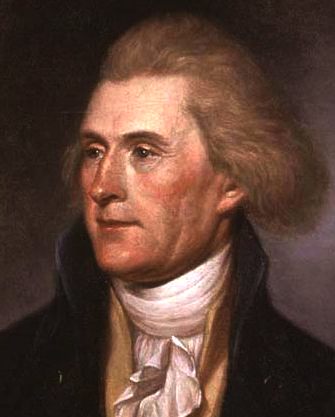
  • Historian Paul Finkleman delivers that harshest verdict yet on the hypocrisy of Thomas Jefferson regarding civil rights and slavery. You should then read David G. Post’s splendid contra essay here. (The last two sentences in Finkleman’s op-ed are pretty much indefensible.)
  • A fascinating reflection, inspired by the movie “Lincoln,” on Utilitarianism and “the ends justifies the means.”
  • In fact, the program is a benign one, but considering the issue raised in my last post, it is hard to imagine more perfect symbolism for the American public trading self-sufficiency for government protection than the trade described here.
  • If you missed the recent George Will column, a frightening one, about the assaults of free speech and thought around the campuses of American universities, you have another chance to read it, here.
  • I only recently learned that 3-D copiers are a reality, and Dr. Chris MacDonald, on his always excellent Business Ethics Blog, has some insight on their ethical implications here.
  • Once again this year, I have an essay in The 2013 Hardball Times Baseball Annual, and publisher Dave Studenmund references my analysis of the Stephen Strasburg affair here.
  • Finally, thanks to Mary Wright on the HR Gazette for posting the Ethics Alarms Apology Scale.

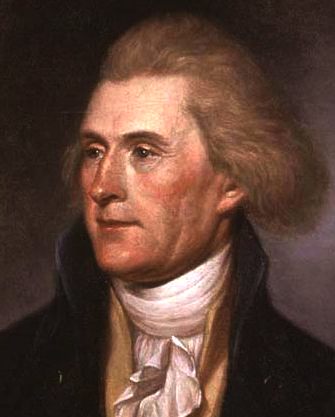
Unethical Quote of the Week: Thomas Jefferson

 “Brought from their infancy without necessity for thought or forecast, [blacks] are by their habits rendered as incapable as children of taking care of themselves, and are extinguished promptly wherever industry is necessary for raising young. In the mean time they are pests in society by their idleness, and the depredations to which this leads them.”

—-Thomas Jefferson, quoted in a new book, “Master of the Mountain: Thomas Jefferson and His Slaves,” by historian Henry Weincek. Jefferson wrote this in 1819, 43 years after the Declaration of Independence, in response to a request for support from a family friend who was taking his own slaves to freedom. Jefferson refused, and this was part of his response.

Great writer. Great philosopher. Bad man.

I have been working on a post on the topic of Presidential character, a lifetime study for me, as a rebuttal of a post on the Daily Caller titled, “Why Good Men Don’t Become President?” Good men do become President; in fact, almost all of the men who have become President were or are good men, Barack Obama included. Leaders, however, are a peculiar breed of good men, since leadership itself requires a different priority of virtues than other roles. Those who do not understand or appreciate leadership, and I believe that the author of that article does not, often conclude that leaders are necessarily bad.

Thomas Jefferson, I submit, was one of the few bad men who did become President. Continue reading

William Aramony and the Fallen Hero Dilemma

As he usually did, the extraterrestrial, mutant, collective or whatever he was William Shakespeare (no human could be that wise) had it exactly right, and a long time ago: “The evil that men do lives after them; The good is oft interred with their bones.” In a dispirited column on the CNN website, obviously inspired by the Paterno debacle, ESPN writer L.Z. Granderson writes that he has become afraid to watch the news, fearing that another of his heroes will be shown to be a fraud:

“And when we find out our gods are not perfect, we’re confused. We don’t know what to do with a storyline where the perceived protagonist is complex. Heroes aren’t supposed to do bad things. That’s what villains are for. So either the good supersedes the bad, or the bad makes it impossible to remember the good. We don’t like it when such duality exists in one person. We don’t want to know our heroes are human.” Continue reading

Ethics Quote of the Era: Thomas Jefferson and the Continental Congress of 1776

“We hold these truths to be self-evident, that all men are created equal, that they are endowed by their Creator with certain unalienable Rights, that among these are Life, Liberty and the pursuit of Happiness.–That to secure these rights, Governments are instituted among Men, deriving their just powers from the consent of the governed, –That whenever any Form of Government becomes destructive of these ends, it is the Right of the People to alter or to abolish it, and to institute new Government, laying its foundation on such principles and organizing its powers in such form, as to them shall seem most likely to effect their Safety and Happiness.”

—-The Declaration of Independence, authored by Thomas Jefferson, edited, ratified and signed by him,  Button Gwinnett, Lyman Hall, George Walton, William Hooper, Joseph Hewes, John Penn, Edward Rutledge, Thomas Heyward, Jr., Thomas Lynch, Jr., Arthur Middleton, John Hancock, Samuel Chase William Paca, Thomas Stone, Charles Carroll, George Wythe, Richard Henry Lee, Benjamin Harrison Thomas Nelson, Jr., Francis Lightfoot Lee, Carter Braxton, Robert Morris, Benjamin Rush, Benjamin Franklin, John Morton, George Clymer, James Smith, George Taylor, James Wilson, George Ross, Caesar Rodney, George Read, Thomas McKean, William Floyd, Philip Livingston, Francis Lewis, Lewis Morris, Richard Stockton, John Witherspoon, Francis Hopkinson, John Hart, Abraham Clark, Josiah Bartlett, William Whipple, Samuel Adams, John Adams, Robert Treat Paine, Elbridge Gerry, Stephen Hopkin,  William Ellery, Roger Sherman, Samuel Huntington, William Williams, Oliver Wolcott
Matthew Thornton.

Ethics Heroes all.

Thank you, guys.

(You can read the entire document that changed the world…undeniably for the better…here.)

Ethics Quote of the Week: The Washington Post Editors

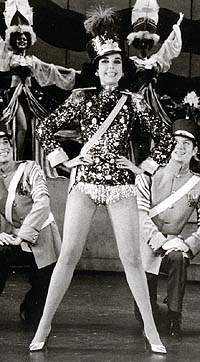
Clear out, everybody! Ann Miller wants to honor Thomas Jefferson!

“Aggrandizing what amounts to a stunt based on misinformed views of the First Amendment cheapens the real and courageous achievements of those who advance the causes of civil rights by refusing to comply with immoral laws”

—–The Washington Post, in an editorial entitled “Dancing at a National Memorial Isn’t Civil Disobedience”

The Post is talking about the escalating and pointless battle by self-indulgent, publicity-seeking, First Amendment grand-standers —a description that I shortened to the crude but sufficiently explanatory “assholes” in my post on the same topic-–to demonstrate for the endangered ‘right” to dance inside government memorial structures(Next up: frog races, strip shows, and Mummer parades). The editorial makes the true content of this noble exercise plain: it is 100% nonsense: Continue reading

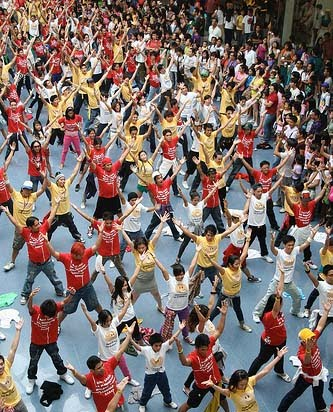
Dancing With Thomas Jefferson: How Assholes Make the Law Spoil Life For Everyone

Coming to a place of honor and reflection near you.

On Saturday, the U.S. Park Police forcefully arrested five “Code Pink” protesters under the dome of the Jefferson Memorial for defying a recent Federal Appeals Court ruling that dancing at federal monuments was not constitutionally protected expression.

Perhaps you missed that ruling earlier this month, which was, I presume, made necessary by the realization that a flash mob could break out at any moment at the Lincoln Memorial or the Alamo. That was not the threat in 2008, however, when Mary Oberwetter was arrested, also at the Thomas Jefferson Memorial, for hoofing to celebrate Thomas Jefferson’s birthday.

She sued the National Park Service for violating her First Amendment rights, and on May 17 the U.S. Court of Appeals for the D.C. Circuit held that the Jefferson Memorial should have a “solemn atmosphere” and that dancing, silent or otherwise, was an inappropriate form of expression there. The appellate judges concurred with the lower court that the memorial is “not a public forum,” and thus demonstrators must first obtain a  permit. Demonstrations that require permits in the Park Service’s National Capital region are defined as

“…picketing, speechmaking, marching, holding vigils or religious services and all other like forms of conduct which involve the communication or expression of views or grievances, engaged in by one or more persons, the conduct of which has the effect, intent or propensity to draw a crowd or onlookers. [The] term does not include casual park use by visitors or tourists which does not have an intent or propensity to attract a crowd or onlookers.”

The Appellate Court wrote: Continue reading

Home-Grown Mengeles, And What We Must Learn From Them

Josef Mengele: researcher, utilitarian, monster

We knew, or should have known, that this extremely ugly shoe was bound to drop eventually.

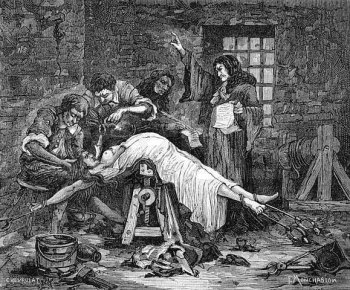
Last autumn, when the U.S. apologized for federal doctors infecting prisoners and mental patients in Guatemala with syphilis 65 years ago, it put us on notice that a vile and unethical cultural standard had taken hold of the American medical and scientific communities in the 20th century, one that held  it was “right” for the weakest, most powerless and most disposable of human beings to be tricked, coerced or bribed into serving as subjects for experiments that could lead to miraculous cures and treatments for the rest of the population. This–depriving human beings of their rights and lives in the interest of science—is “the ends justify the means” at its worst. But the Guatemala experiments proved that this was once flourishing and respectable in the U.S. scientific and medical research communities, so it would have been surprising if there weren’t more stories of home-grown Mengeles, and sure enough, there were. The U.S. acknowledged as much when it apologized for the Guatemalan tests. Now we have details. Continue reading

Why Students Lose Respect for School Authorities, Case Study 309,456: “The Red Scare”

Inappropriate, Thomas!

It is not directly relevant to Natalie Munroe’s complaints perhaps, but when students today seem less than in awe of those adults who claim to be qualified to guide them to wisdom and success in school, they often have good cause to be wary. Take the example of Stephanie Plato, a sixth grader at Cobb Elementary School in Houston’s Channelview school district.

Stephanie was suspended from school because the red and blonde highlights her mother let her get died into her hair as a 12th birthday present violated the school’s code of conduct.

You read that right.

We are not talking electric orange here, or anything strange and disruptive. Just a few red highlights in her naturally brown hair. But the school dress code bans “inappropriate hair color”…such as red.  Don’t ask me why. It doesn’t matter why. It is stupid. Continue reading

Bush’s Torture Admission, Absolutism, and America’s Survival

George W. Bush, currently hawking his memoirs, has admitted in the new book and in interviews about it that yes indeed, he approved waterboarding of terrorist suspects, believed it was legal, and moreover offers evidence that the information thus acquired saved American lives. W’s opinion on these matter are hardly a surprise, but they have re-energized the defenders of the Administration’s policies of “enhanced interrogation” and rendition of apprehended terror suspects to foreign locales where the interrogation techniques were “enhanced” even more.

“NOW do you agree with the policy?” they ask, as if the answer was obvious. “The information prevented a horrific terrorist attack on Heathrow Airport (in England). See? See?

Let us assume, just to simplify things, that everything is as President Bush represents. Waterboarding was, by some legitimate analysis, legal. The information saved American lives and prevented terrorist attacks. Do these facts mean that the use of torture—and waterboarding is torture, whether one defines it as such or not—by the United States of America was justified, defensible, and ethical?

No. I don’t think so. I believe that for the United States of America to approve and engage in the use of torture is by definition betrayal of the nation’s core values, and thus threatens its existence as the nation our Founders envisioned as completely as a foreign occupation.  I wrote on this topic in 2009… Continue reading

Ethics Heroes: Thomas Jefferson Descendants David Works, Shay Banks-Young and Julia Jefferson Westerinen

Among the  Common Ground Awards that will be given out tonight is one inscribed to:

“The Descendants of Thomas Jefferson and Sally Hemings: David Works, Shay Banks-Young and Julia Jefferson Westerinen For their work to bridge the divide within their family and heal the legacy of slavery in the United States”

And therein lies quite a tale. Continue reading