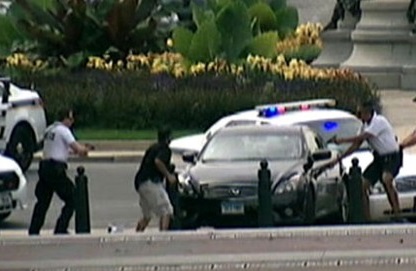
“Ok, now, let’s talk about this: what other options do we have to stop this mad-dog driver, other than shooting her? Ma;’am, will you pleas take 5 in your murderous rampage while we meet? Ma’am?”
Hindsight bias isn’t the worst or most pernicious reasoning fallacy, but it may be the most annoying, and is certainly the most common. After an event in which one or more instant decisions had to be made in seconds or minutes, critics with time a-plenty solemnly explain how they would have done things differently, and how the original decision-maker was stupid, cowardly, misguided, incompetent, unethical, or even criminal. The most striking example of a hind-sight bias victim in recent years is Penn State’s Mike McQueary, but at least in his situation there is room for argument, though I argued here that few of his critics can know how they would have responded under similar circumstances. In the case of this week’s shooting of a crazed Capitol Hill kamikaze motorist, later determined to be a troubled dental hygienist who may have been suffering from post-partum depression, I don’t think the criticism is rational, fair or justified, and shows hindsight bias at its worst.
Of course the Secret Service had to shoot her. It would have been reckless and negligent had they not. She had tried to crash through the White House barricades in an automobile. She had run down one officer, for all anyone knew at the time, fatally. She was refusing to stop, and was near D.C.’s Union Station, where there are people everywhere, and a car can easily run up on the sidewalks, which are wide. She had to be stopped immediately, or innocent people, maybe many people, were likely to die.
After she expired from the shots fired at her (but not before peeling away at a high speed), it was determined that the driver, later identified as Miriam Carey, was unarmed. The shooting agents didn’t know that, so it’s irrelevant. Besides, she was armed, with a deadly vehicle, and her motives were unclear. For all the officers knew, she was trying to kill as many pedestrians as she could. This wasn’t a typical situation or traffic stop. This was occurring at the center of our government, and security officers have to take enhanced precautions. The welfare of the individual causing the threat is not, and should not be, the primary concern.
Two factors in the incident seem do drive the unethical amateur second-guessing. One was that the woman’s toddler was in the car, and might have been harmed. This was not the Secret Service’s problem. Carey put her daughter in harm’s way, and if her conduct resulted in the child’s injury or death, she would have been totally responsible, not the agents who shot into the car. (They apparently were not aware of the child’s presence, so again, this in not a fair factor to consider after the fact.) The other factor: guns were involved. Thanks to programmed paranoia and gun-phobia irresponsibly planted in the culture by anti-gun zealots, many, too many, Americans arrive at a reflex position that any gun-related death is unnecessary, because guns, after all, are evil and should be banned. Such opinions should be treated as the products of deranged minds, or excessive Piers Morgan viewing.
A Facebook friend (and regular friend too), a distinguished and intelligent former journalist who I’m sure won’t mind my quoting him, asked his social network, “WAS THERE NO OTHER WAY?” That question is the epitome of hindsight bias. Sure there were other ways. Maybe an agent could have dived in the car window and dislodged her. Maybe a well-aimed shot at her hands could have made it impossible to drive. Perhaps they could have shot out the tires, hoping that the driver didn’t realize that you can still make a car with flat tires move at a pretty good clip, at least for a while. An electro-magnetic pulse might have stopped all the engines in the vicinity, neutralizing the car. Maybe Batman was nearby, or Corey Booker. None of that matters, because the security officials involved were in a unique and unprecedented situation, and had to accomplish their prime objective, stopping a dangerous individual in a highly populated area, under pressure, while in peril themselves, as quickly as possible. The proper question is not whether they could have done better, upon calm analysis and reflection. The question should only be, “Was the response reasonable under the circumstances?”
It was.
________________________________
Sources: Washington Post 1, 2
 Ethics Alarms