Comment of the Day: “The Idiot, the Ex, and the Consequences”

I’ve been remiss in posting “comments of the day” of late; it is not a reflection on comment quality, which has been excellent, but rather on my own distractions. Here is a new one at last, from new commenter Kathryn. It appeals to me because it nails the subtext of the original post, and like most Comments of the Day, takes the original topic to the next stage of analysis. I hope we hear more from her. Here is Kathryn’s Comment of the Day on the post, “The Idiot, the Ex, and the Consequences.”

“I am waiting, perhaps overly optimistically, for culture to catch up with information availability and develop new ways of handling privacy outside of responding to information when it is made public, regardless of the source or context for that information. Everyone says/does something particularly unwise/unwell/without grace during their life. Technology is getting to the point that these moments, rather than being forgotten or a story told among friends, are fairly permanently in the public record. (The Internet is public, whatever Facebook settings attempt to convince you.) Continue reading

The Idiot, the Ex, and the Consequences

Denise Helms, who will probably not look like this the next time you see her if she knows what’s good for her.

My position would usually be this: for an employer to use a privacy setting Facebook post as justification for firing an employee is unfair. That applies to vacation photos of an elementary school teacher holding a beer and looking bleery-eyed at a pub, a Sunday school teacher doing a strip tease at a bachelor party, and political posts of a radical, vulgar or offensive nature. Two factors can change the equation, though. Action may be justified if the posting reasonably calls into question the trustworthiness of the employee in his or her job duties, or if the posting becomes public, subjecting the employer to embarrassment or undermining the employee’s ability to do her job, as in the naked teacher cases.

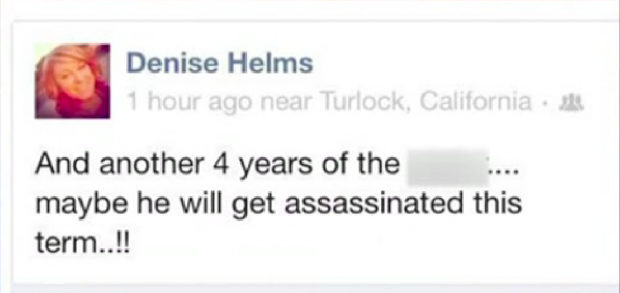
Denise Helms, the idiot referenced in the title above, posted this on her Facebook page, intended only for her closest, presumably most racist or most idiotic friends:

Continue reading

The Lenahan Effect Meets The Streisand Effect

From the Legal Ethics Forum:

The Lenahan Law Firm in Dallas Texas has subpoenaed Google to release the real name of an anonymous critic who posted an un complimentary online review of the firm’s services. The firm wants to sue the poster for daring to question its performance by writing,

“Bad experience with this firm. I don’t trust the fake reviews here.”

For this perceived insult, the Lenahan firm wants to punish “Ben” to the tune of $50, 000 in damages.

Ironically, the lawsuit, rather than the review, proves to my satisfaction that “Ben” has a point. He was clearly expressing his opinion: it is up to him, and only him, whether he regards the experience of working with the Lenahan firm as “bad” or not. In the complaint, the firm says that the declaration that the positive reviews are “fake” alleges dishonesty and fraud by the firm. Utter nonsense. First of all, the allegation, fair or not, is also obviously an opinion. Second, “Ben” is saying that the reviews are fake, which could mean insincere, among other interpretations. He does not attribute them to the firm. He doesn’t say where they came from. He doesn’t know. Maybe I sent them.

On the screen shot included in the complaint, it clearly says that “0 of 3” people found “Ben’s” review helpful. For that, the firm wants $50,000 in damages, since that zero potential client was driven to another firm with his lucrative business.

Unbelievable.

Over at Popehat, lawyer-blogger (and Ethics Alarms 2011 Ethics Blogger of the Year) Ken has been carrying on a vigorous battle against online censorship of free expression by threats and lawsuits. His current target is a ridiculous faux lawyer who is now threatening Ken for pointing out the error of his ways. In his commentary as well as his various emails to the individual, Ken explains with admirable precision why opinions are not actionable assertions of fact, useful passages that I would recommend to the Lenahan Law firm. The firm’s efforts to bully critics by making an example out of “Ben” also unwisely incur the “Streisand Effect,” the online phenomenon by which efforts to censor information on the web has the perverse consequence of giving it more visibility and influence.

I don’t know if there is a name for the effect—“The Lenahan Effect,” perhaps?—by which a law firm’s willingness to pursue a spurious, unnecessary and excessive lawsuit against a former client for expressing his views about the firm’s work has the perverse effect of showing the world why that client feels the way he does, but that’s what the Lenahan lawsuit against “Ben” does.

That’s only my opinion, of course.

A Ban on Threatening “Spiritual Injury”: Unconstitutional But Ethical?

There you go, Bill, letting people be unethical again...

Eugene Volokh, a First Amendment  provocateur, notes that Minn. Stat. Ann. § 211B.07 makes it a gross misdemeanor to

“….directly or indirectly use or threaten force, coercion, violence, restraint, damage, harm, loss, including loss of employment or economic reprisal, undue influence, or temporal or spiritual injury against an individual to compel the individual to vote for or against a candidate or ballot question.

The professor opines that the spiritual injury part, at least, is unconstitutional. Interesting.

Prohibiting the interference and manipulation of a human being’s rights of autonomy and self-determination by using threats to compel his voting choices is a legitimate area for the law, because ethics is notoriously inadequate at preventing electoral abuses. It is also an area where the law is an especially blunt instrument, and many conceivable violations of § 211B.07 would seem to risk colliding with free speech. “If you don’t vote for Ron Paul, I’ll never speak to you again!” comes to mind. The threat of “spiritual harm”—“Vote for Mitt Romney, my flock, or I condemn you to Hell!” adds the  free exercise of religion to the mix, particularly when the threat is linked to a position of a candidate that violates religious doctrine.

I have no difficulty concluding that any and all threats to force a citizen to vote according to another citizen’s desires are wrongful and damaging to democracy, and should be condemned and discouraged to the maximum extent possible. Ethical though such prohibitions may be, some, like the use of threatened spiritual injury, are impossible under the Bill of Rights.

So threatening to send someone to Hell if they vote for Newt Gingrich—a reasonable result, when you think about it—is unethical, but a law punishing that threat is unconstitutional.

Sorry, Ethics…looks like it’s all up to you!


Ethics Hero: Ken, Popehat Blogger

"You'll find what you're looking for over at Popehat!"

In the spirit of “Miracle on 34th Street,” in which a Macy’s Santa famously sends a shopper to its rival department store Gimbels (R.I.P.), I’d like to direct readers to run, not walk, over to Popehat, the witty and cantankerous blog that often covers similar territory as Ethics Alarms. There Ken, a practicing lawyer, has penned as strong an essay on ethical issues as you are likely to encounter. Writing about an unethical marketer’s outrageous tactics that included posing as a lawyer to intimidate bloggers, Ken powerfully expounds on the use of bogus lawsuit threats to stifle free speech and opinion on the web, and how to fight it.

This has been a continuing theme of his for a long time, to the point of qualifying as a crusade. It is a worthy crusade, and Ken, along with Popehat, is performing a public service with posts such as this one, colorfully entitled, in the Popehat fashion, “Junk Science And Marketeers and Legal Threats, Oh My!”

Good work, Ken.

Ethics Hero: David Letterman

No Free Speech weenie he. Yale, take note.

I stopped watching David Letterman years ago, when I learned that he was an unapologetic serial sexual harasser.  I don’t like to patronize the work of professionals, however talented, who should have been fired and would have, if their employers had any integrity. As a result, I missed Letterman’s ascent into ethics hero territory. It pains me to admit this, since I neither like nor generally respect him, but that is where David Letterman belongs.

On the June 5, 2011 edition of “The Late Show with David Letterman,” the host smilingly pulled his finger across his throat to note the U.S. military’s reported killing of Ilyas Kashmiri, an Islamist terrorist who was one of the organizers of a deadly attack in India that killed and wounded hundreds of innocent civilians. On a roll, Letterman made a joke about Osama bin Laden’s death as well.A group of radical Islamists took offense, and in a posting on the Islamist web forum Shumukh al-Islam, called for Letterman’s murder, urging the eventual assassin to cut out Letterman’s tongue.

Continue reading

Unethical Quote of the Week: University of Wisconsin-Stout Chancellor Charles W. Sorensen

"Oh, HELP me, University administrators! A poster says that a fictional space cowboy from a TV series that isn't on anymore might kill me, or someone, under certain conditions!"

“UW-Stout administrators believe strongly in the right of all students, faculty and staff to express themselves freely about issues on campus and off.  This freedom is fundamental on a public university campus. However, we also have the responsibility to promote a campus environment that is free from threats of any kind—both direct and implied. It was our belief, after consultation with UW System legal counsel, that the posters in question constituted an implied threat of violence.  That is why they were removed. This was not an act of censorship.  This was an act of sensitivity to and care for our shared community, and was intended to maintain a campus climate in which everyone can feel welcome, safe and secure.”

—-

, one featuring a humorous quote from a cult TV science fiction series, the other a satiric poster opposing fascism, as in cases where speech-censoring university administrators remove harmless pop culture references they don’t understand. Continue reading

Comment of the Day: “Unethical Business Practices: Online Reputation Services”

For those offended by the fact that this is the second Comment of the Day, I can only note that I haven’t posted a COTD for a while, so they can consider this one as making up for say, September 9.

Tgt has some uncomfortable truths about the practicalities of taking principled stands, in the context of my discussing the dishonest and bullying tactics of so-called online reputation protection services without specifically naming any one company.

There are gradients of this dilemma, which I’m not sure the author sufficiently acknowledges. For example, in the recent Defense of Marriage Act controversy in which law firm King & Spalding arguably dumped an unpopular representation because of inappropriate but no less threatening warnings from its biggest client, there are core professional values involved: once a lawyer ( or firm) accepts a representation, he or she may not, consistent with professional norms, drop the new client because of fear that the representation will have unpleasant consequences. There is no ethical obligation, however, to engage in a protest or civil disobedience when one objects to an abuse of official power. There is an obligation to do something, and it is ethically legitimate to choose a course that addresses the wrong without causing unnecessary harm to oneself or others. One not  cowardly by not being foolhardy.

Unless I accept John Adams’ rather perverse conviction that the only way one knows one is doing the right thing is when he is certain that the consequences will be personally ruinous, I don’t agree that I have failed an ethical obligation by choosing to flag unethical conduct without specifically inciting a company whose business it is to intimidate websites.

Besides, as I noted in my response to this comment, I am not through with these guys. Not by a longshot. But here is tgt’s Comment of the Day to my opening volley: Continue reading

Unethical Business Practices: Online Reputation Services

Consider this just a polite request to remove that accurate but ucomplimentary post about my client.

The web has created some new business niches, and one that fascinated me was the emergence of online reputation defenders, who purport to make sure that Google searches and web research about individuals and businesses do not turn up negative information that can harm business prospects, career advancement, or reputations generally.

While I can see the appeal and potential profitability of such services, manipulating online content is an ethical gray area. It is as wrong to artificially make someone look good  on the internet as to artificially make them look bad. In general, anyone who has been out and about very long will find both positive and negative information about themselves on the web, of varying accuracy. People who have experience with web research understand this, so the impressions they get from checking out a potential employee or business partner will usually, though not always, be tempered with skepticism.

They can and should apply common sense: What is the source of the negative information? How old is it? Was this one incident or complaint that doesn’t seem representative of the individual or company as a whole? I would rather have all the information available, and be able to make my own decisions, rather than have the most favorable material elevated in visibility and the least favorable made difficult to find or removed altogether. These services promise to “bury” the negative material. Continue reading

Ethics Train Wreck On Facebook: Jessica Studebaker and the Sneaky Voelkerts

The imaginary Jessica Studebaker

David and Angela Voelkert are so obviously perfect for each other. It’s just a tragedy that they can’t get along.

By the time the couple’s multiple deceptions were sorted out, Angela had been scared out of her wits, David had spent four days in jail, and federal prosecutors looked like they had never heard of Facebook. The perfect recipe for an ethics train wreck—lies, more lies, and incompetence—and that’s exactly what they got.

Last Friday, the FBI arrested David Voelkert, 38, a South Bend, Indiana man who had recently exchanged messages with a 17-year-old Facebook friend named Jessica Studebaker. As described in an FBI affidavit, Voelkert’s Facebook exchanges with Studebaker included telling her that he had placed a GPS device in his ex-wife’s car to surreptitiously monitor her movements, and that he was looking for “someone to take care of” Angela Voelkert, so the teen “ should find someone at your school…that would put a cap in her ass for $10,000.” Continue reading