Unethical Quote of the Month: OkCupid

Not OK...

Not OK…

“Hello there, Mozilla Firefox user. Pardon this interruption of your OkCupid experience. Mozilla’s new CEO, Brendan Eich, is an opponent of equal rights for gay couples. We would therefore prefer that our users not use Mozilla software to access OkCupid. Politics is normally not the business of a website, and we all know there’s a lot more wrong with the world than misguided CEOs. So you might wonder why we’re asserting ourselves today. This is why: we’ve devoted the last ten years to bringing people—all people—together. If individuals like Mr. Eich had their way, then roughly 8% of the relationships we’ve worked so hard to bring about would be illegal. Equality for gay relationships is personally important to many of us here at OkCupid. But it’s professionally important to the entire company. OkCupid is for creating love. Those who seek to deny love and instead enforce misery, shame, and frustration are our enemies, and we wish them nothing but failure.”

—Dating website OkCupid, calling for a boycott of Mozilla, including Firefox, its webserving software, because of the past political/social/religious views of Mozilla CEO Brendan Eich

Full disclosure: 1) I use Firefox. 2) I detest boycotts,and 3) I am biased against them by nature, because they are almost always coercive, extortive, and unfair.

This statement, however, has more wrong with it than just its advocacy of a boycott.
Continue reading

Comment of the Day: “Noah” Ethics

noahs-beaver-problem

Patrice, the Ethics Alarms resident Catholic theologian (and a dear friend), weighs in on the “Noah” controversy, in the this Comment of the Day on the post, “Noah” Ethics:

My undergraduate theology degree is indisputably from a Catholic perspective, although many of the scholars we studied were not Catholic, nor even Christian. I was required to take only 4 semesters of biblical literature, but even those few academic hours of biblical studies taught me enough about biblical analysis to understand how “The Bible” (which, as I’m sure you know, is just a mutually-agreed upon canon of literature which omits as much as it includes) came to be. I often think that it is a shame that true knowledge about biblical literature mostly seems to reside only in academia. Unfortunately, most of the zealots out there would and probably do regard biblical scholarship as an attack on God. The battles over the centuries over biblical inerrancy/infallibility/literalism are merely unread footnotes to most people. Continue reading

“Noah” Ethics

God

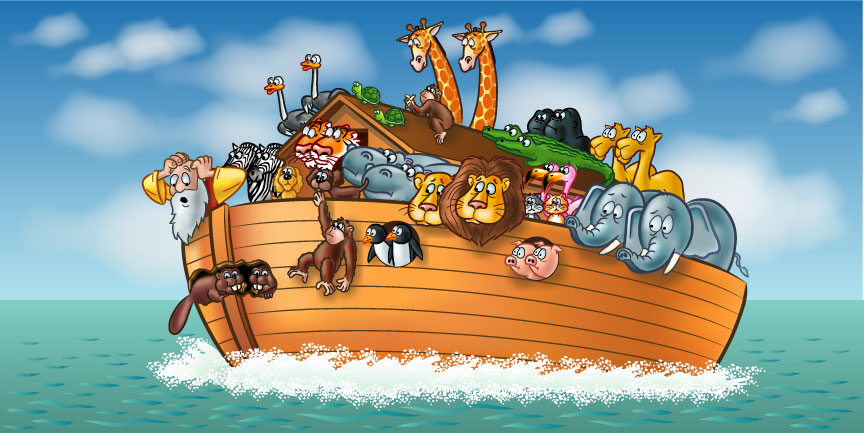
There is nothing unethical about “Noah,” the biblical spectacular that harkens back to the grand old days when Cecil B. DeMille reigned supreme. I haven’t seen the movie, and yet I can say that with absolute certainty. The reason I can say it that there is no way on earth that a movie about Noah and the Ark, in this day and age, could possibly be unethical. Even if the Old Testament were literal fact, which it is not, cannot be and in all likelihood was never intended to be, “Noah” couldn’t possibly be unethical, because it is a movie.

Never mind that of all the Biblical fables, with the possible exception of Adam and Eve, the tale of Noah is perhaps the most obviously impossible. The movie is art—of one kind or another—and does not represent itself as a documentary or make any factual assertions whatsoever. Thus it can be distinguished from a truly unethical film like Oliver Stone’s “JFK,” which intentionally misrepresented recent historical facts to “prove” a theory of the Kennedy assassination that was irresponsible and almost certainly false. Is “Noah” dishonest? It is impossible to be dishonest about a presumptively non-historical event about which there is no direct evidence whatsoever, and when there is no intention to deceive. Is it disrespectful? Art has no duty to be respectful. Is it fair? Fair to who? An artist’s stakeholders are those who appreciate his or her art. Does it do harm, or intend to? No. Continue reading

More “Is We Getting Dummer?” Horrors

dictionary

I was having a quick sandwich before my flight at Reagan Airport and could not avoid hearing in excruciating detail the conversation next to me. It appeared to be some kind of staff meeting among business colleagues traveling to a common destination. One of the young professionals, a man in his early 30s, must have said “That’s incredulous” or “I find that incredulous” four or five times. Nobody corrected him; maybe none of the other four mature, supposedly educated people at the table knew that he was misusing a high school vocabulary word, though that’s a horrible thought.

For a moment I entertained thoughts of pulling him aside, like old Biff in “Back to the Future 2” encountering his younger self, whom he told “It’s ‘make like a tree and leave,’ not ‘make like a tree and get out of here’—you sound like an idiot when you say that!” Except that I would have said, “It’s incredible, not incredulous! People will lower their opinion of you when you misuse words. Pay attention! Read! Learn to speak properly!”

If schools won’t or can’t educate competently any more, and the culture is determined to make us dumber by the day, then it is up to us to help each other out. Continue reading

Groupon Celebrates National Incompetence and Ignorance With A Presidents Day Double KABOOM!

Hamilton-exploding_head2

The Ethics Alarms KABOOM!—a special designation for ethics-related stories that make my head explode—has a new variation, thanks to Groupon: the repeating KABOOM!, triggered by two related KABOOMs in the same episode. My head has been exploding repeatedly since I learned about this late last night.

Hold on to your craniums, for here is a Groupon press release sent out earlier this week, the first of the KABOOM! twins:

Groupon Celebrates

Presidents Day

by Honoring

Alexander Hamilton!

Commemorate a man historically powerful enough to be on money with $10 towards $40 on a local purchase while they last!

CHICAGO, Feb 14, 2014 (BUSINESS WIRE) — Starting tomorrow, Groupon ( http://www.groupon.com ) (NASDAQ: GRPN) will be kicking off Presidents Day weekend by giving customers 10 dollars off 40 dollars when they purchase a deal for any local business. The $10 bill, as everyone knows, features President Alexander Hamiltonundeniably one of our greatest presidents and most widely recognized for establishing the country’s financial system.

Beginning Saturday, Feb. 15 at 9 am CST, shoppers will be able to redeem this offer by using the promo code “10OFF40LOCAL”, which isn’t very catchy, but neither was President Hamilton’s famous saying, “Nobody expects to trust his body overmuch after the age of fifty.”

President Hamilton is best known for the fiscal sensibilities that led him to author economic policies, establish a national bank and control taxes. Customers can honor our money-minded commander-in-chief and find deals by searching Groupon.com for local deals all through President’s Day weekend. Promo codes are limited, and more information can be found at: https://www.groupon.com/faq#faqs:content-269

The emphasis is mine, and I’m paying for every bit of it, let me tell you. My head is doing a terrific Dante’s Peak impression as I type this.

But that’s not all: here comes Groupon’s KABOOM! #2. Is the company embarassed? Chagrined? Are heads rolling? Oh, noooo! For when an enterprising American, one of the few who received a competent fourth grade education, was kind enough to alert Groupon to its unforgivable gaffe, this is what he received in return:

GOUPON IDIOTIt would all be hilarious if it were not so ominous….and unethical. Continue reading

Ethics Alarms Mail Bag: Rep. Jim Bridenstine and The Duty To Confront

A reader asks…

“John McCain and Paul Ryan have corrected constituents who spout conspiracy theories about the President.  Should this Republican have left this town hall comment unchallenged?”

The incident referenced is on view here:

That’s Oklahoma congressman Jim Bridenstine (R-OK) who listens as a woman says, “Obama is not president, as far as I’m concerned.  He should be executed as an enemy combatant…I can’t tell you, or I can’t say because we are in a public place, this guy is a criminal,” and then answers by saying that “everybody knows the lawlessness of this president,” without addressing her more outrageous assertions. “The only way I see out of this is to overwhelmingly change the Senate, so that we can then impeach the SOB,” another woman says. “You know, you look so sweet…” says Bridenstine, deflecting. Continue reading

Comment of the Day: “How People Rationalize Being Close-minded: A Case Study”

battle-marvel

The Ethics Alarms resident humanist, Bruce, has filed a passionate brief condemning the sometimes rough debate on Ethics Alarms, and, in some ways, the blog itself. This is the latest volley in an ongoing thread that has jumped around from multiple posts: my fault, because I keep raising the issue in various ways. I would normally append some reactions at the conclusion of such direct criticism, but it’s a busy day, so I’ll have to put them in the comments to Bruce’s post later, with this exception.

The Ethics Scoreboard, which was not a blog but a website, embodied Bruce’s suggestion of radically fewer posts, more carefully considered and proofread. I am proud of a lot of the work there, but the format was limiting. The goal of Ethics Alarms is to try to inject ethical considerations into the national analysis and discussion of daily events, including politics, that need them but hardly ever receive them, because, sadly, most commentators are either uninterested or incapable of it.  The reason I chose a blog format is that these issues are time-sensitive, and if I am to have even a wisp of a chance of elevating the discussion and encouraging valid analysis of right and wrong, I have to strike quickly, or I might as well be writing about the ethics of the Spanish American War.

Jeffrey Field, my favorite Occupier who often weighs in here, periodically sends me a note that says “Slow down!”  I appreciate that, and take it to heart. Nonetheless, when the news media was (lazily? maliciously?) misrepresenting the meaning of David Wildstein’s lawyers’ letter regarding Chris Christie’s involvement in the George Washington Bridge affair, and I could find nobody who was pointing out what miserably unethical journalism this was, I had to write about it immediately—and, frankly, Ethics Alarms readers were ahead of most of the public. A little later, the New York Times, for example, had to tune down its characterization of the document.

I know my analysis is not always air tight, but I’m not trying to end discussions, but begin them. I wish I could do ten posts a day.

Here’s Bruce, and his Comment of the Day on the post How People Rationalize Being Close-minded: A Case Study”: Continue reading

How People Rationalize Being Close-minded: A Case Study

close_minded

For “close-minded,” you can substitute ignorant, knee-jerk partisan, misguided, arrogant, stupid, reckless,naive, easily-manipulated, or just stubbornly wrong.

I owe Ethics Alarms expatriate Barry Deutsch for pointing me to this; on weekends I often check out the blogs and websites, and sure enough, on his own blog Alas! Barry was once again discussing the issue that was in part responsible for his contentious departure here—the issue of how comfortable on-line forums should be for participants. Though Barry has his own—typically nuanced, too-equivocal for my tastes—views on the topic, the post I want to feature is one he linked to, a blog called Apophemi. In a post about why the blogger avoids participating on the so-called “rationalist” forum “Less Wrong,” which appears to be a major source for the writers of “Big Bang Theory,” he argues for, as translated by Barry and others—he needs a translator—“safe places,” meaning web forums where certain ideas, topics and positions will not or cannot be discussed. He writes (I warned you, remember);

“I am reasonably confident (insert p value here) that this attitude is self-replicating among people who are accustomed to being at risk in a specific way that generally occurs to marginalized populations. (I cannot speak for people who may have a similar rhetorical roadblock without it being yoked to a line of social marginalization, other than that I suspect they happen.) This would mean that rewarding the “ability” to entertain any argument “no matter how ‘politically incorrect’” (to break out of some jargon, “no matter how likely to hurt people”) results in a system that prizes people who have not been socially marginalized or who have been socially marginalized less than a given other person in the discussion, since they will have (in general) less inbuilt safeguards limiting the topics they can discuss comfortably. In other words, prizing discourse without limitations (I tried to find a convenient analogy for said limitations and failed. Fenders? Safety belts?) will result in an environment in which people are more comfortable speaking the more social privilege they hold. (If you prefer to not have any truck with the word ‘privilege’, substitute ‘the less likelihood of having to anticipate culturally-permissible threats to their personhood they have lived with’, since that’s the specific manifestation of privilege I mean. Sadly, that is a long and unwieldy phrase.) Environments for discourse which do not allow/encourage what I’m calling “discourse without limitations” are frequently (that I have seen) trash-talked in the context of environments which do allow/encourage that type of discourse.”

I guess this would be “trash-talk,” then: Apophemi is rationalizing echo chambers, close-minds and intellectual laziness. Continue reading

The Republicans Devolve

devolutionWhether your party is becoming more ignorant, or whether ignorant people are increasingly drawn to your party, the conclusions to be drawn when over 50% of those who identify as members also proudly admit that they have a 19th Century understanding of the universe cannot be called encouraging. Thus the Pew Research Center’s just released data showing that only 43% of Republicans understand and accept evolution is bad news for that party, and indeed for the nation as a whole.

Democrats have nothing to be proud of, as just two thirds (67%) of them told Pew that they believe in evolution, but at least the members of that party are getting smarter: the last poll, in 2009, showed 64% had absorbed the conclusions of Charles Darwin and Stephen Jay Gould. Republicans, in contrast, have gone backwards, dropping from 54% to the current, pathetic figure. For the American public as a whole, the takeaway is that a full 33% are incompetent at life, for that is what complete confusion about and misunderstanding of the world around us means in practical terms. Continue reading

Bob Newhart, Legatus And GLAAD: “What’s Going On Here?” Is Tricky To Answer

"Hey, Bob---What's going on here?"

“Hey, Bob—What’s going on here?”

The news item about comedian Bob Newhart cancelling an appearance for the Catholic executives networking group Legatus under pressure from GLAAD is fascinating.

From the perspective of Ethics Alarms, it illustrates a peculiar phenomenon I experience often, where a prominent story seems to have been designed by the Ethics Gods specifically to combine and coalesce several issues that have been discussed here recently. For Bob’s travails neatly touch on the issues of pro-gay  advocacy groups attempting to restrict expression they disagree with( The Phil Robertson-A&E Affair, Dec. 19), a comedian being pressured to alter the course of his comedy (Steve Martin’s Tweet Retreat, Dec. 23) and an entertainment figure being criticized for the activities of his audience (Mariah’s Dirty Money, Dec. 23). You would think I could analyze the Newhart controversy by just sticking my conclusions from those recent posts, plus some of the more illuminating reader comments, into my Ethics-O-Tron, and it would spit out the verdict promptly.

It doesn’t work that way, at least in this instance, and that prompts the other observation. In most ethics problems, the starting point is the question, “What’s going on here?”, which forces us to determine the factual and ethical context of the choices made by the participants. Here, the question can be framed  several diverging ways, leading to different assessments of the ethics involved. Thus, asking “What’s going on here?” in the Bob Newhart Episode, we might get: Continue reading