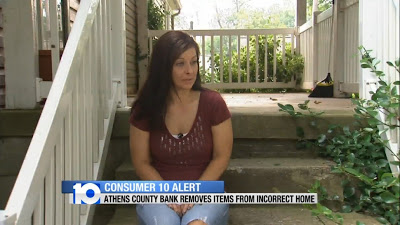
Katie Barnett, the victim.
As I cull the news to find good topics for ethics discussions, the single thought that goes through my mind most frequently is this: “What is the matter with people?” This is often followed by “How do people get this way?” and later, “What can we do with them?”
Most ethical decisions are not brain teasers. They are strikingly obvious, unless you are determined to do wrong, an evil super-villain, or were raised in a barn. How people of influence without a serious head injury can make the horrible decisions they do is one of the mysteries of the age, along with the fate of Judge Crater, the elusiveness of Bigfoot, and the continuing popularity of Jimmy Kimmel.
Imagine, for example, that you run a bank. The Three Stooges wannabes who you sent to repossess a home get the address wrong (the lawn hadn’t been mowed, so they “just assume”), and they trash the wrong house. They remove possessions, losing some, auctioning off others, damaging the rest. The innocent owner of the home comes to you and points out that your contractors screwed up outrageously, a fact that is beyond rebuttal. She presents you with a good faith estimate of the property that was lost—never mind the trauma of having her home emptied by strangers and the fact that she has had to live elsewhere for two weeks. What do you do?
If you are the president of the First National Bank in Wellston, here’s what you do, because you have a non-functioning ethics alarm and more than a few screws loose in other places besides: you reject her assessment, and try to low-ball her on the amount.
“What is the matter with people?”
“How do people get this way?” Continue reading
 Ethics Alarms