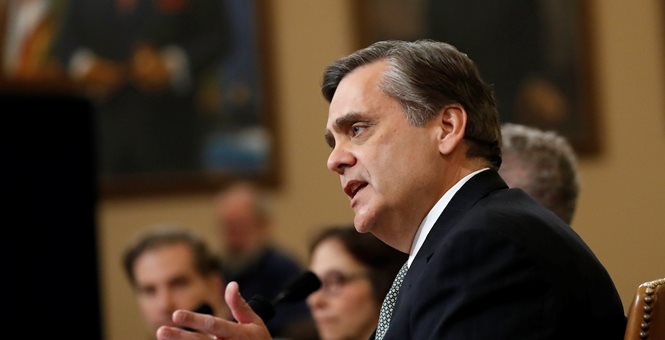
Written Statement of Prof. Jonathan Turley: “The Impeachment Inquiry Into President Donald J. Trump: The Constitutional Basis For Presidential Impeachment” [PART III]

(Part I is here; Part II, here.)

In this section of his testimony, Turley deals with the Ukraine phone call that is supposedly impeachable. Here is the key paragraph:

“Again, the issue is not whether these comments are correct, but whether they are corrupt. In my view, there is no case law that would support a claim of corrupt intent in such comments to support a bribery charge. There is no question that an investigation of the Bidens would help President Trump politically. However, if President Trump honestly believed that there was a corrupt arrangement with Hunter Biden that was not fully investigated by the Obama Administration, the request for an investigation is not corrupt, notwithstanding its inappropriateness. The Hunter Biden contract has been widely criticized as raw influence peddling. I have joined in that criticism. For many years, I have written about the common practice of companies and lobbyists attempting to curry favor with executive branch officials and members of Congress by giving windfall contracts or jobs to their children. This is a classic example of that corrupt practice.”

IV.   THE CURRENT THEORIES OF IMPEACHABLE CONDUCT AGAINST PRESIDENT DONALD J. TRUMP

 While all three acts in the impeachment standard refer to criminal acts in modern parlance, it is clear that “high crimes and misdemeanors” can encompass non-criminal conduct. It is also true that Congress has always looked to the criminal code in the fashioning of articles of impeachment. The reason is obvious. Criminal allegations not only represent the most serious forms of conduct under our laws, but they also offer an objective source for measuring and proving such conduct. We have never had a presidential impeachment proceed solely or primarily on an abuse of power allegation, though such allegations have been raised in the context of violations of federal or criminal law. Perhaps for that reason, there has been a recent shift away from a pure abuse of power allegation toward direct allegations of criminal conduct. That shift, however, has taken the impeachment process far outside of the relevant definitions and case law on these crimes. It is to those allegations that I would now like to turn.

At the outset, however, two threshold issues are worth noting. First, this hearing is being held before any specific articles have been proposed. During the Clinton impeachment hearing, we were given a clear idea of the expected articles of impeachment and far greater time to prepare analysis of those allegations. The House leadership has repeatedly indicated that they are proceeding on the Ukrainian controversy and not the various alleged violations or crimes alleged during the Russian investigation. Recently, however, Chairman Schiff indicated that there might be additional allegations raised while continuing to reference the end of December as the working date for an impeachment vote. Thus, we are being asked to offer a sincere analysis on the grounds for impeachment while being left in the dark. My testimony is based on the public statements regarding the Ukrainian matter, which contain references to four alleged crimes and, most recently, a possible compromise proposal for censure.

Second, the crimes discussed below were recently raised as part of the House Intelligence Committee hearings as alternatives to the initial framework as an abuse of power. There may be a desire to refashion these facts into crimes with higher resonance with voters, such as bribery. In any case, Chairman Schiff and committee members began to specifically ask witnesses about elements that were pulled from criminal cases. When some of us noted that courts have rejected these broader interpretations or that there are missing elements for these crimes, advocates immediately shifted to a position that it really does not matter because “this is an impeachment.” This allows members to claim criminal acts while dismissing the need to actually support such allegations. If that were the case, members could simply claim any crime from treason to genocide. While impeachment does encompass non-crimes, including abuse of power, past impeachments have largely been structured around criminal definitions. The reason is simple and obvious. The impeachment standard was designed to be a high bar and felonies often were treated as inherently grave and serious. Legal definitions and case law also offer an objective and reliable point of reference for judging the conduct of judicial and executive officers. It is unfair to claim there is a clear case of a crime like bribery and simultaneously dismiss any need to substantiate such a claim under the controlling definitions and meaning of that crime. After all, the common mantra that “no one is above the law” is a reference to the law applied to all citizens, even presidents. If the House does not have the evidence to support a claim of a criminal act, it should either develop such evidence or abandon the claim. As noted below, abandoning such claims would still leave abuse of power as a viable ground for impeachment. It just must be proven.

A.  Bribery

Continue reading

Morning Ethics Warm-Up, 12/5/2019: Post Impeachment Hearing Meltdown Edition

Good Morning!

Somehow a picture of the so-called “unicorn puppy,” appropriately named “Narwhal,” seems appropriate today. The Democratic Party/”resistance”/mainstream media has been pushing its corrupt impeachment plot on the assumption that sufficient Trump-haters would find it cute, but as of yesterday the undemocratic motives and ugliness of the effort stood out like a tail on a puppy’s face. You can’t hide it, and lots of people will convince themselves that it’s attractive. But rationally, the damn thing has to come off.

1. On the Stanford law professor’s joke about Barron Trump’s name. Oddly, perhaps the most harmless part of the otherwise embarrassing testimony of Stanford constitutional law professor Pamela S. Karlan yesterday became the most controversial. “While the president can name his son Barron, he can’t make him a baron,” she said.

HAHAHAHAHA! Good one, professor! Gratuitous and completely irrelevant to the issues at hand,  but hey, anything to throw fish to the seals! Based on the outrage around the conservative media, most of which only referenced this knee-slapper without quoting it, I assumed that she had actually insulted the teenager.  I kept reading about how this was one more example of the double standard: using Obama’s daughters for political warfare was off limits, but now this mean professor was getting laughs from Democrats by making fun of Barron Trump. Laura Ingraham tweeted that this joke was guaranteed to turn the public against the impeachment farce for good. (I don’t think so, Laura. You should get out more.) Naturally the First Lady piled on, tweeting at the professor, “A minor child deserves privacy and should be kept out of politics. Pamela Karlan, you should be ashamed of your very angry and obviously biased public pandering, and using a child to do it.” Trump 2020 national press secretary Kayleigh McEnany went even more overboard:

“Only in the minds of crazed liberals is it funny to drag a 13-year-old child into the impeachment nonsense,” she wrote. “Pamela Karlan thought she was being clever and going for laughs, but she instead reinforced for all Americans that Democrats have no boundaries when it comes to their hatred of everything related to President Trump. Hunter Biden is supposedly off-limits according to liberals, but a 13-year-old boy is fair game. Disgusting. Every Democrat in Congress should immediately repudiate Pamela Karlan and call on her to personally apologize to the president and the first lady for mocking their son on national TV.”

Oh come ON. Continue reading

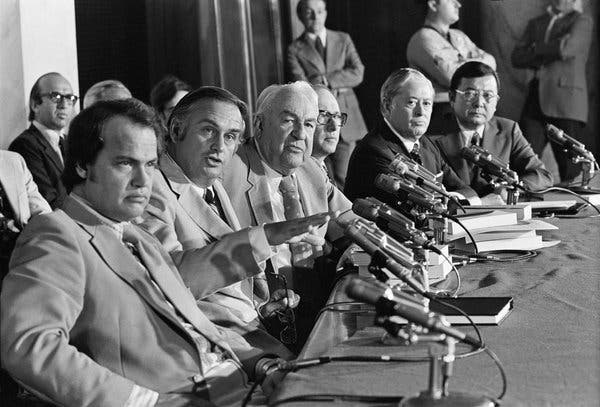
Written Statement of Prof. Jonathan Turley: “The Impeachment Inquiry Into President Donald J. Trump: The Constitutional Basis For Presidential Impeachment” [PART II]

( Part I is here.)

Professor Turley’s testimony continues…

B.  The Nixon Inquiry

The Nixon “impeachment” is often referenced as the “gold standard” for impeachments even though it was not an actual impeachment. President Richard Nixon resigned before the House voted on the final articles of impeachment. Nevertheless, the Nixon inquiry was everything that the Johnson impeachment was not. It was based on an array of clearly defined criminal acts with a broad evidentiary foundation. That record was supported by a number of key judicial decisions on executive privilege claims. It is a worthy model for any presidential impeachment. However, the claim by Chairman Schiff that the Ukrainian controversy is “beyond anything Nixon did” is wildly at odds with the historical record. The allegations in Nixon began with a felony crime of burglary and swept to encompass an array of other crimes involving political slush funds, payments of hush money, maintenance of an enemies list, directing tax audits of critics, witness intimidation, multiple instances of perjury, and even an alleged  kidnapping. Ultimately, there were nearly 70 officials charged and four dozen of them found guilty. Nixon was also named as an unindicted conspirator by a grand jury. The convicted officials include former Attorney General John N. Mitchell (perjury); former Attorney General Richard Kleindienst (contempt of court); former Deputy Director of the Committee to Re-elect The President Jeb Stuart Magruder (conspiracy to the burglary); former Chief of Staff H.R. Haldeman (conspiracy to the burglary, obstruction of justice, and perjury); former counsel and Assistant to the President for Domestic Affairs to Nixon John Ehlichman (conspiracy to the burglary, obstruction of justice, and perjury); former White House Counsel John W. Dean II (obstruction of justice); and former special counsel to the President Charles Colson (obstruction of justice). Many of the Watergate defendants went to jail, with some of the defendants sentenced to as long as 35 years. The claim that the Ukrainian controversy eclipses Watergate is unhinged from history.

While the Ukrainian controversy could still establish impeachable conduct, it undermines that effort to distort the historical record to elevate the current record. Indeed, the comparison to the Nixon inquiry only highlights the glaring differences in the underlying investigations, scope of impeachable conduct, and evidentiary records with the current inquiry. It is a difference between the comprehensive and the cursory; the proven and the presumed. In other words, it is not a comparison the House should invite if it is serious about moving forward in a few weeks on an impeachment based primarily on the Ukrainian controversy. The Nixon inquiry was based on the broadest and most developed evidentiary in any impeachment. There were roughly 14 months of hearings – not 10 weeks. There were scandalous tape recordings of Nixon and a host of criminal pleas and prosecutions. That record included investigations in both the House and the Senate as well as investigations by two special prosecutors, Archibald Cox and Leon Jaworski, including grand jury material. While the inquiry proceeded along sharply partisan lines, the vote on the proposed articles of impeachment ultimately included the support of some Republican members who, again, showed that principle could transcend politics in such historic moments.

Three articles were approved in the Nixon inquiry alleging obstruction of justice, abuse of power, and defiance of committee subpoenas. Two articles of impeachment based on usurping Congress, lying about the bombing of Cambodia, and tax fraud, were rejected on a bipartisan basis. While the Nixon impeachment had the most developed record and comprehensive investigation, I am not a fan of the structure used for the articles. The Committee evaded the need for specificity in alleging crimes like obstruction of justice while listing a variety of specific felonies after a catchall line declaring that “the means used to implement this course of conduct or plan included one or more of the following.” Given its gravity, impeachment should offer concrete and specific allegations in the actual articles. This is the case in most judicial impeachments.

The impeachment began with a felony when “agents of the Committee for the Re- election of the President committed unlawful entry of the headquarters of the Democratic National Committee in Washington, District of Columbia, for the purpose of securing political intelligence.” The first article of impeachment reflected the depth of the record and scope of the alleged crimes in citing Nixon’s personal involvement in the obstruction of federal and congressional investigations. The article included a host of specific criminal acts including lying to federal investigators, suborning perjury, and witness tampering. The second article of impeachment also alleged an array of criminal acts that were placed under the auspices of abuse of power. The article addressed Nixon’s rampant misuse of the IRS, CIA, and FBI to carry out his effort to conceal the evidence and crimes following the break-in. They included Nixon’s use of federal agencies to carry out “covert and unlawful activities” and how he used his office to block the investigation of federal agencies. The third article concerned defiance of Congress stemming from his refusal to turn over material to Congress.

These articles were never subjected to a vote of the full House. In my view, they were flawed in their language and structure. As noted earlier, there was a lack of specificity on the alleged acts due to the use of catch-all lists of alleged offenses. Continue reading

Written Statement of Prof. Jonathan Turley: “The Impeachment Inquiry Into President Donald J. Trump: The Constitutional Basis For Presidential Impeachment” [PART I]

Today, at the impeachment hearings, Prof. Jonathan Turley performed a great public and national service by eviscerating the Democratic theory of impeachment legally, logically and historically. I cannot wait to see if his decisive testimony is given half the prominence by the New York Times as the various headlines shouting about how an official would have done things differently if he or she were President. Unlike almost all of the testimony so far, Turley’s was based on facts and law, and addressed the issue at hand: is there any justification for impeachment proceedings?

It’s a wonderful and clear piece of scholarship that addresses several approaches to the matter that I had wanted to address, notably how the three previous impeachment efforts compare with this one.

Every citizen should read it all; of course, almost none will. The testimony is long, because it is thorough; I have edited it for ease of reading, eliminating footnotes. If you want to read the original document, it is here. Ethics Alarms is going to present this in several parts. Send that link to your smug impeachment-cheering friends, relatives and social media contacts. Tell them that unless they read it, you really don’t want to hear any more on the subject from them, because they want to remain ignorant.

I am proud—relieved?—to find that this serious and admirable scholar embraces many of the positions I have discussed here, though in far more detail and with considerably more authority.

INTRODUCTION

Chairman Nadler, ranking member Collins, members of the Judiciary Committee, my name is Jonathan Turley, and I am a law professor at George Washington University where I hold the J.B. and Maurice C. Shapiro Chair of Public Interest Law. It is an honor to appear before you today to discuss one of the most solemn and important constitutional functions bestowed on this House by the Framers of our Constitution: the impeachment of the President of the United States.

Twenty-one years ago, I sat here before you, Chairman Nadler, and other members of the Judiciary Committee to testify on the history and meaning of the constitutional impeachment standard as part of the impeachment of President William Jefferson Clinton. I never thought that I would have to appear a second time to address the same question with regard to another sitting president. Yet, here we are. Some elements are strikingly similar. The intense rancor and rage of the public debate is the same. It was an atmosphere that the Framers anticipated. Alexander Hamilton warned that charges of impeachable conduct “will seldom fail to agitate the passions of the whole community, and to divide it into parties more or less friendly or inimical to the accused.”2 As with the Clinton impeachment, the Trump impeachment has again proven Hamilton’s words to be prophetic. The stifling intolerance for opposing views is the same. As was the case two decades ago, it is a perilous environment for a legal scholar.

I appear today in my academic capacity to present views founded in prior academic work on impeachment and the separation of powers. My testimony does not reflect the views or approval of CBS News, the BBC, or the newspapers for which I write as a columnist. My testimony was written exclusively by myself with editing assistance from Nicholas Contarino, Andrew Hile, Thomas Huff, and Seth Tate explores the technical and arcane issues normally involved in an academic examination of a legal standard ratified 234 years ago. In truth, the Clinton impeachment hearing proved to be an exception to the tenor of the overall public debate. The testimony from witnesses, ranging from Arthur Schlesinger Jr. to Laurence Tribe to Cass Sunstein, contained divergent views and disciplines. Yet the hearing remained respectful and substantive as we all grappled with this difficult matter. I appear today in the hope that we can achieve that same objective of civil and meaningful discourse despite our good- faith differences on the impeachment standard and its application to the conduct of President Donald J. Trump.

I have spent decades writing about impeachment and presidential powers as an academic and as a legal commentator. My academic work reflects the bias of a Madisonian scholar. I tend to favor Congress in disputes with the Executive Branch and I have been critical of the sweeping claims of presidential power and privileges made by modern Administrations. My prior testimony mirrors my criticism of the expansion of executive powers and privileges. In truth, I have not held much fondness for any president in my lifetime. Indeed, the last president whose executive philosophy I consistently admired was James Madison.

In addition to my academic work, I am a practicing criminal defense lawyer. Among my past cases, I represented the United States House of Representatives as lead counsel challenging payments made under the Affordable Care Act without congressional authorization. I also served as the last lead defense counsel in an impeachment trial in the Senate. With my co-lead counsel Daniel Schwartz, I argued the case on behalf of federal judge Thomas Porteous. (My opposing lead counsel for the House managers was Adam Schiff). In addition to my testimony with other constitutional scholars at the Clinton impeachment hearings, I also represented former Attorneys General during the Clinton impeachment litigation over privilege disputes triggered by the investigation of Independent Counsel Ken Starr. I also served as lead counsel in a bill of attainder case, the sister of impeachment that will be discussed below.

I would like to start, perhaps incongruously, with a statement of three irrelevant facts. First, I am not a supporter of President Trump. I voted against him in 2016 and I have previously voted for Presidents Clinton and Obama. Second, I have been highly critical of President Trump, his policies, and his rhetoric, in dozens of columns. Third, I have repeatedly criticized his raising of the investigation of the Hunter Biden matter with the Ukrainian president. These points are not meant to curry favor or approval. Rather they are meant to drive home a simple point: one can oppose President Trump’s policies or actions but still conclude that the current legal case for impeachment is not just woefully inadequate, but in some respects, dangerous, as the basis for the impeachment of an American president. To put it simply, I hold no brief for President Trump. My personal and political views of President Trump, however, are irrelevant to my impeachment testimony, as they should be to your impeachment vote. Today, my only concern is the integrity and coherence of the constitutional standard and process of impeachment. President Trump will not be our last president and what we leave in the wake of this scandal will shape our democracy for generations to come. I am concerned about lowering impeachment standards to fit a paucity of evidence and an abundance of anger. If the House proceeds solely on the Ukrainian allegations, this impeachment would stand out among modern impeachments as the shortest proceeding, with the thinnest evidentiary record, and the narrowest grounds ever used to impeach a president. That does not bode well for future presidents who are working in a country often sharply and, at times, bitterly divided.

Although I am citing a wide body of my relevant academic work on these questions, I will not repeat that work in this testimony. Instead, I will focus on the history and cases that bear most directly on the questions facing this Committee. My testimony will first address relevant elements of the history and meaning of the impeachment standard. Second, I will discuss the past presidential impeachments and inquiries in the context of this controversy. Finally, I will address some of the specific alleged impeachable offenses raised in this process. In the end, I believe that this process has raised serious and legitimate issues for investigation. Indeed, I have previously stated that a quid pro quo to force the investigation of a political rival in exchange for military aid can be impeachable, if proven. Yet moving forward primarily or exclusively with the Ukraine controversy on this record would be as precarious as it would premature. It comes down to a type of constitutional architecture. Such a slender foundation is a red flag for architects who operate on the accepted 1:10 ratio between the width and height of a structure. The physics are simple. The higher the building, the wider the foundation. There is no higher constitutional structure than the impeachment of a sitting president and, for that reason, an impeachment must have a wide foundation in order to be successful. The Ukraine controversy has not offered such a foundation and would easily collapse in a Senate trial.

Before I address these questions, I would like to make one last cautionary observation regarding the current political atmosphere. In his poem “The Happy Warrior,” William Wordsworth paid homage to Lord Horatio Nelson, a famous admiral and hero of the Napoleonic Wars. Wordsworth began by asking “Who is the happy Warrior? Who is he what every man in arms should wish to be?” The poem captured the deep public sentiment felt by Nelson’s passing and one reader sent Wordsworth a gushing letter proclaiming his love for the poem. Surprisingly, Wordsworth sent back an admonishing response. He told the reader “you are mistaken; your judgment is affected by your moral approval of the lines.” Wordsworth’s point was that it was not his poem that the reader loved, but its subject. My point is only this: it is easy to fall in love with lines that appeal to one’s moral approval. In impeachments, one’s feeling about the subject can distort one’s judgment on the true meaning or quality of an argument. We have too many happy warriors in this impeachment on both sides. What we need are more objective noncombatants, members willing to set aside political passion in favor of constitutional circumspection. Despite our differences of opinion, I believe that this esteemed panel can offer a foundation for such reasoned and civil discourse. If we are to impeach a president for only the third time in our history, we will need to rise above this age of rage and genuinely engage in a civil and substantive discussion. It is to that end that my testimony is offered today. Continue reading

Post Thanksgiving Ethics Hangover,11/29/2019: The Toilet Bowl, Mr. Peanut, And Other Embarrassments

This is always one of the strangest days of the year.

Especially strange for me: I keeled over right at the start of Thanksgiving dinner for no discernible reason. One minute I was sipping a beer and feeling oddly light-headed, and the next my son was lifting me off the floor. It must have been spectacular, because it scared the hell out of everyone but my son’s girlfriend, who assumed I was staging a gag. (She got to know me fast…) I’m sorry I missed the excitement.

Today I’ve been feeling out of it, but I can’t tell whether the cause is the fainting spell, L-Tryptophan, or something else (it has been a rough week). My wife has been following me around like a bloodhound, expecting me to go down for the count.

I’ll be seeing my doctor first thing Monday. But enough about me:

1. Tit for Tat. Three women,  Jana Solis, Natalie Sept and Nicole Vogel, accused Gordon D. Sondland, the United States ambassador to the European Union, of making unwanted sexual advances toward them years ago, right after he testified as a star witness at the impeachment proceedings against President Trump. Sondland appeared before Congress and gave what was  viewed by many as damaging testimony about the President’s dealings with Ukraine and the alleged “quid pro quo.”  The timing of the accusations is suspicious, and the Left has no one to blame but itself as its weaponized “believe all women” nonsense circles around like the deadly torpedo in “The Hunt for the Red October.” This was begun by Anita Hill, escalated by Cristina Blasey Ford, and soon such convenient accusations will have no power whatsoever.

Good.

2.Please remember: Hillary Cinton is (at least) as rotten a human being as Donald Trump, just a different kind of rotten human being. Journalist Ronan Farrow told the Financial Times  that Hillary Clinton cut him off him when she discovered he was investigating sexual assault allegations against Hollywood mogul Harvey  Weinstein. Weinstein donated tens of thousands of dollars to groups supporting Clinton’s candidacy during the 2016 presidential campaign, according to Federal Election Committee data.

Though Clinton had appointed Farrow as her special adviser on global youth issues in 2011 when she was Secretary of State and he had worked with Clinton “for years,” she quickly distanced herself from him and cancelled an interview after she learned that he  was looking into Weinstein’s harassment and sexual abuse.

“It’s remarkable how quickly even people with a long relationship with you will turn if you threaten the centers of power or the sources of funding around them,” Farrow said. “Ultimately, there are a lot of people out there who operate in that way. They’re beholden to powerful interests and if you go up against those interests, you become radioactive very quickly.”

It’s not remarkable. What’s remarkable is that so many women still get misty over the fact that this cynical hypocrite who pretended to be a feminist champion while allying herself with people like Bill Clinton and Harvey Weinstein was deservedly defeated in the 2016 election. Continue reading

Yes, It’s Bizarro World—But The Mainstream Media Anti-Trump Bias Is Still Ridiculous

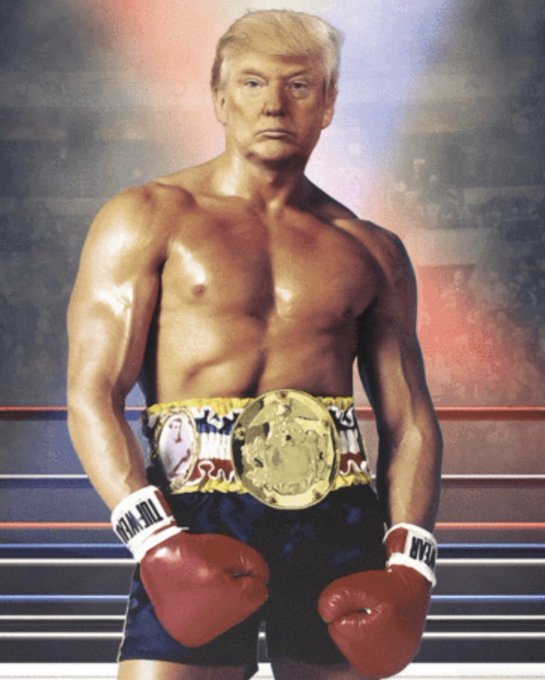
The President’s master-trolling display before Thanksgiving plunged us squarely into Bizarro World Ethics territory. I cannot imagine any previous President of the United States pulling a public stunt even close to as juvenile and silly as tweeting the photo above out to his followers and, inevitably, the world. I can’t imagine another President even considering it. The leader of the free world, the dignified occupant of the White House, the leader and role model of millions just doesn’t do something like that. He just…just..doesn’t, that’s all!

Yet there it was , just before 11:00 am on November 27. And like so many other seemingly vulgar and impetuous acts and statements that President Trump has authored, the deranged foes of the President managed to make it look like a brilliant stratagem. First the Washington Post—surely there must be some perceptive people working there, wouldn’t you think?—sent out this hurrumphing tweet:

Oh, it’s doctored! Good sleuthing, Post! Quick, add this to your recent list of Trump mendacities: he tried to make the public think that he’s built like Rocky under those blue suits, the liar!

And “unclear why”!!! Unclear why? How bone-headedly biased does someone have to be to not understand why Trump would tweet out a photo of himself as “Rocky” (in “Rocky 3”, to be accurate)? Has anyone on the Post staff seen “Rocky,” or is so stuffed with culturally ignorant naifs whose idea of an ancient inspirational movie is the ten-year-old “The Blind Side” that “Rocky” (1976) and its descendants are buried in their “Irrelevant films my grandparents watched” files? Continue reading

Pre-Thanksgiving Day Ethics Wrap-Up, 11/27/2019

Be thankful tomorrow, everybody.

There’s always something…

1. On unethical misleading language, Part A: Today’s “Nah, there’s no mainstream media bias” note: I was suddenly struck after reading one, two, three, four impeachment-related stories in a row in four separate news sources that they all used the phrase “dirt on Joe Biden.” Isn’t that strange? “Dirt” isn’t a description, it’s a characterization, and a deliberately  pejorative one that assumes that Biden is a victim of a dastardly action. It’s widespread use is one more smoking gun that demonstrates mainstream media bias aimed at smearing President Trump. The term “dirt” presupposes that if the President sought to persuade the Ukraine to aid the U.S. in an investigation, something it is obligated by treaty to do, it was only to assist his re-election chances. When the term “dirt” has been used in conjunction with a politition seeking damning information on Bill Clinton, either George Bush, or Trump himslef, it was always in the context of an election campaign. Few wrote that the Mueller investigation was a “dirt” seeking operation (though in truth it was). But it’s always “dirt on Joe Biden” that the Ukraine was allegedly asked/forced/extorted into looking for. When Jeffrey Epstein was being investigated, nobody said the FBI was seeking to smear him with “dirt,” because news sources accepted that an investigation was appropriate.

Yet there are many reasons and strong evidence suggesting that an investigation of Joe Biden’s alleged machinations to benefit his son by abusing his office and misusing his influence was (and is) also appropriate. The United States should not just shrug off corruption in its highest offices because a complicit individual is running for President, but that is the thrust of the current impeachment push by House Democrats. For the media to intentionally choose terminology—and slang, which is usually not in a newspaper style-book— to lead readers away from the argument that an investigation of Joe Biden was necessary and valid whether he was running for President or not shows a disturbing disinterest in fair reporting, and a preference for anti-Trump propaganda. Continue reading

The Big Lies Of The “Resistance”: A Directory, Updated (11/29/2023)

Introduction

The “Big Lie” strategy of public opinion manipulation, most infamously championed by Adolf Hitler and his propaganda master Joseph Goebbels, has, in sinister fashion, become a routine and ubiquitous component of the Left’s efforts to remove President Donald J. Trump from office without having to defeat him at the polls, and subsequently after his defeat, to attempt to prevent him from defeating a hopelessly inept failed successor. One of the most publicized Big Lies, that Trump had “colluded” with the Russian government to “steal” the Presidential election from Hillary Clinton was eventually exposed as such by the results of the Mueller investigation, the discrediting of the Steele Dossier, and the revelation that Democrats (like Adam Schiff) and the mainstream news media deliberately misled the public. and Democrats, with blazing speed, replaced it with another Big Lie that there was a “Constitutional crisis.” I could have added that one to the list, I suppose, but the list of Big Lies is dauntingly long already, and this one is really just a hybrid of the Big Lies below.

Becoming addicted to relying on Big Lies as a political strategy is not the sign of ethical political parties, movements, or ideologies. Perhaps there is a useful distinction between Big Lies and “false narratives,” but I can’t define one. Both are intentional falsehoods designed to frame events in a confounding and deceptive manner, so public policy debates either begin with them as assumptions, thus warping the discussion, or they result in permanent bias, distrust and suspicion of the lie/narrative’s target. For simplicity’s sake, because I believe it is fair to do so, and also because “Big Lie” more accurately reflects just how unethical the tactic is, that is the term I will use.

Big Lie #1. “Trump is just a reality TV star.”

This is #1 because it began at the very start of Trump’s candidacy. It’s pure deceit: technically accurate in part but completely misleading. Ronald Reagan was subjected to a similar Big Lie when Democrats strategically tried to denigrate his legitimacy by  referring to him as just an actor, conveniently ignoring the fact that he had served as Governor of the largest state in the nation for eight years, and had split his time between acting and politics for many years before that, gradually becoming more involved in politics and public policy. (Reagan once expressed faux puzzlement about the denigration of his acting background, saying that he thought acting was an invaluable skill in politics. He was right, of course.)

In Trump’s case, the disinformation was even more misleading, He was a successful international businessman and entrepreneur in real estate, hotels and casinos, and it was that experience, not his successful, late career foray into “The Apprentice” (as a branding exercise, and a brilliant one), that was the basis of his claim to the Presidency.

The “reality star” smear still appears in attack pieces, even though it makes even less sense for a man who has been President for four years. The tactic is ethically indefensible . It is not only dishonest, intentionally distorting the President’s legitimate executive experience and success,  expertise and credentials, it is also an ad hominem attack. Reality TV primarily consists of modern freak shows allowing viewers to look down on assorted lower class drunks, vulgarians, has-been, exhibitionists,  idiots and freaks. Class bigotry has always been a core part of the NeverTrump cabal, with elitist snobs like Bill Kristol, Mitt Romney, the Bushes, and George Will revealing that they would rather capitulate to the Leftist ideology they have spent their professional lives opposing (well, not Mitt in all cases) than accept being on the same team as a common vulgarian like Donald Trump.

With all of this, the final irony is that “The Apprentice” wasn’t even a true reality show.  It was an elimination  contest, with Donald Trump as the arbiter.

This earliest of the Big Lies backfired on its creators.  Trump’s adversaries began to believe it themselves, causing them to underestimate their adversary.  They realized, too late, that they weren’t running against poor Anna Nicole Smith, Kim Kardashian, or Scott Baio, but a tough, ruthless, confident street fighter with some impressive leadership and public speaking skills.

It is a mark of how flat the learning curve of the President’s adversaries is that they still think calling him a “reality TV star” shows anything but their own dishonesty and ignorance. Continue reading

End-Of-Week Ethics Inventory, 11/24/19: Really, Really Bad Mood Edition

Worst…Ethics Alarms…Week…Ever!

Or so it seems, anyway. Have people already started ignoring life for Thanksgiving? Or am I being punished for not being able to squeeze enough posts out while driving, flying, typing in crowds and moving in and out of various abodes while trying to work? To make it worse, there was a lot going on that required some time and solitude to research and analyze, and I just didn’t have it. I also managed to make myself sick. Tuesday and Wednesday had the worst non-holiday mid-week traffic of 2019, and Saturday had the lowest number of visits for that day in three years.

Well, as Andy Kinkaid, my late, cynic-philosopher college roommate, a ruined Vietnam veteran,  used to respond several times each day to every argument, disappointment, tragedy, catastrophe, and piece of bad news as he smiled and retreated to his darkened room to get stoned, “Fuck it, right?

1. Apparently there is a copyright battle over the obnoxious catch-phrase “OK, Boomer!,” the viral dismissive insult being hurled at Baby Boomers who dare to question the wisdom, passion, and hive-mind beliefs of Gen. Z-ers and Millenials. It looks like all such efforts to “own” the phrase are doomed, because it has rapidly become so ubiquitous as a put-down so quickly that nobody can prove it originated with them.

Has it occurred to any of the smug little snots brushing aside their elders that this is nothing but a personal ad hominem attack without substance, no more fair or valid, and just as rude and bigoted, as “Shut up, bitch,” “Go home to your mother, Pee-Wee,” or “Get a job, Pedro”? As a Baby Boomer, I think we ought to agree on a standard retort to “OK, Boomer” of equal substance and wit, and I hereby nominate “Keep flailing, Dumb-Ass!”

2. Speaking of Millennials, a New York Times social columnist informs me that they have decreed that on-line the term “OK” or “Okay” is now considered rude, and the proper term is “k-k,” which sound to me like a Klan chapter short of members, or someone with a stutter. Just because you want to create ugly and pointless new conventions to metaphorically mark your cyber-territory doesn’t mean I have to assent.

And no, I never have and never will use LOL or LMAO. They’ll have to shoot me first. Continue reading

Comment Of The Day: “Yes, It’s Open Forum Time Again!,” And Reflections On The State of Our Democracy, Part 1

The discussion on the Open Forum this week, unmoderated, was remarkably effective in covering important topics in my absence that I would have been writing about had I not been caught in a conflict of duties. Among them: the impeachment hearings; Chic-Fil-A capitulating to public bullying; Bob Barr’s speech; the President’s pardon of several officers convicted by military courts, and several others, including the AFP news service botch of using Obama era figures to condemn Trump’s illegal immigration policies.

Excellent job, everybody. Thank you.

This may not be the only COTD to come from that Open Forum, but long-time contributor Michael R. hit on several points that I would have written about, and have before. It is important to keep the context of and motives underlying the Trump Impeachment Ethics Train Wreck before us, even if it involves returning again and again to a repulsive topic, and repeating the factors that make the 2016 Post Election Ethics Train Wreck the threat to the nation’s comity, security, viability and continued success that it has become.

I’ll be back at the end, but for now, here’s Michael R.’s Comment of the Day:

The election of Trump shows that elections of Republicans can be democratic. The treatment of Trump seems to show that elections don’t matter. The people can elect anyone they want, but if they elect the wrong person, the government will make sure that mistake is rectified. It looks like we have a Lt. Colonel who decided he didn’t like the President’s foreign policy and started impeachment proceedings against him. We have 5,6,7…I don’t know how many head FBI executives who fabricated evidence, lied, and leaked classified information, and investigated every facet of the President’s life to try to remove the President. We have how many Justice Department and State Department officials who have willfully obstructed the President’s orders if not blatantly tried to have him removed from office. The bureaucracy even raided the office of the President’s personal attorney and leaked files they seized.

How many Federal Judges have cancelled his executive orders merely because they don’t agree with them? How many federal judges have ruled that the President can’t cancel an executive order if the judges disagree with the decision? How many judges ruled that it is OK to spy on a Presidential campaign as long as they don’t like that candidate?

Democracy may not be dead, but it isn’t very healthy. I have begun to see lots of posts along the lines of “What do we do when elections stop working. What do we do when we can’t change things no matter who we elect?” Looking at the last 3 years, how many people need to be removed from the government before elections matter? 2000? 3000? 10,000? 100,000? Maybe have a poll…

I’m back. Continue reading