Morning Ethics Warm-Up: 6/13/17

1.  The controversy over the Central Park “Julius Caesar” casting Donald Trump–his stage clone, really—as Caesar continues to be ignorantly argued. What’s worse, Fox News constantly calling the Shakespearean classic an “assassination play” (it’s not, not even close), or people who really would love to see Trump assassinated arguing that there’s a double standard because some professional productions of  “Julius Caesar” in recent years cast a black actor as the targeted emperor? Does anyone for a second believe that if a high-profile theatrical production depicted a character as clearly intended to symbolize Obama as the New York City production styles its Caesar as Trump being assassinated in a scene like the one below, there would not have been equivalent, indeed greater outrage?

The most cited production with a black, modern business-suited Caesar had an actor with a shaved head playing the role, clearly signalling that this was NOT Barack Obama. This, however, is “Donald Trump”:

My question is: Does the audience cheer? I bet they do, and I bet that’s exactly what the director wanted. I support the production, and reject efforts to pressure donors into pulling support. Theater is often political, and outrageous, and should be. But the play’s defenders who cite versions that evoked a black leader as equivalent are arguing that people are more upset at a faux Trump assassination than they would have been if “Obama” were slaughtered in Central Park, and that is absurd.

2. Another looming boycott is the effort to punish NBC’s Megyn Kelly for interviewing InfoWars’ Alex Jones, the professional conspiracy theorist and right-wing liar. Because he famously suggested that the Sandy Hook massacre was a hoax—an instant IQ test for anyone deciding to ever pay attention to this jerk again—Sandy Hook parents and their allies are condemning NBC and Kelly for “giving him a platform,” and have succeeded in getting one sponsor, JP Morgan, to drop its ads. How long before both ends of the political spectrum start routinely pushing boycotts of any journalists who “give a platform” to someone their “side” has pronounced as evil?  The Sandy Hook victims’ families continue to abuse the sympathy their tragedy evoked by using it to attack core rights using appeals to emotion and little else. Some quotes from the Washington Post story: Continue reading
From “The Pazuzu Excuse” Files: The Justly-Fired TV Reporter’s Lament

Colleen Campbell, a local  Philadelphia television reporter, got herself fired for an obscenity-packed rant berating a cop  outside a Philadelphia comedy club. What she didn’t know was that the whole, ugly thing was filmed. You know that rule that says “ethics is what you do when nobody’s looking except your embarrassed companion and a policeman who you have no respect for anyway because he’s just a cop? That’s the one Colleen whiffed on.

Campbell ae was kicked out of the club for “loud whispering” throughout the show. Once outside, she denied being disruptive to an officer who removed her. The officer replied that Campbell and her male friend needed to just leave the scene. The reporter replied, charmingly,

Or what? Or what, motherfucker? Lick my asshole. How about that? Fucking piece of shit. That’s why nobody likes fucking police … idiots in this fucking town.”

Campbell, 28, didn’t know her act was caught on camera and posted to Facebook until after she received word from the station that she had been fired. Now she says…

“That’s not me or how I talk or act or anything at all…I don’t know what to do. I feel ruined and embarrassed for me and my family….I feel awful…That’s not me or how I speak or how I talk or how I was raised. I had to delete all my social media, because I’m getting threats….I wanna apologize to the officer. I don’t remember the whole altercation at all. I remember feeling attacked. I would never talk like that. It was like watching a whole different me.”

The Kathy Griffin episode sparked several of those currently popular blog posts and web essays about how social media destroys people who make “one mistake” and if it could happen to them, it can happen to you. Ethics Alarms has had several of these posts in the past, always about regular citizens who had an ugly e-mail distributed to the universe by an angry girl friend, or a tasteless or misunderstood tweet to a friend gone viral. No question: these web lynchings are out of proportion to the offense. Continue reading

“The Keepers,” The Catholic Church, And Bishop Fulton J. Sheen

I began watching Netflix’s new “true crime” series “The Keepers” last night. I may not last through all seven episodes. In addition to the documentary story-telling methodology, which moves at the pace of a slug-race, the story of how unsolved murder of a Baltimore nun might  be part of  (yet another) horrific cover-up by the Catholic Church made me so angry and frustrated that I quit in the middle of the third episode. The series makes the case that the nun, Sister Catherine “Cathy” Cesnik, was killed because she was about  to reveal ongoing sexual abuse of young teenage girls by the priest running the Archbishop Keough High School for girls.

The abuse and the extent of it is not speculation. As in so many other places, the Catholic Church in Baltimore eventually paid millions in damages to multiple victims of multiple predator priests who the Church moved around the  region—so they could molest and assault new victims—rather than handing them over to law enforcement. It is hard to imagine any priest worse than Father Joseph Maskell, however, if even some of the allegations against him are true. Victims say he used student files and illicit police connections to target teenage girls who were already being sexually abused. He manipulated them using a sick combination of religion, guilt, hypnotism and intimidation, sexually abused them, and even delivered some over to members of the Baltimore police department for more abuse.

The documentary focuses on the school’s Class of ’69, though there must have been equally abused girls before and after. The conspiracy of silence began to crack in 1992, when an especially  victimized member of the class suddenly realized that she had repressed memories of horrible experiences, and finally complained to the Baltimore Archdiocese, setting off the kind of despicable Church defensive strategies too familiar to anyone who has seen “Spotlight.”

This documentary isn’t good for my state of mind. It makes me wonder not only if all is lost, but also if all wasn’t lost long ago. I was raised in a largely Catholic community. I am not religious, but as an ethicist I recognize the important, civilizing role religion has played in teaching and enforcing moral principles for the majority of the public for whom ethical analysis is too challenging. Episodes like the Father Maskell scandal raise questions that I rebuke myself for asking, like “How can this be?” “Jane Doe,” the star witness in the documentary, is still a devout Catholic. Her immediate response to every dilemma is to pray. I don’t get it. She was savaged, threatened and abused by a priest that she knows the Church allowed to prey on the vulnerable students entrusted to him. Why would she still trust the Catholic Church?

Why would anyone? Continue reading

Conundrum: Is CNN’s Dylan Byers An Ethics Dunce, Or An Ethics Hero?

Midnight  Friday morning,  CNN was analyzing the GOP’s perplexing win in Montana’s special election for the House of Representatives—perplexing to Ethics Alarms because the winner, Gianforte, is a dishonest thug, but perplexing to CNN because their reporters were desperately hoping for a sign that voters were turning on President Trump, something their network has been working on for many months.  CNN’s Media reporter Dylan Byers then blurted out this remarkable statement:

“There’s this conversation that’s happening among people following the news industry, which is how can we bridge the sort of gap between all of those conservatives who don’t trust the media, and get them to start knowing that, you know, we’re acting in good faith, with good intentions? Maybe you can’t, because they’re not even listening. From the second, it’s not as though they’re reading the article and considering it, or listening the audio and considering it. They’re just not paying attention to it, because  they don’t trust us.

And this, by the way, you look at the tapes of Trump there. Two things have happened. One, over the course of several decades, the conservatives have done a masterful job at capitalizing the waning trust in media and using it to their advantage. But a second thing has happened, too, which is, on occasion, more than the media would like to admit, we have not told the story of conservative Americans, disenfranchised Americans, who believe that they are losing their country. The story we have largely been telling is a story that is more or less in step with the arc of history as defined by Barack Obama and Hillary Clinton. It does not mean we favor them to win. It just means that sort of vision of a progressive future, a global future, and that is not one that resonates with so many conservative American voters.”

“The story we have largely been telling is a story that is more or less in step with the arc of history as defined by Barack Obama and Hillary Clinton.”

It is notable that none of the three journalists on the panel with Byers challenged this damning characterization. Continue reading

Responsible And Necessary: The Appointment Of A Special Counsel

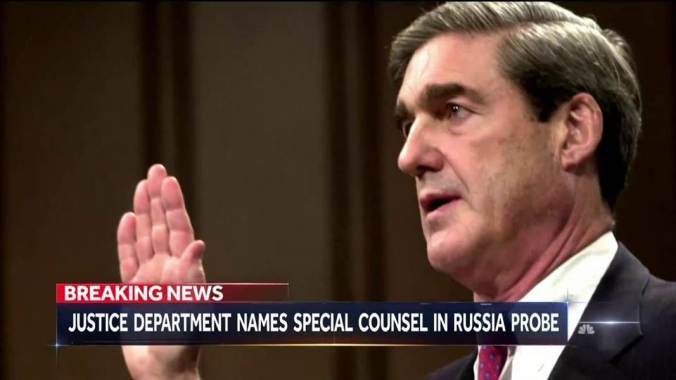
The Justice Department appointed Robert S. Mueller III (above), a former F.B.I. director, as special counsel to handle the Russia probe.

I am reading conservative pundits fuming over this development for a number of reasons, some of them valid and troubling. However, there is no good argument to be made that a Special Counsel isn’t necessary now.

Assistant Attorney General Rod Rosenstein explained his decision to make the appointment (remember, he is acting AG in the Russian investigation, because Jeff Sessions was bullied and hectored into recusing himself, also unavoidable):

“In my capacity as acting Attorney General, I determined that it is in the public interest for me to exercise my authority and appoint a Special Counsel to assume responsibility for this matter.My decision is not a finding that crimes have been committed or that any prosecution is warranted. I have made no such determination. What I have determined is that based upon the unique circumstances, the public interest requires me to place this investigation under the authority of a person who exercises a degree of independence from the normal chain of command.”

Exactly. As for the last sentence, President Trump has no one to blame but himself. His own, typical, blundering, blathering ways created this atmosphere—that and “Deep State” leaks calculated to undermine him, and a news media feasting on those leaks like sharks on chum.

It is being argued that you can’t appoint a special prosecutor unless there is a finding that crimes have been committed. Here are the relevant sections of the law:

§ 600.1 Grounds for appointing a Special Counsel.

The Attorney General, or in cases in which the Attorney General is recused, the Acting Attorney General, will appoint a Special Counsel when he or she determines that criminal investigation of a person or matter is warranted and –

(a) That investigation or prosecution of that person or matter by a United States Attorney’s Office or litigating Division of the Department of Justice would present a conflict of interest for the Department or other extraordinary circumstances; and

(b) That under the circumstances, it would be in the public interest to appoint an outside Special Counsel to assume responsibility for the matter.

§ 600.2 Alternatives available to the Attorney General.

When matters are brought to the attention of the Attorney General that might warrant consideration of appointment of a Special Counsel, the Attorney General may:

(a) Appoint a Special Counsel;

(b) Direct that an initial investigation, consisting of such factual inquiry or legal research as the Attorney General deems appropriate, be conducted in order to better inform the decision; or

(c) Conclude that under the circumstances of the matter, the public interest would not be served by removing the investigation from the normal processes of the Department, and that the appropriate component of the Department should handle the matter. If the Attorney General reaches this conclusion, he or she may direct that appropriate steps be taken to mitigate any conflicts of interest, such as recusal of particular officials.

I don’t read the law so narrowly. The law requires that there be a determination that a criminal investigation is warranted, not that crimes have been committed. Continue reading

The Legal Profession Appears To Have A Serious Character Standards Problem…

I refer you, for context, to the recent post about Shon Hopwood, Georgetown Law Center’s former bank-robber, former federal prisoner professor, who was welcomed into membership in the D.C. bar…like me.

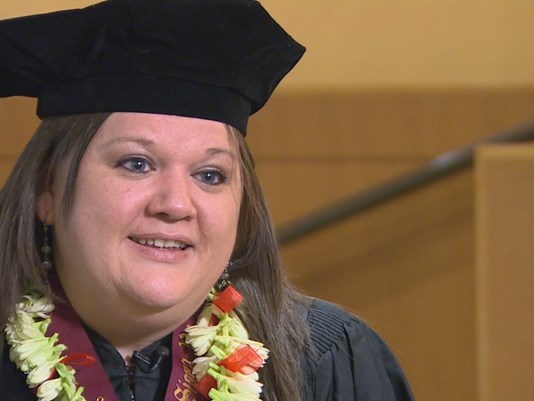
Now comes word that Tarra Simmons, a third-year law student, convicted felon and former drug addict, who in December won a Skadden Fellowship to help people recently released from prison, was told by the Washington State Bar Association that she did not possess the character to make her a trustworthy lawyer.

Tarra was a magna cum laude law school graduate, and co-chairs Washington’s Statewide Re-Entry Council.  She recently received a gubernatorial appointment to the state’s Public Defense Advisory Committee, and was selected by the dean of Seattle University School of Law to receive the school’s dean’s medal this year.

Nevertheless, the character and fitness board’s vote against Simmons was not even close, at 6-3.

A registered nurse for 11 years, Simmons became addicted to prescription drugs and methamphetamine after her father died, as she self-medicated for depression. In 2011, she was charged with felony theft, drug possession and gun possession, pleaded guilty, served 20 months in state prison. She says she  wants to assist former justice-involved individuals, as  a lawyer who has lived their experience, so they “can overcome barriers and rejoin society.”

But Tarra cannot cannot take the Washington Bar examination without getting a positive  character and fitness recommendation, and that looks unlikely. She’s appealing to the Washington Supreme Court, but traditionally that forum is tougher in assessing the  character and fitness of  potential admittees.

I think her course now is obvious: move to the District of Columbia. The bar there will surely see no reason to doubt her character.

After all, it’s not like she robbed a bank.

__________________________

Pointer: ABA Journal

Ethics Quiz: The Bank Robber Professor

A few weeks ago the Washington Post published the unusual story of  Shon Hopwood, a member of the D.C. Bar and  a tenure-track faculty member at the Georgetown University Law Center. He spent 11 years in federal prison for robbing banks n Nebraska—that’s banks, plural—became a jailhouse “lawyer,” got  a scholarship to law school, was somehow approved as meeting the character provisions required for bar membership, and now amuses his Georgetown law students with tales about how when he played basketball in federal prison, he had to carry a shank in case his team started to lose.

You should read his story, which I’m sure will enrich Hopwood in  a movie deal, if it hasn’t already, but you shouldn’t have to read it before you answer today’s Ethics Alarms Ethics Quiz:

Should a convicted bank robber be teaching law students?

Continue reading

More Ethics Observations On The Firing of FBI Director James Comey

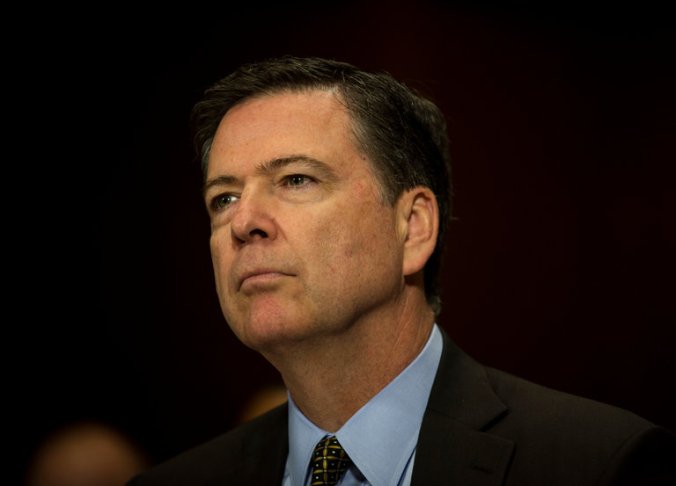
It’s all this guy’s fault…

I have read the initial comments on the original post-–which I interrupted my viewing of a Red Sox game to write, just so you know how dedicated I am—had some additional thoughts and processed some new data. Here are some more observations:

1. The New York Times biased reporting is even worse than I thought. Today’s print edition has a “Saturday Night Massacre” size headline screaming:

TRUMP FIRES COMEY AMID RUSSIA INQUIRY

This is deceit, and, as I noted before, yellow journalism. It is technically accurate, but misleading and false anyway. Trump also fired Comey in May,  “amid” the North Korea crisis, and while the Orioles were playing the Nationals. There is absolutely no evidence whatsoever that Comey’s firing had anything to do with the Russia investigation except this: Comey thoroughly botched the last major investigation the FBI was engaged in.

The Times goes further, adding another above the fold story headlined, “The President Lands a Punch, and Many Hear Echoes of Watergate.” Ah, the old “many say/many hear/many think” ploy—an unethical journalism classic. Let’s seed the unfair suspicion without taking responsibility for it! Hey, we didn’t say we thought that, just that others do!

2. Many have noted that President Hillary would have fired Comey within seconds of taking office, or as close to that as possible. This is doubtlessly true. It is also true that Republicans would probably be attacking her with as much fury and blatant hypocrisy as Democrats are attacking the firing now.

But doing something unethical in an alternate universe is still not as damning is doing it in this one.

3. I have been working on a “100 Days” overview of the ethics score since President Trump took office. In general, it is both remarkable and disturbing how closely the President’s actual performance tracks with my expectations, as explained over the last two years. One aspect of this mostly negative assessment that is undeniably positive, however is that President Trump, unlike his predecessor, does not fear making decisions, and makes them despite the amount of criticism he knows will be coming, especially from the news media. (The previous President knew that he had nothing to fear from the news media, since it was invested in making him seem successful and wise even when he wasn’t.)

The firing of Comey is a perfect example, as was the decision to enforce, belatedly, Obama’s “red line” in Syria.

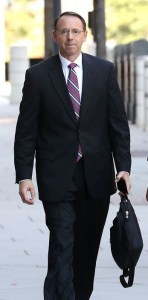
4. Nowhere near enough focus has landed on Rod Rosenstein (left) , the  deputy attorney general who was only confirmed a couple of weeks ago ( April 25, 2017). Rosenstein is an impressive lawyer with a long, distinguished  record in both Democratic and Republican administrations, and authored  the  “Memorandum to the Attorney General” on the subject of “Restoring Public Confidence in the FBI.” This articulates the best reasons for firing Comey, and any critic who argues that it made sense to keep him on is tasked with rebutting Rosenstein’s brief. Good luck with that.
Continue reading

Ethics Observations On The Firing of FBI Director James Comey

President Trump on Tuesday fired the director of the FBI, James B. Comey today. Rod Rosenstein, the new deputy AG who replaced Sally Yates, prepared a memo that recommended the firing, and Attorney General Jeff Sessions concurred.

Ethics Observations:

1. Here’s how the New York Times described the firing in its story’s opening sentence:

President Trump on Tuesday fired the director of the F.B.I., James B. Comey, abruptly terminating the law enforcement official leading a wide-ranging criminal investigation into whether Mr. Trump’s advisers colluded with the Russian government to steer the outcome of the 2016 presidential election.

That’s pretty despicable, and as blatant an example of intentional negative spin as you are likely to see, even from the Times. There were so many justifications for firing Comey that the mind boggles. Attaching the act to the one elicit reason for firing Comey is just yellow journalism, and nothing but. The Times is really a shameless partisan organ now.

2. Should Comey have been fired? Of course. He didn’t have to be fired, but to say that at this point he was not trusted by either political party and was widely viewed as incompetent would be an understatement  The fact that his testimony before Congress last week was not only riddled with errors, but riddled with errors that made headlines, was reason enough to fire him.

From the Washington Post:
Continue reading

Ethics Hero: Pop Star Nicki Minaj

I wouldn’t cross the street to watch over-the-top, beautiful but annoyingly nasal pop singer Nicki Minaj perform, but I’d walk miles to shake her hand.

Over the weekend, the mega-star answered Twitter questions about a lip syncing contest using her “Regret in Your Tears” music video. One audacious follower asked if the singer would pay for her college tuition. It never hurts to ask, right?  Minaj not only agreed but offered to pay the tuition for other fans, tweeting,

Show me straight A’s that I can verify w/ur school and I’ll pay it. Who wants to join THAT contest?!?!🤷🏽‍♀️ Dead serious. Shld I set it up?

And she did set it up. Requests came in from all quarters, containing transcripts and student loan balances.

“U want to go to college but can’t? How much do u need to get u in school? Is that the only thing stopping u?” Minaj asked an immigrant fan who said she could not afford classes. Minaj  sent the money. She also assisted a single mother who needed $500 for her remaining tuition, and sent $6,000 to cover the fall semester for another Twitter follower, including his room and board, courses and meal plan.

Yes, I am keeping my fingers crossed that Minaj’s spontaneous outburst of kindness and charity isn’t exploited by scammers. She’s certainly laying herself wide open to be misled. Yet one cannot be generous and compassionate and not be vulnerable to the worst in society. I’m sure Nicki knows that. To her credit, she is willing to court the risk to change some lives for the better.

She’s a deserving Ethics Hero, and boy, I needed one today.

_____________________

Pointer: Alexander Cheezem