Gallup’s Trust Survey: Congress in Freefall

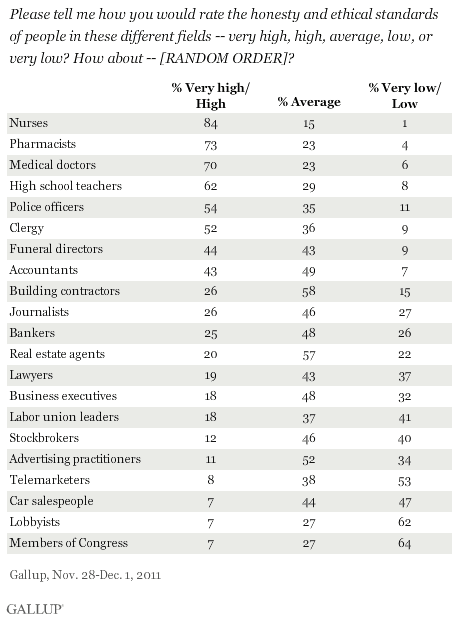
Gallup’s just released annual survey of public attitudes toward various professions held few surprises this year. As has been the case for over a decade,nurses and pharmacists topped the list as the  professions regarded as the most honest and ethical. I find the presence of high school teachers fourth (ahead of police officers)  a triumph of public relations, nostalgia and wishful thinking, but the other top rated professions were predictable. In general, the professions we are forced to depend upon the most are the ones we trust the most—because we have little choice. The ones we trust the least tend to be those with whom we can be in conflict with or see as having differing interests from our own. Doctors are always going to rank higher than lawyers, for example, because there are no doctors trying to make us sick.

Of the 21 professions in the survey, only seven—including funeral directors!—had positive numbers, meaning that more people regarded them as ethical than unethical. The seriously distrusted professions, with a percentage of very low ratings significantly higher than the proportion of very high ratings, begins with lawyers, business executives, union leaders, stock brokers, and advertising execs in order of trustworthiness; bankers, interestingly, avoided this group and had about as many supporters as detractors. But the bottom four is where the really dishonest professionals dwell, according to the poll. With single digit positive ratings compared to negative ratings of  more than 50% are telemarketers, car salesmen, lobbyists, and at the very bottom, Congress, with 64% of the public regarding the institution as dishonest and unethical. That, Gallup says, is not only the lowest rating for Congress since the survey has been taken; it is the worst rating for any profession.

That Congress has sunk so far is not a surprise. It is just depressing.

Here are the results:
So Who Do We Trust To Fight Crony Capitalism?

Shut out of the last Iowa debate because of low poll numbers, earnest, honest, ethical, reasonable, intelligent and boring candidate Jon Huntsman gave his assessment of the event to ABC’s Christiane Amanpour, saying that the main issue facing the country was a trust deficit:

“The most important issue of all was not even touched upon and that is the deficit of trust we have in the United States, in fact it may have played right into the trust deficit. That is, nobody trusts Congress anymore. We need term limits in Congress, we need to close the revolving door that allows members of Congress to move right on into the lobbying profession. No one has trust anymore towards the executive branch, no one trusts Wall Street with the banks that are too big to fail. So I would argue that the issues that are most salient in our political dialogue today were not even touched upon last night…”

Huntsman is right. It was especially astounding that this issue wasn’t addressed in the debate (and that those crack moderators Diane Sawyer and George Stephanopoulos  didn’t mention it) after more than a month of Occupy Everywhere protests that sorta-kinda dealt with the trust issue (oh,  what a little focus could have wrought!)  and the recent “60 Minutes”  expose on insider trading by members of Congress. Also preceding the debate was this trust-buster: in July of 2008, Bush Treasury Secretary Hank Paulson held a meeting with select Wall Street fund managers and gave them advance notice of government action that they could use to make significant profits: Continue reading

Ethics Quiz: The Conundrum of the Imaginary Editor

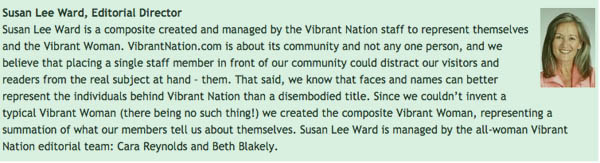
The above staff bio is featured on  VibrantNation.com, a website styled as “the leading online community for Baby Boomer women – the place where they connect and support each other on issues unique to life after 50.” The “composite staff member” known as Susan Lee Ward even has her by-line on some articles.

Your Ethics Quiz Question:

Is featuring an imaginary editor on a website unethical if it is fully disclosed? Or is it just batty?

The problem is one that has come up before: does disclosing something as an untruth cleanse it of its unethical characteristics? After all, there is no Susan Lee Ward, yet she is listed as an editor. That picture can’t possibly be her, because there is no “her.” Anyone who doesn’t read staff bios will in fact be deceived–and how often do you read website staff bios? Heck, people still write me angry e-mails saying that they don’t know who is writing all these ethics essays.

As usual, this comes down to a matter of trust. Are we less likely to trust a website that posts the bio and picture of a staff member who doesn’t exist? Or are we more likely to trust a website that tells us that it has invented an editor? OR are we less likely to trust a website that says it has invented a website for new-agey reasons that don’t really make much sense? When a publication uses fake editors, I wonder who or what they are trying to hide.

My reluctant call on this one: I don’t distrust the site because it has invented an editor. It has made a good faith effort to be transparent.

I distrust the site because inventing an editor for the stated reasons tells me that the real staff is insane.

[Thanks to Health News Review for finding this.]

What’s Fair To Herman Cain Now?

I love this Cain-trapped-in-amber image, except that the idea of a future entrepreneur creating an island attraction where former disgraced presidential candidates are cloned from their preserved DNA to roam free is terrifying.

Herman Cain has withdrawn from the GOP presidential nomination competition in the wake of Ginger White’s claims that he and she engaged in a 13-year long romantic affair. He withdrew in a particularly deceitful way, saying that his campaign was being suspended. Like most of his recent conduct and statements lately, this resort to face-saving euphemism does not speak well of his character. Yes, it’s true, his quest for the White House is suspended. It is also what is technically called toast. A more honest, courageous, candid and accountable man would have said so. I think we can safety say that one way or the other, this campaign took the measure of Herman Cain, and found him to be as wanting in character as he is inexperience and diligence. The system, ugly as it is, worked.

What else can we now fairly say of Herman Cain? I believe we can fairly conclude that… Continue reading

Ethics Quote of the Month: Herman Cain Attorney Lin Wood

What's that you say, Mr. Wood? Marital infidelity is irrelevant to a presidential candidate's qualifications? Did John Edwards tell you that?

“Mr. Cain has been informed today that your television station plans to broadcast a story this evening in which a female will make an accusation that she engaged in a 13-year long physical relationship with Mr. Cain. This is not an accusation of harassment in the workplace – this is not an accusation of an assault – which are subject matters of legitimate inquiry to a political candidate. Rather, this appears to be an accusation of private, alleged consensual conduct between adults – a subject matter which is not a proper subject of inquiry by the media or the public. No individual, whether a private citizen, a candidate for public office or a public official, should be questioned about his or her private sexual life. The public’s right to know and the media’s right to report has boundaries and most certainly those boundaries end outside of one’s bedroom door. Mr. Cain has alerted his wife to this new accusation and discussed it with her. He has no obligation to discuss these types of accusations publicly with the media and he will not do so even if his principled position is viewed unfavorably by members of the media.”

Attorney Lin Wood, on behalf of his client Herman Cain, in a statement to Fox News in response to its  interview with a Georgia woman, Ginger White, who says she had a 13 year adulterous relationship with the Republican presidential contender.

Sorry, Mr. Wood. You are dead, dead wrong. Continue reading

November 22, 1963—The Dawn of American Distrust

In November of 1963, the American public’s trust in its government stood at over 75%. The previous President had been a revered general who guided the Allied forces to victory over Japan and Germany. We were united against a sinister, common enemy, world Communism, led by a shoe-banging dictator who promised to bury us. The new President was a young, glamorous and inspiring man of wit and vision, whose signature policy initiatives embraced American exceptionalism and virtue—the Peace Corps, space exploration. Even in a city with more JFK foes than fans, the President and his wife drove through the streets of Dallas in an open limousine. And on a bright and beautiful fall day, two rifle shots blew John F. Kennedy’s brains out.

Today, 48 years later, public trust in the government is below 15%, an all-time low. Protesters are in dozens of American cities, challenging the foundations of American progress and success. Large numbers of the public believe that the U.S. Supreme Court assisted in a successful plot to steal a presidential election, and that a U.S. President planned the attacks on the World Trade Center and the Pentagon in 2001; that the CIA invented AIDS to kill African-Americans; that Barack Obama’s presidency is illegal; and, of course, that there was a massive government cover-up of a conspiracy to assassinate Kennedy, a conspiracy that might well have involved his successor, Lyndon Johnson.

It is the lack of trust, more than any single factor, that feeds the ruinous hate and partisanship that has made American government impotent at the worst possible time, with crises intentional, domestic and spiritual surrounding us. Continue reading

I Wonder…What Would It Take To Get Fired From the SEC?

Keep up the way you’re going, guys. You’ll drive me to “Occupy D.C.” yet.

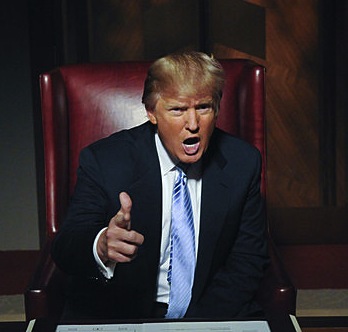
Do you think The Donald would be willing to run the SEC? At least he knows how to fire someone.

Eight Security and Exchange Commission employees were demoted, docked pay, suspended or otherwise disciplined for their role in the agency’s rank incompetence that allowed Bernard Madoff to steal billions of dollars and destroy lives and charities despite the timely warning of a persistent whistleblower, and more red flags than a bullfight. Yet despite mismanagement of epic and disgraceful proportions, the SEC couldn’t bring itself to fire anyone.

This is the state of accountability in today’s America. Run a corporation into the ground, lose the jobs of thousands, and take a mega-million dollar parting gift. Accept a bribe while you are serving as a State Senator, and not only keep your job, but get acquitted by a jury on the theory that you are too stupid to understand that what you were doing was a crime. Now the SEC’s response to an almost unimaginable breach of diligence in investment oversight by its staff doesn’t involve getting rid of a single one of the individuals responsible—even the individual deemed the most culpable, whose termination was recommended by the agency’s lawyers.

Why, you ask? Continue reading

Ethics Hero: Judge Laurence Silberman

Here President Bush attempts to strangle Judge Silberman for being insifficiently loyal to conservative causes.

Judge Laurence H. Silberman, a senior judge on the federal appeals court, cast the deciding vote as the U.S. Court of Appeals for the D.C. Circuit  upheld, 2-1, the constitutionality of the controversial individual mandate. The mandate, which is almost certain to be reviewed by the U.S. Supreme Court, is the linchpin of President Obama’s health-care insurance law that requires most individuals to purchase insurance coverage or be fined.

You can hardly have more impeccable conservative or Republican credentials than Silberman. He served in the Nixon administration, was appointed by President Reagan to the court and is a Federalist Society stalwart as well as a favorite judicial scholar of the political right. An appeals judge shouldn’t be praised for doing his job, which is deciding cases based on the law and the Constitution rather than political loyalties or ideological bias. Unfortunately, political loyalties and ideology is how the press, partisan groups, elected officials and, it must be said, too many judges, do think cases are decided, and that belief  grievously harms faith in the justice system and trust in the rule of law. Continue reading

Ethics Exercise: Being Fair To Herman Cain Now

The other shoe.

In the wake of Sharon Bialek’s  press conference describing an alleged incident involving of attempted quid pro quo sexual harassment by Herman Cain in 1997 [read the account here] , and the Cain camp’s instant and unequivocal denial, fair Americans are posed with a classic ethics challenge: how do they assess her accusations while being fair to the accused? It is a daunting problem, with many components. How do can we compare Cain’s credibility with Bialek’s? What, relevance, if any, does the timing of her appearance have? How are the previous, still anonymous, un-detailed allegations of hostile work environment harassment to be factored in to our calculations?

Addressing this conundrum requires wading into a jungle of biases, presumptions and  caveats. Among them:

1. Is Bialek credible? Continue reading

The Washington Redskins and the Nepotism Trap

Bobby Kennedy was lucky. Kyle Shanahan isn't.

No leadership error embodies the appearance of impropriety more completely than nepotism, and, for good measure, it also creates an inherent conflict of interest and undermines fairness and integrity. Yet people continue to argue that it is not inherently unethical, and leaders and managers in all fields continue to walk into the nepotism trap. The fact that it doesn’t always snap shut is not an argument in its favor, for this is just moral luck; letting your kid play with matches in bed won’t necessarily burn the house down or kill him, but it’s still irresponsible.

Washington Redskins fans now have a painful lesson in nepotism’s drawbacks to guide their own decisions. As has been a routine event about now in the pro football season since hapless owner Dan Snyder became responsible for the team’s personnel, the Redskins season is imploding, and the head coach is on the griddle. This season that coach is Mike Shanahan, and the problem is his offense. The Skins were shut out Sunday, 23-0, and appear to have no quarterback, no offensive line, and no clue.

The team’s offensive coordinator? Kyle Shanahan, the head coach’s son. Now what? Continue reading