Can Shattered Trust Be Restored? Should it?

Last September I wrote about minor league catcher Derek Bender. He was playing for the Fort Myers Mighty Mussels, the Minnesota Twins’ Low-A affiliate, and was accused after a game of tipping off several hitters for the Lakeland Flying Tigers, a Detroit farm team, regarding the next pitches the Mighty Mussels pitcher was going to throw. Lakeland scored four runs in the second inning to win the game 6-0 and win the Florida State League West division, eliminating the Mighty Mussels from playoff contention.

Lakeland’s coaches alerted Fort Myers coaches regarding Bender’s alleged pitch tipping, and the fact that Bender had told several teammates that he was exhausted and wanted the season to be over was sufficient to convince the organization that Bender had deliberately lost the game for his own team.

The Twins released him. Despite his previous status as a high-rated prospect, the catcher is now a pariah in the game. MLB’s investigation has not been completed, though news stories last fall stated his pitch-tipping as fact. Bender’s agency representing him advised him to make no public statements until there was official report. That seems to have been bad advice: the belief that the player cheated to cause his own team to lose has taken hold as the accepted narrative.

Now he has given an extensive interview to The Athletic, the New York Times sports publication. He says he is innocent of the accusations. Bender met with investigators in November, going over the fateful inning pitch-by-pitch to prove that he was innocent. If the report concludes he did tip off opposing batters to his pitcher’s pitchers, Bender’s baseball career is almost certainly doomed.

Continue reading

Rainy Monday Ethics, 11/30/2020: Statues, Dogs And Lies

Also getting me down, Karen Carpenter songs. As with great movies with O.J. Simpson or Gig Young in them, these are hard to enjoy now, at least for me. One of the most lovely natural voices in pop music history was silenced by the pernicious disease of anorexia, exacerbated by, among others, her brother, her family, and music industry executives, who made Carpenter so self-conscious about her weight and appearance that she slowly starved herself to death before her 33rd birthday. I wish I could hear her sing—and I will do that a lot in the days approaching Christmas—without thinking about that, but I can’t.

1. Proposition: any nation’s historical figures who had the impact on those nations that Margaret Thatcher did in Great Britain over a significant period of time deserve to be memorialized with statues, absent some cataclysmic disqualifying act, like Richard Nixon’s Watergate scandal. Even in Nixon’s case, I would support a public memorial to such a historically influential figure.

In the English town of Grantham, where Thatcher grew up, an 11-foot pedestal awaits the arrival next year of a large statue of “the Iron Lady.” Apparently many in Britain, and a large proportion of Gratham’s working class residents, disapprove of Thatcher’s conservative politics and policies, and thus oppose the statue, which will be in immediate danger of toppling the minute it is erected.

Morons. One doesn’t have to personally agree with a historical figure’s position or even admire her to appreciate the impact that figure had. The criteria for memorializing prominent citizens should center on whether future generations need to know who they were and what they did, not whether their achievements and conduct are approved of according to often fleeting political, social and cultural values. Charles Moore, who wrote an authorized biography of Mrs. Thatcher, says, “It’s obvious there should be statues to Britain’s first woman prime minister. But…but…George Floyd! The New York Times’ article on the controversy says that statue toppling has become a world-wide phenomenon since the death of George Floyd. Now that makes sense: one of Great Britain’s most successful and important leaders should be robbed of her legitimate honors because a rogue cop accidentally contributed to the death of a black criminal in Minnesota.

Continue reading

Lessons of the Tulowitzki Jersey Fiasco

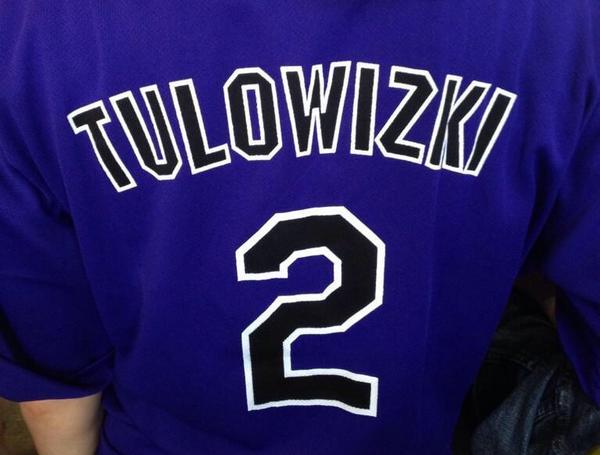
Troy Tulowitzki is the superstar Colorado Rockies shortstop, and has been since for nine years. He has been named an All-Star four times,won two Gold Glove awards and two Silver Sluggers; he is widely regarded as one of the best players in baseball. Last weekend was Tulowitzki jersey night, with 15,000 lucky fans getting a Rockies purple jersey with the home town hero’s name on the back.

Here is how the the jerseys looked…

His name is spelled T-U-L-O-W-I-T-Z-K-I...just like it sounds, in fact.

Tulo jersey

Observations: Continue reading

The Associated Press And The Scandal That Wasn’t

It was tough giving my dog the bad news that the AP had screwed up...

It was tough giving my dog the bad news that the AP had screwed up…

Over the local evening news came a stunning report: Terry McAuliffe the Democratic candidate for Governor of Virginia, where I vote and make my home, had been accused in federal documents of lying to investigators checking the facts behind a Rhode Island death benefits scheme. Confirmation bias being what it is, I had no trouble giving the report full credence ( I long ago concluded that McAuliffe is sleazy and will lie whenever there is a perceived up-side for him, though I never thought he was stupid), and informed my dog, Rugby, for whom I am organizing a write-in campaign, that his chances of being Governor were looking up. Then, less than two hours later, I was preparing to write about this latest development in the most ethics-free governor’s race in the country, and checked online for more details. I discovered only this:

RICHMOND, Va. (AP) The Associated Press has withdrawn its story about documents in a federal fraud case alleging that Virginia Democratic gubernatorial nominee Terry McAuliffe lied to a federal official investigating a death benefits scheme. The indictment did not identify McAuliffe as the “T.M.” who allegedly lied to investigators.

Wait…how could this happen? How could the Associated Press, the nation’s premiere news agency, essentially accuse a candidate for high office in a highly contested election of a felony less than a month before votes are cast, just in time for the story to be the lead story all over the state in question, and then withdraw it shortly thereafter? Don’t tell me about “mistakes”: the AP and the profession of journalism have standards and procedures of long-standing that, if followed diligently, ensure that this never happens. Facts must be checked and confirmed by reliable sources. Supposition must not be stated as truth. Here is the AP’s distillation of its ethical framework: Continue reading

Strange Ethics: Another Indiana Prosecutor Jumps the Rails

"Ward, I'm worried about the Hoosier.."

There’s a wonderful Charles Addams cartoon that shows a bunch of hobos and bums lying around Greek columns under a college reunion “Welcome Alumni!” banner. One of the disheveled alums says, “I used to think it was me, but maybe this school is just no damn good.”

In light of a second Indiana prosecutor losing his job over making outrageous suggestions about how Wisconsin’s Gov. Walker should handle his labor battles, I’m beginning to wonder about Indiana’s training of its various government attorneys.

First, as discussed here, an Assistant Attorney General went on twitter and suggested that Walker use “live ammunition” on union demonstrators.

Now a deputy prosecutor in Johnson County named Carlos Lam has resigned after conduct far worse than that. At least Jeff Cox, the tweeter, was probably joking. Lam sent a serious  email to Walker suggesting that the governor—I’m not making this up—set up a fake attack on himself to attract public sympathy, writing… Continue reading