Ethics Quote of The Week: Umpire Marty Foster

“I saw the pitch and of course don’t have the chance to do it again. But had I had a chance to do it again, I wouldn’t call that pitch a strike.”

—– American League Umpire Marty Foster, in the wake of the controversy over his game-ending strike call in the Texas-Tampa Bay game last night.

In other words, “I missed it. I was wrong.”

Strike Three?

Strike Three?

Good for Foster. His wildly inaccurate call was strike three on Rays batter Ben Zobrist, who thought that he had worked a base on balls. This would have placed Rays runners on first and second with two outs, creating a reasonable opportunity for the Rays to tie or win the game.  Instead, the Rangers got a gift. Rays manager Joe Maddon, in interviews and in a tweet to his followers, said, “That can’t happen in a major league game,” meaning that the call was beneath major league umpiring standards.  Of Maddon, Foster said,  “He was frustrated and I understand .He acted probably the best he can under that situation.”

Obviously, there have been many, many worse calls, nearly as bad calls, and only a smidge better calls, and there will be this season. In the vast majority of those, umpires have and will remain mum, maintaining that they were in the best position to judge the pitch or the play, and that even video showing their gaffes are misleading. Foster, however, did the hardest thing for many of us: admitting a mistake. Admitting so, to himself as well as the world, doesn’t make him a worse umpire; it makes him a better one.

Note: I apologize for the sparse postings the last few days. I am involved in a night and day project that is preventing me from doing thinking and working on anything else…even baseball. Naturally, the only game update I happened to watch, at 2:20 AM, was an ethics story.

___________________________________

Sources: NBC Sports (and Graphic); Townhall

Ethics Dunces: Atlanta Braves Fans

The Atlanta Braves lost the first ever National league Wild Card play-off game, 6-3, to the St. Louis Cardinals, thanks primarily to their own atrocious fielding (the Braves made three costly errors.) Nonetheless, many fans felt they “wuz robbed” because of a bizarre play in the 8th inning, when the Cardinals were rescued from a bases loaded, one out situation after the game’s left field umpire, Sam Holbrook, apparently feeling that he had to do something to justify being on the field (regular season games don’t have left field umpires), called the infield fly rule on a pop-up that landed safely in the outfield. The infield fly rule is designed to prevent sneaky double plays, and is called when an easy pop-up might be intentionally dropped by an infielder. Thus the ball is an out whether it is caught or not.

There were three problems with the call. First, it was called very late in the play, after it was evident that the Cardinals fielders might not catch it. Second, given its placement, letting the ball drop to try to get a double play really wasn’t an option. And, third, as I noted, the ball landed in the outfield, which an infield fly is not supposed to do. The Braves argued the call, to no avail.

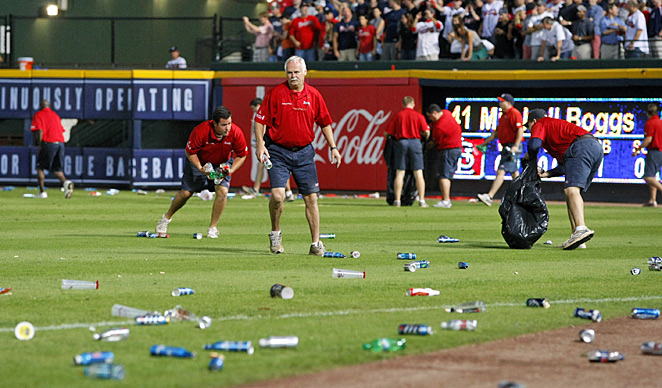
Then the Braves fans at Turner Field, perhaps primed by left-over anger at the NFL’s departed replacement refs, proceeded to act like total jackasses by throwing every piece of junk and debris they could get their hands on down onto the field. Continue reading

Umpire Accountability, As The Day of the Robots Fast Approaches

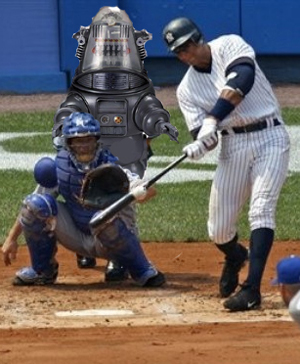
If Robby replaces you, Larry, it's your own fault.

Are baseball’s umpires trying to get themselves replaced by machines? Or perhaps baseball’s brass are conspiring to allow incompetent and lazy umpires to do themselves in, as their miserable work wins over the traditionalists and the Luddites to mechanical ball and strike-calling and their overseers refuse to take decisive action against the worst officials they have. Whatever the explanation, today’s debacle ending the Tampa Rays-Red Sox game in Boston showed an appalling lack of accountability and professionalism in a segment of the game that is critical to its credibility and integrity. Continue reading

Deadly Incompetence in Seattle….Luckily, It Was Just a Game

I know about the ADA, but still...hiring blind umpires who can't count just isn't working out...

It is rare that an ethics outrage repeats itself so closely that I could recycle a previous essay and just change the names. This occurred, however, in Seattle this past Saturday, in the baseball game between the Mariners and the San Diego Padres. San Diego’s Cameron Maybin walked on a 3-2 count (four balls are required by the rules) and eventually scored the only run of the game on Antonio Gonzalez’s fifth-inning single, allowing the Padres to defeat the Mariners 1-0 on Saturday night.

With one out in the fifth, Maybin walked when a pitch was called high by home plate umpire Phil Cuzzi. A video review of the at-bat by official scorer Dan Peterson confirmed the count should have been 3-2 when Maybin trotted to first base, meaning that his turn at the plate wasn’t completed. But Cuzzi, who like all umpires carries a pitch counter, saw that the stadium scoreboard showed a three-ball count before the pitch, and since 1) technology is always right 2) he wasn’t paying attention 3) he can’t count to “4” and 4) (or is it 3?) it isn’t like calling balls and strikes is his job or anything, he decided that the player had earned a base on balls. Continue reading

Most Unethical Bobblehead EVER

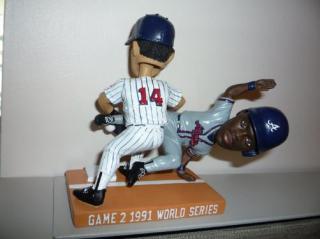
The vile bobblehead

In Game two of the 1991 World Series between the Minnesota Twins and the Altanta Braves, Brave outfielder Ron Gant singled and rounded the bag, drawing a throw to first base. He appeared to beat the throw to the bag, but the Twins’ jumbo first baseman, Kent Hrbek,  wrapped his arm around Gant’s leg and lifted him off the base as he applied the tag. First base umpire Drew Coble managed to completely miss Hrbek’s illegal tactic, and called Gant out to end the inning. The Twins went on to win that game by one run, and in one of the closest Series of all time, also won the World Championship, 4 games to 3.

Hrbek’s muscling of Gant off of first base has been widely regarded as one of the most egregious examples of cheating by a player in baseball’s 130 year history. So, to commemorate the 20th anniversary of the Minnesota World Series triumph, the Twins will hold a special “1991 World Series Champs Reunion Weekend” promotion featuring members of the 1991 team at the August 5 game, and the first 10,000 fans through the gates will receive a free Kent Hrbek/Ron Gant bobblehead, depicting the infamous play. Continue reading

The Replay and Integrity: Baseball at an Ethics Crossroads

On the final day of baseball’s regular season, the San Francisco Giants were playing the San Diego Padres in a contest with post-season implications for both teams. Had the Padres won , it would have forced two one-game playoffs, with the loser of a Giants-Padres showdown today facing the Braves on Tuesday to determine the National League Wild Card team. In the bottom of the first, the Giants’ Andres Torres smashed a Mat Latos  pitch down the left-field line. The ball clearly landed right on the chalk-marked foul line, kicking up a cloud of white dust as undeniable proof that the ball was fair,and the batter destined for second base or beyond. Third-base ump Mike Everitt called it foul, however. Broadcasters, the Giants managers, everyone protested and pointed, but to no avail.

The Giant’s won anyway, so it only mattered to Torres’s batting average. But a time-bomb is ticking. Baseball, which was embarrassed last season into adopting video replay for home run calls, allows no videotape mandated reversals on other blown umpire calls. As the game heads into its period of highest visibility, when casual baseball fans start paying attention to the best teams playing for the title, the likelihood of an obviously wrong call by an umpire leading to an undeserved win in a crucial game is unacceptably high. Why does baseball’s leadership resist a solution? Continue reading

Milt Pappas in the Baseball Ethics Wilderness

Polls say the vast majority of baseball fans wanted Commissioner Bug Selig to over-rule umpire Jim Joyce after the fact and award Armando Galarraga a perfect game. The point of view is purely emotional, and as an ad hoc break with the rules, traditions and practices of the game would be so devastating to baseball’s integrity that I did not expect anyone outside the sport to adopt it. I was very wrong about that. Ex-pitcher, ESPN commentator and blogger Curt Schilling and Sports Illustrated baseball writer Jon Heyman were just a few of the voices calling for Bud to announce that Joyce’s epic mistake, among the thousands and thousands of terrible judgment calls by umpires in the game’s history, should be the one that is changed after the game is over.

But an ex-pitcher who threw a no-hitter himself, Milt Pappas, did us all a favor by showing the ethics wilderness this kind of thinking can cause to sprout overnight. First, Pappas wistfully suggests that if Galarraga’s lost perfect game can be saved by Selig, maybe his 38-year-old not-quite-perfect no-hitter  can be similarly burnished. Pappas also believes that a perfect game is so important, umpires should consciously try to one along. if I interpret his “logic” properly, he thinks that on Joyce’s erroneous call the umpire should have called the runner “out” on a close call even if he was safe. Continue reading

Ethics Hero: Umpire Jim Joyce

The irony is that a less honest and courageous umpire would have made the correct call. Continue reading

Avocations, Conflicts of Interest, and Country Joe West

Some employers are troubled by the avocations and outside activities of employees, a concern that often deserves a  defiant “none of your business” in response. However, sometimes the concern is justified, such as when the avocation adversely reflects on the individual’s reputation to the extent that it harms his or her ability to perform, or when the avocation actually interferes with the job, such as a when a recreational rugby player keeps missing work because of injuries. Another problem is when the avocation creates a conflict of interest in which conduct that may be good for the avocation undermines the job.

The latter is exemplified by Major League Umpire Joe West, who fancies himself a country music singer and songwriter when he isn’t calling balls and strikes. As nicely narrated on the blog “It’s About the Money,” West has long been the most flamboyant and combative of umps, as proven by the fact that a lot of people know his name. Umpires aren’t supposed to be stars, celebrities or personalities: if you notice a particular umpire, it is almost always because he has made a mistake.  They are important, however. Their acuity of sight and judgment are called upon many times in every game, and can make a significant difference in scores, standings, championships and careers. Like judges, they have to be trusted, and their integrity above suspicion. “The Common Man,” who wrote the blog post, believes that West’s singing career, such as it is, creates a conflict of interest that undermines that trust, and worse, warps his judgment on the field. Continue reading