OH NO! Political Correctness Got Me!

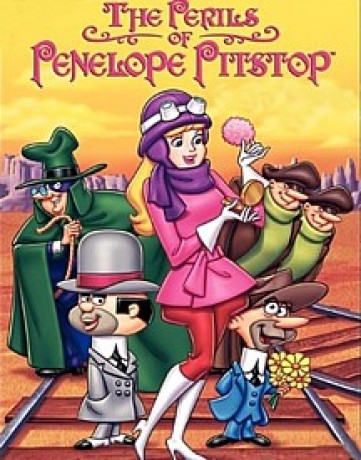
Late last night as I was battling worry and insomnia, my TV remote transported me to the Cartoon Network where I encountered, for the first time  in 40 years, a minor Hanna-Barbara animated series called “The Perils of Penelope Pitstop.” Like all Hanna-Barbara shows, but especially the Saturday morning variety, “Penelope” was crudely drawn and aimed its humor at the lowest common denominator: compared to it, Woody Woodpecker is Faulkner. Drawn in by the comforting sounds of great vocal artists of the era like Mel Blanc and Paul Winchell, however, I watched about ten minutes of the show and realized, to my horror, that I now found it offensive…and not for the reason that I found it annoying in 1970 (it is, after all, moronic).

The plot of  every episode of “The Perils of Penelope Pitstop” (a spin-off of H-B’s more successful but just as repetitious and silly “Wacky Racers”) was the same. A female auto racer who is also a blonde, helpless bimbo with a Southern accent is stalked by a villain called “The Hooded Claw,” voiced by the great Paul Lynde.  The Hooded Claw, for no discernible reason,  concocts elaborate plots to kill Penelope, but is foiled, at the last second, every time. The cartoon is an obvious riff on “The Perils of Pauline,” the famous Pearl White silent movie cliffhanger serial in which each segment ended with the heroine tied to a railroad track or falling to earth dragging a collapsed parachute. Yet I found it impossible to appreciate the cartoon’s meager charms because of the loud clanging of  ethics alarms in my brain. Why is the only woman in the show portrayed as a walking, talking Barbie Doll? And why are kids being encouraged to laugh at a woman being stalked by a homicidal maniac? Because he’s an inept homicidal maniac? What could possibly be funny about stalking, an insidious phenomenon that every year leads to multiple murders?

“Oh my God,” I thought. “I’m politically correct!Continue reading

Ethics Quote of the Day: Lori Palatnik

Is "ding-dong" wrong?

“In life we must know what is good and what is evil. Yes, we are commanded to remember that there is evil in the world, and not only are we allowed to celebrate when it is destroyed, we must.”

Mrs. Lori Palatnik, in an essay today entitled “Is It Proper To Celebrate Osama bin Laden’s Death?”

Writer David Sirotka at Salon, among others, has sharply criticized the jubilant reaction of most Americans to the terrorist’s death. He found the chanting crowds in front of the White House and Times Square disturbing, symbolizing a gleeful embrace of violence as the way to address problems, an instance of becoming the enemy in order to defeat it: Continue reading

Why I Hate Hate Crime Laws

Just do it with love, and they'll be lenient...

I did it to myself, I confess: reminding myself of the nation’s offensive hate crime laws while writing about the McDonald’s beating, pausing in the middle of the main theme of the post to note the foolishness of investigating whether or not an unprovoked attack qualifies as a hate crime. Hate crime laws infuriate me every time I think about them, because they represent the lowest and most cynical form of cultural values-setting by lawmaking, an important governmental task that is increasingly a lost art, because today’s lawmakers care more about posturing and power than values.

Two unidentified men beat Bryan Stow, a 42-year-old paramedic, senseless in the parking lot outside Dodger Stadium on opening day. Why? He was wearing a San Francisco Giant jersey, and it was Dodger territory. Continue reading

The MacDonald’s Beating Video, Another Dead Canary in The Ethics Mine

Vernon Hacket: videographer, violence afficianado, shameless bystander

Last week, In the early hours of  April 18,two teenaged patrons at a Rosedale, Maryland MacDonald’s brutally beat Chrissy Lee Polis, 22, into a seizure. The attack was captured on a video recorded by Vernon Hackett, one of the MacDonald’s workers, on a cellphone camera. Other employees can be heard laughing on the video, and Hackett apparently is heard warning the attackers that the police are coming. He has been fired by the restaurant’s proprietor.  (More on this here.)

His firing was well-deserved, but it doesn’t begin to address the disturbing implications of the incident. Continue reading

American Disrespect for History, April 18 Edition

I waited until midnight, just to see if how many major news organizations would note the importance of April 18 before it was over. Oh, many mentioned the Boston Marathon, and almost every one of them prominently mentioned that it was tax day. The real importance of April 18, however, and the American heroes who made it significant, was ignored yesterday in all but a pitiful few newspapers and websites. It was yet another example of this country’s growing disrespect for its origins, its ignorance of the deeds of the men and women who created the United States, and the increasing disconnect between America’s present and its founding ideals.

On April 18, 1775, an accomplished silversmith named Paul Revere, eventually joined by fellow patriots  Charles Dawes and Dr. Samuel Prescott, rode from Charlestown, Mass. to Lexington, stopping at houses and farms along the way to warn the occupants that “The British are coming!” Continue reading

Ethics Quiz: Farrakhan, Snooki, Senator Portman, and University Speaker Ethics

Pick your poison!

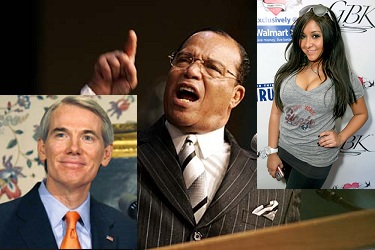
Your Ethic Quiz question for the weekend: Which of these is the most unethical choice to speak at a University?

Your choices:

A. Nicole “Snooki” Polizzi, the over-the-top trashy break-out star of the bottom-of-the barrel cable reality show “Jersey Shore,” hired for $32,000 by Rutgers University to address students. Continue reading

Uncaring, Unremorseful, and Rich…But Not Unethical

"You question my priorities?"

Columnist Carolyn Hax, who gives wise and witty relationship advice, has a sure instinct for ethics though the word doesn’t often appear in her column. It did today, though…and it didn’t belong there.

A woman wrote Hax to ask if it was “okay” to break off a long-time friendship “over ethics.”  Her college roommate made millions “off the recession” as an investment banker, and had retired wealthy at 35. A professedly non materialistic college professor, the writer was bothered that her ex-roomie had “no remorse or feeling for the people who are losing their homes or jobs.” She felt her retired and well-off friend should be “volunteering or doing something worthwhile” instead of travelling and “complaining about her portfolio.” Continue reading

The Message or the Messenger: The Mysterious Foundation For A Better Life

Does it matter who's behind the curtain?

The Foundation for a Better Life sponsors those slick TV spots promoting ethical values like kindness, sportsmanship, charity, and sacrifice. I have long wondered where they came from, and belatedly visited the organization’s website, Values.com, where I spent quite a while clicking through their extensive links to descriptions of core ethical values and inspiring stories. Not bad. The only deficiency I could see with the site was the lack of any explanation regarding how the Foundation was funded, who ran it and who was responsible for it. The site describes itself thusly:

“The Foundation is a non-profit 501(c)(3) organization, started in 2000. Our sole objective is to promote positive values, using print and broadcast media.

We want the stories we share about the positive actions and values of others to serve as inspiration for someone to do one thing a little better, and then pass on that inspiration. A few individuals living values-based lives will collectively make the world a better place.

The Foundation does not have a political or religious agenda. Our values are selected with the hope that most individuals would find these values universal, encouraging, and inspiring. The Foundation acknowledges that each person has a unique lens through which he or she views the world. Naturally there are religious, nonreligious, political, and cultural views that give meaning to our lives. Our objective is to provide a wide spectrum of values without any intended agenda or slant and provide an uplifting message around each one.”

And this appears to be exactly what the Foundation does. Continue reading

Comment of the Day: “The Tears of Keith Ellison”

Less to do with the original post and more concerned with weightier matters is this thoughtful comment by blameblakeart, the Comment of the Day:

“This event in Japan has crystalized for me Jack – we as Humanity, as Earthlings – are all in this together, side of the aisle being probably the least of our worries. We need to use our smarts and our will to manifest a better, more abundant, more perfect world, all together, not just for a chosen few.

“10000+ years ago there were hundreds of species that basically cease to exist. What the 8.9 Japanese earthquake tells at least me is that life is tremendously fleeting, but intensely beautiful, magic, and precious, of all things, Human and Of this Earth. I don’t know why there are those out there trying to distract us from these simple truths with all these bogus, hateful, incendiary tactics.”

Comment of the Day: “Ethics Quote of the Week: Blogger Jeff Jarvis”

Karl Penny calls me to task here for yielding to another commenter’s premise (but not his conclusion from it) that celebrities lead more interesting lives than their typical fans. Since “interesting” has various meanings—in Charlie Sheen’s case, the ironic Chinese definition (as in “may you live in interesting times”) comes to mind, and I could argue that celebrities by definition lead lives that their fans find more interesting than their own, hence the fact that they are celebrities. Nonetheless, Karl’s point is critical, and I thank him for making it so eloquently. And Karl’s would have been the Comment of the Day even if he hadn’t mentioned my dad—but it didn’t hurt. Here is Karl on “Ethics Quote of the Week: Blogger Jeff Jarvis”:

“Now, Jack: “Nobody denies that rich stars have more interesting lives than their fans,…” Nobody? Hey, what am I? Chopped liver? But, seriously I do deny that celebrities lead more interesting lives than the rest of us. In my experience—and these days, I hear a lot from others about the details of their lives—everyone has a story to tell. Indeed, they have a narrative, and one that is way more interesting, and far more uplifting, than those of the celebrities whose stories are broadcast at us. Continue reading