Ethics Quiz: Al Roker’s Unethical Selfie And Malfunctioning Ethics Alarm

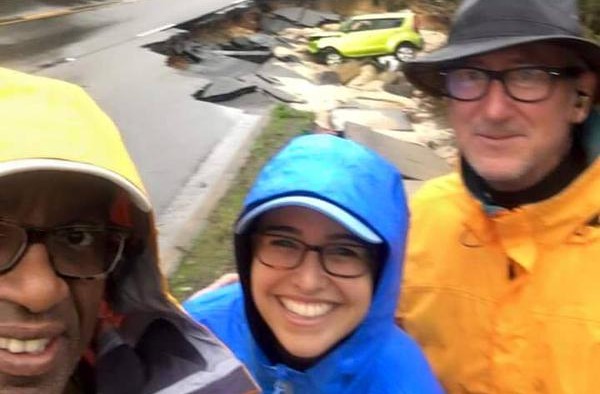
Roker-selfie

The question here is a simple one.

On the scene of the devastating flooding in South Carolina, Today Show weather man Al Roker tweeted a selfie of him and  NBC colleagues beaming happily in front of a collapsed highway and a trapped car, with the caption “My crew and I getting ready to report on East Coast flooding from S. Carolina on @NBCNightlyNews with Kate Snow.”

Yes, after many complained on social media about the discordant juxtaposition of cheerful self-promotion and tragedy, Roker apologized, but not before.  The basic question is “What the hell is the matter with these people?“, or as today’s Ethics Alarms Ethics Quiz asks,

Is Roker’s insensitivity signature significance of a malfunctioning ethics alarm, or just an excusable one-time mistake?

Continue reading

Unethical App Of The Month: Peeple

The co-founders of Peeple. I don't care which is which.

The co-founders of Peeple. I don’t care which is which.

(I’m officially adding this as an Ethics Alarms category. I don’t know why it too so long.)

The Washington Post reports that a greedy woman who never heard of the Golden Rule will be launching Peeple, “essentially Yelp for humans,” sometime in November:

“…you will be able to assign reviews and one- to five-star ratings to everyone you know: your exes, your co-workers, the old guy who lives next door. You can’t opt out — once someone puts your name in the Peeple system, it’s there unless you violate the site’s terms of service. And you can’t delete bad or biased reviews — that would defeat the whole purpose.”

Which is what, exactly? To pre-bias all future relationships by making sure they are colored by someone else’s judgment, emotions, or prejudices? Not only should no one want to be rated on such a service, no one should want to use it if they have a brain in their head. (No one should want to use Yelp, either.) Why should my standards, which are unique to me, be suppressed by the standards of other people I don’t know or respect? My ability to trust new acquaintances will be undermined by people I have no reason to trust, since a) I won’t know them and b) I won’t trust anyone so unethical as to smear someone like this.

As for positive reviews, what’s to stop someone from arranging to give positive feedback on a friend in exchange for a return rave? Nothing. The app will pave the way for sociopaths and con artists. Imagine what Bill Clinton’s reviews would look like.

Julia Cordray, one of the app’s founders, tells the Post, “People do so much research when they buy a car or make those kinds of decisions Why not do the same kind of research on other aspects of your life?”

Because it isn’t valid research, you moron. It is hearsay and opinion, neither of which would be admissible in court, for excellent reasons: they are unreliable.

The Post:

“A bubbly, no-holds-barred trendy lady” with a marketing degree and two recruiting companies”—“Trendy lady”? Great, I hate her already—“Cordray sees no reason you wouldn’t want to ‘showcase your character’ online”—I already showcase my character online, thanks. It’s called Ethics Alarms, but the difference is that I really do know myself, and I trust the standards of the reviewer implicitly. They are very close to my own…

“Co-founder Nicole McCullough comes at the app from a different angle: As a mother of two in an era when people don’t always know their neighbors, she wanted something to help her decide whom to trust with her kids.”

There we go. With any luck, there will be a few good, whopping law suits for defamation that will either reduce the user base of this App From Hell to four pranksters and a few mean and bored seniors with grudges, or drive the Trendy Lady to another scheme to make the world a little more unpleasant. Continue reading

Ethics Hero: Advice Columnist Carolyn Hax

But it worked for Scarlet!

But it worked for Scarlett!

I’ve made Hax, the Washington Post’s relationship advice columnist, an Ethics Hero before. This time it’s for something more than her usual spot-on instincts about right and wrong, and more about her method of expressing them. You know I am not fond of weasel words, equivocation and gentle rhetoric when emphatic prose is called for, and Hax, though she is more prudent than I, laps her competition when it comes to firing off both barrels when it is called for.

In this response, she was responding to a man whose brother stopped speaking to him after he gently suggested to him that his niece had a huge honker for her face and it might be time to visit the local plastic surgeon. The advice-seeker lives  “in a community where a lot of teenage girls have cosmetic surgery at 16,” he explained, and both his wife and daughter had their noses made button-like. “Was I over the line in making this suggestion in a private setting?” he asked Hax.

Her unrestrained, wise and glorious response: Continue reading

Ten Ethics Questions For Unshakable Hillary Voters

casual woman - no evil

Jamelle Bouie, Slate regular, can’t imagine Democrats voting for a Republican over Hillary just because she jeopardized national security, flouted her own department’s policies, destroyed evidence, and has lied about both her conduct and its significance continually. “Morning Joe” host Mika Brzezinski said yesterday that she is offended at Clinton’s lies about her e-mail, and is insulted that Hillary thinks that the American public is “that stupid.” She then said “If Hillary Clinton wins the nomination, I would vote for her,” thus proving that she, at least, is exactly as stupid as Hillary thinks she is. Then, of course, we have Paul Begala, who memorably said, “Voters do not give a shit. They do not even give a fart… Find me one persuadable voter who agrees with HRC on the issues but will vote against her because she has a non-archival-compliant email system and I’ll kiss your ass in Macy’s window and say it smells like roses.” (I keep quoting this because it perfectly embodies the level of ethical character (that is, 0)  of political operatives and the contempt in which they hold their prey, American citizens.). Then, on the recent post about ethics corruption and Clinton, regular commenter Beth wrote, speaking for informed, intelligent Democrats,

“..we’ll still vote for her in the main election over a Republican who will push for policy positions that we are against.”

I am not picking on Beth, whom I respect and consider a friend, but this is fascinating and alarming to me. She is a mother, and thus committed to teacher her children ethical values;  she is a lawyer, and she understands, for example, that destroying material you know is likely to be subpoenaed is unethical and often criminal. She does not approve of lying. Yet she expects none of this to deter her and other  intelligent Democrats from voting for Hillary Clinton.

The Democratic Party obviously is counting on this kind of reasoning, or they would not be offering such a corrupt, damaged, untrustworthy candidate. Indeed, I sense that the Beth Block doesn’t want to hear or read about Hillary’s slimy activities, because it makes them feel ashamed about what they think they will do two Novembers from now.

It should make them feel ashamed.

I wonder, though: how far will they go with this unethical and irresponsible logic? Thus I have these ten questions for them… Continue reading

The Clinton E-Mail Scandal, Part Two: The Corrupter, The Corrupt And The Corrupted

corrupted2

Like so many political scandals, the Hillary Clinton e-mail mess has multiple benefits even as it reveals the scabrous underside of the American political culture. Prime among the benefits is that it provides a useful test of who is trustworthy and perceptive, and who is untrustworthy due to an excess of bias, partisan fervor, warped values or just mush-for-brains.

The stunningly cynical and dishonest statement by Clinton communications chief Jennifer Palmieri, dissected in Part One, revealed that the Clinton machine really does have zero respect for the intellect of the American public, that the Clintons still believe that you can lie your way out of anything (even if the lies make no sense), and that a lack of ethics really does eat away at gray matter.

Look: every week, sometimes three times a week, I harangue lawyers about how they are ethically obligated to take careful measures to protect proprietary client information that is stored or communicated through electronic means. They immediately comprehend how it is essential, especially government lawyers. Why? Because the government is the most vulnerable of clients, among those who can be most hurt by careless information technology, and is ahead of much of industry and the private sector in developing policies and methods of keeping information as secure as possible. Hillary Clinton’s casual lies about how her “home-brewed” server was no big deal is literally stunning to these lawyers, because they know that no high ranking government official is as cavalier about official e-mails as Clinton’s repeated statements would suggest she was.  As is a pattern among Democrats during the Obama administration, Clinton’s dissembling is designed to fool the ignorant, because the ignorant are many and useful.  It is based on the assumption that nobody, certainly not the news media, will enlighten them sufficiently to understand the magnitude of what Clinton did, and the breathtaking audacity of her lies. Continue reading

Ethics Quote Of The Week: Slate Writer Jamelle Bouie

hillary-clinton-winking“Barring an indictment for criminal behavior, Hillary Clinton, if she’s the Democratic nominee, will not lose the 2016 presidential election because of her emails. To think so, or to think they’ll change the race, is to say that scandal will override partisanship; that an otherwise liberal voter will walk into the ballot booth and mark the box for Jeb Bush or Gov. Scott Walker or Sen. Marco Rubio because of digital mismanagement. I liked what Clinton said about early childcare, thinks our hypothetical voter, but sending government email on a private server makes her unfit for the White House.”

—–Slate’s resident racial-distrust monger, Jamelle Bouie, writing about how Hillary Clinton’s still unfolding e-mail scandal will affect her candidacy.

What a cynical and frightening attitude to  express  about one’s own ideological kith!

Could he be right? The typical progressive/liberal/Democrat sees the blatant lies of Hillary Clinton exposed, that she deliberately risked national security, deliberately breached her own department’s and the Obama administration’s policy, falsely denied that any laws or regulations were involved, disingenuously said her conduct was no different from other officials, destroyed e-mails knowing they were about to be subpoenaed in a Congressional investigation, placed national secrets at risk, described the process of unraveling her deceptions and incompetence as “fun,” sent out one surrogate after another to obfuscate and deny the facts and the truth, and repeatedly lied about the matter herself, following a well-established pattern that already causes most of the nation to regard her as untrustworthy, and still that typical progressive/liberal/Democrat will say, “Hey, I like what she said about early child care, so what difference does it make that she’s devious, dishonest, incompetent,  possibly criminal, reckless and thinks the public is made up of dupes?”

Really? Really? REALLY???

Who are these creatures, and how did they get this way? Are all Democrats this completely unconcerned about character and ethics, or is Bouie, who obviously is, just projecting his own crippling ethics rot on others?

That does it.

I’m heading for the bridge…

 Update: A rather more rational and less depressing analysis from Ron Fournier, who, unlike Jamelle, doesn’t try to spin Clinton’s conduct as “digital mismanagement.”


KABOOM! The Michael Brown Memorial

Brown memorial

Normally, as is the usual Ethics Alarms tradition when a story causes my head to explode, I would begin with a graphic representing the moment when reading a news item about unethical conduct so shorted-out my cranial wiring that my skull did an imitation of Dante’s Peak. The cause of the eruption, in this case, is even more disgusting than some of those bloody pictures, so I’m posting a photo of that instead. Now, assuming you have an ethics compass that doesn’t spin wildly due to a manufacturing defect, your head has exploded too.

KABOOM!

I have to hand it to the good people of Ferguson, Missouri. They have officially disproved the chestnut, “You have a right to your opinion, but you don’t have a right to your own set of facts.” The late Michael Brown—I’m sure you’ve heard of him—is being honored with his own memorial in the town, like military heroes, local martyrs, long-time community leaders, and distinguished men and women born in communities and who honored them by their accomplishments. Apparently the city is under the misconception that Michael Brown fits one of these categories, despite conclusive evidence to the contrary certified by the U.S. Justice Department, which was desperate to prove that the Gentle Giant was a pure as the driven snow. Thus Ferguson is anointing Brown with icon status, poisoning the values and the culture of the city from the moment the memorial is dedicated.

How sad, how wrong, and how stupid. Continue reading

Atrocious People, Part I: The Dog Rescuer, Elantra Cunningham, And What To Do About Her

bad-apples1

Let me make the ultimate conclusion of this post immediate and prominent:

The dog rescuer, , is admirable and ethical in every way. , the irresponsible and ungrateful woman who placed the dog in peril and had Hammons arrested for rescuing it is unethical and shockingly lacking in civilized values.

Let us all henceforth regard them and treat them appropriately according to their conduct in this matter.

There.

Now the details.

22-year-old Elantra Cunningham, owner of both the dog and the car, insisted that a police officer arrest Hammons for trespass and destroying private property. “It was not an arrest made by the deputy’s own volition,” Chief Deputy Lee Weems explained. “The woman pressed charges for breaking out the window of the car, and the deputy did what he had to do.”

Animal control cited Elantra for leaving her dog in a hot vehicle. Hammons spent the night in jail.

Comments: Continue reading

Unethical Mothers Day Quote Of The Year: Joanne Samuel Goldblum

diapers

“On Mother’s Day, many moms do not get taken out to brunch or presented with potted plants. For them, Mother’s Day is just like any other day – a struggle to get by. There is one gift we can collectively give them, though: We can stop judging. We can throw away the good mother/bad mother distinction. We can recognize that most mothers genuinely want to do what is best for their children. It is simply much easier for some of us than for others.”

—-, a social worker and the executive director of the National Diaper Bank Network, in Washington Post column titled “Stop judging poor moms. Bad policies hurt their kids — not bad parenting”—also a strong candidate for “Sweeping Generalization of the Decade.”

There’s an old Chinese proverb that goes, “When the only tool you have is a diaper, every problem looks like a baby’s butt.”

Or something like that. runs a laudable and necessary social service that provides diapers for families that can’t afford them. That’s a wonderful service and a wonderful charity, and she and her colleagues are doing a service for humanity. Unfortunately, her unique perspective on the problem of negligent and irresponsible parenting has produced her column in the Post, which uses a stream of rationalizations, logical fallacies and rhetorical deceits to reach an absurd and societally dangerous conclusion.

The fact that public policy may not do enough to help stressed mothers or minimize the damage caused by the irresponsible, negligent, dangerous or self-destructive—or just plain stupid—decisions by women that made them mothers in the first place, cannot mean that society should stop “judging mothers.” intentionally uses “judging” as a pejorative term (evoking the Biblical rationalizations), and with that tactic sides with the ethical relativists. Without critical judgment, there can be no standards. Without public conclusions regarding ethical behavior and unethical behavior, what conduct we encourage and what conduct we condemn, there can be no culture, no shared values, and no internal or external controls to limit destructive behavior. Everyone has a societal obligation to judge their own conduct, and that of everyone else. Judging conduct does inherently reflect on the purveyors of that conduct, but pointing out destructive conduct by mothers does not and must not preclude compassion, fairness, respect and charity.

Goldblum’s initial attack on anyone who dares to suggest that women should not have children they can’t afford to care for and that will permanently cripple their chances at success, proceeds by paring such critics with those who oppose the work of her organization.

“One man called me screaming that impoverished moms should “just use newspaper!” to diaper their infants. In letters and phone calls, others have accused us of encouraging mothers to keep “breeding.” (Barnyard animals breed, mind you. Women have babies.) Our critics believe the women who come to us are bad mothers who should not have had children in the first place. (We rarely get criticism of fathers, as if women become pregnant all by themselves)”

Breathtaking. She begins with the fallacy I call “The Bad Lawyer,”concluding from the fact that a proposition has some foolish advocates that the proposition itself is incorrect. Yes, anyone who advocates endangering a baby’s health by using newspaper as diapers is too mean and dumb to be in civilized society, but using that position to characterize critics or irresponsible mothers is dishonest debating. The suggestion that women decide to have babies they can’t afford because they are confident that they can get free diapers is similarly idiotic,but the position that it’s irresponsible to have children when you should know you can’t care for them is not only not idiotic, it’s blazingly obvious. Continue reading

The AWOL Walter Fauntroy, Flawed Black Martyrs And The Duty Of Outrage

Walter Fauntroy, D.C. icon, civil rights hero, fugitive, coward, crook...but still a hero. Somehow.

Walter Fauntroy, D.C. icon, civil rights hero, fugitive, coward, crook…but still a hero. Somehow.

As I was composing this post in my head, I stumbled upon—and I mean that, because I normally avoid her columns like cheap Chinese food—Kathleen Parker’s latest column. Parker is the sort-of conservative, sort-of op-ed pundit who has mastered the art of compassionate equivocation, meaning that her opinions on public affairs usually consist of one long sigh. She was at it again here, except that the topic she was sighing about confounds me, he who does not shrink from assigning blame, almost as much as it does she who usually spreads blame so evenly that its ethical impact is nil.

Parker wrote…

At the same time that people avoid too-sensitive subjects, they seem to fear stating the obvious lest their thoughts be interpreted as an act of betrayal to “the group.” Politicians are the most risk-averse of all. Few are the Democratic women who will find (or express) fault with Clinton. It is the rare African American who finds fault with Obama. When Rawlings-Blake also said that she “gave those who wished to destroy space to do that,” her Democratic colleagues spoke only of her “poor choice of words.” Not poor thinking? Not lousy leadership? Republicans don’t get a pass. Heaven forbid they should call out someone who wants to inject biblical end-times into political debate.”

Ah, how it makes my chest fill with pride that I have flagged all three of the ethical breaches Parker mentions within the few daysHillary Clinton’s brazenly suspicious conduct and the disgraceful refusal of her cheering section to either acknowledge or question it…Rawlings-Blake’s “lousy leadership”… and Republicans who use religiosity as a prop. Parker being Parker, she had earlier used an example of missing outrage that sets my teeth on edge because, while correct, it calls to mind another area of missing outrage and societally-damaging martyrdom that I can’t quite figure out how to talk about.

Where is the outrage beyond the African American community about police brutality and the deaths of young black males? Where are members of Congress other than those belonging to the black caucus? My God, the list of those killed is staggering,” she writes, “yet this is not a new phenomenon. Baltimore’s Freddie Gray, the 25-year-old who suffered spinal injuries while in police custody and died, is but the most recent. Yet you see only the usual black activists speaking up.”

True. The missing paragraph, however,  is this: “Where are the African-American activists asking why so many young black men are constantly in positions that place them in conflict with the police? When protesters chant the names and carry photos of police victims like Freddie Gray, Walter Scott, yes, and Mike Brown, they are presenting in honored terms African-Americans who weren’t credits to their communities or examples for the next generation to emulate. Indeed this ritual sanctifies lives and backgrounds that are part of the same urban pathology as the police attitudes that killed them.”

Freddie Gray was only 25-years-old, and yet he already had a staggering 18 previous arrests since he turned 18-years-old. His mother was a heroin addict; he had no father in his life. Why was someone like this even out of jail, in a position to become yet another victim of police anger and contempt against the endless wave of young, irresponsible, law-defying young men who undermine the vitality of their own communities and the nation?

The fact that Gray’s death was undeniably the greater outrage shouldn’t allow the outrage of lives like his to be ignored. Black crime and police dysfunction are part of the same pathology. If only the Bill O’Reillys are going to ask the hard questions about black communities policing their young and changing their deadly culture—and are they really hard for O’Reilly, whose audience is inclined to look for ways to side with the police even when they commit murder?—then those questions and their equally hard answers, involving, among other things, avoidance of responsibility and accountability, can be and will be largely ignored.

This is part of the loyalty to “the group” phenomenon that cripples the African-American community and warps its values. It is especially powerful when prominent leaders, those African-Americans who should be leading the way away from self-destructive conduct and who have the power, visibility, and credibility to do so, demonstrate an atrocious lack of ethics themselves. Where are the black voices—those not belonging to black women he sexually assaulted, that is—condemning Bill Cosby? Or Al Sharpton? Charles Rangel?

Washington, D.C.’s overwhelmingly black population was conditioned to accept black leadership outrages by the late Marion Barry. I was not quite aware of the extent of this cultural purging of the ability to hold prominent African-Americans to ethical standards until I read a jaw-dropping Washington Post feature about the wife of local civil rights legend Walter E. Fauntroy, who helped Martin Luther King plan the 1963 March on Washington, and who served as the District’s congressional delegate for two decades. The tone of the article is enough to make a reader think he or she is going mad. The loving 80-year-old wife, Dorothy Fauntroy, speaks about her husband in glowing terms that nothing in the article suggests is inappropriate. Continue reading