Good for them. If only more Americans had similar courage….but having a guaranteed lifetime position definitely helps.
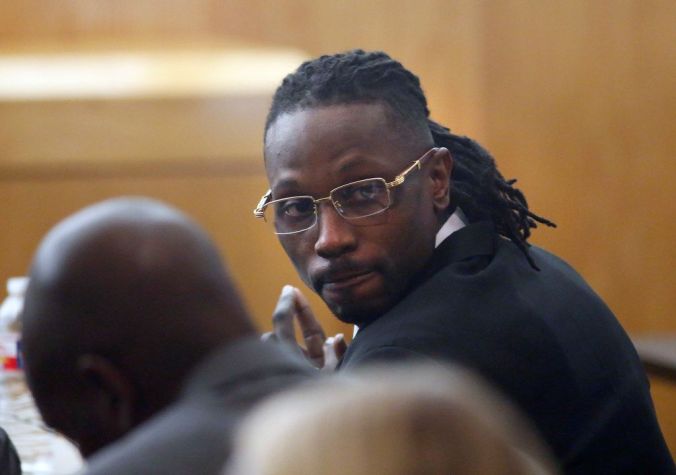
The Supreme Court last week silently rejected an appeal by a death row inmate in Texas arguing that his conviction was unjust because a juror had admitted to racial bias. Kristopher Love (above) is black, and his lawyer had been forced to accept a juror whose answer to a potential juror questionnaire query, “Do you believe that some races and/or ethnic groups tend to be more violent than others?” was “Yes.” Asked about that answer, the white juror said, “Statistics show more violent crimes are committed by certain races. I believe in statistics.”
The prospective juror in question, who is white, said yes. Pressed by defense lawyers, he said he based his views on “news reports and criminology classes” rather than his “personal feelings toward one race or another,” and that he did not “think because of somebody’s race they’re more likely to commit a crime than somebody of a different race.” He insisted that he did not feel animosity or suspicions toward Love “because he’s an African American.”
1 Yesterday there was a fascinating articleon how the famous opening chord of “A Hard Day’s Night” was (perhaps) made. I have been meaning to make a comment about the new Sirius-XM Beatles Channel, which I had occasion to listen to for many hours while being trapped in traffic jams and construction driving back and forth to Virginia Beach and Richmond, and this is a good time to post it.
I have been getting lousy, dishonest, bait-and-switch service and products with such regularity lately, ranging from an investment firm that couldn’t send the proper forms to give me access to my own money, to Verizon, which has been giving me a six-month runaround while its slooooow WiFi breaks down for days, to Progresso soup, which either decided to put what looks and feels like ground up chicken bones in its vegetable soup, or just the can I bought, that I had despaired of again seeing anything approaching excellence for the sake of excellence from a U.S. business until I returned to Disneyland or Fenway Park. The Beatles Channel makes the grade. It isn’t just the songs, which would have made the channel a hit all by themselves. Sirius-XM includes scholarship, history, musicology, rare recordings, interviews, celebrity and non-celebrity disc jockeys and cultural analysis, around the clock, with new programming every day. I’ve sat through college courses that were less thorough, and too many courses to count, in both college and graduate school, that were less informative and valuable. There are some things worth paying for, and products that are better than you expected!
2. The New York Times headline after a hard day’s night for the GOP in Virginia and New Jersey: DEMOCRATS SCORE TWO BIG VICTORIES IN TRUMP REBUKE.
I’m sure it was the koi.
This is flagrant spin and distortion, and unethical journalism. The New York Times should just put “You hate the President, you know you do” on the banner. The Times didn’t call last November’s across the board rejection of Democrats in state house races and Congress an “Obama rebuke,” though it was, and the results in Virginia and New Jersey cannot be fairly pinned on Trump. The two state governors races went pretty much as everyone assumed they would months ago. New Jersey’s result, from a very Democratic state, was a predictable rejection of its spectacularly failed and detested Republican governor, and Virginia’s election of a moderate Democrat over a Republican who tried to both reject Trump while trying to hitch-hike on some of his better positions was predictable as well.
I would also guess that the Donna Brazile revelations about the Democratic Party’s corruption is not on typical voter’s radar, so the wave of self-hating Democrats staying home that some predicted did not materialize. The Texas shooting, however, probably activated the always vigorous “The Constitution be damned, think of the children!” knee-jerk progressive block to go to the polls.
By now the Times’ routine propaganda tricks are no surprise, but the practice of attaching editorial comments connoting negative implications for the President is neither fair nor objective. But then, the news media knows this: it is attempting a coup by poisoning public opinion. This is the major ethics story—and ethics crisis—in the nation today, and has been so for a year.
3. Now a compliment to the New York Times. Finally, someone wrote an relatively honest article regarding the causes of mass shootings in the U.S. “What Explains U.S. Mass Shootings? International Comparisons Suggest an Answer” is the online version; the print edition headline is “Only One Thing Explains Mass Shootings In The United States.” Both headlines are misleading—the Times has a headline problem—but the article’s main point is correct: “The only variable that can explain the high rate of mass shootings in America is its astronomical number of guns.”
Not inadequate laws. Not enforcement. Not crazy people. Not crime. Not the NRA.
Just lots of guns.
Thank you.
The Times also correctly hints at—it could have and should have done more than hint—why we have more guns than any other country:
In the process of making a comparison between the US and Switzerland, which as the country with second highest gun ownership rate has far fewer shootings (Fun Facts! Switzerland, like Australia, isn’t the United States, and the Swiss, like Australians, are not like Americans), the Times notes,
“Swiss gun laws are more stringent, setting a higher bar for securing and keeping a license, for selling guns and for the types of guns that can be owned. Such laws reflect more than just tighter restrictions. They imply a different way of thinking about guns, as something that citizens must affirmatively earn the right to own.”
Translation: The United States protects and guarantees the inherent human right to self-defense and autonomy, and Switzerland doesn’t. In the U.S., the wise Founders, government doesn’t have to grant you the right to own a gun; you already have it. Or in other words, Switzerland isn’t the United States. (See above.) God bless America.
The Times continues under the heading “The Difference is Culture”:
“The United States is one of only three countries, along with Mexico and Guatemala, that begin with the opposite assumption: that people have an inherent right to own guns.The main reason American regulation of gun ownership is so weak may be the fact that the trade-offs are simply given a different weight in the United States than they are anywhere else.”
“May be”? That’s exactly why Swiss-style “regulation”—as in “We tell you if you can own a gun and what kind of gun you ‘need., Citizen!”—isn’t an option in the U.S. The Constitution also gives the right to speech a different “weight” than other cultures do, and the amount of certainty required to send someone to prison, and when the police can search your home, and many other examples where this nation and this culture insists that individuals and individual rights come first, not government power. The fact that the United States accepts the costs of individual liberty is what makes it the United States.
There are so many guns in the U.S. because Americans like guns, and in this country, people generally can make and get what they like. They should like guns: the United States,more than others, owes its existence to guns. Our most popular entertainment involves guns. Most of all, the #2 mandate in the Bill of Rights guarantees that every citizen begins life with the right to own guns.
Mass shootings are a side effect of the Second Amendment and the core individual right to be armed. The only way to reduce such shootings is to eliminate that right and confiscate guns. Either the currently vocal anti-gun zealots understand this and are lying, or they don’t, and are ignorant.
[The National Review has some legitimate criticism of the Times data analysis, but it doesn’t affect the validity of the Times general conclusion.]
4. Here’s the depressing ethics note of the day, or perhaps the year. On the first day of jury deliberations at the bribery trial of Senator Robert Menendez, a juror asked the judge a basic question: “What is a Senator?”
I guess a necessary voir dire question or two was omitted by the lawyers .
U.S. District Judge Patricia Minaldi was removed from St. Charles, Louisiana jury trial for criminal fraud in February, then her replacement declared a mistrial. Nobody knew why until the Associated Press got transcripts unsealed. They do not give one great confidence in the management of the justice system.
In one unsealed transcript (PDF), federal prosecutors and a public defender jointly called U.S. District Judge Donald Walter ,who took over the case from Minaldi, to ask him to grant a mistrial. The chief judge had assigned Walter to the case in an order that cited Minaldi’s inability to be present at the trial, but provided no additional explanation.
Minaldi was unable to be present because she doesn’t have the requisite awareness of the world around her or of the requirements of her job to be a judge. The botched trial included this ominous incident:
On the last day of the trial before it was suspended, Assistant U.S. Attorney Robert Moore was questioning a witness about the defendant’s grant application which had been filled out on a computer. Judge Minaldi interrupted the witness to ask what a “drop-down box” and “drop-down menus” were.
“I have no idea what that means,” Minaldi said, regarding the reference to drop-down menus. “No offense, but if I don’t understand it, I don’t think anybody else is going to understand it,” she continued. “I’ve been to law school. I’ve been doing this for 30 years. I have no idea what y’all are talking about.” After another question—Minaldi didn’t understand references to “Y’s and yeses” in relation to the answers to yes or no questions on the application—the judge recessed the court for lunch.
“Get your act together. Okay,” Minaldi told Moore. “I have no idea what’s going on here. Get your act together.”
Because it was HIS fault she had no idea what was going on. Continue reading →
I sometimes facetiously tell legal ethics classes that the average judge is ten years behind the average lawyer in technological acumen, who is five years behind the average 13-year-old. The law and legal ethics consensus is always playing catch-up with technological developments, and every time technology is put to a new or unexpected use in a trial, some judge may react to it like a Cro-Magnon encountering his first flame.
This happened recently in the case of Carino v. Muenzen (N.J. Super. Ct. App. Div.) During jury selection, plaintiff’s counsel began using his laptop computer to go to the Web and seek information on prospective jurors. Defense counsel objected, and the following exchange took place: Continue reading →

 Ethics Alarms