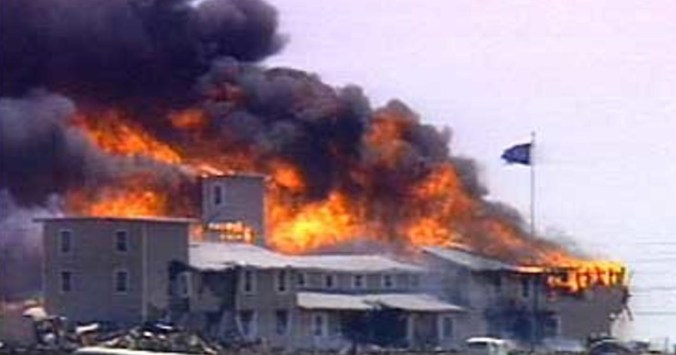
Another horrible occurrence that I did not mention yesterday while review the ethics-related events of April 19 through the centuries was the tragic conclusion of the FBI’s seige against Mount Carmel in Waco, Texas, in 1993. After a 51-day stand-off between the federal government and an armed religious cult, the compound burned to the ground, with about 80 members of Branch Davidians, including 22 children, dying in the blaze.
This was an ethics train wreck to be sure, and an unusually deadly one. There are so many documentaries and online accounts of the incident (of various quality and accuracy) that I’m not going to add to them here. I do recommend the 2018 Showtime docudrama series “Waco,” which is now streaming with a fascinating new sequel, “Waco: Aftermath,” currently being presented on Showtime.
There is a natural bias in “Waco”: its main sources were a book by one of the survivors and cult members whose wife perished in the fire, and another by an FBI negotiator who was extremely critical of how the agency handled the situation. Both authors come off as heroes of the disaster to the extent that such a botch can have heroes. When the docudrama premiered in 2018, many reviewers complained that the writers treated the FBI as the villains of the story, with cult leader David Koresh portrayed too sympathetically.
My impression, seeing “Waco” now, is that the series’ creators were on to something that has come into sharper focus in recent years. The FBI abuses its power, is badly managed, has too much autonomy, and can’t be trusted. That should have sunk in in 1993, but the news media was determined to let the hallowed law enforcement agency, Attorney General Janet Reno, and especially President Bill Clinton off the hook. I remember the coverage well: Koresh’s cult was lumped into the paramilitary and survivalist anti-government movement of the period. The Waco siege followed on the heels of the Ruby Ridge fiasco the year before, involving the same federal agencies, the FBI and the ATF. Even though that fatal showdown was ultimately shown to be exacerbated by the Feds (and a lawsuit found the agencies liable for damages), the public and media still were conditioned to regard the FBI as the “good guys.” Sure, it was tragic that people died, but the consensus was that they brought it on themselves, sad as the outcome was. At the time, I found it astounding that Reno wasn’t forced to resign, and that President Clinton escaped any accountability at all.
Much of that result was because of the subsequent Oklahoma City Bombing by Timothy McVeigh in 1995. Public opinion was turning against the trend of over-aggressive government following Waco: Rush Limbaugh in particular was leading a daily attack on what he saw as as Big Government restrictions on personal liberties (like the right to live out in the desert with fellow followers of a deranged but charismatic religious fanatic who claimed to be chosen by God). Once McVeigh’s truck brought down the Alfred P. Murrah Federal Building, destroyed or damaged 324 other buildings within a 16-block radius, killed 168 people and injured 680, however, public opinion turned decisively the government’s way. McVeigh cited Waco as a major reason for his terrorism, and the Cognitive Dissonance Scale worked its predictable magic: now the Branch Davidians were linked to pure evil. The FBI, and thus the U.S. government, propelled to the other side of the scale, the “good guys” at Waco, at Ruby Ridge, and always.
They aren’t, and weren’t. “Waco,” for all its flaws, makes that contrary conclusion unavoidable.
 Ethics Alarms