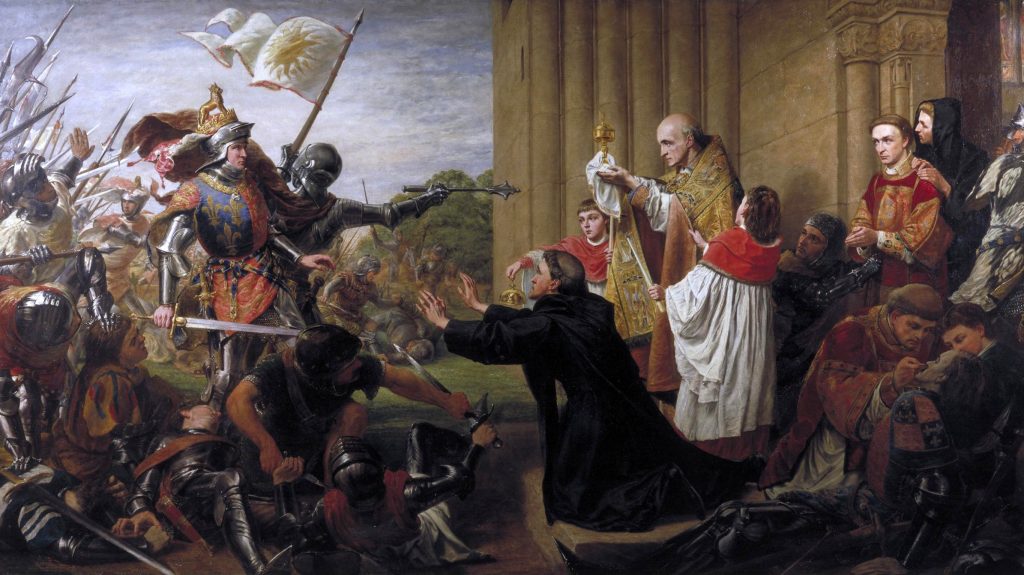
Guest post by Steve-O-in NJ
In the year 1399 a nobleman of the House of Lancaster named Henry of Bolingbroke ousted Richard II of the house of Plantagenet, son of Edward III, from the throne of England, partly over alleged tyranny and mismanagement (possibly brought on by a personality disorder), but just as much over pride, power, and differences regarding how to govern. Henry IV’s reign was fraught with problems as the nobles battled for power and influence under an unconsolidated rule, including Henry “Hotspur” Percy’s revolt, an attempt to restore Wales’ independence by Prince Owen Glendower, even an attempt to restore Richard to the throne in something called The Epiphany revolt. After all, once someone has ousted a rightful ruler by force (or fraud or corruption), why can’t he be ousted by force?
Henry IV died at 45 due to less than wonderful health. Henry V, Prince Hal, followed his father to the throne. Though Shakespeare portrays him as a hero, and he did achieve some great feats on the battlefield, he died at 35 (previously thought to be of dysentery, but now thought of as probably heatstroke from hacking and banging in full armor in August) leaving a young and mentally infirm son to inherit the throne as Henry VI. The English nobles hadn’t forgotten the recent dynastic struggle, and there was no reason for another nobleman, named Richard of York (you need a scorecard to keep track of all these Richards and Henrys), also a cadet branch of the Plantagenet house, like the Lancasters were, not to decide to press his own claim to the throne, starting the 30-year dynastic struggle known as the Wars of the Roses, since the Lancaster symbol was a red rose and the York symbol was a white rose.
 Ethics Alarms