The I.R.S. E-Mails: The New York Times, Flagship Of The Respectable Mainstream Media, Proves Its Corruption

IRSInvestigations

Washington, DC – Today, Ways and Means Committee Chairman Dave Camp (R-MI) issued the following statement regarding the Internal Revenue Service informing the Committee that they have lost Lois Lerner emails from a period of January 2009 – April 2011. Due to a supposed computer crash, the agency only has Lerner emails to and from other IRS employees during this time frame. The IRS claims it cannot produce emails written only to or from Lerner and outside agencies or groups, such as the White House, Treasury, Department of Justice, FEC, or Democrat offices.
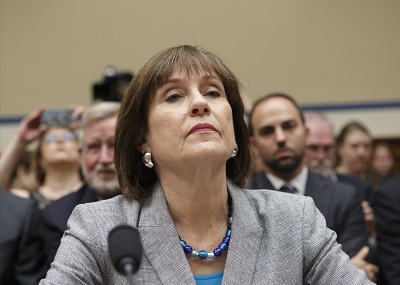
You can be forgiven if you somehow missed this story, though it is obviously alarming, newsworthy, and possibly sinister. Many in the mainstream media have gone out of its way to ignore it. Yet this is likely or certainly possible spoliation, the illegal destruction of documentary evidence during litigation or an official investigation, which the House inquiry into the IRS’s irregularities regarding the approval of conservative groups prior to the 2012 election certainly is. If a private company “lost” key  and potentially incriminating evidence like this, indictments would follow. (RIP: Arthur Andersen) Recall, please, that Lerner pleaded the Fifth Amendment to avoid self-incrimination—her right, but hardly cooperative or comforting. This news is even less so.

Oversight Subcommittee Chairman Charles Boustany Jr., M.D. (R-LA) added, “In the course of the Committee’s investigation, the Administration repeatedly claimed we were getting access to all relevant IRS documents. Only now – thirteen months into the investigation – the IRS reveals that key emails from the time of the targeting have been lost. And they bury that fact deep in an unrelated letter on a Friday afternoon. In that same letter, they urge Congress to end the investigations into IRS wrongdoing. This is not the transparency promised to the American people. If there is no smidgen of corruption what is the Administration hiding?”

Good question.

And yet, The New York Times decided that this wasn’t “news fit to print” anywhere. Roger Kimbell marvels: Continue reading

The Unethical—But Useful!— White House “Oopsie!” Doctrine

rotting fish head

In a—oh, hell, I’m out of adjectives to describe “This is so ridiculous it makes me want to throw myself into a woodchipper”—move that will transform U.S. culture, the White House has pioneered a new and refreshingly simple way for wrongdoers and law-breakers to take responsibility for their misconduct.

Just say, “I forgot to obey the law. Sorry!” Let’s call it the “Oopsie!” Doctrine.

Yes, this is how the White House bravely owned up to intentionally violating the statute, the National Defense Authorization Act, that requires the Executive Branch to alert Congress of the pending release of prisoners from Guantanamo at least 30 days in advance. Deputy National Security Adviser Tony Blinken called Senate Intelligence Committee Chairwoman Dianne Feinstein (D-Calif.) to officially say that the White House was sorry it failed to alert her, and therefore Congress, in advance of a decision to release five Taliban prisoners from the prison in Guantanamo in exchange for American deserter, and quite possible traitor, Bowe Bergdahl. The Obama Administration is calling this “an oversight.”

That’s right. The White House breaking the law is an oversight. Never mind that the President was well aware of this particular law, having stated that he regarded it as unconstitutional when he signed it. It was an oversight! None of the foreign policy experts and advisors, neither the Secretary of State or Defense or all their little deputies, nor the hoards of lawyers that Defense, State and the White House employ, remembered that there was a little matter of a relatively recent law that had to be followed in cases like this one. They all missed it, had a brain fart, whiffed, were day-dreaming, took their eye off the ball, goofed, tripped up, pulled a boner. It can happen to anyone! Continue reading

Rationalizing Corruption

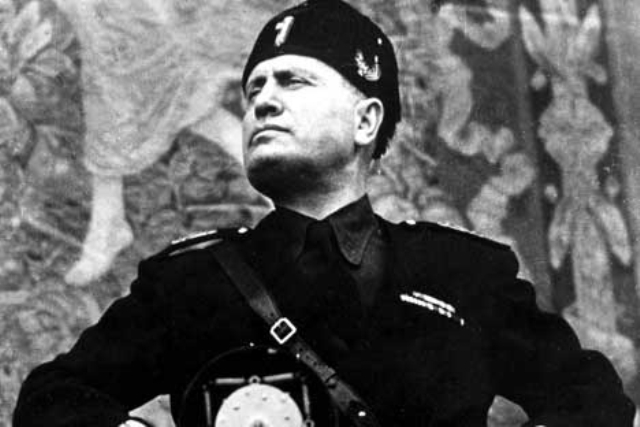
But remember: the trains ran on time!

But remember: the trains ran on time!

It is a debate that erupts here periodically: Do you vote for the honest and trustworthy politician whose policies you despise, or the lying rogue who stands for all the “right” things? Washington Post editor Hilary Krieger raises the issue with gusto in the Sunday Washington Post, with an essay titled (in the print edition) “Is a little political corruption all that bad?”

Yes, Hilary, it is.

Next question?

But perhaps that’s not sufficient to kill this particular snake, so let’s delve a bit deeper into this truly fatuous, ethically obtuse article. Continue reading

Ethics Quote of the Week: Bob Woodward

“You’re talking about government not working, but who’s in charge of the Executive Branch? You go to the Constitution, and the President has sole responsibility for the Executive Branch. This rests on him.

You were talking earlier about kind of dismissing the Benghazi issue as one that’s just political, and the President recently said it’s ‘a sideshow.’ But if you read through all these emails, you see that everyone in the government is saying, ‘Oh, let’s not tell the public that terrorists were involved, people connected to al-Qaida. Let’s not tell the public that there were warnings…’  One of the documents with the editing [shows] that one of the people in the State Department said, ‘Oh, let’s not let these things out.’ And I have to go back 40 years to Watergate, when Nixon put out his edited transcripts of the conversations, and he personally went through them and said ‘Let’s not tell this,’ ‘Let’s not show this.’

“I would not dismiss Benghazi. It’s a very serious issue. As people keep saying, four people were killed. You look at the hydraulic pressure that was in the system to not tell the truth, and, you know, we use this term and the government uses this term ‘talking points.’ Talking points, as we know, are like legal briefs. They’re an argument on one side. What we need to do is get rid of talking point, and they need to put out statements or papers that are truth documents. ‘OK, this is all we know.’”

—Bob Woodward, Watergate legend, on MSNBC, making the case that the altering of the Benghazi “talking points” and subsequent use of misleading statements about the origins of the attack is not, as the President has said, ” a side-show,” but rather a serious and disturbing event worthy of criticism and attention.

truth-graphic

“Quick! Let’s hide it!”

One reason I like this quote is that I feel that in the long run the Benghazi talking points scandal—for that’s what it is, a scandal—may be the most significant, if not the most egregious, of the three scandals now rocking the Obama Administration. For the reason this is true, we only have to consult Jay Carney, who incredibly told Piers Morgan yesterday that in referring to the I.R.S. targeting of conservative groups for obstructive treatment, the Justice Department’s intrusion on AP phone records and the false “anti-Muslim video” narrative,  the CNN host was “concocting scandals that don’t exist…especially with regard to the Benghazi affair that was contrived by Republicans and, I think, has fallen apart largely this week.”

Wow. Continue reading

The Trustbusters Circle The Wagons: Why?

Why do they always do this?

"Thank you, Sen. Reed, for your comments. You can stop spinning now."

“Thank you, Sen. Reed, for your comments. You can stop spinning now.”

Republicans, Democrats—why? Why do they think, when they are caught in an obvious example of misconduct, it is smarter and more useful—it certainly isn’t honest, courageous or ethical—not to simply confess and apologize, even if it’s with hardly an ennobling statement no better than, “You got us. Yeah, we were lying. That was wrong. Sorry,'” rather than continue to lie? The now ridiculous contortions of Democrats (and their knee-jerk supporters in the public and the media, but forget about them, for they are merely pathetic) are doing independent harm, because they destroy trust in government generally, and that, for a democratic republic, is potentially fatal.

Way back in September, when U.N. Ambassador Susan Rice disgraced herself by going on five Sunday talk-shows and stating with deceitful certitude ( “our current best assessment”…”we believe”)  that the deadly attack on the U.S. outpost in Libya was solely the result of spontaneous outrage on the part of extremists over a video, and not an organized terrorist attack, critics said that the Administration was covering up what really happened, and lying about what they knew. The accusation was shouted down and indeed ridiculed by Administration officials, Democrats in Congress, and the Obama-promoting media (it was in the middle of an election campaign) as a partisan smear, but in fact the critics, partisan though they were, were right. Rice was disseminating disinformation. The Administration and its State Department were intentionally blaming a video when they knew better. Why is another story: conservative pundits believe it was to avoid having to admit, mid-campaign, that the signature accomplishment of the President’s term, killing Osama bin Laden and supposedly crushing al Qaida, was not quite the complete victory the Democrats were claiming. If that was the reason, it was a stupid reason, but that doesn’t mean it didn’t happen that way. Hiding inconvenient facts before an election is despicable, but lying to the public and the world is serious enough, whatever its motive.

When she was questioned in Congress about the misleading descriptions, Secretary of State Hillary Clinton signaled that the Administration was in cover-up mode, both by lying outright (“I did not say … that it was about the video for Libya.”) and making her infamous and ethically indefensible statement”With all due respect, the fact is we had four dead Americans. Was it because of a protest or was it because of guys out for a walk one night who decided to kill some Americans? What difference at this point does it make?” Now, thanks to multiple revelations, the testimony of whistle-blowers, and newly released e-mails, there is no question that Clinton’s State Department took the lead in scrubbing the CIA talking points that immediately attributed the attack in Benghazi to identifiable terrorist elements connected to al Qaida, and not a spontaneous demonstration against the video. Not only are the Administration’s defenders refusing to admit that what happened happened, they are recycling old tactics from other scandals to do it, which if nothing else is lazy and boring:

  • “This is old news.” Or, as (Liberal! Obama-loving!) NY Times columnist Maureen Dowd termed it, “It’s not true, it’s not true, it’s not true, it’s old news.” Dowd also correctly identified this as a classic from the Bill Clinton playbook, used for too many bona fide scandals to list. Continue reading

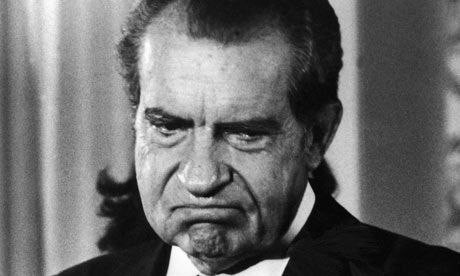
Don’t Blame Nixon

They can’t lay this one off on you, Dick.

I know it is much the vogue in Washington these days for leaders to blame previous leaders for persistent problems rather than to accept accountability and responsibility for not successfully solving them. Trendy though this attitude may be, however, Washington Post columnist Kathleen Parker’s column assigning fault for the U.S. public’s growing and frightening distrust of government institutions to Richard Nixon and the Watergate scandal shows its folly. It flies in the face of history and fairness, and lets literally thousands of subsequent leaders, elected officials, journalists, pundits and assorted knaves and hypocrites off scot-free.

Parker writes,

“Beyond the obvious, Nixon and the Watergate episode did great, perhaps irreparable, harm to the American spirit. A generation already traumatized by a war that ended up killing 58,000 of its brothers, boyfriends, husbands and fathers lost any remaining innocence, as well as trust in authority and faith in governmental institutions. The flag our forefathers raised on the moral high ground looked suddenly shabby and soiled. When even the president of the United States was willing to burglarize the American people, there was no one left to trust”

Oh, nonsense. The Watergate scandal, by the end, was one of the American system’s finest hours. The system worked, and worked on live television for all to see. A brave judge, John Sirica, showed integrity and grit in refusing to cave in to Presidential intimidation, ordering Nixon to turn over the tapes that ultimately proved his guilt. Senators and House members of both parties handled a complex inquiry diligently and well, with ethics heroes emerging on the Republican side, in individuals like Sen. Howard Baker, and the Democratic side, with the inspiring Senator Sam Irwin and others. When Nixon decided to fire the Special Prosecutor, Archibald Cox, who was getting too close to the truth, his own Cabinet member, Attorney General Eliot Richardson, resigned rather than do Nixon’s dirty work. Ultimately, Republicans and Democrats alike on the House Judiciary Committee voted for impeachment, forcing Nixon to resign. Yes, Tricky Dick was unethical and untrustworthy, but Americans had known that—and called him Tricky Dick— for decades. Then as now, too many Americans decided that “policies” trumped character, so they elected a man whose flawed values and integrity was a matter of public record—twice. Nonetheless, when he and his minions violated the law and threatened the principles of democracy, the vital institutions of the House, the Senate, the judiciary and the press showed their strength and virtue. Nixon was corrupt, not the Presidency, not the government. Continue reading

Unethical Quote of the Week: Adam Dachis

“All posts that belong to the Dark Side are going to feature some ideas that might be a little evil or at least require some flexible ethics. Some things will be downright horrible, and you should not do them, but are either for your information or simply for the point of interest (and will be noted as such). Your judgment and actions are your own, so think before you do anything you read here and only use your dark side for good.”

Adam Dachis, ethics corrupter, in the “Dark Side Disclaimer” that accompanies his column on the website Lifehacker, called “Secrets from the Dark Side.”

His current “Secrets from the Dark Side” column is entitled “How to Lie, Cheat, and Steal Your Way to a Perfect Flight,” which is an accurate description of its contents. Some of Dachis’s “tips” (scams? cheats?) are interesting, some are humorous, and all (well, maybe with one exception) are unethical. Dachis, for his part, doesn’t have the guts to advocate outright the conduct that he is explicitly promoting, nor does he condemn it. As his ethically incoherent ( “Only use your dark side for good”) disclaimer demonstrates, he thinks ethics is a game of some sort, and that being a “little evil” is cute, or trivial, or something.

A true ethics corrupter, Dachis wants to avoid personal accountability for the unethical acts of his readers spurred entirely by his post, while at the same time getting credit for his cleverness. This is the Richard Nixon approach to ethical corruption, planting seeds and disclaiming responsibility for the crop, telling followers, “We could do that, but it would be wrong.” Wink, wink.

Yechhh.

Sunday Morning Revelations: Kurtz, Feldstein, Anderson, and Why We Can’t Trust the News Media

Media critic Howard Kurtz interviewed reporter/author Mark Feldstein this morning on CNN’s “Reliable Sources, who is promoting his book, Poisoning the Press, an insider’s account of how famed Washington, D.C. muckraker Jack Anderson bent, broke, or entirely ignored basic principles of ethics and decency in his quest to fill his column with damaging information about President Richard Nixon and his allies.

There were two moments in the interview that stand as persuasive evidence against anyone who maintains, against mountains of evidence to the contrary, that American journalism is fair, responsible, unbiased and ethical.

One was at the start of the interview, when Kurtz characterized Feldstein’s book as showing that Anderson was as willing to cut ethical corners as Nixon was. “Well, Nixon’s were felonies, and Anderson’s were misdemeanors,” Feldstein corrected him. “Nixon’s felonies killed thousands of people.”

What? Exactly what “felonies” was Feldstein referring to? Continue reading

Summer Rerun: “Ending the Bi-Partisan Effort to Destroy Trust in America”

[TV is full of reruns these days, and sometimes I am grateful for them, for it gives me a chance to see episodes of favorite shows I had missed for some reason or another. Back in early March, I posted the following essay about the origins of America’s current crisis of trust in our government, and how it might be cured by our elected leaders. Since then, the crisis has deepened, and as I was doing some routine site maintenance, I reread the post. It is still very timely (unfortunately), and since far fewer people were visiting Ethics Alarms in March, I decided to re-post it today, with just a few minor edits. I promise not to make this a habit. Still, trust is the reason why ethics is so important in America: if there is a single post of the more than 700 I have written here since October 2009  that I would like people to read, this is it.] Continue reading

The Ethics of Helen Thomas Awards

When does an honor start honoring the wrong values? This tricky ethical problem is now in the spotlight thanks to the sudden self-destruction of Helen Thomas, who blurted anti-Semitic sentiments to a Rabbi, on camera, in an impromptu interview.

There are journalism awards named after Thomas, including The Helen Thomas Award for Lifetime Achievement given by the Society for Professional Journalism. Now that Thomas has included among her life time achievements a demand that the Jews “get the hell out of Israel” and go back to Germany and Poland—you know: “where they belong,” what does her name on the award mean to future recipients? Is accepting it a tacit endorsement of her views? Or should individuals be assessed on the totality of their careers, and not solely identified with their inevitable missteps. no matter how reprehensible? The latter was a common theme of eulogizers at President Richard Nixon’s funeral. Continue reading