Comment Of The Day: “’Three Strikes And You’re Incompetent’ : The Wernher Von Braun Fiasco, And What It Tells Us About Journalism”

This is going to start out as a history-heavy day at Ethics Alarms, and Zoe Brain’s terrific Comment of the Day regarding Wernher von Braun, the abuse of science, and the moral compromises of war  gets it off to a smashing start.

Quick: how much do you know about Japanese Unit 731? Here’s a sample (and here’s some more background) :

Unit 731 was set up in 1938 in Japanese-occupied China with the aim of developing biological weapons. It also operated a secret research and experimental school in Shinjuku, central Tokyo. Its head was Lieutenant Shiro Ishii.The unit was supported by Japanese universities and medical schools which supplied doctors and research staff. The picture now emerging about its activities is horrifying.According to reports never officially admitted by the Japanese authorities, the unit used thousands of Chinese and other Asian civilians and wartime prisoners as human guinea pigs to breed and develop killer diseases.

Many of the prisoners, who were murdered in the name of research, were used in hideous vivisection and other medical experiments, including barbaric trials to determine the effect of frostbite on the human body.

To ease the conscience of those involved, the prisoners were referred to not as people or patients but as “Maruta”, or wooden logs. Before Japan’s surrender, the site of the experiments was completely destroyed, so that no evidence is left.

Then, the remaining 400 prisoners were shot and employees of the unit had to swear secrecy.

Special thanks is due to Zoe Brain for raising the topic of these horrific  Japanese war crimes, which have received so little publicity compared to their Nazi equivalents.

Here is her COTD on the post, “Three Strikes And You’re Incompetent” : The Wernher Von Braun Fiasco, And What It Tells Us About Journalism”:

I am a sometime Rocket Scientist. I am also a sometime senior engineer on military projects – in this context, “Defence Industry” is an unhelpful euphemism to sanitise a regretably necessary evil.

Von Braun is an object lesson. Although a member of the Nazi party, he joined to further his passion of developing rocketry. His later membership of the SS was coerced, though any man of principle would have resisted rather harder than he did.

His boss, Dornberger, who arguably had more influence on the US space program than Von Braun, was a nasty piece of work. He wasn’t just an amoral mercenary with overly flexible ethics, he was quite approving of working slave labourers to death.

I am in no danger of becoming a Dornberger. A Von Braun? Well, apart from the lack of talent on my part, yes, I could see myself becoming like him if I was careless. Just by getting too wrapped up in a technically sweet solution to an intractable problem, by telling myself I was advancing Science for all Humanity, and a hundred other justifications and excuses for selling my soul, one compromise at a time.

Maybe I already have done. Some work I did 25 years ago is now in the hands of a regime I do not trust. Had they been in power then, I would not have worked on that project, just as I refused to work on some others. Continue reading
“Three Strikes And You’re Incompetent” : The Wernher Von Braun Fiasco, And What It Tells Us About Journalism

Washington radio station WTOP decided to put a local spin on the anniversary of the moon walk by telling its website viewers about the crucial contributions to our nation’s space achievements  by “a brilliant German-American rocket engineer who is laid to rest in Alexandria, Virginia.”

The article, by Dick Uliano, was classic hagiography. No, nothing in it was false, but if a reader knew anything about Wernher Von Braun, it felt like a whitewash, which it was. Oh, there were plenty of hints in the piece that Von Braun was a Nazi, with off-hand sentences amid the upbeat prose, like “In 1932 he began work on Germany’s liquid-fuel rockets that pounded western Europe in World War II,” and “At the close of World War II, von Braun and his rocket team surrendered into the welcoming arms of the United States, which immediately put them to work in America’s space race against the Soviet Union.” Nonetheless, the article never connected the dots, leaving out the mandatory direct statement telling readers what every literate citizen knew in the 1960s: Werner Von Braun was not only a Nazi, but an unapologetic one. It is “fake news” to write about ‘the Alexandria man who was critical to the Apollo program’ without including this information. That is a material omission.

It’s true: the space program relied heavily on the contributions and expertise of Nazi scientists. This is a classic example of utilitarianism of the most unsentimental and most brutal variety. Had he not cut a deal with the Americans, von Braun very likely would have been tried and convicted of war crimes. The U.S. correctly and pragmatically concluded that making a pact with a devil was nonetheless essential to national security. That does not mean, however, that there was anything admirable about von Braun whatsoever. At best he was amoral, a mercenary. At worst he was as much of a monster as any of Hitler’s enablers. Continue reading

Ethics Quiz: Operation Paperclip

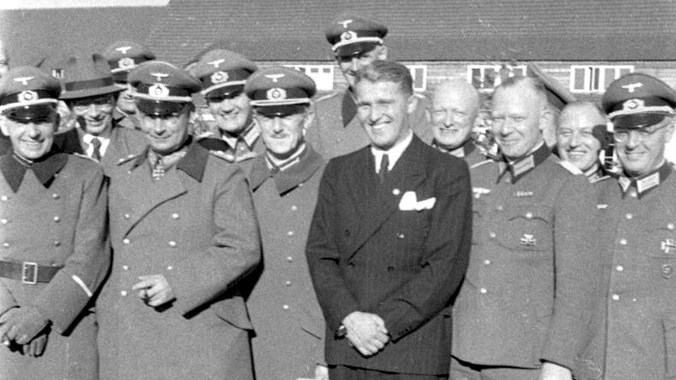
That’s Wernher in the nice suit…

In the previous post, I discussed the position holding that scientists should be shunned, and even blocked from grants and research opportunities, based on their character flaws, statements, and workplace misconduct.

Operation Paperclip was a secret program of the Joint Intelligence Objectives Agency that occurred between 1956 and 1959.  The operation  brought more than 1,600 Nazi German scientists, engineers, and technicians, most notably Wernher von Braun and his V-2 rocket researchers, plus their family members (bringing the total to over 6,000 Germans)  to the U.S. for government employment in the effort to gain a military and scientific advantage over the Soviet Union in the post-war world. The Soviet Union took their own selection of German scientists.

The Ethics Incompleteness Principle states that…

…when a system or rule doesn’t seem to work well when applied to an unexpected or unusual situation, the wise response is to abandon the system or rule—in that one anomalous case only— and use basic ethics principles and analysis to find the best solution. Then return to the system and rules as they were, without altering them to make the treatment of the anomalous situation “consistent.” No system or rule is going to work equally well with every possible scenario, which is why committing to a single ethical system is folly, and why it is important to keep basic ethical values in mind in case a pre-determined formula for determining what is right breaks down.

Your Ethics Alarms Ethics Quiz Of The Week: Continue reading