No, I didn’t forget the Alamo, and I hope against hope that more Americans than not are at least noting the anniversary of when the mission that became a fort fell in the early morning hours of March 6, 1836. As soon s I get this post up, I’m going to re-watch the 1960 John Wayne movie commemorating the siege and the men who died that day. The Duke’s film has plenty of flaws, but a lack of conviction and passion isn’t one of them; in the end that, plus the Demiri Tiomkin score, is what what makes “The Alamo” my favorite cinematic telling of the story.
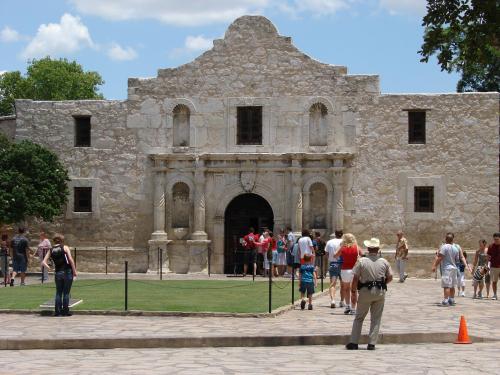
Did the old newspaperman’s manifesto from another John Wayne movie, “The Man Who Shot Liberty Valence” ever apply more perfectly to an event in American history? “When the legend becomes fact, print the legend.” “I answered them with a cannon shot.” The line in the sand. The couriers who came back to the fort to die. Jim Bowie fighting from his sickbed. Davey Crockett fighting to the end. Truth and fiction, the Alamo is my favorite of all American history tales, and the Alamo itself is my favorite historical site to visit in the United States.
I didn’t have a new inspiration to justify a new post this year, so I’m reprising the one from this date in 2023. Among other things, it included the climax of the Alamo diary Michael West contributed a few years ago.
Now the bugles are silent And there’s rust on each sword And the small band of soldiers Lie asleep in the arms of the Lord.
***
I regard the siege of the Alamo one of the signature ethics events in U.S. history, both for what it was and what it came to represent. There have been many posts on the subject as well as many references to the Alamo in other posts, all of which are accessible here.
Today, March 6, marks the fall of the converted mission. Ethics Alarms has two pieces from its archives to present: Continue reading →
I regard the siege of the Alamo one of the signature ethics events in U.S. history, both for what it was and what it came to represent. There have been many posts on the subject as well as many references to the Alamo in other posts, all of which are accessible here.
Today, March 6, marks the fall of the converted mission. Ethics Alarms has two pieces from its archives to present:
I.Last year, Texan and Ethics Alarms stalwart Michael West’s provided Ethics Alarms readers with a day by day account of the Alamo’s the final days, March 5 and March 6. Here it is:
March 5, 1836
After the previous day’s war council (on March 4), Santa Anna was content that his glorious assault would occur. But evidently, according to several reliable Mexican sources, a civilian woman from the town, who had retreated to the Alamo with the Texans, made it out of the Alamo during the night and gave dire information to the Mexicans. Evidently the Texan garrison was increasingly despondent. According to the lady who escaped, Travis and the garrison had discussed their options and one of the more forceful arguments made was that they should consider surrender.
Santa Anna wanted none of this, and accelerated his assault time-table (which he hadn’t necessarily meant for the 6th of March but for the 7th or even the 8th).
The Mexican soldiers would have received their orders in the morning and spent the rest of the day making preparations. There was little physically they had to do other than check the locks of their muskets, ensure they had the requisite number of extra flints (which would occasionally break in battle – testing the coolness of even the most experienced soldier), or assist in the production of several ladders Santa Anna had commanded each battalion to have prepared.
No, most of the preparation would have been mental. A deeply Catholic people, the Mexican soldiers would have spent their energies on prayer and confession. New soldiers would have been nervous about how they would perform under fire, simultaneously trying to hide their nerves from the experienced soldiers, who would have recognized the unique challenge before them. Almost none had been asked to climb tall walls after traversing several hundred yards under fire against an enemy who had, in the previous 12 days, proven that their rifled muskets out-ranged the standard Mexican issue musket by nearly 300%Some of Santa Anna’s soldiers were eager to get into the fight – to uphold the honor of the Mexican nation against, not only rebels, but rebels seemingly motivated by pro-American attitudes. Some of Santa Anna’s soldiers had been farmers pressed into service only months before, who would have had a partially begrudging attitude and were mostly leaning towards “let’s get this over with so I can get home.” Some of the dictator’s soldiers were convicts for whom the upcoming bloodshed was just one more act of brutality to endure in an already brutal and brutalized life. For a large number of the soldiers, for whom soldiering was life, this would be a terror that they knew would be expected of them. Regardless of their motivations, there would be no getting out of the upcoming ordeal and every single one of them would be in the same peril when a Texan cannon roared out at their formation.
Set to wake up at midnight to begin movements to their attack positions, the few soldiers could fall asleep would have tried to do so by twilight.
Inside the Alamo, evening would draw a miserable day to a close. Earlier that day, according to Enrique Esparza, aged 8 (who’s father, Gregorio, was fighting with the Texans), the faeful courier entered the Alamo with news that despite all the hopeful reports, no immediate help was on its way. Travis would have discussed with the men their options – a break-out attempt in case of a successful assault would be their best recourse. A break out during the day would be impossible and one at night would be extremely risky. Whatever was said, it appears all but perhaps one of the men decided to stay
For the Texans, sleep would come quickly that evening. For the first time in 12 days, Santa Anna’s cannons didn’t create chaos inside the compound. It was silent. There could be no doubt that the defenders knew what this meant, but they were exhausted. They would have kept watch and pure anxiety might have boosted their necessary alertness. Nonetheless, they began succumbing to sleep deprivation and may have been deep in dreams of life after the war – or perhaps of life before the war.
Before collapsing in whatever position suited rest, most would have reviewed their plans in their minds of how to get out once they’d done what they could to slow or halt the Mexican advance. No shame in that: when a battle is clearly lost and standing your position doesn’t buy anyone else on the battlefield any opportunity to turn the tide, there’s no principle of warfare that requires that a soldier die on principle.
Most would have recognized that with San Antonio immediately to the west, and several Mexican artillery batteries to the north and south, the east would be the best direction to break out for should the situation so demand. That was also where the gathering Texan army could be found, eventually.
Right after dusk, Travis dispatched the final courier on yet another appeal for assistance. Then, as in each night during the siege , Travis assigned several men outpost duty beyond the walls of the Alamo to provide an early warning before turning the watch over to another officer.
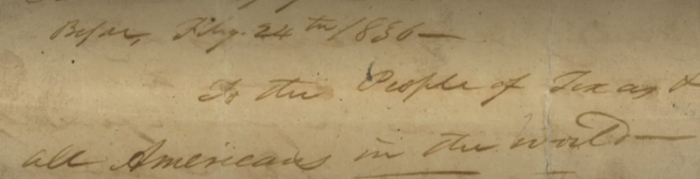
“”To the People of Texas & All Americans in the World—Fellow Citizens & compatriots—I am besieged, by a thousand or more of the Mexicans under Santa Anna — I have sustained a continual Bombardment & cannonade for 24 hours & have not lost a man — The enemy has demanded a surrender at discretion, otherwise, the garrison are to be put to the sword, if the fort is taken — I have answered the demand with a cannon shot, & our flag still waves proudly from the walls — I shall never surrender or retreat. Then, I call on you in the name of Liberty, of patriotism & everything dear to the American character, to come to our aid, with all dispatch — The enemy is receiving reinforcements daily & will no doubt increase to three or four thousand in four or five days. If this call is neglected, I am determined to sustain myself as long as possible & die like a soldier who never forgets what is due to his own honor & that of his country —Victory or Death.“
Col. William Barrett Travis, Commander of the Alamo in San Antonio, Texas, on February 24, 1836, as his make-shift fort with its couple hundred volunteers were surrounded by the army of General Santa Ana, and a siege was inevitable.
Travis sent out several appeals for assistance and reinforcement that day, but this one has been enshrined as one of the iconic letters in American history. When the Texas revolution began in 1835, Travis, a failed lawyer, businessman and husband—he had abandoned his wife and unborn child in Alabama to escape his debts and start a new life in the Mexican territory—had became a lieutenant-colonel in the revolutionary army and was given command of troops in the recently captured city of San Antonio de Bexar (now San Antonio). On February 23, 1836, a large Mexican force commanded by General Antonio Lopez de Santa Ana arrived in the town. Travis and his troops barricaded themselves in an abandoned mission repurposed as a fort, the Alamo, where they were joined by a volunteer force led by Texas land speculator and adventurer Jim Bowie. Later, another, smaller group of volunteers organized by former Congressman and self-made legend Davy Crockett joined them.
Before Travis’s fevered and desperate letter-writing, the Mexican dictator had demanded the fort’s unconditional surrender, promising no quarter if the defenders refused. As his letter said, Travis answered with a cannon shot.
And the rest, as they say, is history.
This is an especially important time for Americans to remember the Alamo.
The following post was mostly assembled from past essays here about my favorite event in American History…
I will never forget my first visit to the Alamo, and seeing Texans weeping, openly, proudly, as they read the plaque with Travis’s words engraved on it:
Commandancy of the Alamo Bejar, Feby. 24, 1836
To the People of Texas & All Americans in the World
Fellow citizens & compatriots
I am besieged, by a thousand or more of the Mexicans under Santa Anna I have sustained a continual Bombardment and cannonade for 24 hours & have not lost a man The enemy has demanded a surrender at discretion, otherwise, the garrison are to be put to the sword, if the fort is taken I have answered the demand with a cannon shot, and our flag still waves proudly from the walls. I shall never surrender or retreat. Then, I call on you in the name of Liberty, of patriotism and everything dear to the American character, to come to our aid, with all dispatch. The enemy is receiving reinforcements daily & will no doubt increase to three or four thousand in four or five days. If this call is neglected, I am determined to sustain myself as long as possible and die like a soldier who never forgets what is due to his own honor & that of his country VICTORY OR DEATH.
William Barret Travis.
The story of the Alamo isn’t taught in schools outside of Texas. It wasn’t taught in my school, either: like most American history, I learned about the event though a thick mixture of pop culture, reading (Walter Lord’s “A Time To Stand” was a birthday present in 1961) and ongoing research. I recently completed “Texas Rising,” which was also just broadcast on cable as a mini-series starring the late Bill Paxton as Sam Houston. Historian Stephen Moore is a plodding writer, but he nicely puts to rest the currently popular politically correct slander that the defenders of the Alamo and the Texas rebels were fighting to keep their slaves, and trying to steal Mexico’s land. The Texians were opposing a dictator who had changed the terms under which they had come to the territory, and anyone familiar with the American character could have predicted what would happen when a despot demanded that they submit to unelected authority. The Alamo was a fight for liberty and democracy, and its martyrs exemplified sacrifice for principle and country.
While the Alamo was under siege, the provisional Texas government organized at Washington-on-the-Brazos. On March 2, the convention declared independence and the Republic of Texas was born, at least on paper. The Alamo’s garrison showed its support for independence from Mexico by sending its own delegates to the convention.While they were unaware that Texas had declared independence, the roughly 200 Alamo defenders stayed at their post waiting on help from the settlements. Among them were lawyers, doctors, farmers and a former congressman and famous frontiersman from Tennessee named David Crockett. While the youngest was 16 and the oldest defender was Gordon C. Jennings, age 56, most defenders were in their twenties. Most were Anglo, but there were a handful of native Tejano defenders as well. Legendary knife fighter and land speculator James Bowie was in command before falling ill and sharing duties with Travis. Several women and children were inside the Alamo, including 15-month-old Angelina Dickinson. Just before the final battle, Travis placed his ring around her neck, knowing she would likely be spared. One of the last messages from the Alamo was a note from Travis asking friends to take care of his young son Charles.
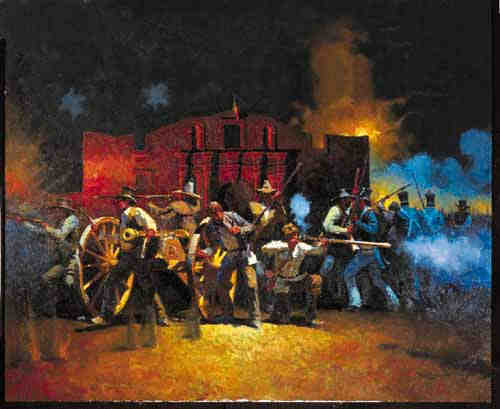
The final attack came before dawn on March 6, 1836. As Mexican troops charged toward the Alamo in the pre-dawn darkness, defenders rushed to the walls and fired into the darkness. Travis raced to the north wall but was soon killed. Bowie was most likely killed in his bed, while reports differ as to Crockett’s death. Many believe Crockett survived the initial attack but was put to death by Mexican soldiers soon afterward.
Mexican soldiers breached the north wall and flooded into the compound. The fierce battle centered on the old church, where defenders made a last stand.
It is now April, and though I vowed at the end of February to finally post a thorough essay on the significance of the Alamo to U.S. culture, ethics, traditions and ideals at some point during the dates corresponding to the fort’s siege and fall on March 6, 1836.
I never did.
I thought I had posted an earlier essay about the Alamo. No, I haven’t. This is as inexplicable as it is inexcusable. The Alamo is by far my favorite historical landmark, and one of the events in American history that most inspires and fascinates me, beginning from when I looked on in horror as Fess Parker, as Davy Crockett, desperately clubbed Mexican soldiers as the last Alamo defender standing, and hundreds more charged toward him, as I heard on the soundtrack,
His land is biggest an’ his land is best, from grassy plains to the mountain crest
He’s ahead of us all meetin’ the test, followin’ his legend into the West
Davy, Davy Crockett, king of the wild frontier!
I learned all about Davy, of course, the real Davy, America’s first pop culture celebrity who created a legend about himself and by fate, irony or justice, inadvertently placed himself in a situation where he had to live up to his own hype—and by all accounts,did. Then there was Jim Bowie. I had seen several dramatized versions of his famous last stand, fighting off soldiers from his cot, finally dispatching one last attacker with his Bowie knife. It is one of the great examples of a scene so good it should have been true, though it wasn’t: Bowie was dead or unconscious by the time the Mexican burst into his sick room. Never mind: that’s how an American hero goes down, fighting. “Print the legend.” Later I learned how Bowie really was one tough, brave SOB, the perfect man for the Alamo, if he hadn’t been dying of cholera.
My impression of William Barrett Travis was biased by Lawrence Harvey’s portrayal of him as a martinet (with a British accent that supplanted his Southern one after the first scene) in the John Wayne film “The Alamo”, my favorite movie as a kid. The real Travis was a pefect example of someone who had failed in everything, including as a father and a husband, but redeemed himself magnificently at the end. His final letter to the world is one of the great proclamations of defiance, dedication and courage in all of history.
I will never forget my first visit to the Alamo, and seeing Texans weeping, openly, proudly, as they read the plaque with Travis’s words engraved on it:
Commandancy of the Alamo Bejar, Feby. 24, 1836
To the People of Texas & All Americans in the World
Fellow citizens & compatriots
I am besieged, by a thousand or more of the Mexicans under Santa Anna I have sustained a continual Bombardment and cannonade for 24 hours & have not lost a man The enemy has demanded a surrender at discretion, otherwise, the garrison are to be put to the sword, if the fort is taken I have answered the demand with a cannon shot, and our flag still waves proudly from the walls. I shall never surrender or retreat. Then, I call on you in the name of Liberty, of patriotism and everything dear to the American character, to come to our aid, with all dispatch. The enemy is receiving reinforcements daily & will no doubt increase to three or four thousand in four or five days. If this call is neglected, I am determined to sustain myself as long as possible and die like a soldier who never forgets what is due to his own honor & that of his country VICTORY OR DEATH.
William Barret Travis.
The story of the Alamo isn’t taught in schools outside of Texas. It wasn’t taught in my school, either: like most American history, I learned about the event though a thick mixture of pop culture, reading (Walter Lord’s “A Time To Stand” was a birthday present in 1961) and ongoing research. I recently completed “Texas Rising,” which was also just broadcast on cable as a mini-series starring the late Bill Paxton as Sam Houston. Historian Stephen Moore is a plodding writer, but he nicely puts to rest the currently popular politically correct slander that the defenders of the Alamo and the Texas rebels were fighting to keep their slaves, and trying to steal Mexico’s land. The Texians were opposing a dictator who had changed the terms under which they had come to the territory, and anyone familiar with the American character could have predicted what would happen when a despot demanded that they submit to unelected authority. The Alamo was a fight for liberty and democracy, and its martyrs exemplified sacrifice for principle and country.
I let them down. The story of the Alamo should be told and retold, with its ethics lessons made clear and bright. Next year, on March 6. 2018, Ethics Alarms will honor Davy, Bowie, Travis, Bonham, Almaron Dickinson and the rest of the 220 or so heroes who died that day, and do it the right way, not as an afterthought.
Mark Sanford evokes that stirring Civil War battle, the Alamo.
The unethical and increasingly ridiculous Mark Sanford, now in the process of losing what should have been a sage House seat for Republicans in South Carolina, has added the public crime of “making Americans dumber” to his list of disqualifications for public office.
Sanford was the rising star South Carolina governor—married, with children— who went AWOL on the job to have a clandestine liaison with his South American mistress, using public funds in the process, and lying through his staff to cover his tracks. He didn’t have the courage or the decency to resign, nor did he have the common sense and decency to quietly disappear so he would stop embarrassing his wife, his state, Republicans, men, and Homo sapiens everywhere. Instead he returned to run in a primary for a House seat, and since Republican primary voters will apparently vote for anyone or anything, won. Now he’s running behind in the polls to a Democratic candidate whose key qualification is that her brother is a popular TV comic.
Sanford has run a full page ad in some newspapers, painting himself in heroic terms and comparing himself to the martyrs of the Alamo: Continue reading →
 Ethics Alarms