Comment of the Day: “‘White Christmas’ Ethics Addendum: Battlefield Incompetence, Insubordination And More In The Holiday Classic”

To kick off the Not-Too-Early-To-Play-Christmas-Music Season, here is a Comment of the Day that adds another chapter to the Ethics Alarms commentary on “White Christmas,” the Bing Crosby-Danny Kaye musical film that is one of the five or six most resilient of the Christmas classics. The initial ethics analysis is here.

The post that spawned the latest take was a rare guest essay by Ethics Alarms veteran texagg04.

Now comes new commenter SykesFive to provide insight into the pivotal character of General Waverly, played by Dean Jagger. Among other things, he argues that one reason the general was so beloved was that he was poor general, treating the lives of his men as more important than his mission.

Here is his Comment of the Day on tex’s post, “White Christmas” Ethics Addendum: Battlefield Incompetence, Insubordination And More In The Holiday Classic:

I have a somewhat different take on this. I sometimes think I am the only person who thinks so much about the Waverly character.

As the scene opens, Major General Waverly is being relieved for frankly the only reason American unit commanders were relieved during the war: he didn’t take the objectives. That is failure. It could be lack of aggression or poor coordination or anything else, but ultimately it is failure and the commanding officer will pay the price. He will be shuffled off to a rear area command, or maybe just left to bum around the theater, and be out of the Army by the end of 1945 because his record will be so tarnished. He will be lucky not to revert to his prewar rank.

Waverly’s age suggests he was a company-grade officer during WWI and may or may not have seen combat during that conflict’s closing weeks, then spent decades idling in the interwar army. Apart from whatever happened in 1918, Waverly has no more combat experience than anyone else in the division. He is not an experienced commander by any measure. He had the right credentials–a few articles in service journals, no serious problems on his posts, and of course a West Point Ring–but had never really been tested as a field-grade officer. Again this is a common profile.This is a very common profile for WWII US Army division commanders.

So in 1940, let’s say Colonel Waverly seemed like a likely candidate for command of an infantry division in the expanding army. He did well enough with some trial commands–all during stateside training and expansion–and was promoted to one and then two stars. He seemed competent enough when the 151st Division was formed and went through let’s say nearly two years of intensive training in Texas or California or wherever. And so the division was sent to Europe in let’s say August 1944, then spent a couple months languishing in Normandy or the Pas de Calais region, during which time Waverly was a friendly presence at other officers’ headquarters as well as around his division. Bear in mind that at this point, and really for the whole war after the breakout from Normandy, the limit on American frontline strength was providing fuel and artillery shells. There were more men and tanks than could be sustained at the front. Continue reading
Morning Ethics Warm-Up, 10/8/2017: TV Comics, Law Deans, Sports And California…Everything Is Seemingly Spinning Out Of Control!

Good Morning!

On the day that the Boston Red Sox will begin their stunning comeback against the Houston Astros …


1 Speaking of baseball, a poll shows that the NFL fell from the most popular major sport in the nation last year to the least favorite last month, while baseball regained its traditional but usually treated as fictional “National Pastime” status. The NFL also dragged down the popularity of college football. Not all of this can be blamed on Colin Kaepernick, Black Lives Matters, and incoherent protests that aren’t against the National Anthem, well, maybe its third verse, but take place during the National Anthem, well, because. Ethics Alarms isn’t the only voice that has declared football to be callous and barbaric, now that the game’s unavoidable concussions are being shown to cause a deadly brain disease. Too many helmeted heroes beat their spouses and lovers, and commit felonies. The biggest star in the NFL, Tom Brady, is a smug, cheating jerk. It never helps when the President of the United States, even one like Trump, attacks an institution from the bully pulpit. Still, the timing certainly suggest that the NFL’s botched handling of The Knee is the catalyst for its current nosedive in popularity. Just think how many brains will be saved if this is permanent.

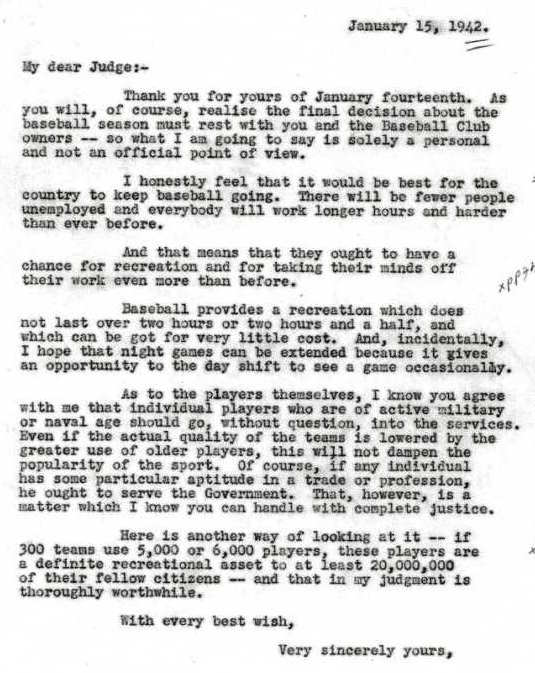
Meanwhile,  Major League Baseball is benefiting from staying true to its traditional national role of unifying the country rather than dividing it. No on-field protests mar the National Anthem. The sport is entertainment, celebrating American themes like individualism, the triumph of the underdog, and grace under pressure. In 1942, FDR urged Major League Baseball to keep playing, even though the remaining players were unfit for military service, leaving the teams stocked with older players and a collection of misfits, like Pete Gray, the one-armed outfielder.  After Baseball Commissioner Judge Kenesaw Mountain Landis wrote President Roosevelt in January, FDR replied with this letter the same day:

It is not, however, in the best interest of the country to keep the NFL “going.” Continue reading

Ethics Hero: World War II Veteran Marvin Strombo

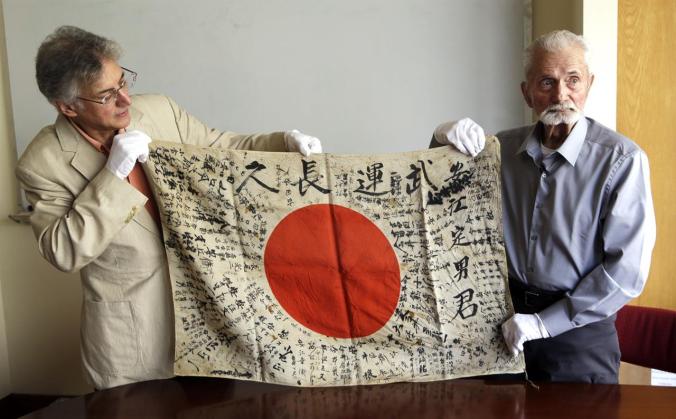
Many Japanese soldiers during World War II went into battle carrying small “Rising sun” flags, the red sphere on the field of white, with the white field decorated by hundreds of classmates, family members and friends. The flags were for good luck, and to link soldiers to their loved ones while they fought for the Emperor.  I had never heard of this practice until today; my father served in the European theater, so he would not have known that many American soldiers took these personal talismans from the bodies of fallen Japanese soldiers as war trophies.

U.S. Marine Marvin Strombo was such a soldier. A member of  an elite sniper platoon during the bloody battle for the Pacific island of Saipan in 1944, he had taken a flag from a dead Japanese soldier lying on his left side—he remembered that the young man looked like he was  asleep—after he noticed something white sticking out from his jacket.

The flag with all the inscriptions on it hung behind glass in Strombo’s gun cabinet in his home in Montana for decades until 2012, when the son of his former commanding officer contacted him for assistance with a book he was writing about the exploits of his father’s platoon. (ARGHHH! I just remembered that I haven’t gotten back to a member of my Dad’s unit who wrote me a couple of months ago!) Working with the author,  Strombo learned about  the Obon Society, a nonprofit organization in Oregon that works to locate and return the personal Japanese flags to the families of the fallen soldiers who carried them. Researchers determined that the dead soldier Marvin’s flag had belonged to was named Yasue Sadao. What Strumbo thought was calligraphy were really the signatures of 180 friends and neighbors, including 42 relatives, who saw Yasue off to war from Higashi Shirakawa, a small village of about 2,400 people in the mountains roughly 200 miles west of Tokyo. Continue reading

Morning Ethics Warm-Up: 7/20/17

Καλημέρα!

[This is pronounced “Kaliméra!,” not to be confused with “Calamari!” My father frequently got them confused when he visited Greece with my mom, the former Eleanor Coulouris, and embarrassed her by greeting the natives some mornings by cheerily saying, “Squid!]

1. The newspaper Arts section headline says, “Mayor Ties Arts Money To Diversity.”

The mayor in question is New York City’s DeBlasio, and since his own family is “diverse,” naturally every other entity has to be, or it is baaaad. This is why I oppose government funding of the arts unless it guarantees that the nation, state or city will not attempt to use its support to control the arts organizations in any way.  Of course, governments will never do that, because manipulating the arts to advance  political agendas is usually the underlying motive in arts grants. Ideologues like De Blasio—wow, he’s terrible—will constantly be grandstanding and doing everything in their power to manipulate artists and their art to ensure that they send the “right” messages—you know, like Nazi art and Communist art. It is exactly the same theory and practice: art as political indoctrination.

Quick: who thinks that De Blasio will be focusing on “diversity” in the management (or on the website) of the Dance Theater of Harlem? Even if the government doesn’t attach strings to its support, arts organizations know that there are more of them than there is tax-payer money to disperse, so there is terrible and often irrsistable pressure to distort their product to give their state funders what the artists think they want—just to be safe.

My professional theater company refused to do that, sticking to the integrity of our mission and not resorting to tokens and virtue-signalling. My now defunct professional theater company, that is.

2. Yesterday, I highlighted the head-blasting comments of New York Times film critic A.O. Scott and his alternate-universe pronouncements about the Obama presidency. To be fair to A.O., his entire profession is packed with historical and political ignoramuses who make their readers dumber with every review. I once created a theater reviewer’s code of ethics, which I mailed to a critic, who sent it back to me with a note that said, “Mind your own business.” Years ago, I published an essay that was called “Why Professional Reviewers Are Unethical,” that began,

When Variety announced that it was firing its in-house film and drama reviewers, there was much tut-tutting and garment-rending over the impending demise of professional reviewing in magazines, newspapers and TV stations. The villain, the renders cry, lies, as in the Case of the Slowly Dying Newspapers, with the web, which allows any pajama-clad viewer of bootleg videos to write film reviews, and any blogger who cares to write a review of a play. “I think it’s unfortunate that qualified reviewers are being replaced,” said one movie industry pundit, “but that’s what’s happening.”

I say, “Good. It’s about time.”

It’s not happening quickly enough, though. “Dunkirk” is opening this week, and, as I predicted, film reviewers are showing their utter historical ignorance. The Washington Examiner skewers them deftly in an essay called “Why the (True) History of Dunkirk Matters.” Highlights, or rather lowlights:

  • USA Today critic Brian Truitt complains that “the fact that there are only a couple of women and no lead actors of color may rub some the wrong way.” He is not the only film critic to observe this.

Morons.

  • Slate.com critic Dana Stevens claims that the British Army at Dunkirk was the “last bulwark against Nazi invasion of the British mainland.”

Not even close to true. Continue reading

Comment Of The Day: “Morning Ethics Warm-Up: 7/7/17”

Hamburg, post allied bombing, WWII

Ethics Alarms doesn’t have many discussions of foreign policy, in part because policy is usually less about ethics and more about practical realities, theory and policy. What discussion we do have involves leadership, a secondary passion here. Warfare, in contrast, is an ethics category, but also a grand, meta-ethics morass that isn’t a safe space for ethics generally. I regard war as the ultimate ethical anomaly where the rules and theories break down. We cannot avoid encountering mobius strip sequences like..

War is inherently unethical.

Sometimes war is an  unavoidable and utilitarian necessity.

In such cases, it is essential to end such a war as quickly as possible.

The quickest and the most ethical way to end such a war as quickly as possible is by overwhelming and uncompromising force.

Uncompromising force inevitably involves the maximum loss of innocent life, and is unethical.

Half-measures prolong the damage of war and are also unethical.

Wait…where were we again?

My father—the kindest man I ever knew, a grievously wounded war hero and a natural leader who hated guns, detested war (but hated what he saw at the death camp he helped liberate more), would have devoted his life to the military service of his country if he could have and who told his son that if he chose to duck the draft during the Vietnam War that he had his full support—would repeatedly rail against modern surgical tactics designed to avoid civilian deaths at all costs as madness, and a symptom of weak resolve and cowardly leadership. His reasoning: “We could not have won World War II if the news services had been allowed to publicize what war does to civilian populations. It is as simple as that. We would have lost, and Hitler would have won, killed millions more, and divided up the world between Germany, Japan and the Soviet Union. The public had no concept about the horrible things we had to do, and that I participated in, to win that war. If one side is ruthless and the other side is more concerned about collateral damage than winning…and the ruthless side knows it, then ruthless wins.

He died after only a year of Barack Obama’s Presidency, but believed him to be a dangerously deluded and ignorant man regarding the use of power and military force.

I thought about all of this as I read texagg04’s Comment of the Day on the final item of yesterday’s Morning Warm-up. which began,

5.An ethics  question about the North Korea crisis: do common sense ethics apply to foreign affairs? Listening and reading various experts and authorities, I am struck by how many seem to argue that negotiation with the North Korean regime is the only palatable option. The fact that this is simply and unquestionably agreeing to international blackmail by a resolute evil-doer seems to be either unrecognized or ignored.

Here is his Comment of the Day, which Dad would have admired, on the post. “Morning Ethics Warm-up 7/7/17”: Continue reading

Nazi Memorabilia Ethics?

“ARRRGHHH!!!!”

I haven’t checked in on The Ethicist column in the New York Time Magazine in a while: the current resident, Kwame Anthony Appiah, is the real McCoy, unlike all of his predecessors, and his analysis of various queries from readers is usually valid and properly reasoned. This week’s featured issue is a strange one, however.

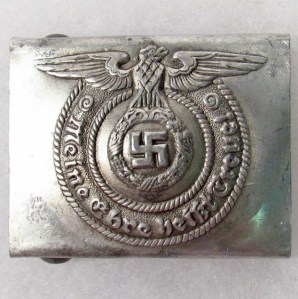
A Peter Hulit of Los Angeles wrote to ask what was the “ethical way” to deal with  a belt buckle from a Nazi uniform that was stored in his late father’s box of World War II memorabilia, collected during his service overseas. Hulit explained,

“I have kept it stashed in my desk. I’m now in my 60s and really don’t want it in my house..I have checked resale sites, and it does have some monetary value, but I do not want it to fall into hands that may use it symbolically for what my father fought against.”

I rate this question as more evidence of Nazi hysteria, one of the side-effect of the 2016 post election Ethics Train Wreck that includes the effort by the Left to slander opposition to Democrats, Clinton and Obama as nascent fascism. It is also a continuation of the historical air-brushing that Orwellian progressives seem to think will magically eliminate all evils from modern society.

World War II artifacts are history and are tools of acquiring knowledge. Knowledge is what those seeing German Nazi motivations in President Trump and his supporters sorely lack. There is no such thing as dangerous history. What is dangerous is to forget history, or to try to pretend that what happened did not.

Nor are objects cursed, or evil. People are evil, and history leaves evidence of evil deeds.  “I don’t want it in my house” smacks of superstition. It’s a belt buckle.

Hulit’s question seems to suck The Ethicist down some unethical holes that he should avoid, and usually does. For example, he writes, Continue reading

Ethics Hero Emeritus Desmond Doss, And “Hacksaw Ridge,”

desmond-doss

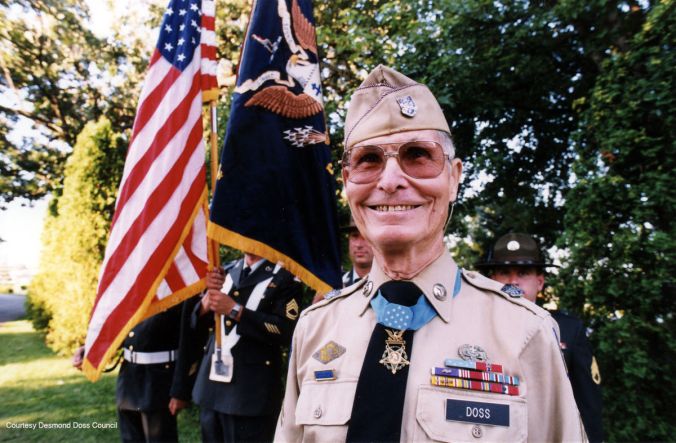
Desmond Doss, who died on March 23, 2006 at the age of 87,  was the very first hero to be enshrined in the Ethics Alarms Hall of Heroes. I wrote about him before there was an Ethics Alarms, shortly after he died.  I had never heard of Doss before, and I remember being angry that I had never heard of him. Everyone should know about him. There literally are no Americans who were any more heroic, and whose ethical conduct was any more astounding, than Desmond Doss.

If the values of this nation, and especially Hollywood, were healthy and correctly aligned, he would be a household name, and the film about his World War II heroism would have been made long ago. Finally “Hacksaw Ridge” was produced in 2016, and has been nominated for an Academy Award, although it will never win.

When I first read about Doss, I couldn’t get my mind around what he had done to be awarded the Congressional Medal of Honor, the only conscientious objector ever to achieve that honor during combat. During the battle of Okinawa, we were told that he survived heavy enemy fire as he struggled to carry seventy-five wounded soldiers to the sheer cliff at Hacksaw Ridge, personally picking up each one and lowering them over the edge the cliff 400 feet to safety.   How is that possible? Now that I’ve seen the film, it still seems impossible.

Desmond Doss proved that principled opposition to violence against his fellow human beings need  not be based on fear, self-interest or self-preservation. It is often impossible to tell whether those who oppose armed combat really object to the spilling of all human blood in battle, or only their own. With Desmond Doss, there was never any doubt. He didn’t like the term “conscientious objector,” preferring the term “conscientious cooperator.” He enlisted in the army following Pearl Harbor, believing that the war against the Axis had to be fought and wanted to be part of the war effort despite believing, as a devout a Seventh Day Adventist, that it was a sin to kill, with no exceptions. Thus he refused to carry a rifle (or shoot one, even in training) but yet insisted that he be involved in combat as a battlefield medic. He achieved conscientious objector status  but would hot accept a deferment. Assigned to the 307th Infantry Division as a company medic, Doss was hazed, abused and  ridiculed  for his dedication to non-violence, and as the Mel Gibson-directed film shows, many of his tormentors eventually owed their lives to his astonishing heroism. All of his compatriots were amazed by his evident fearlessness under fire and remarkable dedication to duty, never hesitating to go after a wounded soldier no matter what the personal risk. As a combat medic on Guam and at Leyte in the Philippines, Doss had already been awarded the Bronze Star  before the three-day battle at Hacksaw Ridge.

Many of the soldiers in Doss’s 307th Infantry, 77th Infantry Division were driven off the ridge by a furious Japanese counter-attack, and  wounded G.I.s were stranded atop it. Doss remained with the wounded, and, according to his Medal of Honor citation refused to seek cover, carrying them, one by one, to the edge of the ridge in the face of enemy fire, some of them from behind enemy lines. He lowered each man on a rope-supported litter he improvised on the spot, using double bowline knots he had learned as a youngster and tying the makeshift litter to a tree stump to serve as an anchor. Every wounded man was lowered to a safe spot 35 feet below the ridge top by the 145 pound medic. Finally, Doss came down the ridge himself, incredibly, unharmed. Continue reading

“White Christmas” Ethics Addendum: Battlefield Incompetence, Insubordination And More In The Holiday Classic


A Special Guest Post by Texagg04

Ethics Alarms commenters who are honored with the annual “Commenter of the Year” title in the yearly Ethics Alarms awards have the option of joining the elite ranks of guest bloggers here. Texagg04 got the honor a couple years ago but never exercised his option. His recently posted, meticulously-researched and fascinating  multi-comment  addition to my 2012 post about the holiday film “White Christmas” seemed too extensive for a mere Comment of the Day, and I asked tex to edit it into a single post. He agreed, and what follows is the result. I recommend seeing the film (it’s on Netflix) either before of after reading his analysis. The 2015 update to the 2012 Ethics alarms “White Christmas” post is here.

—Jack

***

As the kids were watching “White Christmas” and I walked by, in passing, I noticed something amiss about the “military” feel of the opening scenes that seemed off ethically. So I copied and pasted the first website that claimed to be a script of White Christmas. I’m not sure what it was…if it was a working copy or a first draft, but it has significant differences from the actual filmed scenes. So, I’m forced to modify some of my assessment from the original three posts.

All the dialogue is transcribed *directly* from the listening to the movie, so I think I’m pretty close to word for word. The scene descriptions and action statements are modified versions of the script I got from the original website (which can be found here).

Before I go into commentary, I’ll insert the entire dialogue for perusal and familiarity. There are numbers to reference particular dialogue in my analysis at the end. Here are the opening scenes—General Waverly is played by Dean Jagger; Captain Bob Wallace is Bing Crosby, and Private Phil Davis is Danny Kaye:
Continue reading

Remembering Bob Hope

hope and troops

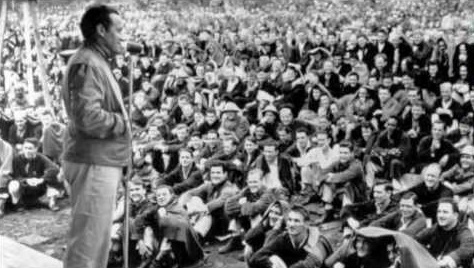
I can’t blame the airport officials who voted 8 to 1 last month to eliminate Bob Hope’s name and change the airfield’s label to “Hollywood Burbank Airport.”  It was a business decision based on hard data. Hope’s name wasn’t resonating with passengers outside of Southern California, especially those east of the Colorado Rockies.

The airfield had been  rechristened to honor Hope in 2003, not long after his death at the age of 100. Yet just a bit more than a decade later, the entertainment icon whose theme song was “Thanks for the Memory” is fading from ours at record speed.  The comments on various news reports on the airport’s decision range from stunningly ignorant to disrespectful. Bob Hope deserves better. The culture will be stronger if it remembers him, and so will the nation.

I must admit, I didn’t see this coming, but I should have. The survival or disappearance of once famous figures from our cultural memory fascinates and often horrifies me. One of the definitions of culture is what a society chooses to remember and chooses to forget: these seemingly random decisions have significant long-term consequences. Occasionally there is a last-minute rescue:  just as the Treasury was preparing to remove Alexander Hamilton from the ten-dollar bill, a Broadway musical, of all things, rescued his image and re-established his cultural presence. Usually, however, once a figure drops down the memory hole, he and the public appreciation of his importance is gone, gone, gone. Forever.

The mechanics of this process are chaotic. A single movie that enters classic territory and is featured regularly on television can rescue the memory of a whole career for generations. Ray Bolger, an eccentric dancer who was never regarded as close to Fred Astaire or Gene Kelly in the hierarchy of Hollywood hoofers nonetheless remains a recognizable figure today purely on the basis of “The Wizard of Oz.” Edward G. Robinson was a famous and respected actor mostly on the strength of his gangster films, but his memory survives almost entirely due to his strange ( and strangely miscast)  role as the Hebrew villain in “The Ten Commandments.” Meanwhile, who remembers George Raft?

Hope, I now realize, despite one of the longest and most successful careers in show business history and epic stardom on radio, films, theater and T, despite being the most frequent and most successful MC for the Oscars telecast and while he was alive and regarded for 50 years as the undisputed champion of stand-up comics, has no such marker to keep his image and memory alive. Humor is famously dependent on the times and culture, and Hope’s humor and style were more so than most. He was not a physical or slapstick comedian, and his movies, with the exception of the best of his “Road” movies with Bing Crosby, were at best mildly funny. The later ones, like his films with Phyllis Diller and Lucille Ball, weren’t even that. By the 1960’s, Bob Hope’s reputation as an entertainment icon was so well-established that he didn’t really need to be funny; the fact that he was Bob Hope was enough. He was a living relic of vaudeville, radio comedy and traditional TV skits who never changed his delivery or mildly self-deprecatory yet cocky demeanor. But what was special about him? There’s little available on TV or elsewhere to let new generations in on the secret. Continue reading

Ethical Quote Of The Day—D-Day, That Is : Gen. Dwight D. Eisenhower, Supreme Allied Commander

dday_landing

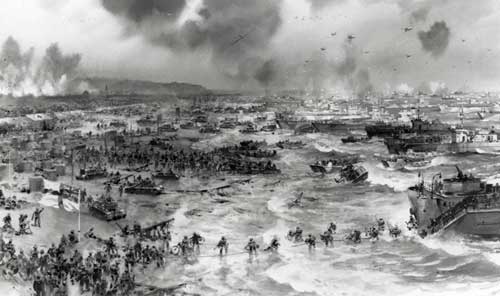
“Our landings have failed and I have withdrawn the troops. My decision to attack at this time and place was based on the best information available. The troops, the air and the Navy did all that bravery could do. If any blame or fault attaches to the attempt it is mine alone.”

—–Gen. Dwight D. Eisenhower, Supreme Allied Commander in Europe, as found on a piece of paper he wrote on just before the D-Day invasion began, and just after he ordered it to commence, on June 6, 1944.

Eisenhower wrote these words to be his own apology and acceptance of responsibility had the massive invasion at Normandy been a defeat rather than the history-altering victory it was.

It almost was a defeat, and as the note, which Ike’s naval aide, Captain Harry C. Butcher, found crumpled in his shirt pocket weeks later and saved for posterity, shows, Ike realized all too well that it might be. The secret dry run for the invasion had been a deadly fiasco, the weather was atrocious, and no military operation on this scale had ever been attempted before in the history of man. It took a combination of German mistakes, high command confusion, individual heroics and the usual twists and turns of chaotic fate that decide most battles to allow the Allies to prevail. Continue reading