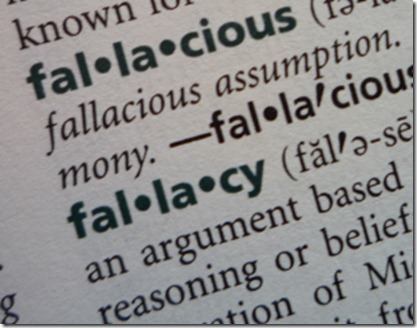
I realized it was time to post the definitive Ethics Alarms List of Debate Cheats and Fallacies after once again having to point out to an indignant commenter that calling him a jerk based on a jerkish comment was not an ad hominem attack, and that saying idiotic things on-line carry that risk. Here, at last, is the current list, adapted from multiple sources. As with the Rationalizations List, with which this occasionally overlaps, I invite additions. Participants here should feel free to refer to the various fallacious arguments by number, and to apply critically them to my posts as well as the comments of others. Am I immune from occasionally falling into one or more of these bad debate techniques and rhetorical habits? No. The other reason I wanted to get the list up was to reinforce my own efforts to be persuasive without being manipulative.
1. Ad Hominem Attack
An ad hominem attack means that one is substituting the character or quality of an adversary’s thought for the argument the adversary is presenting. This is unfair, as well as misleading. “Your argument is invalid because you are a crook, a fool, an idiot” is an ad hominem attack. It is not an ad hominem attack to prove an argument idiotic, and conclude, on the basis of signature significance, (which requires that an argument be so idiotic that no non-idiot would conceive such a thing and dare express it),that the one making the argument is an idiot, since only an idiot would make such an argument. Confusing the true ad hominem attack with the latter is a useful deflection by poor advocates of the fair consequence of their advocacy. Idiots can still hold valid positions, and disproving the position has nothing to do with proving they are idiots.
1 a. The Toxic Introduction.
A more subtle application of the ad hominem attack is The Toxic Introduction, where the argument of another is introduced by noting a negative quality about the individual. The effect is to undermine the argument before it has even been heard, by its association with a less than impressive advocate.
2. Butch’s Stratagem (The Straw Man)
Continue reading →
 Ethics Alarms