When Alaska Senate candidate Joe Miller finally came clean about his unethical, and probably illegal, misuse of a government computer when he was working as a part-time lawyer, he shrugged it off by pointing out that his flaws were actually a qualification for office: it proved that he was just like the people electing him. Continue reading
Month: October 2010
Mayor Bloomberg—Charting New Vistas in Ego, Shamelessness and Hypocrisy
Unbelievable.
New York City Mayor Michael Bloomberg now supports a ballot measure to restore the city’s term-limit law to two terms, the limit he voided to ensure his own third term by asking the City Council to approve a measure that allowed him to run again.
Bloomberg, you may recall, claimed in 2009 that he supported three terms for himself, because he was best prepared to lead the city through tough fiscal times.
But nobody else. Bloomberg is special, you see. Continue reading
Newsweek’s Biased Cover Ethics
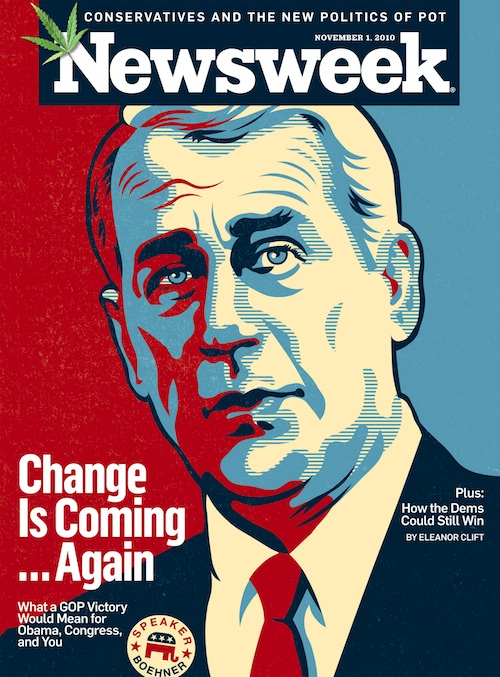 I am looking at the current cover of Newsweek. I am frightened.
According to the magazine, change is coming, and the cover photo makes it clear that it can’t be good. Some monster named “John Boehner” seems to be involved, and he is a vampire, or cannibal, or something worse. A serial killer, maybe, like Jason in “Friday the 13th.” One whole side of his face is dripping with what looks to be blood. There is blood around his mouth, and a scary, demonic eye looks out from a mask of blood on his right side. He is clearly from Hell.
Or a Republican. Continue reading
When Not Voting Is The Right Thing To Do
I just listened to a CNN host chastise Americans for their relatively low voting percentage (less than 50%), and then urge “everybody” to vote–“Men and women have died for your right to vote!” he said. “Democrat, Republican, Independent or undecided–go to the polls and vote!”
Inspiring. And wrong. Continue reading
And the 21st Untrustworthy Candidate is: West Virginia Gov. Joe Manchin!
West Virginia’s Democratic Governor, Joe Manchin, currently running for the open U.S. Senate seat, has now caused me to regret my selections on the Ethics Alarms “Untrustworthy Twenty” within hours of posting it. Manchin belongs on it; oh brother, does he ever. I had missed his nausaeating performance this Sunday on Fox, in which he attempted to retract his endorsement of the Obamacare legislation last March, explaining that he didn’t understand key details of the law when he publicly supported it. Continue reading
Ethics Alarms and ProEthics Presents “The Untrustworthy 20”: Making Ethics the Priority in Election 2010
The key word, in ethics, in government, in all relationships that matter, is trust. Trust is the connective tissue that holds societies together: it can be strengthened by demonstrations of ethical values like integrity, loyalty, honesty, civility, responsibility, competence, and courage, and weakened by proof of unethical traits like fecklessness, dishonesty, lack of independent judgment, selfishness, lack of diligence, greed and cowardice. For decades, the American public’s trust in its elected representatives and governmental institutions—and other critical institutions like the news media and the legal system—has been in steep decline. This is not because of some inexplicable public fad or the poisoning of public perceptions by an unholy alliance of the pop culture and Fox news. The decline in trust has occurred because a significant proportion of America’s elected leaders have not been trustworthy, and the reason this has been true is that American voters have thus far refused to make proof of ethical values their main priority in electing them. Because politicians know this, they feel empowered to engage in corruption, self-enrichment and deception in the confidence that partisan supporters will vote for them anyway, as long as they mouth the same policy positions and deliver their quota of pork, earmarks, and government contracts.
This, of course, does not benefit of country in the long run, but weakens it. It also creates an increasingly arrogant and power-obsessed political class to which ethical values are like Halloween costumes, donned at regular intervals to disguise who they really are. The core principles of the democratic process do not matter to many of these people, and they don’t see why they should matter: witness House Speaker Nancy Pelosi’s refusal to debate her opponent because she knows she can win easily without giving her constituents a fair chance to compare the competing candidates. For most voters, over all, this approach still works, at least at the polls, so obviously untrustworthy officials continue to be elected, and by their conduct continue to destroy public trust.
I was discussing this issue at recent seminar in regard to the candidacy of Richard Blumenthal, the Connecticut Attorney General who is running for the state’s U.S. Senate seat. Blumenthal, to be blunt, is a proven liar and fraud on a grand scale. He intentionally misled the public for years about his military record, and assumed the false mantle of a combat veteran. When his deception was uncovered, he refused to be accountable, absurdly casting the repeated lies about his own past as mere slips of the tongue. Yet a Connecticut citizen at my table proclaimed that he “didn’t care;” that Blumenthal’s policies were what mattered, not his ethics. This is an astoundingly illogical mindset, but a common one. Power tends to tempt and corrupt individuals who have scruples and integrity: what is it likely to produce with an elected official that has neither integrity nor scruples to begin with? If we elect representatives who are untrustworthy, we are likely to be betrayed sooner or later, one way or the other. Worse, we send the message to future candidates, both in and out of office, that integrity and honesty don’t matter to voters, like my Connecticut friend. We thus get more untrustworthy candidates, more untrustworthy representatives, and constantly declining public trust in government on all levels.
Public trust cannot keep declining indefinitely, you know. Eventually, a government that cannot be trusted will collapse.
Just as addressing America’s fiscal crisis will take hard measures and sacrifice, addressing its equally dangerous crisis in trust requires sacrifice too. It will require voters to establish the principle that being “effective,” experienced or having the “right” policy positions will not be enough to justify electing or re-electing individuals who are demonstrably trustworthy. Voters must establish untrustworthiness as absolutely disqualifying a candidate for election to public office. Any ethical, honest candidate with integrity must be seen as per se preferable to a corrupt, dishonest or unethical candidate, regardless of past achievements or policy views.
To this end, Ethics Alarms presents its list of the least trustworthy candidates for national office in the upcoming election. For reasons of space and convenience, it is limited to twenty members, which is obviously and sadly far too few: in the more than 500 races for Congress, the U.S. Senate and governorships nation-wide, the number of untrustworthy candidates undoubtedly numbers in the hundreds. This list is illustrative, not inclusive, but it is my assessment of the worst of the worst.
What makes a candidate so untrustworthy that he or she deserves to be rejected no matter who the opposition may be? This is what I like to call the “Lawn Chair Principle,” when electing a lawn chair is preferable to electing the human alternative. Let’s begin with what doesn’t justify determining that a candidate is necessarily untrustworthy: Continue reading
Ethics Hero: George Clooney
An ethical challenge that all of us face now and then involves being present in a gathering when a host, a friend, a colleague or someone else makes an objectively bigoted or outrageously unfair and disrespectful statement about a group that is not represented and thus unable to defend itself. At such times we all have a duty to confront and correct the speaker and condemn the sentiment, but the execution is difficult, and requires tact, knowledge, clarity and courage. Doing and saying nothing, however, gives the speaker and his slander support and tacit endorsement.
Fortunately, thanks to the magic of on-line video and George Clooney, we now have a lovely “How To” clip that demonstrates the right way to discharge one’s ethical duty in these awkward situations. Continue reading
Ethical Song Lyrics to Remember, by Morey Amsterdam
Today Dick Van Dyke, who is about to turn 85, was interviewed on NPR’s funny game show, “Wait, Wait…Don’t Tell Me!” The star of my all-time favorite sitcom was moved to sing the lyrics to “The Dick Van Dyke Show” famous theme. I had heard them sung by Dick before, but I had forgotten how good they were, both lyrically and philosophically. They were written by the late comic Morey Amsterdam, who played joke-machine Buddy Sorrel on the show, and convince me that he is someone I would have liked to have known. He was a wise man.
Here are Morey’s lyrics (You know the tune, I hope!): Continue reading
Verdict on the New Black Panther Voter Intimidation Controversy: Race-Based Enforcement At DOJ Is Real
The Washington Post, to its everlasting credit, has published a thorough and excellent piece of investigative journalism examining the continuing controversy over the Obama Justice Department’s reluctance to follow through on the prosecution of two paramilitary clad Black Panthers, one brandishing a club, who menaced voters at a Philadelphia polling place. You can, and should, read the whole piece here…especially if you were one of the throng claiming that the story was a trumped-up “conservative media” fabrication. It is true that the conservative media kept the story alive, but that is because the mainstream media inexcusably ignored or buried it, for due to a blatant bias in favor of shielding the Obama Administration from embarrassment, no matter how ell deserved.
It remains a mystery to me how opposing polling place intimidation of any kind, by any group, in favor of any candidate, and insisting that the enforcement of the laws against such conduct be administered without respect to race or politics, could possibly be attacked as a “conservative” position. Or, for that matter, how excusing race-based enforcement could be described as a “liberal” position, or a responsible, fair or ethical one. But they have been, repeatedly, which is why the report by the Washington Post, as one of the media groups that initially ignored the story (and was criticized by it independent ethics watchdog for doing so) is so useful and important. Continue reading
Welcome to The Nursing Blog! Next?
Dr. Chris MacDonald, the articulate Canadian ethicist who is already the proprietor of the best business ethics blog on the Web, is apparently on a mission to bring ethics to every corner of the professional landscape, and all power to him. He is already a collaborator on the useful Research Ethics Blog , a co-writer of The Food Ethics Blog, and the primary force behind the Biotech Ethics website. Now, along with Dr. Nancy Walton, his partner on the research ethics site, he is launching a new ethics blog, on the topic of nursing. The Nursing Blog is a great idea, for a profession that faces persistent, difficult, and daily ethical issues. As Dr. Walton says in the debut post, there is a need. Whenever I learn about professional blogs, I pass on the links in seminars with those professionals: nothing strengthens ethical instincts and conduct better than a daily dose of thoughtful discussion or debate on ethical issues related to one’s own field. Bravo and brava, Doctors McDonald and Walton! And thanks.
While I’m thinking about it, I have some other ethics blog ideas for Chris to consider as he broadens his ethics blogging empire.
How about a horny lawyers ethics blog, for example? Clearly one is needed. Another need: a New Jersey Turnpike employees ethics blog….and fast. There is also a pressing need for a prosecutors ethics blog, since California’s bar is investigating 130 of them for wrongdoing. I know there are a few such blogs already, but clearly, they are not enough. And, of course, we are waaay overdue for a Public Broadcasting fairness and integrity blog.
So congratulations, Chris…but you still have a lot of work to do.
 Ethics Alarms