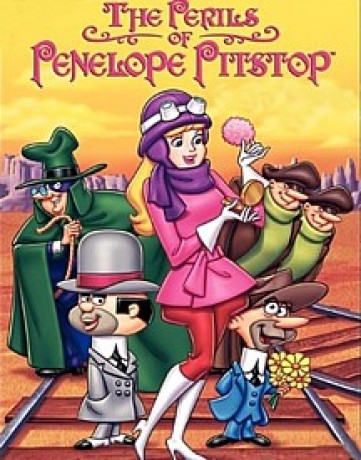
 Late last night as I was battling worry and insomnia, my TV remote transported me to the Cartoon Network where I encountered, for the first time in 40 years, a minor Hanna-Barbara animated series called “The Perils of Penelope Pitstop.” Like all Hanna-Barbara shows, but especially the Saturday morning variety, “Penelope” was crudely drawn and aimed its humor at the lowest common denominator: compared to it, Woody Woodpecker is Faulkner. Drawn in by the comforting sounds of great vocal artists of the era like Mel Blanc and Paul Winchell, however, I watched about ten minutes of the show and realized, to my horror, that I now found it offensive…and not for the reason that I found it annoying in 1970 (it is, after all, moronic).
The plot of every episode of “The Perils of Penelope Pitstop” (a spin-off of H-B’s more successful but just as repetitious and silly “Wacky Racers”) was the same. A female auto racer who is also a blonde, helpless bimbo with a Southern accent is stalked by a villain called “The Hooded Claw,” voiced by the great Paul Lynde. The Hooded Claw, for no discernible reason, concocts elaborate plots to kill Penelope, but is foiled, at the last second, every time. The cartoon is an obvious riff on “The Perils of Pauline,” the famous Pearl White silent movie cliffhanger serial in which each segment ended with the heroine tied to a railroad track or falling to earth dragging a collapsed parachute. Yet I found it impossible to appreciate the cartoon’s meager charms because of the loud clanging of ethics alarms in my brain. Why is the only woman in the show portrayed as a walking, talking Barbie Doll? And why are kids being encouraged to laugh at a woman being stalked by a homicidal maniac? Because he’s an inept homicidal maniac? What could possibly be funny about stalking, an insidious phenomenon that every year leads to multiple murders?
“Oh my God,” I thought. “I’m politically correct!“
None of these things occurred to me in 1970; I’m not sure when my brain was anti-Penelope Pitstopped. I might have had some qualms about the show (other than the fact that it stinks) after young actress Rebecca Shaeffer was killed by a stalker in 1989, but probably not; I think it took many years of reading, listening and sometimes arguing with pop culture critics and women’s rights advocates who maintained that not even cartoons should stereotype women as sex objects and victims, and that making a joke out of stalking, even ridiculous stalking, trivialized a deadly societal problem. Whenever and however my shift in consciousness happened, it’s happened. I can’t turn off the switch. My ethics alarms have been set by the culture around me to go off at the sight of a dumb, fat cartoon villain in a mask and green cloak who sounds like the guy that used to be the center square on “The Hollywood Squares.”
I am officially incapacitated on this topic now. I can’t even venture an opinion as to whether my objection to the show’s “attitudes” (I am very certain that the writers did not regard the cartoon as the result of attitudes , but as a natural comic take on a classic movie genre) is reasonable or not. The seriousness of stalking has blown away all my deeply-ingrained deference to humor when watching “Penelope Pitstop”. Is this a valid cultural adjustment, or one more example of successful thought-control by the political correctness police?
Don’t ask me; you might as well ask Winston if Big Brother is really lovable.
I don’t mourn the loss of the inability to smile at or even tolerate a 1969-1970 children’s show, and I think it is possible, even likely, that stalking is one of those things, like child sexual abuse or genocide, that should never be trivialized in mass media for entertainment purposes. Nevertheless I take this incident as a warning that the power of cultural consensus can alter our values without our even being conscious of it happening. The lesson is that we cannot be passive, complacent or apathetic when we detect concerted efforts to turn the cultural battleship, regardless of the proposed new direction.
The wisdom and ethics of a cultural shift need to be considered, debated, challenged, and tested, and every one of us has a societal duty to be an active participant in the process. The consequences of absorbing misguided social norms can be devastating. If we allow cultural values to be set by the loudest, the most zealous, the politically expedient or the most easily offended, rather than by rational evaluation, wisdom and objective analysis, we risk losing a lot more than “Penelope Pitstop.”
 Ethics Alarms
I can’t believe we were able to watch the coyote and roadrunner without huge warning messages not to “try this at home.”
I would submit that Penelope Pitstop is no different from the pit bulls in a dog-fighting game: entirely fictitious and never existing in the real world except as (pixels/celluloid). I don’t think anyone would watch that show, even today, and think of it as a serious documentary series on How to Stalk and Murder a Blonde Race Driver.
The show (and indeed 99% of cartoons in the U.S.) is pure comedy. You can argue about whether it’s funny or not, but if your argument is that certain topics in comedy are always and forever off-limits, then you’ve killed comedy.
And as comedy’s killer, no one will ever like you.
So what we really need is a dog fighting game where, if you lose, you get the sound of Muttley laughing at you.
–Dwayne
True. Before you know it, we’ll be discussing “There’s Something About Mary” where she has multiple stalkers and how that shouldn’t be trivialized.
I don’t disagree much. I think a Saturday morning TV show has a greater responsibility to monitor its content than a video game manufacturer. Intellectually, I also know Penelope and the Claw are just humanoid stand-ins for Wile E. and the Runner, and should be harmless.
Thanks for the Muttley reference. Muttley trivia: On what HB show did Muttley’s earliest version first appear? Same template and habits, different name.
“I think a Saturday morning TV show has a greater responsibility to monitor its content than a video game manufacturer.”
Agreed. That’s why the things the “villains” do are either harmless or so comically out-of-proportion (like Ko-Ko’s axe?) that there’s no mistaking it for real evil. And that’s also why the bad-guys NEVER win (Laff-a-lympics notwithstanding–the “Really Rottens” did win at least once).
–Dwayne
I admit I’m not as familiar with Perils as I am with Wacky Races, but I do vaguely remember similar dog characters that pre-date Muttley. And I think his existence as “Mumbly” came later, not earlier. So I give up.
But I will tell you that IMO the Wacky Races video game for the Sega Dreamcast was one of the best games ever made on that console, full stop.
The pre-curser of Muttley was Quickdraw McGraw’s dog “Snuffles,” who had the same laugh and the same proclivity for turning on his master. Snuffles was also a dog biscuit addict.
Of course, one reason they were similar is that Daws Butler did the voices for both.
Personally, I think Richard Connelly missed a golden opportunity when he didn’t include Penelope Pitstop on his Houston Post list.