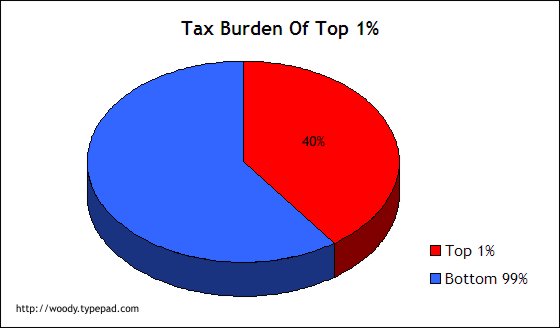
Maybe it should be more. But it is far from "unfair." That 99%, however...
The interminable and depressing negotiations over raising the debt limit have recently featured unseemly demagoguery from the President about making “millionaires and billionaires” pay their “fair share” in taxes. I have no ideological objection to raising tax rates on the richest Americans and even Americans like me; after all, as Willy Sutton pointed out when explaining why he robbed banks, “that’s where the money is,” and we have to pay our bills somehow. The fairness argument, however, is dishonest, and blatantly unfair.
It is unfair because the richest 1% of Americans pay close to 40% of the total tax revenue. Now, that 1% also have a lot of money, but they use a lot of that money to run businesses, create new products and services and hire employees. Maybe they should pay even more, and maybe they get too many tax breaks. To say that paying 40% of the total tax revenue is something to be ashamed of, however, is dishonest.
It is especially dishonest when 43% of the public pay no taxes whatsoever. That is unfair.
I don’t care if a citizen is unemployed, or sick, or living in a box. That citizen derives the benefits of the nation every day of his life, including military and police protection from criminals, foreign invaders and terrorists, the use of roads, byways, and transportation infrastructure, water and sewage systems, parks, garbage collection, regulatory oversight of food and the environment, education of the next generation, and much more. For this he pays absolutely nothing, and unlike most of the rich who pay the largest share of the costs, he may not do much for the community or the country either. He doesn’t start businesses, pay salaries, or take risks. He probably doesn’t serve on juries, or vote.
Although liberals, progressives and Democrats like to pretend otherwise, the purpose of taxes is to pay for government services, not to redistribute income, or to punish all those horrible people who make things, invent stuff, buy commodities and accumulate wealth. We do not say that it is unfair that the driver of a Rolls Royce pays the same price for a gallon of gas that the driver of a 1981 Chevy Nova pays. Same value, same price: that’s fairness. But paying different prices for the privilege of living in America is mindlessly accepted as “fair” without any thought at all. A graduated tax code is pragmatic, and it works pretty well (theoretically), but for 43% of the country to pay nothing for what the rest pay amounts ranging from thousands to millions is not only unfair, it is destructive. It creates a huge class of people who are encouraged to develop the attitude that they have no obligations to the nation at all, but that the nation has an obligation to them. It fuels class resentments that politicians like the President can, and sadly do, exploit.
I believe the country would be healthier and fairer if every citizen had to pay something—the amount doesn’t matter—to the state and federal government, recognizing, when it is a small amount, that they are not paying their fair share, and have an obligation to do better in the future. I believe that the absolute minimum yearly amount—$100? $5?—should accumulate as an interest-gathering permanent debt when a citizen can’t pay it in a given year, and be immediately due when the financial status of the citizen improves.
I also believe that the citizens who pay the bulk of the expenses the United States amasses while serving us all deserve thanks and gratitude from the citizens who now pay nothing, not the resentment and contempt that the President and others try to stir up. That would also be fair.
 Ethics Alarms
I don’t make much money, and I’ve gotten a refund every year I’ve filed thus far (I don’t know if it was for everything I paid or not, to be honest). The idea of paying more would irk me a bit, but what the hell. It’s just money.
I think your idea might be a bit impractical, though. Maybe I’m small minded.
That’s not even remotely true.
About 43-47% of “tax units” (people, couples or households filing tax returns) pay no federal income taxes, according to the Tax Policy Center. But the large majority of Americans pay taxes. Even if they don’t pay federal income taxes, they still pay payroll, investment, state, local, property, and sales taxes (and some other taxes as well).
David Leonhardt estimates that fewer than ten percent of Americans pay no federal taxes. If we also include state, local and sales taxes (which we should, if we’re talking about who pays “no taxes whatsoever”), that would drop to under five percent.
That 43% pays no federal income tax, the same way Exxon doesn’t. To say those people (or Exxon) “pay no taxes whatsoever” is disingenuous.
I’d like to know who the 43% are statistically. Are we talking about “workforce”? Or do newborns count? Surely one group would be someone deployed in a combat zone for the entire year. In the military, for any part of a month you serve in a combat zone, you pay no taxes that month.
I’m also curious if 43% is the number of people who had no liability at all, or had a liability but were able to show no liability after some Govt program deductions. The difference being that my tax liability might be $500 for a year, but I got a $500 credit for some Govt endorsed action. If I owe money before credits, I shouldn’t be inthe 43%.
Your idea about the $5 minimum holds better for the federal benefits than state benefits. In CO, we have a sales tax, so presumably, everyone pays something. That should be enough for police, fire, and state roads. And buying Gasoline with a federal gas tax and Registering a car should be enough for any road, local or federal.
I don’t think $5 minimum makes sense because it’s impractical to impose on the homeless and others that don’t file. But, for those who DO file, I’d put it at the end of the form with a simple check. If equal to 0, if refun is equal to liability, subtract $5. That might work better. I mean, what are you going to do to a homeless person? Throw him in jail for a night and give him 3 meals?
I didn’t say a minimum tax was enforceable. I said it would be fair. I’m not trying to work out the details of tax policy. This is really a simple post—when the President says it is unfair for those who pay most of the federal tax revenue not to pay more, while never suggesting that those who pay little or no revenue are taking benefits they don’t pay for, then the argument is unethically and dishonestly skewed. And it is.
Me, 31% to Feds and my state. GE, $14 billion in income, $0 taxes. I’m doing something wrong. However, I do agree everyone should pay something. I’m for a flat tax and for term limits, two things that will never happen.
Also, the top 1% paid 40% of the taxes. Is this top 1% of individual wage earners paying 40% of all income taxes? Or is it 40% of all revenue? Does 1% include companies?
If it’s top 1% of individual wage earners paying 40% of all income tax revenue, then the logical question is this: How much income was reported by the group and what percentage of that income was reported by the top 1%?
Hint: I bet it’s more than 40%.
You think 43% is bad? Wait until it becomes 51%.
That will be the end of the United States of America.
–Dwayne
The Tax Policy Center, which produced the 43% stat a few years ago (it’s now more like 46%, due to the recession), measures in “tax units.” According to their FAQ, “A tax unit is an individual, or a married couple who file a tax return jointly, along with all dependents of that individual or married couple.”
It includes both groups. (Also, it’s only measuring federal income tax liability — so most of the “no liability” people actually paid payroll taxes, etc.)
The top 1% of income earners, earned about 20% of the countries’ total taxable income and paid 40% of federal income taxes. However, when you include all taxes, the top 1% pays about 22% of the total taxes — just about the same as what they earn.
How about a flat tax? No deductions for anything (kids, mortgages, charitable contributions, etc.) Everyone, pays, say 17% of their total income (not “adjusted income”) to the Feds. Some group (below the “poverty line?”) would pay a much smaller percentage, but would pay something. Anyone run the numbers on this?
Also, I am incensed by the Obama accusation that the wealthy aren’t WORKING PEOPLE. My family is in the top 2% of wage earners in this country, but we own our own business and work 12 hours a day to keep it going, especially through the recession. WE ARE WORKING PEOPLE, GOD DAMN IT. Just because one happens to meet with some modicum of success through one’s own initiative or because one is more highly skilled than most, doesn’t mean one doesn’t WORK. This blase, prejudicial use of the term “working people” is divisive in the extreme, and I believe firmly that Obama and liberals for decades have used it on purpose to create discord for their own benefit.
Including all taxes, taxes in the US are flatter than many people imagine. The bottom 20% of earners pay about 16% of their income in taxes. The second 20% pays about 20% in taxes. The middle 20% pays about 26%.The fourth 20% pays about 25% of their income in taxes. And the top 20% pays about 30% of their income in taxes.
Just looking at Federal taxes, Americans on average pay about 18% of their income in federal taxes, and the richest 1% pays about 22% of their income in federal taxes. That doesn’t seem to me like the very richest are grotesquely overpaying.
Not so sure about this. The fact that the richest 1% of Americans are even capable of paying close to 40% of the total tax revenue ought to speak volumes about the level of income disparity in the US. Furthermore, you cannot say it is unfair for 43% of the public to pay no taxes without also stating what percent of the nation’s income they represent. What amount of wealth are these people even capable of providing to the federal government? I doubt imposing more taxes on the poorer half of the population does anything better than having a false appearance of fairness while imposing another financial burden on those who are already struggling.
No, it has nothing to do with how much income it represents. They live here, they accept benefits, they should contribute something. Why is this even debatable? And why is “income disparity” inherently objectionable? Jay Leno is a unique talent, and that talent makes millions for his employers. So there’s a huge disparity between the incomes of Jay and my mailman—so what? Why do you think that it unfair, or problematical? You don’t want to see my mailman host the “Tonight Show.”
It’s simply not true that 43% of the US pays no taxes, so discussion of if it’s fair or unfair seems moot.
That’s an unfair parsing of what he said. Saying that the current level of income disparity is unfair is NOT the same thing as saying that “income disparity” in and of itself is inherently objectionable.
I think it’s a good thing to have income disparities, both because it’s just that people who work harder receive greater rewards, and because it’s necessary for a market system to function, and markets have many positive benefits.
But I’d argue that income disparities that are too large have negative side effects. First of all, incredible concentrations of wealth tend to lead to incredible concentrations of political power, which has antidemocratic effects. In other words, if Wall Street has so much excess wealth that it can essentially buy off Congress, that’s not a good thing.
Second of all, if the upper class and the middle class are very far apart in income, that means the upper class will have very little reason to care about policies that are good for the middle class. If the income disparity between the upper and middle classes exists but is not gargantuan, then a lot of things that matter to the middle class — good public services, affordable hospitals, good public schools — may also matter more to members of the upper class. This in turn may lead to better policy outcomes.
These are all unwarranted assumptions, Barry. The fact that many wealthy people care very much about how the rest of the nation does is demonstrated every day. I don’t comprehend your first statement at all—how is fairness “moot” when the argument, as framed by the President, for one, is about what is fair? A backwards fairness argument is flogged daily, and when someone points out that it makes no sense from a fairness point of view, the retort is “well, fairness is moot.” I agree–then stop saying that having the richest pay an even more disproportionate share of the nation’s expenses is “fair.” I agree that it’s necessary, but saying it is fair distorts reality and ethics.
It’s debatable because we’re looking at a number with little to no context or explanation. If I were angry about 43% of the population not paying income tax, I’d want to know darn well who those people are. No one has established that they even have anything at all to contribute. For all we know, they represent a single-digit percentage of the entire nation’s wealth. Diddlysquat. They’re earning less than the majority, obviously, but how worse off are they? How would they be impacted by the increased financial burden, and what would anyone gain? There’s a laundry list of questions comparable to those you or I would ask of the climate change alarmists who’d advocate the equivalent of economic suicide. I’m sure you’d come to soften your position if you dug a little deeper on this one.
As for income disparity, I don’t see anything inherently objectionable about it either. I’d never advocate punishing success. Some people really do work hard while others are honestly lazy bums who need to wake up. But the world has never been fair, and the rewards of labor are hardly proportional for everyone. There is a point where differences in economic status become untenable in a “kings vs peasants” sort of way, and all signs point to us heading in that direction.
I noticed a big difference when I got married. Even though my income increased, the amount of federal income taxes I paid were cut in half. I now pay more in state income taxes than federal and one year I paid no ($0) in federal income taxes. When I was single, I paid ~$7000/year and that was on 30% less income! There really does need to be a change in the way the deductions are figured. Maybe eliminating them altogether.
Of course, you have to realize that before we were married, my wife paid negative income tax. She received more back in refunds that she paid in federal taxes. That is part of the big problem you alluded to in your article.
“[T]he purpose of taxes is to pay for government services, not to redistribute income.”
This is far from settled. The idea that wealthy people owe the poor some compensation for the success that is made possible by their ownership of goods they did not produce with their own labours (especially land) goes back at least to Thomas Paine.
“I believe the country would be healthier and fairer if every citizen had to pay something—the amount doesn’t matter—to the state and federal government, recognizing, when it is a small amount, that they are not paying their fair share, and have an obligation to do better in the future.”
Maggie Thatcher thought so too. It didn’t work out so well for her.
Nine million nonpayers, or 12.8 percent of the total, are in the middle income quintile. Another 1.9 million — 2.6 percent of the total — are in the second-highest quintile, and some 443,000, or 0.6 percent of the total, are in the top quintile.
The Tax Policy Center breaks down that last number a bit further: There are 78,000 non-paying units in the top 95th to 99th income percentile, 24,000 in the top 1 percentile, and 3,000 in the top tenth of a percentile.
This group has a nickname, too: they’re the HINTs, for high income, no taxes.
These might be people who get their income from tax-exempt bonds or overseas sources, as CNN reported last year.
Or they might be people who have incurred losses from partnerships or S Corporations. Or people who have run up “extraordinary” medical or dental bills. As The Fiscal Times noted in December, these are other ways to realize one’s HINT status.
http://www.huffingtonpost.com/2011/06/28/46-percent-of-americans-e_n_886293.html
I’ve heard that, if ALL income over $250,000 per year were taxed at a rate of 100%, it would bring in enough revenue to operate the federal government for about five months. Haven’t done the calculation myself, but it wouldn’t surprise me if true. Hey, I have an idea. Why doesn’t everybody turn all of their money over to the government and let the politicians dole it back out as they see fit? All those people who are so concerned about “fairness” couldn’t possibly have a problem with that, could they? Don’t roll your eyes. The folks in D.C. already think that all of our income belongs to them. That’s why, when they speak of allowing people to keep more of their own money, as in a tax reduction, they refer to it as an “expenditure.”