
What if Michael Vick were a hippopotamus?
For your first Ethics Alarms Ethics Quiz this September, we revisit ESPN’s controversial article by journalist Touré, who was assigned the task of engaging in the thought experiment,“What would have been different if Michael Vick were white?”
Vick, for all you football-challenged readers, is the current star quarterback of the Philadelphia Eagles who just signed a $100 million contract with the team and another rich deal with Nike. A few short years ago, Vick was in prison, his NFL and endorsement contracts cancelled, his career seemingly over, because of his conviction on multiple counts of animal abuse charges and running a dog-fighting ring. Since his release, Vick has done all the right things in the public rehabilitation of his image, and his remarkable football talents did not erode in jail. When Vick was being prosecuted, a number of journalists and commentators who should have their brains put out to pasture asked if Vick, who was shown to have personally electrocuted and beaten to death some of his dogs, would have been treated less harshly by the law had he been white. The answer was and is no (or perhaps “no, you idiots”), just as it was for O.J. Simpson.
Why ESPN thought any enlightenment would come out of revisiting this fatuous argument is a puzzler, but Touré, to his credit, at least tried to come up with an interesting angle. Unfortunately, he arrived at a vaguely offensive and stupid one. As he summarized his own piece in a follow-up essay:
“How did race interact with him getting to the point in his life where he was able to kill dogs? Surely race was part of the story before he was arrested and sentenced. It didn’t just show up then. I thought for certain the massive moral failing that was displayed in Vick’s ability to kill dogs was wrapped up in his not having a positive paternal influence from his father, something that too many black men of our generation have had to deal with, which leads us to construct manhood on our own. Some manage to do that well, some do not.
“I also thought that even though dog fighting is a multiracial endeavor, Vick’s multiclass life, which is seen in many black athletes, is a big part of what conspired to bring him down. The man grows up working class in a community where dog fighting is so common it becomes normalized to him. Then he quickly leaps to the upper class while naturally maintaining close working-class ties. So he’s got the money and will to build a dog-fighting mill that’s larger than the vast majority of them because this is what he was taught to do for fun, but now he’s got the money to really do it big. Meanwhile his cousin, who’s a friend, is still selling weed in the ‘hood. That’s a problem just waiting to happen. The cousin got arrested and Vick inevitably went down, too. Perhaps a smaller dog-fighting mill would have gone unnoticed by a police search for marijuana, but the monstrosity that rich Vick was able to construct was impossible to not notice.”
You may notice that what Touré wrote would have been more accurately titled, “What if Michael Vick Hadn’t Been Michael Vick?” Being black didn’t make Vick a dog fighting enthusiast; there are plenty of whites involved in that underground and illegal “sport.” Being a black celebrity with millions to burn didn’t do it either. Touré’s entire article made the jaw-droppingly obvious observation that many of the forces that molded Vick, born into a dysfunctional family and brought up in a poor region of the South, are especially common to African Americans who are born into dysfunctional families and brought up in poor regions of the South. Amazing! If Michael Vick had been brought up in a Portuguese family in New Bedford, he might have been a fisherman, and if he had been brought up as the adopted son of Sylvester Stallone, he might have been a Hollywood stunt man, and if he had been born female, he might be Serena Williams…so what? The article itself wasn’t pointed enough to be offensive; it was just an example of a journalist who was offered a nice check to write an impossible piece of social pyscho-babble sports drivel and who decided to give it a shot rather than turning the assignment down.
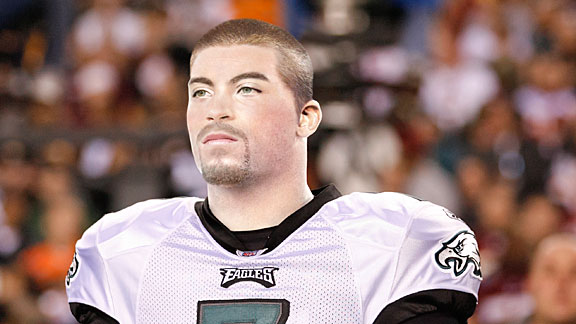
Most of the controversy over the article, however, centered on its illustration, this:
Your Ethics Quiz:
Is there something unethical about using this graphic to illustrate the article?
Almost everyone who weighed in on the controversy thought so, including Touré, who described the picture as a “horrific, misguided picture of Vick in whiteface, which dismayed and disgusted me when I saw it.” The Huffington Post’s sports columnist Hank Koebler called the photo an “absolute embarrassment to sports journalism,” arguing that “the illustration was designed to draw attention and shock, conjuring connotations of the stereotypical blackface of 19th-century minstrel shows.” Bleacher Report’s Michael Schottey accused ESPN of trying to “pander to the lowest common denominator and utilizing race as shock value rather than discussion building.” (As if Bleacher Report, with its regular lists of “The 20 Best Racks in Sports” and “The 50 Ugliest Athletes” would never pander to the lowest common denominator!) Time’s Sean Gregory wrote, “Given America’s shameful history with blackface, it’s just too flippant to flip it around and give an African-American a white identity.”
And so on.
All hysterical, inaccurate, and wrong. There is nothing offensive, inappropriate or unethical about the photo. To begin with, Vick isn’t portrayed in “whiteface.” The Joker was in whiteface. Marcel Marceau was in whiteface. What is shown is an alternate universe Michael Vick born of Caucasian parents, which, after all, is what the title asked: “What If Michael Vick Were White?” Well, for one thing, he’d look a lot like this guy. How is that wrong or offensive? And how is it meant to evoke blackface? Nobody who has a clue what blackface was could make that leap, unless they were trying to manufacture an offense were there was none.
Blackface was used in minstrel shows and other entertainment for white performers (and sometimes black performers) to perform in broad stereotypical styles mocking or imitating black characters and art forms. It was never intended to be realistic; African Americans don’t have white around their mouths, for one thing. It was a racially offensive variation on clown make-up. None of these factors are present in the alternate Vick photo. White Vick is a pretty good looking guy. The white race isn’t denigrated by the photo, and neither is Vick. There is no equivalent insult to whites, and the issue of blackface is raised in the same free association, fact-free way that ignorant people hearing the word “niggardly” hear the word “nigger.”
The rest of the critics’ arguments against the photo consist of accusing ESPN of coming up with an unduly sensational, “shocking” graphic just to “draw attention.” Am I going mad? When did illustrating an article vividly and memorably become bad journalism? It’s a terrific illustration. Unfortunately, the article it illustrates is crap.
The excessive sputtering outrage directed against ESPN’s graphic is a classic “ick factor” reaction: the image of Michel Vick as a white man was arresting and a surprise, and thus it must be “wrong.” It wasn’t wrong. It wasn’t unethical.
And it definitely wasn’t “whiteface.”
 Ethics Alarms
Moreover, the reaction overlooks an even more pressing question: what if White Michael Vick was black?
http://mocksession.com/2011/08/what-if-white-michael-vick-was-black/
But what if Black White Michael Vick was white?
The point is, it’s not a black and white issue. And the real question is, what if Black White Michael Vick was White Black?
Hah, I love it. What a refreshingly commonsensical blog.
Shades of gray…. Was it an especially slow day in the sports news cycle when ESPN cooked up this little endeavor? I mean of all the nonsensical, non sequiter, story ideas (and I use that term loosely) to come up with…. OK, I just went out on the porch and screamed my frustration at the night sky (no, not “Stella!!”) and feel much better now.