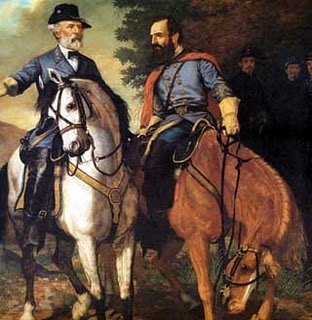
Honor them for their valor if you must, but there was nothing honorable about their cause or their flag.
Once again, emerging from under-ground like a the seven-year locust, a controversy over the flying of the Confederate Flag is raging, this time in Lexington, Virginia, burial place of two Confederate heroes, Stonewall Jackson and Robert E. Lee. A proposed city ordinance would prohibit the flying of the Confederate banner on downtown poles, and some Southern heritage buffs as well as Jackson and Lee fans are upset. “By all means [Jackson and Lee] should be honored,” said Brandon Dorsey, commander of Camp 1296 of the Stonewall Brigade of the Confederate Veterans. “I look at the flag as honoring the veterans.”
The problem is, Brandon, that a large number of Americans look at that same flag as honoring slavery and racism, and for good and historical reasons. African-Americans are not generally interested in parsing the philosophical distinction between “the Confederacy was fighting for slavery” and “the Confederacy was fighting for state’s rights, including the state’s right to enslave African-Americans.” Either way, blacks would have continued to be bought and sold like cattle if the Confederacy, rather than the Union, had prevailed in 1865. It is disingenuous for anyone to argue that regarding the Confederate flag as a symbol of racism and subjugation is political correctness or hyper-sensitivity. Frequent commenter here Stephen Mark Pilling argues that banning the public display of the Confederate flag “is the equivalent of banning the Cambridge Flag, the Pine Tree Flag and that which flew over the Alamo.” Well, not exactly. Those were not the flags of hostile nations seeking the overthrow of the U.S. Government as it existed at the time, nor were they used for decades as the symbol of Jim Crow. The swastika, after all, is also a Hindu symbol of good luck, but it is still terrible taste to display it in public.
It is not against the law to display swastikas, and the First Amendment protects the right to display the Confederate flag on one’s own property, or to carry it with you. The divisiveness and insult conveyed by either, however, makes both inherently harmful to display in public places. If Virginia wants to have Jackson-Lee Day, an anachronistic holiday honoring two of the men who helped tear this country apart in defense of human trafficking, that’s the state’s choice, and it is bad enough. There is no justification for compounding the insult to African-Americans and others by allowing the symbol of that misbegotten cause to be hoisted on light poles and along the streets of downtown Lexington.
Of course, nobody should force any American to have to ponder a Confederate flag at all, except in a book, in a museum, as an illustration, or a battle re-enactment, but in America, we can’t make insensitive speech and bad taste in symbols illegal.
Lexington is right to limit the visibility of the flag to the degree that the Constitution permits; the sad part is that it should have to.
 Ethics Alarms
The problem is that your ethical take here is contingent on highly disputable historical events. I’ll have to set aside the role of slavery and “racism” in the war (though I’ll readily acknowledge that African-Americans are not generally interested in parsing philosophical distinctions). What I would like to know is how, exactly, the Confederacy sought to “overthrow” the U.S. (Union) Government — by forming their own government?
Now I was very careful about that, you’ll note. I said “overthrow the US as it existed at the time,” which is to say, the government as originally formed. Any civil war is an effort to overthrow the government and substitute a new one, if only half. The nation, as it was, would have ceased to exist.
The Confederate flag is the symbol of a foreign government, and certainly a government taking up arms against the US of A. None of which changes the essential message of the flag to all but Clintonian mourners of “the Cause.”
I would like to point out that many Southerners at the time felt that it was the North who was taking up arms against them. The war was referred to as the “War of Northern Aggression” in much of the South for a long time.
The North WAS taking up arms against it. So what? The South was still standing for enslavement, and thus that is what the flag symbolizes, among other things.
As history would tell it, Lincoln’s latecoming to the principle of freeing the slaves came as a PR maneuver to attempt to rally “flagging” Union enthusiasm for what was essentially a struggle for independence and sovereignty by the Southern states.
Here is the amendment originally proposed by Lincoln:
“No amendment shall be made to the Constitution which will authorize or give to Congress the power to abolish or interfere, within any State, with the domestic institutions thereof, including that of persons held to labor or service by the laws of said State. (See U.S. House of Representatives, 106th Congress, 2nd Session, The Constitution of the United States of America: Unratified Amendments, Doc. No. 106-214) … 1861.
Let’s not be to quick to apply revisionist history here. Most thinking people at the time knew that slavery was not right, and had hoped that it would die a natural death. It was historical among Romans, Greeks, and so many other “conquering” civilizations, i.e. among us “white people” who were accustomed to wiping out native peoples in the New Continent, and were not exactly paragons of charity and noblesse oblige towards them. Slavery was essential to the economy of the Southern states, prior to the invention of mechanized cotton harvesters. The states were being gradually squeezed by the monopoly Northern manufacturing states that took their raw materials for finished products. Funny how necessity becomes the mother of ethical principles, or at least blinds us to alternative interpretations of same. The Civil War was not called “The War of Northern Aggression” for nothing.
Point? Sure. slavery would have died a natural death, except that it was unconstitutional from the beginning, and was more likely to be abolished by the courts than Congress. That would have been small consolation to the slaves. The North may have been doing the right thing for the wrong reasons, but it was still the right thing
Just for the record, the swastika is the Hindu symbol of good luck, backwards. Hitler just flipped it around. The original symbol is used in map keys to denote temples all over Japan, and probably other Asian countries as well.
I know, but I’m pretty sure, without a point of reference, the average non-Hindu, non-Nazi wouldn’t know the difference.
You would be correct in your assumption, crella; the Forbidden City in Beijing is chock full of Asiatic swastikas, and the Red Swastika Society (which is basically the Chinese version of Red Cross) still uses swastikas in its imagery today. Additionally, the use of the swastika was not just restricted to South and East Asia; ancient cultures from all over the world, from the Middle East to Eastern Europe to the British Isles to the Americas, all used swastikas at least once in their history.
Ultimately, I’d feel displaying the swastika would be an ethical ok as long as you give it the proper cultural context so even most idiots could get that you were not referencing the Nazis, or you were something like the Red Swastika Society, whose usage of the symbol predates the rise of Hitler.
True, Jack. It’s a damned shame the Nazi’s stole it.
I have to say, that has to rank among the least of their transgressions.
Oh of course!
I saw a teenager in a tire shop here in Houston a few weeks ago. He was wearing a t-shirt that had a Confederate flag with the caption: If this upsets you, go take a history lesson. Well, I’m willing to wager I’ve taken a few more history lessons than a high schooler, and Confederate flags, especially those flying over government buildings for example, still upset me. Why would a courthouse or a capitol building want to fly the flag of a group that advocated overreaching state’s rights and secession, not to mention taking your toys and going home when your candidate isn’t elected? It seems so counter-intuitive. Obviously I don’t believe in banning Confederate flags, but I really have to wonder if anyone who displays them actually paid attention in history class.
I’ll say this for those citizens and politicians who insist on flying the Confederate flag at local monuments and public events: at least they can make the argument that it represents history and a set of values that is still acceptable, even laudable, today. They can make that argument, however disingenuous it may be. The same cannot be said of everyone.
I have seen more than one home in certain very white suburbs here surrounding Buffalo, NY flying confederate flags on their porches. With a heavy heart, I accept that these individuals are free to display whatever hateful symbols they choose and that my impulse to pelt the house with stones does not stand on the same level. Still, there can be no mistaking what must be meant by their display.
I have been tempted to knock on the doors of these homes and ask the residents just what in the hell they are thinking. I wonder whether I would meet with some line of B.S. about freedom from federal intrusion. Perhaps not. When I was a teenager, I had a neighbor who hung a wall-sized Confederate flag in his garage. When I asked him why… well, his response was frank and emphatic, but I’ll spare you the crude specifics. Really, though, what other answer could he have realistically given? The fact that that flag is flown in the North and that it is flown completely outside of the context of displays regarding Southern history should make it perfectly clear that everyone understands exactly what it really means.
My family fought for Virginia and the South during the Civil War and some fought for the North also… and both of them, after the war was over, were citizens of one nation under one flag. And it certainly wasn’t the Confederate battle flag that you see people flying. Why do people insist on flying the battle flag anyway? And not even a proper square one but a bastardized rectangle? If they want to show their Southern pride fly the flag that flew over buildings in the confederacy, the “Stars and Bars,” not the battle flag, which was carried into battle and then used as a physiological weapon against blacks ever since. Also. anyone thinks the war wasn’t about slavery should read the Constitutions of the states that seceded. They specifically mention slavery and their right as a state in the Confederacy to have slaves.
Terrific point. The battle flag symbolizes rebellion and conflict, which is why it is suited for subversive messages. You’re right: if someone wants to honor the Confederacy, why not use the Stars and Bars, which is historically accurate, and does not carry the baggage of the battle flag? It is kind of suspicious that these supposed students of history don’t even have the battle flag’s shape right….
I imported your comment and added it to the “Comment of the Day” on this post. Thanks.
Most of the people flying the Battle Flag are not honoring their heritage, they are neo confederates. I’ve lived in the south all my life and I never remember seeing much of the Battle Flag before the Civil Rights Movement, even at historical events.
Although I agree 100% with you guys I would just like to comment, that yes the Confederate battle flag was mostly square, as it was with the Army of Northern Virginia. some of the other confederate armies did have rectangular battle flags, although it was rare. And the Confederate navy (if you can call what they had a real navy) sometimes flew rectangular CS battle flags, although they mostly flew the Stars and Bars
The Acts of Secession of the cotton states cite slavery as a reason for secession, but Lincoln’s call for volunteers to force the seceding states back into the union was cited as the cause for secession of the upper south. For instance North Carolina cites the safety of the state, not slavery as a cause for secession.
Legalisms. If there had been no dispute over slavery, there would have been no secession to oppose. If the South had chosen to secede without the slavery issue, the North would have had the worst of the legal argument and no moral high ground. Slavery, one way or the other, was the reason there was a Civil War. Efforts to argue otherwise are disingenuous.
To me the point of flying the Confederate flag is to remind the Federal government that states and individuals have rights. We can leave the union. I expect to see more fly now as the Federal government grows, over controls and taxes the citizens into the ground. The flag stands for rebellion against Federal over reach and an individual’s right to protest that. “Obamacare” alone is a good reason to fly any confederate flag.
And to some people it’s just a pretty piece of cloth. The salient point is that to African-Americans, the flag symbolizes sympathy and support for the cause that held that they were not human beings, and could and should be sold, bred, and treated like farm animals. I don’t dispute that the flag has other meanings, but that doesn’t matter. The one most offensive meaning is genuine and unavoidable, and that’s enough for fair and reasonable people to leave the Confederate flag and its complex messages to history.
If we all had the same opinion about everything our history would be pretty boring!!!!!