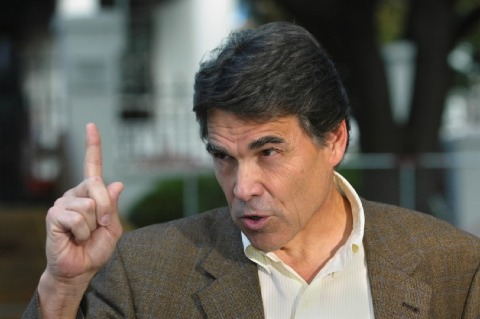
He speaks the truth! STONE HIM!!!!
In the Bizarro World that is American politics, Gov. Rick Perry was deemed to have stumbled not at all when he spoke of his skepticism about evolution, because a depressing number of Americans are cheered by the delusion that humans were created in a god-like image 10,000 years ago, despite all evidence to the contrary. But Perry is now seen as making a possibly fatal blunder in his presidential aspirations by telling the truth. Stranger yet, the truth Perry told is an essential one that must be acknowledged to address America’s financial ills, and identifying problems is what leaders are supposed to do. Never mind. People don’t want to believe it, so speaking this truth is “wrong.”
The statement Perry made that has Republicans, Democrats and the media in a dither is that Social Security is a Ponzi scheme. Democrats were salivating at the comment, as it provided them with more ammunition to tell seniors, as they have in every national election within memory, that Republicans want to take away their Social Security checks. For their part, Republicans like Carl Rove protested that no candidate can be elected by “attacking” Social Security. Mitt Romney, unprincipled as ever, used Perry’s words to attack him, implying that the Texan wanted to end the program, which is, of course, a wonderful thing.
Social Security may be a wonderful thing, but it is unsustainable in its current form. Everyone knows it, and everyone knows that if it is not reformed radically—that is, if it is not financed in such a way that it does not resemble a Ponzi scheme—it will become a crushing burden on future tax payers. The best and most ethical way to address such unpleasant problems is to be brutally frank about them. In American politics, however, and in the politicized media, honesty does not pay. Honesty, in fact, is wrong.
Of course, Social Security isn’t literally a Ponzi scheme, but the famous swindle of recent Bernie Madoff infamy nicely illustrates what is wrong with the New Deal relic. In a normal, honest world where leaders are more interested in solving problems than in sucking up to interest groups, the Ponzi scheme comparison is a deft, striking and useful tool for forcing reality on a discussion that has been ruinously evasive for decades.
As Shikha Dalmia wrote in Reason Magazine, Social Security is actually worse than a Ponzi scheme:
“One, a Ponzi scheme collects money from new investors and uses it to pay previous investors—minus a fee. But Social Security collects money from new investors, uses some of it to pay previous investors, and spends the surplus on programs for politically favored groups—minus the cost of supporting a massive bureaucracy. Over the years, trillions of dollars have been spent on these groups and bureaucrats. Two, participation in Ponzi schemes is voluntary. Not so with Social Security. The government automatically withholds payroll taxes and “invests” them for you. Three: When a Ponzi scheme can’t con new investors in sufficient numbers to pay the previous investors, it collapses. But when Social Security runs low on investors—also called poor working stiffs—it raises taxes…Social Security taxes have been raised some 40 times since the program began. The initial Social Security tax was 2 percent (split between the employer and employee), capped at $3,000 of earnings. That made for a maximum tax of $60. Today, the tax is 12.4 percent, capped at $106,800, for a maximum tax of $13,234. Even adjusting for inflation, that represents more than an 800 percent increase.”
Her conclusion: “Rick Perry should stop soft-peddling the issue and tell it like it is.”
Why is everyone from the President to Congress to most of the media so averse to being straight about why Social Security is unsustainable, and is, in its present form, the equivalent of a swindle? They are hostile to the truth because America is long past the point where there is a solution to the problem that won’t be unfair to somebody. This is what happens when an unethical situation isn’t addressed immediately. After a while, there are no good solutions, only solutions that are better than the others.
At this point, any real solution, meaning an effort to correct the accumulated results of running Social Security like a Ponzi Scheme, will alienate one or another block of voters. Politicians don’t have the courage to face that, and journalists don’t have the integrity to admit it…especially when it means telling readers and viewers that a rootin-tootin righty like Rick Perry is correct. Somebody will get screwed, whether it is younger taxpayers who will have to pay more and more of their income to fulfill a commitment to older Americans that was oversold, or retirees, who will get only a fraction of what they were promised, or wealthy retirees, who don’t need the money but who can reasonable say that they paid into the system for a lifetime and shouldn’t be penalized for saving wisely, or the nation as a whole, which could find itself dancing the misirlou if its national debt keeps riding.
Instead of admitting this, confronting it responsibly, and telling the American people the truth—and the bad news— in direct and uncompromising terms, the one politician who has put the Social Security crisis into proper perspective is being condemned. Indeed, say the pundits, Gov. Perry’s statement may have single-handedly doomed his quest for the presidency.
That’s right: telling the truth about an impending crisis that our government has been ignoring for decades makes you unelectable. Is it any wonder that ethics is a concept that the American political system regards with contempt?
 Ethics Alarms
I really wanted someone else to comment first. But…
The statement is true, but it doesn’t make the speaker of the statement a truthful person. Perry is a “talking head” being foisted on us by the MSM. He’ll flop in a second for a dozen votes.
Ron Paul 2012 – He’s not a kook, he’s just consistently outside the talking head caucus. I like this blog, so if you think I’m a kook for being a Paulite, Paulista, Paulbot, etc, just put up with me. I wouldn’t normally get political, but you started it.
Jim, it wasn’t a political post at all. I have no admiration for Perry, but he was honest and correct on this.
Paul’s foreign policy theories are isolationist, ahistorical, dangerous, irresponsible, and insane.
Well…we just won’t talk about this anymore. 🙂
Even the most left of the left wing admit that Social Security needs to be fixed. Bernie Sanders, an admitted socialist, has come up with a plan to save it. You may not agree with his plan, but he has one. The problem with Rick Perry and Social Security is that he doesn’t want to save it, he wants to end it. He has said that it was “wrong from the beginning.” He says that it is “a failure.” He can call it a Ponzi scheme, and it does have similarities to one; it also has many differences. But his statement that it won’t be there for our children is just wrong. It will be there, but the benefit will be decreased unless we do something. I don’t believe Rick Perry wants to do anything, he is ideologically against the concept, and that is what is going to sink his campaign. He is already backtracking, by the way.
When he says that Social Security, in its current form, is the equivalent of a swindle, he is correct. A different safety net for the elderly that is means tested wouldn’t be the same. Is this really about labels? Getting rid of THIS social security, as it now exists, is called reform, or, if you want, a new program that won’t bankrupt the country.
The fact that he’s backpeddling is just the phenomenon we’ve watched for decades. You describe the program accurately, and you are forced to recant.
That’s not true, Jack. “Everyone” doesn’t know it. Many people — people who know a great deal more about economics than you do — disagree with you in good faith.
The “current form” of how Social Security is this: The government takes money from current taxpayers, and it gives money to Social Security beneficiaries. If you think it works any other way, you’re mistaken.
1) That model in no reasonable way resembles a Ponzi Scheme.
2) That model is not a crushing burden on taxpayers, nor is there any reason to expect it to be.
The Congressional Research Service found that if we eliminate the cap on payroll taxes (so that people pay payroll taxes on income over $107,000, income current exempt from payroll taxes), we can pay the current level of benefits. In fact, we’d have a small surplus. (See “Social Security: Raising or Eliminating the Taxable Earnings Base” from the CRS, September 2010.) That’s not a “crushing burden”; it would just require the best-off people to pay the same percentage of payroll tax that I and most working Americans already pay, while those of us who earn under $107,000 a year wouldn’t see our taxes go up at all.
Barry, this is plain denial. I’m surprised at you. Even the most positively oriented fans of SS are admitting that the structure resembles a Ponzi scheme…what do you mean it “in no reasonable way resembles a Ponzi Scheme” ? It takes multiple current contributers (“investors”) to pay for one beneficiary, and the beneficiaries are increasing while the number of those paying into the fund are decreasing. I’ve already received my letter telling me that I can only rely on getting 75% of what was once “promised”—I fully expect the next letter to whittle it down more.
My father worked in the pension field, and saw this coming decades ago. He prepared several reform plans, including serious means testing and raising the retirement age, plus taxing the benefits. Two things have to happen to avoid catastrophe. 1) People have to stop lying about the viability of the program. 2) People like me, (and the majority of seniors, the wealthiest segment of society), have to agree to give up all or most benefits so the truly needy have their safety net. And yes, this will be a screw job.
Those who regard Social Security’s viability as an article of faith for expanding entitlements are understandably challenged to admit that the program was not designed for its current purpose of our current demographics. But I expect rational people to be objective. Denying the obvious isn’t rational. The fund is empty, owed by a government entity 14 trillion in debt, and there are more pressing priorities that sending money to the wealthy retirees who don’t need it. Start there. This shouldn’t be political. It’s a matter of ethics: honesty, courage, and responsibility.
Jack, I’m disturbed that you didn’t respond to me pointing out an essential fact you got completely wrong.
According to the Congressional Budget Office, “under current law, the resources dedicated to financing the program over the next 75 years fall short of the benefits that will be owed to beneficiaries by about 0.6 percent of GDP.” (PDF file.)
Here’s a table, again from the CBO, of options for meeting the shortfall. You can mix-and-match the options; anything that adds up to 0.6 completely fixes SS. That’s not a “crushing burden” on either taxpayers or the economy, and saying it is contradicts the facts.
This is the central issue we should be discussing; is fixing SS a big, crushing burden, requiring the entire program to be completely restructured, or can it be done with small fixes to the current structure? The facts show that it can be fixed with small changes to the current structure.
Now that I’ve shown you that, has your mind changed?
If not, why not? Do you think the CBO is lying? Do you consider 0.6% of GDP is a crushing burden on the economy that can’t possibly be sustained (and what evidence is there to support such an extreme claim)?
Many knowledgeable people, including experts on both the economy and on Ponzi schemes, disagree with you.
I could provide many more links, but that’s enough to prove that, contrary to what you claim, there are many people (often well-credentialed people) who deny that SS is a Ponzi scheme. Unless your views are not changed by facts, you should now be willing to admit that there are, in fact, people who disagree with you.
Since that’s been settled, let’s examine a more substantive policy issue: “the structure resembles a Ponzi scheme” is not a meaningful statement.
You could say the structure of my house resembles a prison. In a literal sense, that’s true: Both prisons and my house have walls, plumbing, windows, a roof, and other such common structural elements. Nonetheless, anyone who claims that my house is like a prison is substantively wrong. My house doesn’t have bars on the windows, doesn’t have guards, and the residents can walk in and out freely. If you’re interested in substance, my house can’t reasonably be said to resemble a prison.
Ponzi schemes, by definition, have no viable funding source, and are based on lying to investors about that. As such, they collapse very quickly. SS, in contrast, has a very viable funding source, publishes its finances in full, and has lasted decades. As the Historian’s Office of the Social Security Administration writes:
If a program is honest about its funding and structure, has a viable funding source, and can last for decades, then it’s not like a Ponzi scheme in any way that matters.
(Correspondingly, if Ponzi schemes worked effectively for many decades, weren’t based on lying, and had viable long-term funding, then there’d be no reason to oppose them.)
What letter are you talking about? Who sent it?
Sometimes political partisans sound out deceptive mailers, intended to look like they came from an actual government agency unless you read all the tiny print. I’m fairly sure that the SSA has never sent out a letter such as you describe.
If you don’t mind my asking, how many years are you from retirement? It’s true that if we do nothing at all to fix Social Security, then YOUNG people will eventually receive only 75% of projected benefits (that’ll happen around 2050, iirc). But I had thought you were a middle-aged guy, like I am.
1) Don’t be disturbed—I’m playing a lot of tennis games here, and in my SPARE time.
2) Give me some time to digest all of this,
3) What makes it burdensome to the crushing point is that there is in fact no money in the pot, just IOUs. Making up that money, plus interest, is going to cost.
4) Chris Matthews just agreed it was a Ponzi scheme. Not that it proves anything….
1) and 2) Fair enough! 🙂
3) Yes, it will cost. According to the CBO, it’ll cost about 0.6% of GDP. That’s not nothing, but it’s not a crushing burden.
(What is a crushing burden is rising medical costs — but that’s Medicare, not Social Security, as you know.)
4) Thank you for acknowleging that it proves nothing. 🙂
Just so you know, I consider Chris Matthews an ass. It’s sometimes amusing when he kicks around other asses, but we’d be better off without folks like Matthews on TV (on both sides of the aisle). We need fewer people who yell. (I hate Obermann, too.)
Slight correction — if we do absolutely nothing to fix Social Security, then payouts might have to be reduced to 75% as early as 2037. Which is to say, even if we do nothing to fix it, it pays out at 100% for a quarter century.
So what do you think the chances are that Congress will do absolutely nothing? I think it’s unrealistic to think that Congress will do nothing over the next 25 years to fix the shortfall; Social Security is a very popular program, and seniors are the voting block who votes the most reliably.
There are many ways to reform Social Security, and none of them need be “radical.” Barry suggested one way, Bernie Sanders another, and there are other suggestions out there. Rick Perry wants to privatize (that would have worked well in 2007-08), or leave it up the states to opt out, meaning even fewer contributors. Both would, in my belief and in the belief of those economists Barry mentioned, lead to its demise. This is not reform, this is starting over with the intent to make it fail, which is, in my opinion, exactly what Rick Perry wants. The crushing burden would be on future senior citizens. I also resent, as an almost-senior-citizen, the attempts to comfort me with the assurance that MY benefits will not be affected. Most people actually care about what is going to happen to the benefits their children and grandchildren will receive. Appealing to our selfishness does not work, but appealing to our willingness to look at common sense solutions to make sure today’s workers receive those benefits and that the program continues could be successful, even if it involves sacrifice.
Not interested in debating how to fix social security, Jan—not my field. I’m interested in honesty. I have no idea what Perry’s motives are. He’s being more truthful than everyone else. That’s my focus.
It is similar to the flap over Sarah Palin’s “death panels,” which honestly focused attention on health care rationing as the inevitable course of cost controls. You can object to the inflammatory phrasing, but denying the phenomenon is flat out dishonest….as both Paul Krugman and Robert Reich, when it isn’t in their interests to bash Palin, have admitted. “Death panels” and “Ponzi Scheme” are vivid metaphors for features that policy makers hide with euphemisms and slight of hand. Yes, they focus on the negative, but they are still far more honest than denying the negative to lull the public into supporting a program without knowing the downsides.