
Comment of the Day: “Look Out! There’s a Speed Trap Ahead!”

Veteran commenter Tim LeVier updates an older Ethics Alarms post about the ethics and law regarding the practice of flashing headlights at oncoming cars on the highway to warn them of speed traps. Police had been ticketing the flashers; I said that this was wrong, there being no law against the practice, but that warning law-breakers of a police presence was poor citizenship and unethical nonetheless.

I still feel that way, but insufficiently considered other reasons, ethical ones, that might prompt the same conduct. Tim, while pointing us to a more recent story on the topic, remedies my failure….as he has before. As usual, I am grateful.

Here is his Comment of the Day on Look Out! There’s a Speed Trap Ahead!:

“…A couple of points: Continue reading
Ethics Dunce: Innovative Legal Marketing

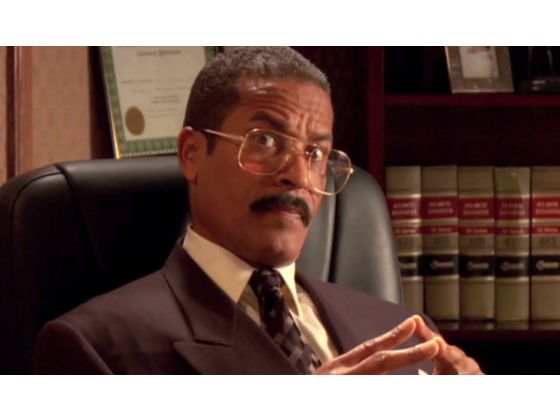
Would "Seinfeld's" Jackie Chiles be a worse spokeperson for lawyers than Arnie Becker? Hmmmm...

L.A. Law’ Actor Corbin Bernsen, whom we originally got to know as priapic divorce attorney Arnie Becker on the old TV lawyer series  “L.A. Law,” was recruited in 2009, fifteen years after “L.A. Law” went to re-run heaven, to serve as the paid spokesperson for Innovative Legal Marketing, a Virginia-based company providing marketing services for lawyers and law firms. Now Bernsen has filed a lawsuit claiming he’s owed more than $668,000 after the company allegedly breached its contract and dropped him.

I have no idea whether Bernsen or the marketing firm has the law on its side in the suit, but I do know this: for a legal services marketing firm to recruit the actor who played Arnie Becker to promote legal services is an implicit insult to the legal profession and the intelligence of the public. Continue reading

Ethics Dunce: Gov. Rick Perry

GOP Presidential Candidate History: The Battle of Concord, fought in 16th Century New Hampshire

I’ve been down this road too many times with various Tea Party favorites, so I’ll make it brief:

  • If you are going to keep talking about the Founders, the Declaration, the Constitution and the Revolutionary War, get your facts right. Paul Revere was not warning the British (Sarah); the Shot Heard ‘Round the World was not fired in New Hampshire, no Founding Father  did  spend his life trying to get rid of slavery,  and John Quincy Adams wasn’t a Founding Father (Michele); and “life, liberty and the pursuit of happiness” isn’t from the Constitution (Herman).
  • Don’t make the public more cynical than it already is about the intelligence and competence of its elected leadership by sounding like an ignoramus.
  • Don’t make our already historically ignorant public even more ignorant by giving it  bad information, from a supposedly trustworthy source. Continue reading

How Do I Write A Measured Ethical Analysis When I Am Shaking With Indignation and Rage?

None of these men had the arrogance to believe it would be appropriate to apologize for the difficult choices made by their predecessors. They were right.

UPDATE, 10/13 Readers: This post has been proven wrong, based on a misinterpretation of a diplomatic cable that has been clarified to Ethics Alarms by a reliable and objective source. You can read  the explanation, and my apology, here.

I will try.

A secret cable dated Sept. 3, 2009 was recently released by WikiLeaks.  Sent to Secretary of State Clinton, it reported that Japan’s Vice Foreign Minister Mitoji Yabunaka told U.S. Ambassador John Roos that “the idea of President Obama visiting Hiroshima to apologize for the atomic bombing during World War II is a ‘nonstarter.'”*

The Japanese did President Obama and the United States an enormous  favor, but the utter foolishness and lack of comprehension of national principles, American history and the duties of presidential leadership shown by the fact that the idea of such an apology could get to the point where the Japanese had to reject it goes beyond mind-boggling and shocking to frightening, infuriating and offensive. Continue reading

Comment of the Day: “When the Going Gets Tough, the Tough Get Unethical…”

Buck, a professional firefighter, has some wry observations on the Camden County, Georgia plan, discussed in a recent post here, to save money by letting prison inmates fight fires. Here is his Comment of the Day on When the Going Gets Tough, the Tough Get Unethical, Chapter I: Camden County, Georgia has a Terrible Idea to Save Money:

“Oh! This is a wonderful idea, for a variety of reasons:

“1. This puts obviously unemployed workers back to work.

“2. Since public safety personnel are our best and brightest in our community, we would put fewer of them in harm’s way. We have to save their lives to be available for the next parade to represent how trustworthy and respectable they are. If we replace them with convicted felons. and one of them loses their life, there is no loss, truly. True firefighters are much too valuable to risk doing such a dangerous job. On a truly dangerous emergency, the convicts could be sent in to do the dirty work. This would work! Continue reading

Abusing Stutterers: I Am Surprised and Disappointed

A prominent stutterer. She managed to be rather popular in groups despite the problem, or so I hear.

The New York Times related the story of County College of Morris student Philip Garber Jr., who stutters badly. He is also confident and inquiring, and likes to participate in class discussions, though naturally his speech problems make that process challenging for him, his teachers, and his classmates.

One instructor, an adjunct professor named Elizabeth Snyder, simply refused to call on him, and informed him that his stuttering was disruptive, and to keep his questions to himself or write them down. He reported this to the Dean, who told him that he should transfer to another class.

What? Continue reading

“The 48 Laws of Power”: Robert Greene’s Recipe for Power, Greed and Misery

“The 48 Laws of Power” is a 1998 book by Robert Greene, a best-seller, and a re-packaging of ideas from multiple sources, including “The Prince” and “The Art of War.” Those who wonder why it is that certain sub-cultures in the United States—business, Hollywood, the entertainment industry, politics, finance— appear to be incurably cynical, amoral, corrupt and untrustworthy would do well to read it, provided they are able to resist being persuaded by its brutal philosophy.

Greene, who has other similarly-oriented best-selling books on business success, is considered a guru by the music industry, and has been embraced with special enthusiasm by hip-hop moguls. What is remarkable about his 48 laws is how completely they discard all ethical virtues, as if fairness, honesty, integrity, responsibility, respect and trustworthiness were irrelevant to the topic of power. In fact, the five most important laws of power are…

1. You must prove your worthiness to hold power by your manner of acquiring it.

2. Power without competence, wisdom and good will lead to tragedy.

3. Do not use power to restrict the welfare, autonomy, freedom, and pleasure of  others, but to enhance them.

4. Regard power as a means, not an end.

5. When retaining power itself becomes the goal, it is time to surrender it. Continue reading

Unethical Quote of the Week: Rep. Michele Bachmann…Again

Bachmann doesn't kid about this.

“When you take the 9-9-9 plan and you turn it upside-down, the Devil’s in the details.”

—-Rep. Michele Bachmann, concluding her critique of rival Herman Cain’s “9-9-9” tax plan during the Bloomberg GOP presidential candidates’ debate.

Throughout her campaign, as she has throughout her political career, Rep. Michele Bachmann has been sending coded messages to her Evangelical Christian base, usually through Bible references that most Americans don’t recognize. But most of us have seen “The Omen.” When an Evangelical like Bachmann suggests, with a big smile of course, that a black Presidential rival named Cain is pushing a plan that becomes the Mark of the Beast when turned upside-down, she’s not joking….indeed, I have never seen any evidence that Michele Bachmann is capable of joking. Continue reading

When the Going Gets Tough, the Tough Get Unethical, Chapter I: Camden County, Georgia has a Terrible Idea to Save Money

Fortunately, ax-murders aren't eligible for firefighting duties....YET!

Camden County officials are considering putting prison inmates to work as firefighters as a cost-cutting measure.

The program would put two inmates in each of three county firehouses. The prisoners (will they wear striped fire-fighter uniforms?)  would respond to all emergencies, including residential fires, alongside the trained firefighters. The special program would be open to convicts charged with non-violent crimes, including drug offenses and robbery.

According to the details of the plan, the inmates would have no guards, but would be monitored by a surveillance system and by the non-criminal firefighters, who will undergo training to guard the inmates. It is estimated that the inmate firefighter program could save the county more than $500,000 a year.

Oh. Well, I guess that makes this irresponsible, reckless, offensive program all right, then! Continue reading

Roger Williams, Consequentialism, and “Born Free”

Roger Williams in his 80's. Take THAT, Drake!

Roger Williams, the pianist whose hit renditions of songs like “Autumn Leaves” and “Born Free” are pop culture generational touchpoints, died this week. One item in his obituary has double ethical significance:

“While majoring in piano at Drake University in Des Moines, he began developing a style that was a fusion of jazz, classical and pop. When a school official overheard him playing the tune “Smoke Gets in Your Eyes,” he was expelled because the school had a “classics-only” policy…”

It is both encouraging and depressing to learn that school administrators were just as doctrinaire, unreasonable, unfair, incompetent, stupid and willing to abuse their power while playing with the lives of young people back in the 1940’s as they are today—encouraging, because that generation seems to have come through it pretty well; depressing, because this field appears to have a flat learning curve.

Mainly, however, Williams’ run-in with music snobs at Drake beautifully illustrates what is wrong with the consequentialist argument that we should assess the ethical nature of an act based on its consequences. Continue reading